

How to scale creative marketing with AI for max ROI
Unlock proven AI techniques to test marketing visuals and copy variations for higher ROI. Explore tools, strategies, and metrics.


TL;DR:
- AI-driven automation accelerates creative production and testing for more efficient ad scaling.
- Structured, data-backed testing outperforms volume-based approaches, leading to higher ROI.
- Effective creative scaling relies on disciplined workflows, audience simulation, and pre-testing, not just increasing creative volume.
Most performance marketers assume that publishing more ad creatives automatically drives more revenue. It feels logical: more variations, more chances to win. But volume without strategy is just noise. The reality is that AI-driven automation accelerates creative production and testing in ways that manual workflows simply cannot match. What separates top-performing campaigns from average ones is not the number of creatives produced but the speed and precision of iteration. This guide breaks down what creative scaling actually means, which AI tools power it, how to measure its impact, and how to avoid the traps that waste budget.
Table of Contents
- What is creative scaling in marketing?
- AI tools and platforms for creative scaling
- Best practices for scaling ad creatives efficiently
- Measuring creative scaling impact on campaign performance
- The uncomfortable truth about creative scaling: What most marketers get wrong
- Unlock creative scaling efficiency with POPJAM.IO
- Frequently asked questions
Key Takeaways
| Point | Details |
|---|---|
| AI accelerates creative scaling | AI platforms speed up creative production and enable rapid iteration for digital campaigns. |
| Pre-testing boosts campaign ROI | Testing ad creatives before launch maximizes results and minimizes wasted spend. |
| Data-driven optimization is critical | Using audience insights and iterative feedback loops enhances ad performance and drives ROI. |
| Efficient workflows drive results | Organizing creative processes with AI empowers marketers to scale without sacrificing quality. |
What is creative scaling in marketing?
Creative scaling means systematically producing, testing, and optimizing multiple ad variations to find what resonates with your audience without proportionally increasing time or cost. It is not about flooding platforms with content. It is about building a repeatable system that generates high-quality, relevant variations fast.
Traditional creative scaling relied on designers, copywriters, and project managers working in sequence. A single campaign refresh could take weeks. AI-powered scaling collapses that timeline to hours by automating variation generation, copy testing, and audience matching simultaneously.
| Factor | Traditional scaling | AI-powered scaling |
|---|---|---|
| Production speed | Days to weeks | Hours |
| Cost per variation | High (manual labor) | Low (automated) |
| Testing capability | Limited A/B tests | Multivariate at scale |
| Audience personalization | Broad segments | Psychographic precision |
| Iteration cycle | Slow, manual feedback | Real-time data loops |
Why does this matter for modern campaigns? Ad fatigue is real. Audiences on Meta, TikTok, and Google see thousands of ads daily. Creative relevance decays faster than ever. Scaling gives you the agility to rotate fresh, targeted variations before performance drops.
Key benefits of creative scaling include:
- Campaign agility: Launch new variations in response to trends or competitor moves within hours
- Audience relevance: Serve personalized creatives to micro-segments without multiplying production costs
- Efficiency: Reduce the manual bottleneck between creative ideation and live testing
- Data richness: Generate more signals faster to inform smarter budget allocation
“The shift to AI-powered creative automation is not a trend. It is a structural change in how performance teams operate. Teams that automate iteration cycles outpace those still running manual workflows by a significant margin.”
The AI ad creative overview makes clear that automation is no longer optional for teams serious about performance. It is the foundation of competitive creative strategy in 2026.
AI tools and platforms for creative scaling
Now that you understand what creative scaling means, let’s look at the technology making it possible. The market has matured quickly. A handful of platforms stand out for their ability to combine creative generation, audience simulation, and pre-launch testing in one workflow.
| Platform | Key strength | Best for |
|---|---|---|
| POPJAM.IO | Synthetic personas + pre-testing | Performance marketers, DTC brands |
| Canva AI | Template-based design automation | SMBs, social content |
| AdCreative.ai | Ad variation generation | E-commerce teams |
| Pencil | Predictive creative scoring | Agencies, paid social |
| Runway | AI video generation | Video-first campaigns |
POPJAM.IO stands apart because it combines creative generation with psychographic audience simulation. You can build synthetic personas that mirror your real audience, run ad variations through those personas before spending a dollar, and export winning creatives directly to Meta, TikTok, or Google. The AI ad generator automates creative variations and streamlines testing, which means your team spends less time guessing and more time optimizing.
Here is how to integrate AI creative tools into your existing workflow:
- Audit your current creative process. Identify where bottlenecks occur: ideation, production, approval, or testing.
- Define your audience segments. Build psychographic profiles or synthetic personas before generating creatives.
- Set variation parameters. Decide which elements to test: headline, visual, CTA, format, or platform.
- Generate and simulate. Use AI to produce variations and run pre-launch simulations against your personas.
- Launch winners first. Push the highest-scoring creatives live and continue iterating based on real performance data.
- Feed results back into the system. Use campaign data to refine personas and inform the next creative cycle.
The creative automation platform approach means your workflow becomes self-improving over time. Each campaign generates data that makes the next one smarter.

Pro Tip: Run your creatives through a pre-testing simulation before launch. Teams that pre-test consistently report lower CPAs and faster ramp-up times because they eliminate low-performers before they consume budget. The AI creative ROI data supports this approach strongly.
Best practices for scaling ad creatives efficiently
With tools in place, the next challenge is process. Most teams that struggle with creative scaling are not using the wrong tools. They are using good tools without a disciplined workflow.
Organizing your creative workflow for scale starts with a clear taxonomy. Label every creative by platform, audience segment, format, and test hypothesis. This sounds tedious, but it pays off immediately when you need to analyze which variables drove performance.
Essential practices for efficient creative scaling:
- Modular creative design: Build creatives in components (headline, visual, CTA) so you can swap elements without rebuilding from scratch
- Centralized asset library: Store all brand assets, copy variants, and approved visuals in one accessible location
- Defined testing hypotheses: Every variation should test one specific assumption, not multiple variables at once
- Automated approval workflows: Use AI review tools to flag off-brand creatives before they reach human reviewers
- Regular creative audits: Retire underperforming creatives on a set schedule to prevent ad fatigue from dragging down account performance
- Platform-native formats: Generate creatives in the native format for each platform rather than resizing a single master asset
The steps for high-impact ads reinforce that structure and discipline in the creative process consistently outperform raw output volume.
Pre-testing ad creatives delivers measurable lift in campaign ROI. This is not a nice-to-have. It is the single highest-leverage action most teams are skipping. Running a creative through a simulated audience before launch takes minutes and can save thousands in wasted spend.
Data-backed creative optimization increases ROI by up to 47%. That number comes from teams that replaced gut-feel creative decisions with structured testing and feedback loops. The gap between data-driven teams and intuition-driven teams is widening every quarter.
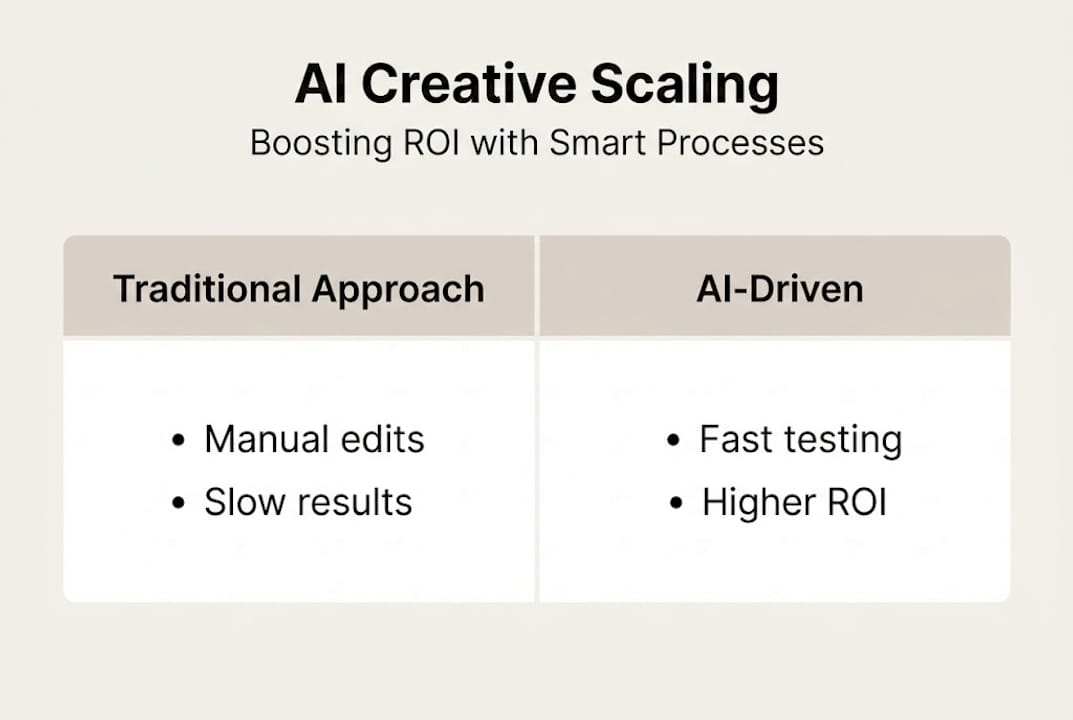
Pro Tip: The most common pitfall in creative scaling is treating every new creative as a fresh start. Your best-performing ads contain signals. Analyze what worked, isolate the variables, and build your next batch of variations on proven foundations rather than starting from zero.
Measuring creative scaling impact on campaign performance
Once your ad creative is scaled, measuring its impact is mission critical. Scaling without measurement is just expensive experimentation. You need a clear set of KPIs tied directly to your creative decisions.
Core KPIs to track for creative scaling:
- Click-through rate (CTR): The most direct signal of creative relevance and hook strength
- Cost per acquisition (CPA): Measures whether creative efficiency translates to actual revenue efficiency
- Creative fatigue rate: Tracks how quickly a creative’s performance decays over time
- Variation win rate: The percentage of tested variations that outperform your control creative
- Time to first conversion: How quickly a new creative generates its first result after launch
- Return on ad spend (ROAS): The ultimate measure of whether creative investment is paying off
AI-powered creative testing lifts CTR by 47%. That is not a marginal improvement. A 47% CTR lift on a campaign spending $50,000 per month is a transformative result. It comes from replacing random creative variation with structured, data-informed testing cycles.
Feedback loops are what separate teams that scale successfully from those that plateau. After each campaign, feed performance data back into your persona models and creative briefs. Ask: which audience segment responded best? Which format outperformed? Which message angle drove the lowest CPA? These answers shape your next creative sprint.
Testing before spending saves budget and boosts results. The ad testing tool from POPJAM.IO lets you simulate audience reactions before committing media budget, which compresses the learning cycle dramatically.
The AI marketing insights available in 2026 make it possible to predict creative performance with a level of accuracy that was unimaginable three years ago. Teams using these tools are not just reacting to data. They are anticipating it.
The uncomfortable truth about creative scaling: What most marketers get wrong
Here is something most marketing teams will not admit: their creative scaling problems are not tool problems. They are mindset problems. The instinct to produce more creatives when performance dips is deeply ingrained, and it is almost always wrong.
More creative volume creates more noise, more management overhead, and more opportunities for inconsistent brand messaging. The teams winning at creative scaling in 2026 are producing fewer variations than their competitors, but those variations are tested, refined, and grounded in real audience data.
The shift AI enables is not about speed alone. It is about replacing volume-based thinking with iteration-based thinking. Every creative becomes a hypothesis. Every campaign becomes an experiment. And every data point feeds the next cycle.
The data-backed ROI evidence is clear: teams that embrace structured testing over creative volume consistently outperform those chasing output metrics. The uncomfortable truth is that discipline beats creativity when it comes to scaling. Your best creative idea means nothing if you have not tested it against your actual audience before spending.
Unlock creative scaling efficiency with POPJAM.IO
Ready to put creative scaling into practice? POPJAM.IO gives performance marketers and e-commerce teams the tools to generate, simulate, and launch high-performing ad creatives without the manual bottleneck.
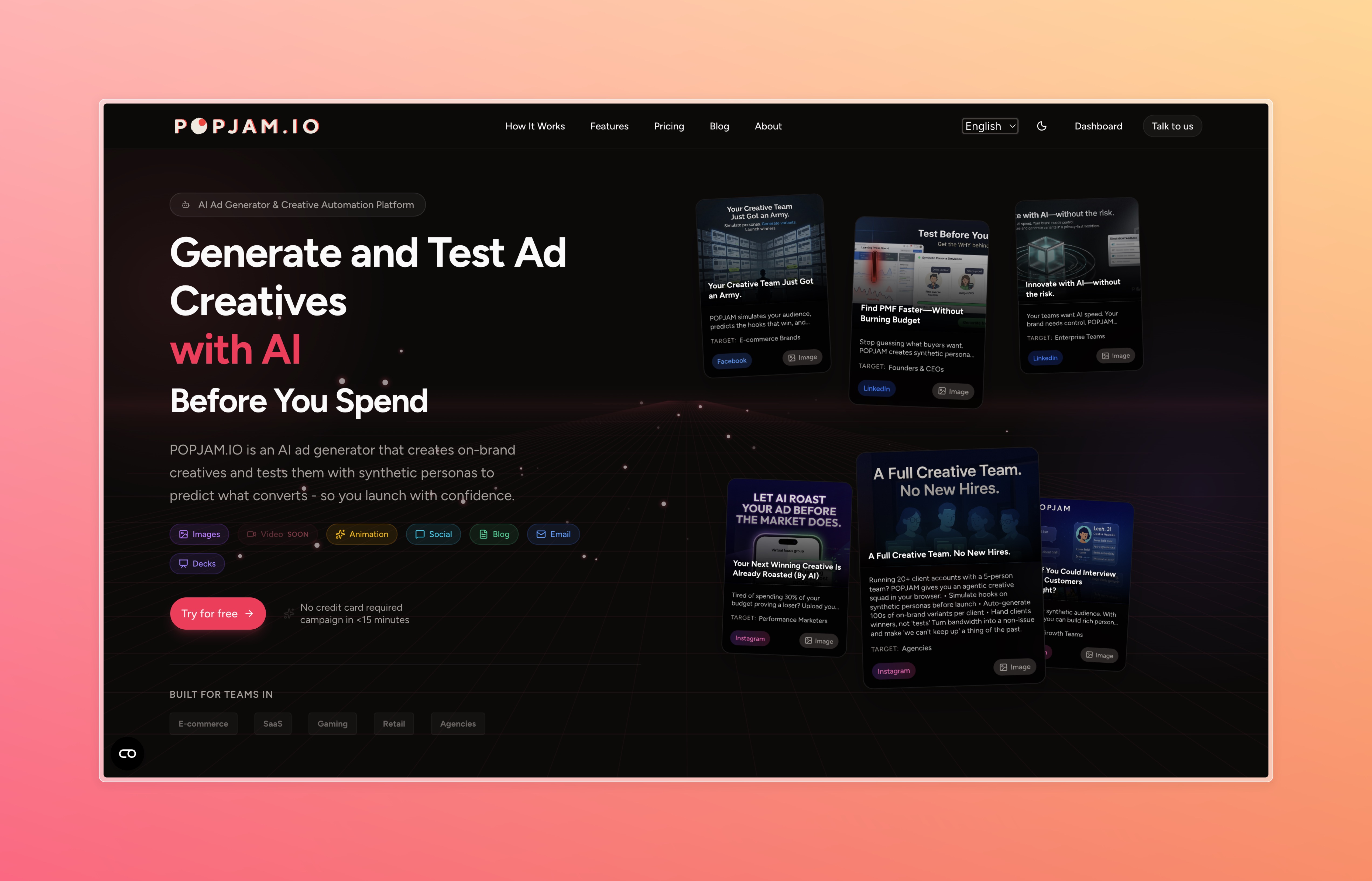
Start with the AI ad generator to produce platform-native creatives for Meta, TikTok, Google, and more in minutes. Use ad testing to simulate audience reactions and identify winners before you spend. Then push your best creatives live through the creative automation platform for a fully connected workflow. POPJAM.IO is built for teams that want data-backed creative decisions, faster iteration cycles, and measurable ROI gains from every campaign.
Frequently asked questions
How does AI-powered creative scaling save time and boost campaign ROI?
AI automates creative production and testing, enabling faster iterations and more effective campaigns. AI ad creative delivers a 47% CTR lift and measurable ROI gains by replacing slow manual workflows with data-driven feedback loops.
What are the best AI tools for scaling digital ad creatives?
Platforms like POPJAM.IO’s AI ad generator and creative automation solutions make scaling fast, organized, and impactful by combining creative generation with pre-launch audience simulation.
Why should marketers pre-test ad creatives before launching?
Pre-testing identifies high-performing creatives before budget is committed, preventing wasted spend and consistently delivering stronger campaign results and optimized ROI.
Which campaign metrics signal that creative scaling is working?
Higher CTR, improved CPA, and stronger ROAS are the clearest signals. AI ad creative lifts CTR and ROI when testing and iteration are built into the creative workflow from the start.