

How to create high-impact ad creatives: steps & testing
Learn how to create and test high-impact ad creatives for DTC campaigns. Practical frameworks, benchmarks, and AI-powered strategies to boost ROAS and CTR.


UGC-style ad creatives are quietly outperforming polished studio productions, and if you’re running DTC campaigns, that gap matters. UGC-style ads deliver 4x CTR for prospecting compared to traditional formats. The problem isn’t creativity. It’s speed, structure, and knowing what to test. This guide walks you through every stage of the creative process, from picking the right formats and tools to running tests that actually move the needle. Whether you’re managing Meta campaigns or scaling TikTok spend, you’ll leave with a repeatable framework that cuts guesswork and boosts performance.
Table of Contents
-
What you need to start: Creative formats, tools, and benchmarks
-
Testing and optimizing your ad creatives: Strategies that work
-
Troubleshooting and common mistakes: What to fix and what to avoid
Key Takeaways
| Point | Details |
|---|---|
| UGC formats win | User-generated content videos outperform polished ads for prospecting and engagement. |
| Modular testing works best | Testing hooks and bodies separately yields clearer data and scalable creative success. |
| Refresh creatives frequently | Weekly creative refresh prevents fatigue and keeps performance metrics strong. |
| Use AI for scale | AI-powered tools accelerate creative production, cloning, and optimization for DTC campaigns. |
| Align ad and landing page | Matching creative message and landing pages maintains conversion rates and lowers costs. |
What you need to start: Creative formats, tools, and benchmarks
Before you build a single creative, you need to know what formats work, what tools support them, and what numbers tell you whether something is performing. Skipping this step is how teams waste weeks on assets that never had a chance.
Core creative formats for DTC brands:
-
UGC short-form video: Authentic, lo-fi, and built for mobile feeds. Works best for prospecting on Meta and TikTok.
-
Lifestyle images: High-emotion product-in-context shots. Strong for retargeting and catalog ads.
-
Carousels: Ideal for showcasing product ranges or telling a sequential story.
-
Animations and motion graphics: Grab attention in static-heavy feeds without requiring full video production.
For mobile-first placements, always build at 9:16 (Stories, Reels, TikTok) and 1:1 (feed placements). Anything else is leaving real estate on the table.
Performance benchmarks to track from day one:
| Metric | What it measures | Target range |
|---|---|---|
| Hook Rate | % of viewers watching past 3 seconds | 25%+ |
| CTR (Click-Through Rate) | Ad engagement relative to impressions | 1.5%+ (Meta), 1%+ (TikTok) |
| ROAS | Revenue generated per dollar spent | 2x+ (varies by margin) |
| Frequency | Average times one user sees your ad | Keep below 3 before refreshing |
Short-form video with hooks in the first 3 seconds consistently delivers higher CTR across platforms. That 3-second window is your entire first impression.
“Creative fatigue is not a maybe. It’s a when.” Plan for it from the start.
Ad fatigue typically sets in within 2 to 4 weeks, which means your creative pipeline needs to be continuous, not reactive. Pair your creative workflow with AI marketing tools that help you generate and rotate assets before performance drops.
Pro Tip: Set a calendar reminder every 10 days to review frequency and Hook Rate. If frequency climbs above 3 and Hook Rate drops, it’s time to rotate, not wait.
Step-by-step guide: Creating powerful ad creatives
With your formats and benchmarks locked in, here’s how to actually build creatives that perform. The goal is a modular, repeatable system, not a one-off production sprint.
Step 1: Start with UGC-style assets Record or source authentic, first-person style content that mirrors how real customers talk about your product. Avoid over-produced visuals. Rawness builds trust, and trust drives clicks.
Step 2: Write multiple hooks before anything else Your hook is the first 3 seconds of video or the first line of copy. Write at least 5 hook variations per creative concept. Test them separately before committing to a full production run.

Step 3: Build modular creative components Separate your hook, body, and call-to-action into interchangeable parts. Modular testing of hooks and bodies with single-variable changes and isolated test campaigns yields measurable, actionable results. This approach lets you identify exactly which element is driving or killing performance.
Step 4: Apply platform-specific best practices
-
Meta: Use 9:16 for Reels and Stories. Lead with emotion, follow with proof.
-
Google PMax: Prioritize high-quality lifestyle images and short punchy headlines.
-
TikTok: Native-looking content wins. Avoid anything that looks like a traditional ad.
Step 5: Use AI to generate and clone winnersAI tools scale creative production and clone high-performing assets, driving measurably higher campaign efficiency. Once you find a winning hook or format, AI can generate dozens of variations in minutes rather than days.
Using an AI ad generator platform removes the bottleneck between creative strategy and execution. You can move from brief to live asset in a fraction of the time.
Statistic to know: DTC brands that test 5 or more creative variants per campaign consistently outperform those testing 1 to 2 variants. Volume of testing is a competitive advantage.
Pro Tip: Never test a new hook on your best-performing audience. Use a cold audience segment so you get clean data without risking your top performers.
Testing and optimizing your ad creatives: Strategies that work
Launching a creative is only the beginning. Systematic testing is what separates brands that scale from brands that plateau. Here’s how to structure it properly.
How to structure your creative tests:
-
Create a dedicated test campaign separate from your main campaigns.
-
Allocate 10 to 20% of total spend to creative testing. Avoid killing tests early and always isolate single variables.
-
Run each test for a minimum of 7 days before drawing conclusions.
-
Use the same audience across all test variants to eliminate audience bias.
-
Graduate winning creatives into your main campaigns once they hit benchmark thresholds.
Key benchmarks for scaling decisions:
| Signal | Action |
|---|---|
| Hook Rate above 30% | Scale spend on this creative |
| CTR above 2% | Move to main campaign |
| ROAS below 1.5x after 7 days | Pause and analyze |
| Frequency above 3 | Rotate creative immediately |
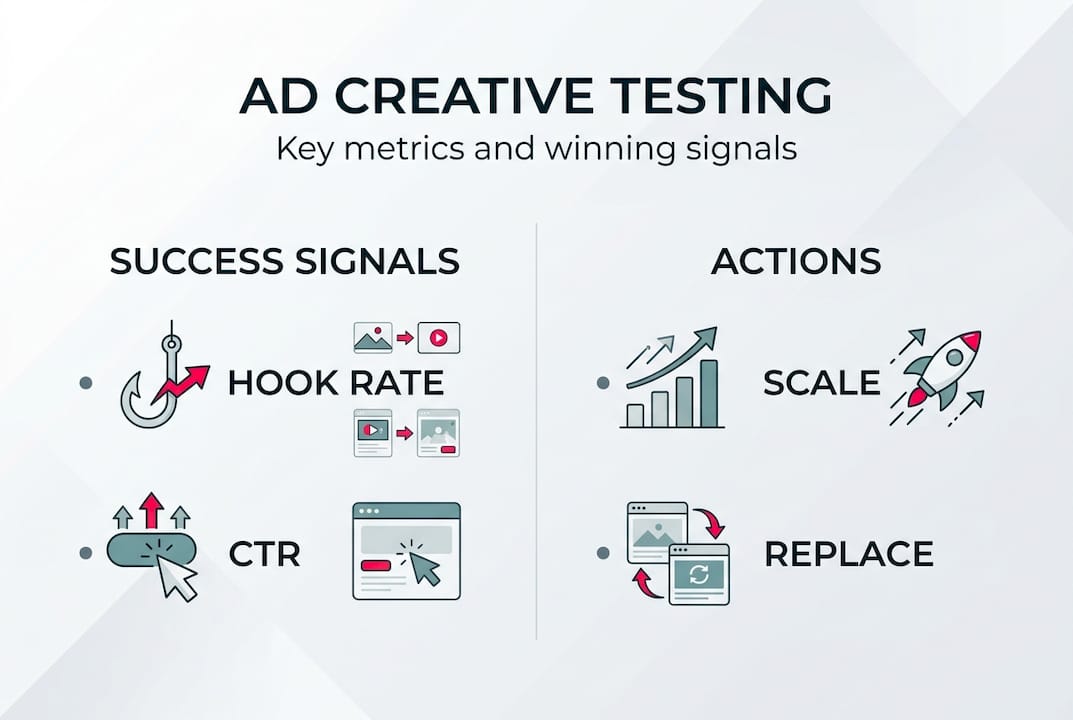
Meta and TikTok require at least 50 conversion events before exiting the learning phase. Pulling the plug before that point means you’re making decisions on incomplete data.
Common testing mistakes to avoid:
-
Testing multiple variables at once (you won’t know what caused the result)
-
Ending tests too early because early numbers look bad
-
Using the same audience for testing and scaling simultaneously
-
Ignoring frequency as a signal of fatigue
“The brands winning on paid social aren’t the ones with the best creatives. They’re the ones with the best testing systems.”
Use creative testing tools that give you real-time feedback on hook performance and engagement signals before you commit full budget.
Pro Tip: When a creative starts to fatigue, don’t scrap it entirely. Try swapping just the hook or the first frame. Often the body and offer are still strong, and a fresh opening is all it needs.
Troubleshooting and common mistakes: What to fix and what to avoid
Even well-structured campaigns run into problems. Knowing what signals to watch and how to respond quickly is what keeps your ROAS healthy.
Signs your creative is underperforming:
-
High CPC with low conversion rate: Usually signals a mismatch between your ad message and your landing page. High CPC flags poor conversion and creative alignment issues. Always match ad messaging to landing page copy.
-
Low Hook Rate (below 20%): Your opening isn’t stopping the scroll. Rewrite the hook entirely.
-
High CTR but low ROAS: The ad is compelling but the offer or landing page isn’t converting. Fix the funnel, not the creative.
-
Rapid frequency increase: Your audience is too small or your creative volume is too low. Expand the audience or add new variants.
Creative alignment checklist:
-
Does the ad headline match the landing page headline?
-
Is the offer in the ad (discount, free shipping, etc.) visible immediately on the landing page?
-
Does the visual tone of the ad match the landing page design?
-
Is the call-to-action consistent from ad to page?
Misalignment between ad and landing page is one of the most common and most fixable performance killers. It’s not a creative problem. It’s a funnel problem.
Pro Tip: Run a quick audit every two weeks. Pull your top 5 ads by spend and click through each one manually. Check whether the landing page experience matches what the ad promised. You’ll catch alignment issues before they drain budget.
For ongoing AI creative optimization, automated performance monitoring can flag these issues before they compound into significant budget waste.
Try AI-powered ad creative generation and testing
If the frameworks above feel like a lot to manage manually, that’s because they are. Generating enough creative volume, running structured tests, monitoring fatigue signals, and iterating fast is a full-time job without the right infrastructure.
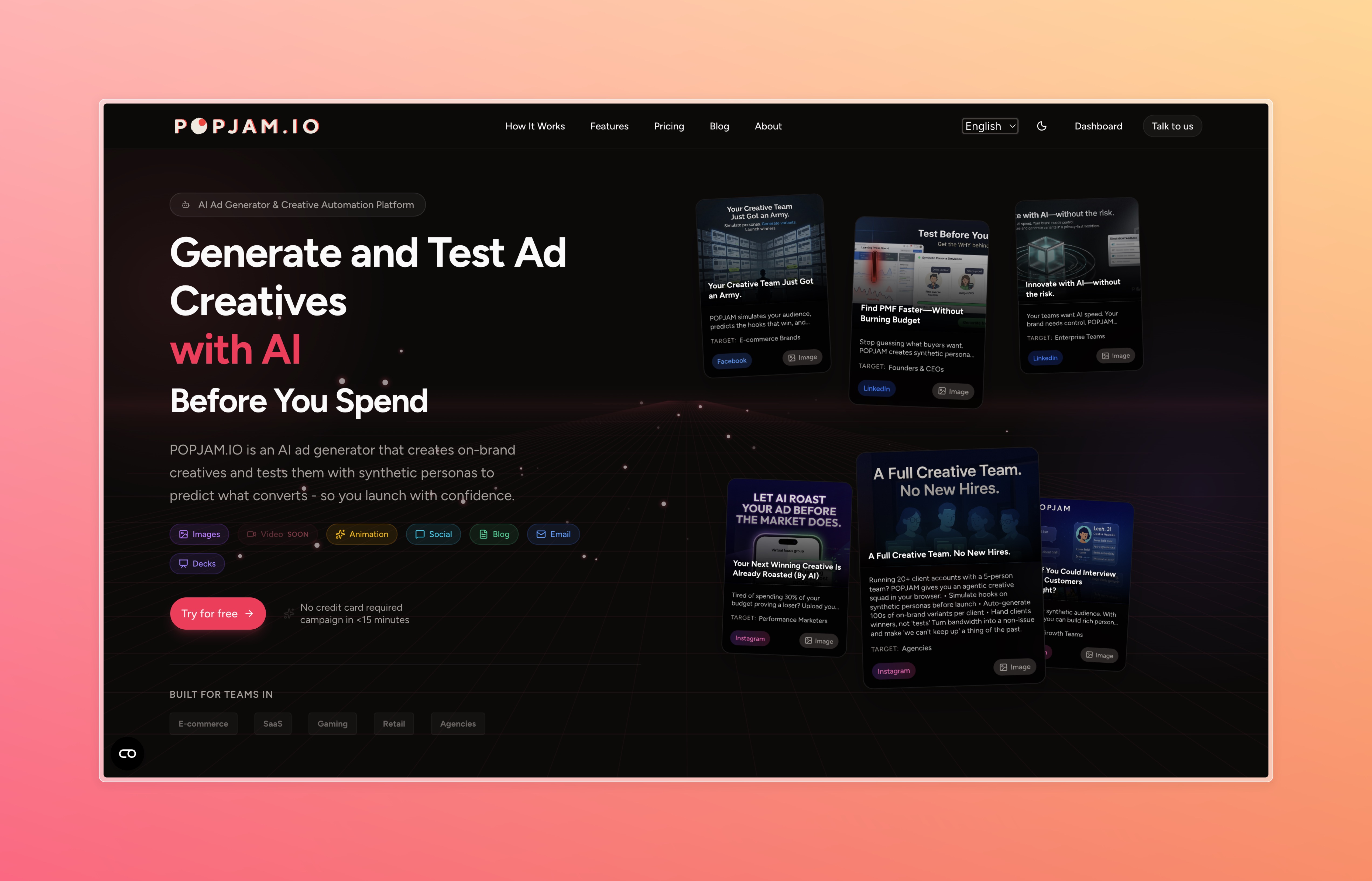
POPJAM.io is built specifically for performance marketers and DTC brands who need to move fast without sacrificing quality. The AI ad generator platform lets you generate platform-native creatives for Meta, TikTok, Google, and more in minutes. You can simulate audience reactions using synthetic personas before spending a dollar on media. Explore the full suite of free AI marketing tools to see how creative generation, testing, and optimization can run in one connected workflow. When you’re ready to scale, check creative platform pricing to find the right plan for your team’s output goals.
Frequently asked questions
What is the best ad creative format for DTC brands?
UGC-style short-form video consistently delivers the highest CTR for prospecting, particularly on Meta and TikTok. UGC-style videos boost CTR 4x compared to polished ad formats for cold audiences.
How often should I refresh my ad creatives?
Refresh your creatives every one to two weeks to stay ahead of fatigue. Creative fatigue sets in within 2 to 4 weeks, so building a proactive rotation schedule is essential for maintaining performance.
How do I test ad creatives most effectively?
Isolate one variable per test, run tests in separate campaigns, and dedicate 10 to 20% of your total budget to testing. Single-variable testing with a dedicated budget produces cleaner data and faster learning cycles.
How can AI tools help with ad creative generation?
AI automates creative generation and clones high-performing assets for broader testing, allowing marketers to scale creative volume without scaling headcount. The result is faster iteration and more efficient budget allocation.