

How AI transforms performance marketing: insights for 2026
AI in performance marketing isn't always a cost-saver. Learn where AI delivers real ROI, where it creates risk, and how to use it strategically in 2026.


TL;DR:
- AI enhances targeting, creative generation, and campaign automation but can increase costs and risks.
- Successful AI use requires clean data, human oversight, and structured testing to avoid pitfalls.
- Human judgment and strategy remain vital as AI acts as a tool, not a replacement in performance marketing.
AI is widely treated as the ultimate shortcut in performance marketing. Run smarter campaigns, spend less, convert more. The reality is messier. While AI genuinely accelerates creative production and sharpens targeting, it also amplifies auction competition, inflates costs for underprepared advertisers, and introduces new failure modes that most teams never see coming. If you’re managing paid campaigns or overseeing ad creative strategy, understanding where AI delivers and where it quietly drains budget is the difference between scaling profitably and chasing platform-reported metrics that don’t match your bottom line. This guide cuts through the noise and gives you a grounded, practical framework for using AI in 2026.
Table of Contents
- The hype vs. reality: What AI actually does for performance marketing
- Where AI shines: Targeting, creatives, and campaign efficiency
- Risks and pitfalls: AI’s hidden costs and performance traps
- Best practices for leveraging AI in your marketing stack
- Our perspective: What most marketers miss about AI in performance marketing
- Get more from your AI marketing: Test, learn, and win
- Frequently asked questions
Key Takeaways
| Point | Details |
|---|---|
| AI increases competition | AI platforms can raise ad costs even as they automate targeting and optimization. |
| Best for creatives and automation | AI excels at generating and testing ad variations but still needs human oversight for success. |
| Beware of common pitfalls | Blindly following AI suggestions can lead to over-optimization, brand risks, and wasted spend. |
| Test and refine constantly | Ongoing testing and refinement are necessary to unlock AI’s full potential for marketing ROI. |
The hype vs. reality: What AI actually does for performance marketing
Every major ad platform now leads with AI. Google’s Performance Max, Meta Advantage+, and TikTok Smart Performance Campaigns all promise to do the heavy lifting. And they do, but not always in your favor. The gap between what platforms claim and what advertisers actually experience is wide enough to drive a budget through.
The core issue is that AI in advertising is optimized for platform goals first. Platforms want to maximize auction participation and revenue. Your ROAS (return on ad spend) is a secondary concern. AI excels at optimizing short-term metrics but struggles with brand building, and risks include hallucinations in copy and over-optimization toward vanity metrics. That’s not a fringe opinion. It’s a structural reality of how these systems are built.
The numbers back this up. A 2025 study found that 84% of advertisers see neutral or negative results with Google AI Max, mainly due to poor data inputs and over-optimization. That’s not a minority edge case. That’s the majority experience.
| Metric | Advertiser expectation | Typical AI outcome |
|---|---|---|
| Cost per click | Lower | Often 10-15% higher |
| Conversion rate | Higher | Variable, data-dependent |
| Creative performance | Consistent wins | High variance |
| Brand safety | Maintained | Risk with auto-copy |
| Time saved | Significant | Real, but with tradeoffs |
Where AI genuinely helps:
- Dynamic creative assembly at scale
- Real-time bid adjustments across large data sets
- Audience segmentation based on behavioral signals
- Reducing manual A/B testing cycles
- Identifying high-performing creative patterns faster
Where AI creates problems:
- Inflating CPCs through amplified auction competition
- Generating off-brand or factually incorrect copy
- Over-indexing on short-term signals at the expense of long-term brand value
- Obscuring performance data inside black-box reporting
- Rewarding large budgets while squeezing smaller advertisers
The creative automation guide from POPJAM goes deeper on how to structure your creative pipeline to avoid these traps. The key takeaway here is that AI is a powerful amplifier, and it amplifies both your strengths and your weaknesses equally.
Where AI shines: Targeting, creatives, and campaign efficiency
To understand where AI genuinely creates value, let’s break down its practical applications in campaign workflows.
The three areas where AI consistently delivers are smarter audience targeting, faster creative generation, and campaign-level automation. Each one has a ceiling, but when used correctly, each one also has a real floor of measurable improvement.
Smarter targeting means AI can process signals that no human team could manually track: browsing behavior, purchase intent, device patterns, and lookalike modeling across millions of users. This is where large data sets pay off. The more conversion data you feed the system, the more accurately it finds buyers.
Faster creative generation is where teams see the most immediate ad creative results. AI can produce dozens of ad variants in the time it used to take to brief a designer. That speed enables real testing velocity, which is the actual driver of creative performance improvement.

Campaign automation handles bid management, budget pacing, and scheduling at a level of granularity that manual optimization simply can’t match at scale.
| Task | Manual optimization | AI-driven process |
|---|---|---|
| Audience segmentation | Hours per campaign | Minutes, continuous |
| Creative variants | 3-5 per cycle | 20-50 per cycle |
| Bid adjustments | Daily or weekly | Real-time |
| Performance reporting | Manual pulls | Automated dashboards |
| A/B test cycles | 2-4 weeks | Days |
What marketers gain from AI in practice:
- 3x to 5x faster creative iteration cycles
- Broader audience reach without proportional budget increases
- Reduced manual workload for bid and budget management
- Earlier identification of winning creative hooks
- More consistent ad delivery across time zones and devices
The catch, as noted by ADOTAT’s ad tech analysis, is that AI bidding raises costs and disproportionately favors large advertisers. Small businesses often find themselves bidding against AI systems that are better funded and better trained on competitor data.
Pro Tip: Use AI to generate 20 to 30 ad variants quickly, then use an ad testing tool to validate which hooks actually convert before you scale spend. Never let the platform decide what works without your own data confirming it first.
The performance marketing best practices that consistently separate top-performing teams from average ones come down to one thing: they use AI to generate options, not to make final decisions.
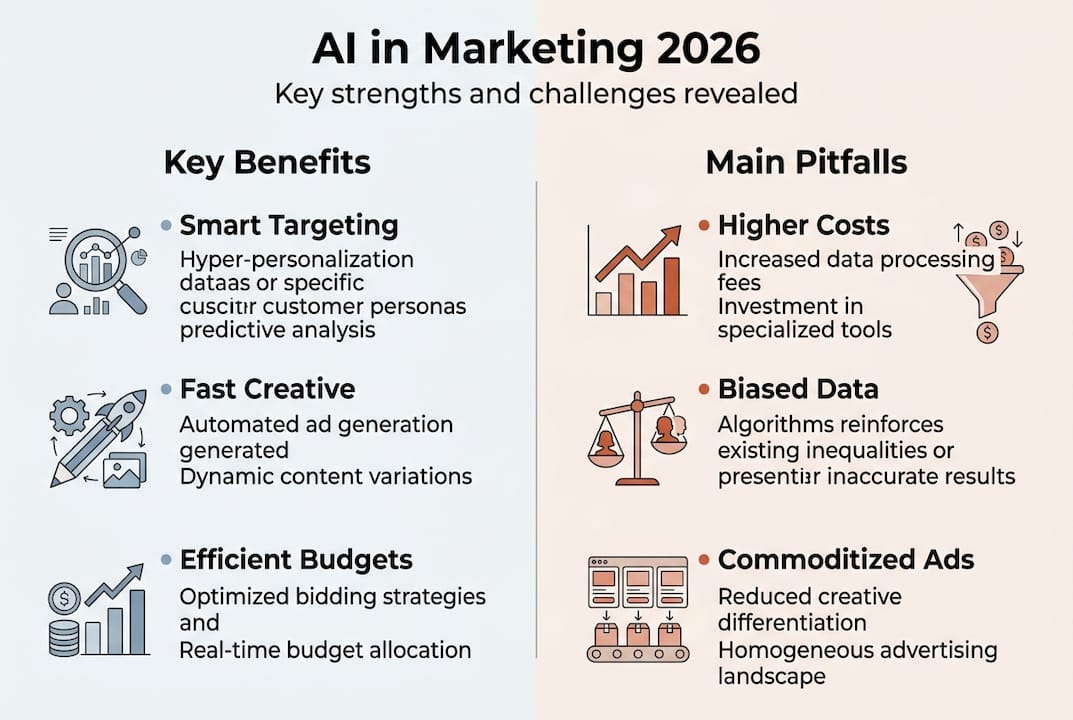
Risks and pitfalls: AI’s hidden costs and performance traps
But with opportunity comes risk. Let’s look at the main challenges marketers face when using AI without a critical framework.
The biggest trap is treating AI as a neutral tool. It isn’t. AI systems are trained on historical data, which means they replicate past patterns, including past mistakes. If your conversion data is thin or skewed, the AI will optimize confidently in the wrong direction.
84% of advertisers report neutral or negative results with AI Max, mainly because of poor data quality and over-optimization toward proxy metrics rather than actual business outcomes. This is the most important stat in performance marketing right now, and most teams haven’t adjusted their strategy to account for it.
The four biggest AI performance traps:
- Over-optimization: AI locks onto early signals and doubles down, often ignoring broader audience segments that convert more slowly but at higher value.
- Hallucination in copy: Auto-generated headlines and descriptions can include inaccurate claims, off-brand language, or tone mismatches that damage credibility.
- Brand safety failures: Automated placements and dynamic copy can appear in contexts that conflict with your brand positioning.
- Data dependency: AI performs poorly when conversion windows are long or when pixel data is limited, which is common for new products or low-traffic sites.
Steps to avoid AI performance traps:
- Feed the system clean, complete conversion data before activating AI bidding.
- Set creative guardrails: provide approved headlines, descriptions, and brand voice guidelines.
- Use an AI generator comparison to evaluate which platforms handle brand safety better.
- Review auto-generated copy weekly, not monthly.
- Check placement reports and exclude irrelevant or harmful contexts manually.
- Review ad creative pitfalls before launching any AI-assisted campaign.
Pro Tip: Before scaling any AI-generated creative, run it through a controlled test with a capped budget. The AI ad maker tools that include pre-launch simulation give you a layer of validation that platform-native AI simply doesn’t offer.
The risk isn’t that AI is bad. The risk is that it’s confidently bad when given bad inputs, and it scales that confidence with your budget.
Best practices for leveraging AI in your marketing stack
To make the most of AI, here’s how forward-thinking marketers stay ahead while avoiding costly mistakes.
The marketers who extract consistent ROI from AI share one habit: they treat AI as an execution layer, not a strategy layer. Strategy still requires human judgment, domain expertise, and an understanding of your customer that no algorithm has access to.
Advertisers experience high variability and brand safety issues with auto-generated copy, particularly when conversion data is weak. This means your first job is to build a strong data foundation before you hand anything over to automation.
Core best practices for AI-powered campaign management:
- Creative: Generate variants with AI, but brief the system with specific brand voice guidelines, approved visual styles, and audience personas.
- Targeting: Use AI audience tools to expand reach, but anchor them to seed audiences built from your best existing customers.
- Optimization: Let AI handle real-time bid adjustments, but set manual constraints on max CPC and budget pacing to prevent runaway spend.
- Testing: Use a structured performance marketing best practices framework to evaluate results against business KPIs, not platform metrics.
- Personas: Build detailed audience profiles using an AI persona generator to give AI systems better targeting signals from the start.
- Tooling: Audit your AI marketing tools stack quarterly to ensure you’re using platforms that give you transparency into how decisions are made.
Ongoing campaign refinement checklist:
- Review AI-generated copy for accuracy and brand alignment weekly
- Confirm conversion tracking is firing correctly before scaling
- Rotate creative every 3 to 4 weeks to prevent ad fatigue
- Exclude underperforming placements and audiences monthly
- Compare AI-reported ROAS against actual revenue in your backend systems
Pro Tip: Use AI for ideation and scaling, but keep a human in the loop for strategy and tone. The best results come from teams that treat AI as a fast, tireless junior analyst, not as a replacement for experienced judgment.
Our perspective: What most marketers miss about AI in performance marketing
The loudest conversation in performance marketing right now is about the AI arms race. Every platform wants you to activate more automation. Every competitor is doing the same. The result is a system where everyone using the same AI tools, trained on the same signals, is bidding against each other in increasingly expensive auctions.
Chasing platform-reported returns without verifying them against actual revenue is how teams end up with impressive dashboards and disappointing profit margins. We’ve seen this pattern repeatedly: marketers activate AI, see early gains, scale aggressively, and then watch margins compress as competition catches up.
The uncomfortable truth is that AI doesn’t create competitive advantage by itself. It commoditizes execution. What still creates advantage is the quality of your creative input, the depth of your audience understanding, and the rigor of your testing process. The creative automation deep dive we’ve built is grounded in this reality. Human creativity, domain expertise, and disciplined testing consistently outperform automation alone. AI is a tool. Treat it like one.
Get more from your AI marketing: Test, learn, and win
If you’re ready to put these principles into action, the right tools can make all the difference.
POPJAM.io is built specifically for performance marketers who want to use AI without losing control of their creative strategy. You can generate platform-native ad creatives for Meta, Google, TikTok, and more, then test them against synthetic audience personas before spending a dollar on media.
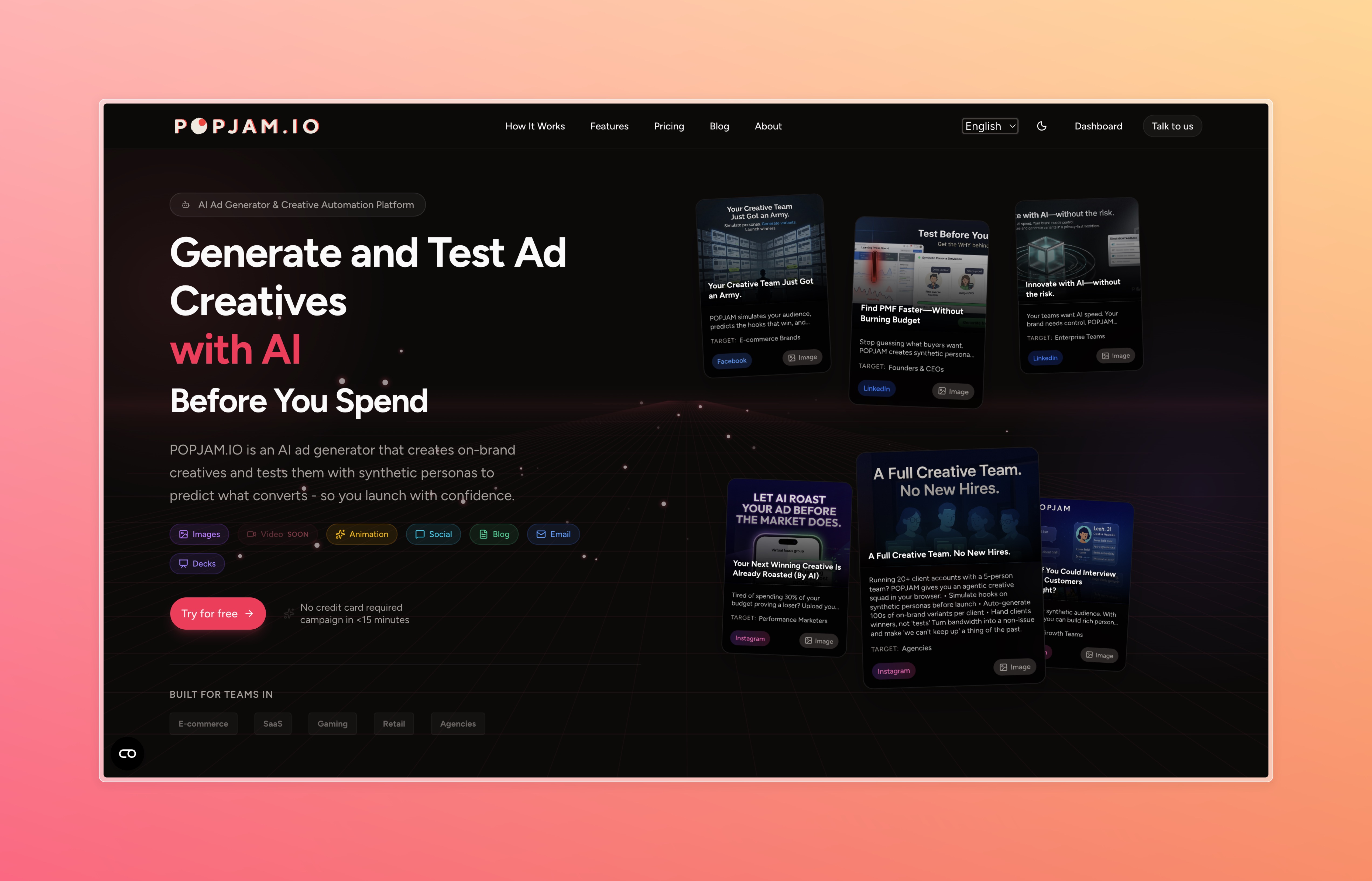
Start with the AI ad generator to produce variants at scale, use the ad testing tool to validate hooks before launch, and explore the full creative automation platform to build a repeatable system that improves with every campaign. Less guesswork. More data-backed decisions. That’s how you win with AI in 2026.
Frequently asked questions
Does AI always reduce ad costs in performance marketing?
No. AI amplifies auction competition and can increase CPC by 10 to 15%, making cost reduction dependent on how well your strategy is structured before activation.
How can marketers avoid AI pitfalls in campaign management?
Test all AI-generated creatives before scaling, maintain strict brand guidelines, and ensure your conversion data is clean. Poor conversion data and auto-generated copy are the two leading causes of brand safety risks and weak results.
Is AI better for large advertisers than small businesses?
Generally yes. AI bidding systems amplify advantages for larger budgets, which increases cost pressure on smaller advertisers competing in the same auctions.
Which tasks in performance marketing benefit most from AI?
AI works best for ad creative generation, targeting optimization, and campaign automation. Brand strategy and creative direction still require human oversight to deliver consistent, on-brand results.
Recommended
- Top performance marketing best practices for results | POPJAM.IO Blog
- AI ad creative: 47% CTR lift and real ROI gains | POPJAM.IO Blog
- Social media ad examples that boost engagement in 2026 | POPJAM.IO Blog
- Creative Automation: The Complete Guide for Performance Marketers (2026) | POPJAM.IO Blog
- AI Marketing Funnel Adaptation: Rank #1, Get Leads, and Dominate Search
- AI in Marketing: Transforming Client Acquisition - Jarrod Harman