

What is AI ad creative? The automated ads guide
Learn what AI ad creative is, how it works, its key benefits and limitations, and the best practices to use it effectively in your ad campaigns.


TL;DR:
- AI ad creative produces multiple variations quickly, enhancing testing and campaign scalability.
- Human oversight remains essential for quality, brand consistency, and compliance in AI-generated ads.
- Successful AI use relies on strong briefs, clear brand assets, and platform-specific adaptation.
Most digital marketers spend the majority of their budget testing audiences and refining targeting parameters, assuming that reaching the right person is the hardest part. It isn’t. Research consistently shows that creative quality drives the majority of ad performance variance, yet it remains the most under-optimized lever in most campaigns. AI ad creative changes that equation entirely. This guide breaks down exactly what AI ad creative is, how the technology works under the hood, what it genuinely delivers versus where it falls short, and the practical steps you can take to make it work for your campaigns right now.
Table of Contents
- What is AI ad creative?
- How does AI generate and optimize ad creative?
- The benefits and limitations of AI ad creative
- Best practices for marketers using AI ad creative
- Our take: Why AI ad creative is a multiplier, not a replacement
- Level up your ad creative with AI tools
- Frequently asked questions
Key Takeaways
| Point | Details |
|---|---|
| AI ad creative defined | AI ad creative refers to AI-generated or optimized ads that use data and brand assets for improved performance. |
| How it works | AI analyzes past performance, generates new visuals and copy, and refines creatives for specific platforms. |
| Strengths and limits | AI excels at speed and iteration but still needs human oversight for brand and compliance. |
| Best practices | Start with quality briefs, review AI outputs, and tailor creatives for each ad platform. |
What is AI ad creative?
AI ad creative refers to the use of artificial intelligence to generate, assemble, and optimize advertising content, covering everything from visuals and headlines to calls-to-action and interactive elements. It isn’t just automation of repetitive tasks. It’s a system that learns from performance data, brand inputs, and audience signals to produce ad variations that are more likely to resonate before a single dollar is spent on media.
According to enterprise AI solutions research, AI ad creative encompasses three core components:
- Visuals: AI-generated images, videos, animations, and platform-native formats tailored to specific placements
- Copy: Headlines, body text, and calls-to-action generated from brand briefs, tone guidelines, and performance data
- Interactive elements: Dynamic overlays, personalized product feeds, and real-time creative swaps based on audience behavior
The value isn’t just speed, though speed is significant. It’s the ability to produce dozens of on-brand variations simultaneously, test them against predicted performance scores, and iterate without waiting on a design team for every round. For performance marketers running campaigns across Meta, TikTok, Google, and LinkedIn at the same time, that kind of output at scale is a genuine competitive advantage.
Why does this matter now? Ad fatigue is accelerating. Audiences scroll faster, algorithms reward novelty, and the shelf life of any single creative is shrinking. Brands that rely on one or two ad variations per campaign are leaving performance on the table. An AI ad generator solves this by continuously producing fresh, relevant creative without proportionally increasing production costs.
Understanding Google AdWords basics also helps here: even search ads benefit from AI-generated copy variations that match intent signals more precisely than manually written alternatives.
Pro Tip: Always start with clear brand assets and detailed creative briefs. The quality of your inputs directly determines the quality of what AI produces. Vague briefs generate generic creative. Specific, well-structured inputs generate powerful, on-brand output.
How does AI generate and optimize ad creative?
The process behind AI ad creative isn’t magic. It’s a structured pipeline that moves from raw brand inputs to optimized, platform-ready ad variations. Here’s how it works in five core stages:

| Stage | What happens | Output |
|---|---|---|
| 1. Brand asset extraction | AI ingests logos, color palettes, fonts, and tone guidelines | Brand profile |
| 2. Prompt understanding | Natural language briefs are parsed for intent, audience, and goals | Creative direction |
| 3. Image and copy generation | Generative models produce visual and text variations | Raw creative assets |
| 4. Layout composition | Assets are assembled into platform-specific formats | Ready-to-use ad units |
| 5. Performance prediction | AI scores each variation based on historical data and engagement signals | Ranked creative shortlist |
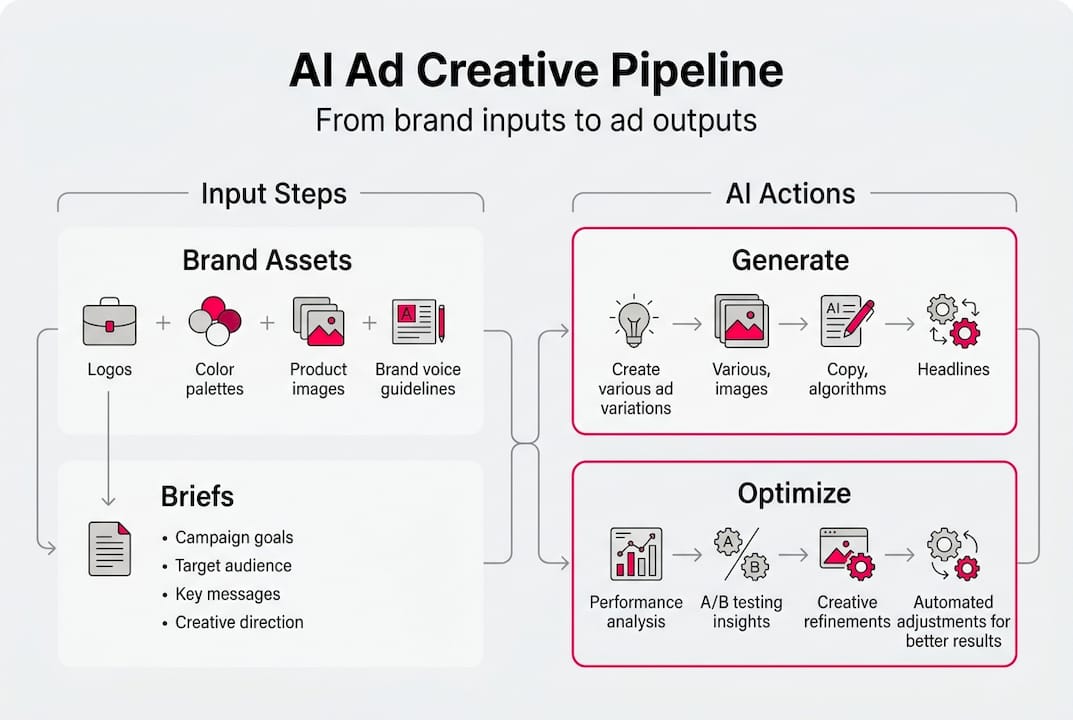
Here’s a real-world scenario. An e-commerce brand selling outdoor gear uploads their logo, product images, and a brief describing their summer campaign. The AI extracts brand elements, generates fifteen image variations with five headline options each, composes them into Meta feed, TikTok vertical, and Google display formats, and then ranks them by predicted click-through rate. The team reviews the top five, makes minor edits, and exports directly to their ad platforms. What used to take a week takes a few hours.
The sequential workflow looks like this:
- Upload brand assets and write a structured creative brief
- Define target audience parameters and campaign goals
- Select platforms and format requirements
- Review AI-generated variations and performance predictions
- Edit and approve final creative
- Export directly to ad platforms for launch
Platform adaptation is where many marketers underestimate AI’s role. A TikTok ad requires vertical video, fast hooks in the first two seconds, and native-feeling text overlays. A Meta feed ad needs a strong visual anchor and a clear value proposition above the fold. Popular AI ad tools now handle these distinctions automatically, reformatting and restyling creative for each platform’s algorithm preferences.
The AI-driven ad creative results speak for themselves when the pipeline is set up correctly. And if you want a deeper look at the production side, the steps to high-impact ad creatives walk through the full process in detail.
The benefits and limitations of AI ad creative
AI ad creative delivers real, measurable advantages. But it also comes with genuine limitations that every marketer needs to understand before building a workflow around it.
| Dimension | AI strengths | AI limitations |
|---|---|---|
| Speed | Generates hundreds of variations in minutes | Can produce generic output without strong briefs |
| Personalization | Scales dynamic creative across audience segments | May miss cultural nuance or brand voice subtleties |
| Testing | Enables rapid A/B and multivariate testing at scale | Requires human review to catch off-brand or misleading content |
| Compliance | Can flag basic issues automatically | Cannot replace legal or regulatory review |
| Originality | Recombines proven creative patterns effectively | Rarely produces breakthrough, culturally novel ideas |
Key benefits of AI ad creative:
- Dramatically faster iteration cycles, reducing time-to-launch from days to hours
- Ability to test creative hooks, formats, and messages at a scale impossible with manual production
- Data-driven variation selection that reduces subjective bias in creative decisions
- Consistent brand asset application across every format and platform
- Lower cost per creative variation, enabling smaller teams to compete with larger budgets
Genuine limitations to keep in mind:
- Output quality is directly tied to input quality. Weak briefs produce weak creative.
- AI doesn’t understand your brand’s cultural positioning or long-term narrative the way a senior creative strategist does
- Compliance and legal review still require human judgment, especially in regulated industries
- Over-reliance on AI-generated creative can create a homogenized look if teams don’t actively push for differentiation
AI excels at iteration, but human input remains essential for quality, compliance, and authenticity. The creative automation insights show how leading teams balance both, and the AI and human partnership model is where the real performance gains happen.
Pro Tip: Always review and edit AI outputs before going live. Even one off-brand headline or misleading visual can damage trust with your audience and create compliance headaches that cost far more than the time saved.
Best practices for marketers using AI ad creative
Knowing the benefits and risks is one thing. Applying AI ad creative effectively in live campaigns is another. Here’s a practical framework that works.
Step-by-step implementation:
- Write a detailed creative brief that includes audience pain points, campaign goals, tone, and specific messaging restrictions
- Upload complete brand assets including logos, approved color palettes, fonts, and example creatives that represent your standard
- Generate a broad set of variations and review them against your brief before narrowing down
- Test your shortlisted creatives using pre-launch simulations or small-budget live tests to identify top performers
- Refine based on real performance data and feed learnings back into your next brief
“Creative is now the number one performance lever in digital marketing. AI creative paired with broad targeting and platform-native formats consistently drives better results than hyper-narrow targeting with weak creative.” Source
Tactical tips for ongoing creative performance:
- Rotate creative every two to three weeks to prevent ad fatigue, especially on Meta and TikTok where frequency is high
- Use dynamic creative optimization (DCO) to automatically serve the best-performing variation to each audience segment in real time
- Write hooks specifically for each platform. TikTok rewards pattern interrupts in the first two seconds. Meta rewards emotional resonance in the first frame.
- Test one variable at a time when possible. Changing the visual and the headline simultaneously makes it hard to know what drove performance
- Use AI-powered ad testing to validate creative before committing full budget
Platform-specific adaptation matters more than most marketers realize. Agency expertise for Facebook ads consistently shows that ads built natively for each platform’s format and behavioral patterns outperform repurposed content. The same principle applies when using AI. Generate for the platform, not just for the campaign.
For a broader view of how AI is reshaping campaign strategy, AI in performance marketing covers the shifts happening across the industry right now.
Our take: Why AI ad creative is a multiplier, not a replacement
Here’s the uncomfortable truth most AI vendors won’t tell you: AI ad creative will not fix a broken strategy. If your offer is weak, your positioning is unclear, or your audience understanding is shallow, AI will just produce more of the same mediocre creative faster. Garbage in, garbage out. That principle hasn’t changed.
What we’ve seen consistently is that the brands winning with AI ad creative are the ones who treat it as an amplifier of strong human thinking, not a substitute for it. They invest in sharp creative briefs. They maintain clear brand standards. They use AI to scale what’s already working, not to figure out what should work in the first place.
The biggest mistake teams make is going hands-off. They generate a batch of AI creatives, skip the review, and launch. Then they blame the tool when performance is flat. The tool isn’t the problem. The process is. Strong brands pair AI speed with authentic human creative judgment, and they use the AI creative case study evidence to guide their decisions rather than guessing.
AI is a multiplier. Multiply strong inputs and you get exceptional output. Multiply weak inputs and you get more noise.
Level up your ad creative with AI tools
If you’re ready to put AI-powered creative to work, the tools exist right now to generate, test, and optimize ad creative at a scale that wasn’t possible even two years ago.
POPJAM.IO is built specifically for performance marketers, e-commerce brands, and agencies who need to move fast without sacrificing creative quality. The AI ad generator platform lets you produce platform-native creatives across Meta, TikTok, Google, and more in minutes. The creative automation tools scale your best-performing concepts into full campaign suites. And the ad testing tool lets you validate creative with synthetic audience simulations before spending a cent on media. Less guesswork. More results.
Frequently asked questions
What types of ads can AI generate?
AI generates various ad formats, including static images, video, animated banners, social media stories, search ads, and display ads across multiple channels and placements.
Does AI ad creative replace human marketers?
AI is an assistant, not a replacement. Human marketers remain essential for brand voice, strategic direction, compliance review, and the kind of original thinking that produces breakthrough campaigns.
How does AI personalize ad creative for different audiences?
AI enables real-time personalization through dynamic creative optimization, analyzing behavioral and contextual data to automatically deliver the most relevant visual and message combination to each audience segment.
What are common pitfalls when using AI for ad creative?
Quality of input and oversight are the two most common failure points. Poor briefs, skipping human review, and failing to adapt creative for each platform’s format requirements consistently undermine AI ad creative performance.
Recommended
- POPJAM.IO - AI Ad Generator & Creative Testing Platform | Test Before You Spend
- Free Ad Testing Tool | Test Ads Before You Spend | POPJAM.IO
- AI ad creative: 47% CTR lift and real ROI gains | POPJAM.IO Blog
- AI Ad Maker | Create & Test Ad Creatives with AI | POPJAM.IO
- AI Growth Package — Autopilot SEO & AI Visibility | Radka Advertising