

AI ad creative: 47% CTR lift and real ROI gains
AI ad creatives improve CTR by up to 47% and cut CPA by 66%. Learn how AI-powered creative generation and testing works, what the data shows, and how to build a hybrid workflow that delivers real campaign results.


TL;DR:
- AI creative can significantly boost campaign performance by increasing CTR, ROAS, and reducing CPA.
- It enables rapid generation and testing of dozens of ad variants, saving time and costs.
- Human oversight is essential for emotional resonance, brand voice, and compliance, especially in luxury or regulated industries.
AI-powered ad creatives can improve CTR by up to 47%, cut cost per acquisition by 66%, and lift return on ad spend by 72%. Those numbers stop most marketers cold. If you’re still running three to five creative variants per campaign and waiting two weeks for a designer to turn around a refresh, you’re leaving serious performance on the table. This guide breaks down exactly how AI-powered ad creative works, what the data actually shows, where it fits into your workflow, and where it still falls short. No hype, just what you need to make a confident decision.
Table of Contents
- AI creative explained: What makes it different?
- Evidence: Measured ROI and performance lift from AI creatives
- How to maximize AI’s value: Workflows and best practices
- Drawbacks and edge cases: When AI ad creative falls short
- Perspective: Why hybrid AI-human creative strategies win in 2026
- Take your creative efficiency to the next level with POPJAM.IO
- Frequently asked questions
Key Takeaways
| Point | Details |
|---|---|
| AI accelerates creative output | AI tools let marketers generate and test dozens of ad variants in a fraction of the time and cost. |
| Performance lift is proven | AI-powered ad creatives regularly boost CTR, ROAS, and lower CPA across platforms like Google and Meta. |
| Hybrid workflows work best | Combining human strategic input with AI’s scale leads to higher-performing, brand-safe ad campaigns. |
| Limitations exist | AI struggles with emotional storytelling and luxury brands, so human oversight remains critical. |
AI creative explained: What makes it different?
AI-powered ad creative uses machine learning to automatically generate, test, and optimize dozens of ad variations across a single campaign. It’s not just a faster design tool. It’s a fundamentally different system for producing and learning from creative at scale.
Traditional creative production works in a linear sequence: brief, design, review, launch, wait for data, repeat. That cycle often takes two to four weeks per iteration. AI flips this model by running 10 to 50+ variants simultaneously, identifying winners in days, and refreshing creative every two to four weeks to combat ad fatigue before it erodes performance.
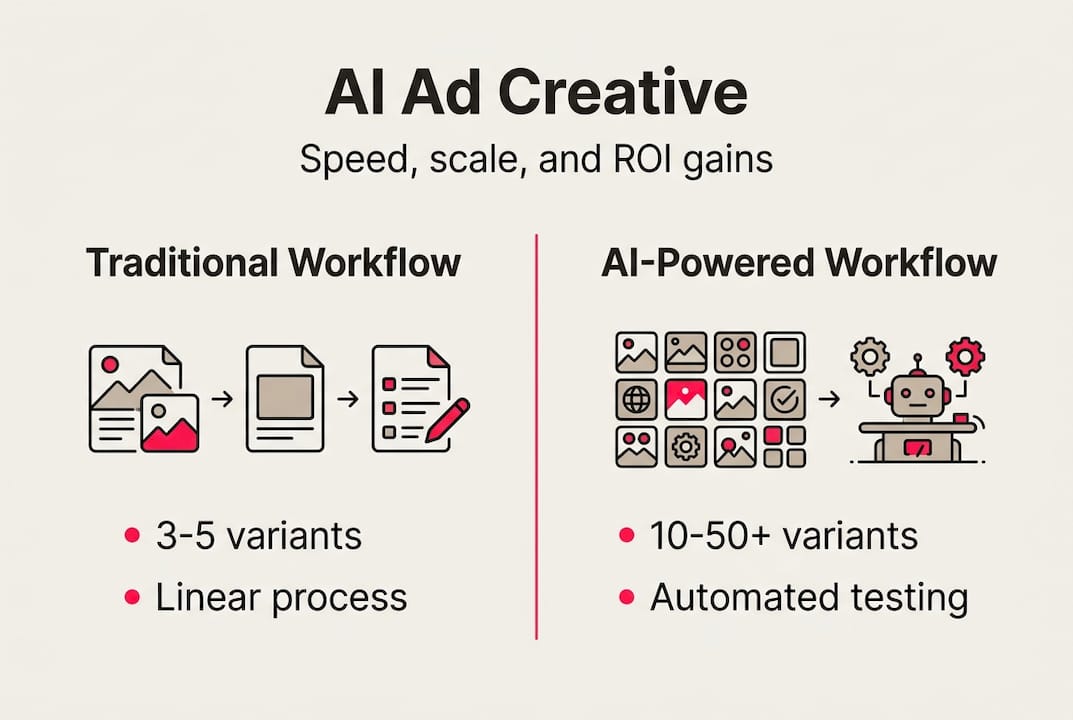
The core methodology is built around high-volume generation and automated testing. You feed the system quality inputs: brand assets, audience signals, messaging pillars. It generates a wide range of creative combinations, tests them against real audience behavior, and surfaces the top performers. Losers get cut fast. Winners get scaled. The loop runs continuously.
Traditional vs. AI creative workflow at a glance:
| Factor | Traditional workflow | AI-powered workflow |
|---|---|---|
| Variants per campaign | 3 to 5 | 10 to 50+ |
| Turnaround time | 2 to 4 weeks | Hours to days |
| Iteration speed | Monthly | Every 2 to 4 weeks |
| Learning speed | Slow, manual | Automated, continuous |
| Cost per variant | High | 85 to 95% lower |
Dynamic creative optimization (DCO) is the engine behind much of this. DCO automatically assembles ad components, headlines, images, calls to action, into combinations and serves the best-performing mix to each audience segment. It’s not guessing. It’s learning in real time.
The performance impact is real. On Google, AI creative adoption has been directly tied to a 61% increase in CTR. That’s not a marginal gain. That’s a campaign-level shift. And it compounds: more clicks at lower cost means your budget works harder every single day.
For teams using an ad testing tool that integrates AI, the biggest unlock is speed of learning. You’re not waiting on a creative agency or an internal bottleneck. You’re running experiments continuously and letting data make the call.
Evidence: Measured ROI and performance lift from AI creatives
Let’s look at what the numbers actually say, because the performance lift from AI creative is not incremental. It’s structural.
Across campaigns, AI-powered creatives improve CTR by 12 to 47%, ROAS by 20 to 72%, and reduce CPA by 15 to 66%. These ranges reflect different industries, budgets, and implementation quality, but even the low end of those ranges represents a meaningful competitive advantage.

Performance benchmarks for AI creative vs. traditional:
| KPI | Typical improvement range | Best-case outcome |
|---|---|---|
| CTR | +12% to +47% | 61% lift (Google data) |
| ROAS | +20% to +72% | +45% (Admiral Media) |
| CPA | -15% to -66% | -66% (Admiral Media) |
| Variants produced | 14x more | 14,300 vs. 47 manually |
The Admiral Media case is worth studying closely. By switching to AI-driven creative production and testing, they achieved a 45% ROAS jump alongside a 66% CPA drop in the same campaign period. That combination is rare in performance marketing. Usually, improving one metric puts pressure on the other.
“AI systems generated 14,300 creative variants in the same time a human team produced 47. That’s not a productivity boost. That’s a different category of operation.”
On the production side, AI reduces creative costs by 85 to 95% and cuts production time by 47 to 95%. That means a brand that used to spend $10,000 on a creative sprint can now run the same output for $500 to $1,500, with more variants and faster iteration.
The KPIs most affected by AI creative adoption:
- CTR (click-through rate): More relevant, better-tested creative drives higher engagement from the right audiences.
- ROAS (return on ad spend): Faster winner identification means budget concentrates on what works sooner.
- CPA (cost per acquisition): Lower waste from underperforming creative directly reduces the cost to convert.
For e-commerce brands running Meta and Google, these gains compound quickly. Explore AI ad maker results to see how this plays out across different verticals, or review AI marketing tools built specifically for performance-driven teams.
How to maximize AI’s value: Workflows and best practices
Knowing the numbers is one thing. Building a workflow that actually captures those gains is another. Here’s how to implement AI-powered creative in a way that delivers consistent results.
- Start with strong inputs. AI amplifies what you give it. Weak briefs, generic copy angles, and low-quality brand assets produce mediocre output at scale. Before you touch any tool, define your audience clearly, nail your value proposition, and prepare a diverse set of visual assets.
- Build a creative brief for the AI. Treat your AI tool like a junior creative team that needs context. Include tone, audience segment, platform, and the specific emotion or action you want to trigger. The more specific the input, the more useful the output.
- Generate a wide variant pool. Aim for at least 10 to 15 variants per campaign, testing different hooks, visuals, and calls to action. Hybrid workflows that pair human strategy with AI execution consistently outperform fully automated approaches.
- Launch with structured testing. Use your platform’s split-testing features to run variants against each other. Resist the urge to pick a winner by gut feel. Let the data run for at least 500 to 1,000 impressions per variant before drawing conclusions.
- Scale winners and cut losers fast. Once a winner emerges, increase its budget. Kill underperformers early. The faster you reallocate, the better your overall campaign efficiency.
- Refresh creative every two to four weeks. Ad fatigue is real and it’s faster than most marketers expect. Build a refresh cadence into your workflow from day one.
Common pitfalls to avoid: generic prompts that produce bland output, running too few variants to get statistically meaningful data, and over-relying on automation without reviewing outputs for brand fit.
Platforms like Meta Advantage+ and Google’s AI systems reward creative variety and recency. Feeding them diverse, fresh creative is not optional. It directly affects delivery and cost.
For building strong AI persona input that improves your creative brief quality, synthetic audience personas are a powerful starting point. And reviewing creative automation best practices before you launch will save you from the most common setup mistakes.
Pro Tip: Always review AI-generated outputs for brand voice, visual consistency, and compliance before publishing. Automation handles volume. You handle standards.
Drawbacks and edge cases: When AI ad creative falls short
AI creative supercharges most campaigns, but there are real limits you need to understand before rolling it out everywhere.
The most consistent gap is emotional resonance. AI can optimize for clicks and conversions, but it doesn’t feel. For brands where the emotional connection is the product, think luxury goods, heritage brands, or high-consideration purchases, AI underperforms in brand storytelling and nuanced emotional execution. Human creatives still hold a clear edge here.
Specific environments where AI creative struggles:
- High-AOV (average order value) products: Expensive purchases require trust-building narratives that AI often flattens into generic benefit statements.
- Luxury and premium brands: Tone, restraint, and visual elegance are difficult for AI to calibrate without heavy human direction.
- Regulated industries: Financial services, healthcare, and legal advertising require precise language and compliance review that automation can’t fully manage.
- Deep brand storytelling: Multi-chapter narratives with character development and emotional arcs need human creative direction.
The UGC (user-generated content) space deserves special attention. Short-term test results for AI-generated UGC can look promising, but authenticity risks are real. Audiences are increasingly good at detecting synthetic content, and backlash when they do can damage brand trust in ways that take months to repair. Use AI UGC as input for real creators, not as a direct replacement.
Setup costs are lower than traditional production, but human oversight and approval processes remain necessary and do slow down launch velocity. Budget for that review time or it becomes a bottleneck that erases the speed advantage.
For a full picture of where AI fits in your stack, the AI ad creative testing platform at POPJAM.IO is built with these constraints in mind, keeping humans in the loop where it matters.
Pro Tip: For high-impact campaigns, always blend AI-generated options with a human creative review pass. AI gets you to 80% faster. Humans get you to 100% better.
Perspective: Why hybrid AI-human creative strategies win in 2026
Here’s the uncomfortable truth about fully automated creative: it’s producing a wave of sameness. When every brand in a category feeds similar inputs into similar AI tools, the outputs start to look alike. Audiences tune out. CTR drops. You’re back to where you started, just faster and cheaper.
The brands winning right now are not the ones automating everything. They’re the ones using AI to execute at scale while keeping human judgment at the strategy layer. Positioning, emotional angle, brand voice, and the specific insight that makes an audience stop scrolling. Those still come from people.
Hybrid workflows that pair human strategy with AI execution consistently outperform both fully manual and fully automated approaches. That’s not a soft opinion. It’s what the performance data shows.
The smartest use of AI in creative automation is as a force multiplier for your best human thinking, not a replacement for it. Feed it sharp strategy and it returns scale. Feed it generic inputs and it returns noise.
Take your creative efficiency to the next level with POPJAM.IO
If these numbers and frameworks resonate, the next step is putting them into practice without rebuilding your entire workflow from scratch.
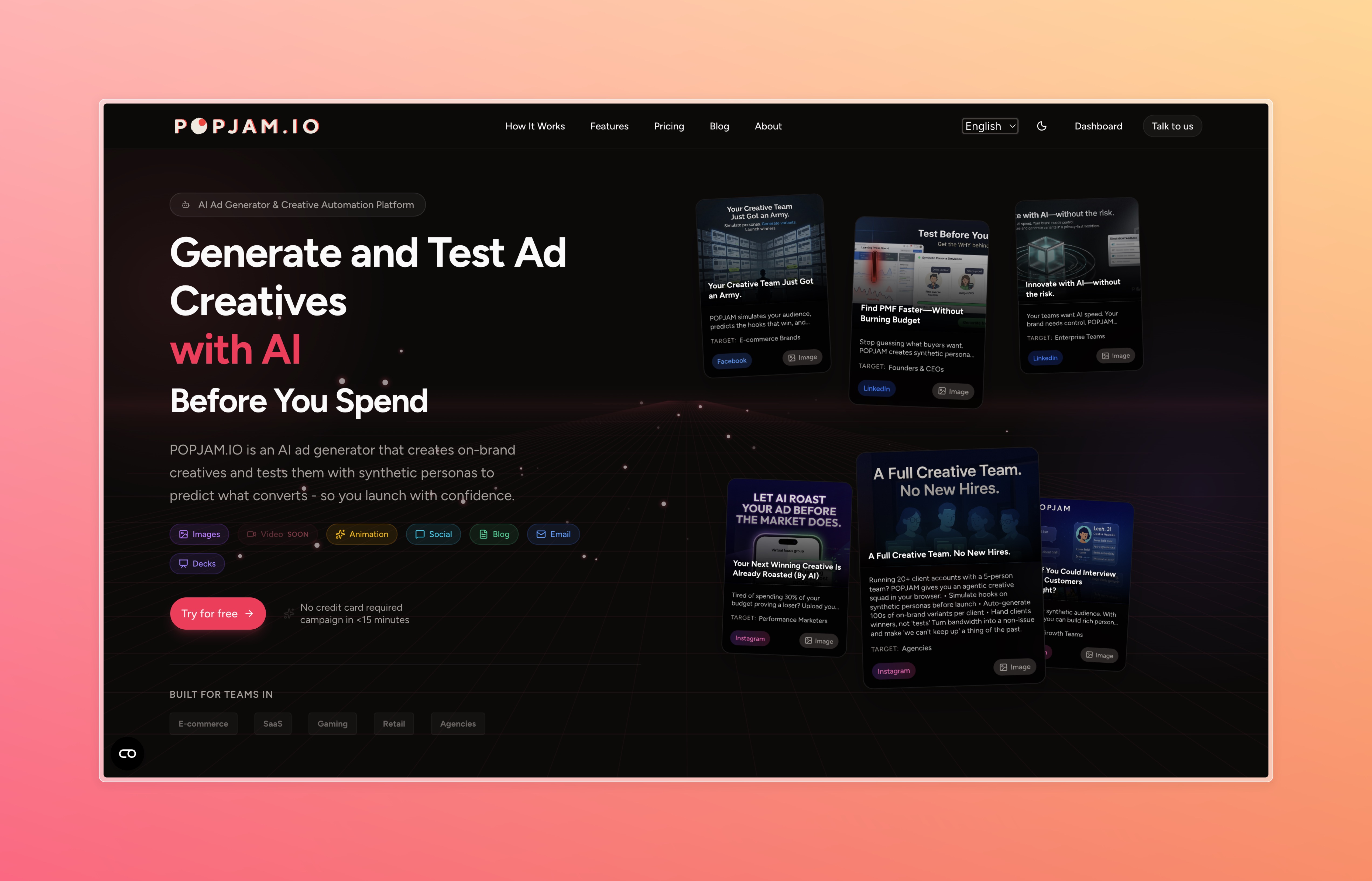
POPJAM.IO is built for exactly this: AI-driven ad creative generation and testing with a hybrid workflow that keeps your strategy in control. You can rapidly generate and pre-test ad concepts before committing budget, using tools designed for performance marketers, not engineers. The AI ad generator produces platform-native creatives for Meta, Google, TikTok, and more, while the ad testing tool lets you simulate audience response before you spend. Start turning your creative process into a competitive advantage today.
Frequently asked questions
How much faster is AI at producing ad creatives than human teams?
AI production speed can be up to 47 times faster than traditional human teams, enabling thousands of variants in the time it takes a team to produce a handful.
Which KPIs see the biggest boost from AI-powered ad creatives?
CTR, ROAS, and CPA show the largest gains. AI-powered creatives improve CTR by 12 to 47%, ROAS by 20 to 72%, and reduce CPA by 15 to 66%.
Are there types of products or industries where AI creative doesn’t work well?
Yes. AI underperforms for luxury goods, high-AOV products, and regulated industries where brand storytelling and emotional nuance are central to the message.
What are the risks of using AI-generated UGC in ads?
Short-term metrics can look solid, but authenticity risks are significant. Audiences who detect AI-generated UGC often react negatively, which can erode brand trust over time.
Do I still need human oversight when using AI creative tools?
Absolutely. Human oversight remains essential for brand consistency, compliance, and quality control, particularly for high-stakes or strategic campaigns.