

Data-backed creatives: boost campaign ROI by 47%
Learn what data-backed creatives are, why they deliver up to 47% higher CTR, and how to build a repeatable AI-powered workflow that improves ad ROI in 2026.


TL;DR:
- Data-backed creatives are shaped and validated through performance data rather than intuition.
- They significantly improve ROI and enable faster, scalable creative optimization.
- Using AI tools and structured testing cycles helps teams generate, test, and refine high-performing ads efficiently.
Creative instinct still matters in advertising, but in 2026, the marketers consistently winning in crowded e-commerce markets are the ones who let data lead. The myth that a brilliant idea alone powers a high-performing ad has quietly collapsed under the weight of evidence. Brands that rely purely on gut feel burn budget on creatives that look great but convert poorly. This article breaks down exactly what data-backed creatives are, why they outperform intuition-driven design, and how you can build a repeatable system to generate, test, and scale ad assets that actually move the needle on ROI.
Table of Contents
- Defining data-backed creatives: Where data meets design
- Why data-backed creatives drive ROI in 2026
- The workflow: How to create data-backed creatives
- Frameworks & tools: Scaling data-backed creatives with AI
- Case studies: Real-world results with data-backed creatives
- A fresh take: What most marketers miss about data-backed creatives
- Take your creatives further with AI-powered tools
- Frequently asked questions
Key Takeaways
| Point | Details |
|---|---|
| Data powers creative effectiveness | Ad concepts tested and refined with real data consistently outperform intuition-based designs. |
| ROI improvement is proven | Brands have seen up to 47 percent increases in click-through rates using data-backed creative strategies. |
| AI streamlines creative workflow | Modern AI and automation platforms enable rapid, scalable testing and iteration for marketers. |
| Balanced approach works best | Successful marketers blend data-driven decisions with creativity and qualitative insights. |
Defining data-backed creatives: Where data meets design
Most marketers have heard the term thrown around in strategy decks, but few teams have a working definition they can act on. Data-backed creatives are digital ad assets whose concepts and elements are shaped, selected, and validated through quantitative analysis. That means every creative decision, from the hero image to the CTA button copy, is informed by real performance signals rather than a designer’s preference or a stakeholder’s opinion.
The data sources that feed this process are more accessible than most teams realize. A/B test results reveal which visual or copy variant resonates with your audience. Engagement metrics like scroll depth, video watch time, and click patterns tell you where attention drops off. Customer feedback, both structured surveys and unstructured reviews, surfaces the emotional triggers and objections your creative needs to address.
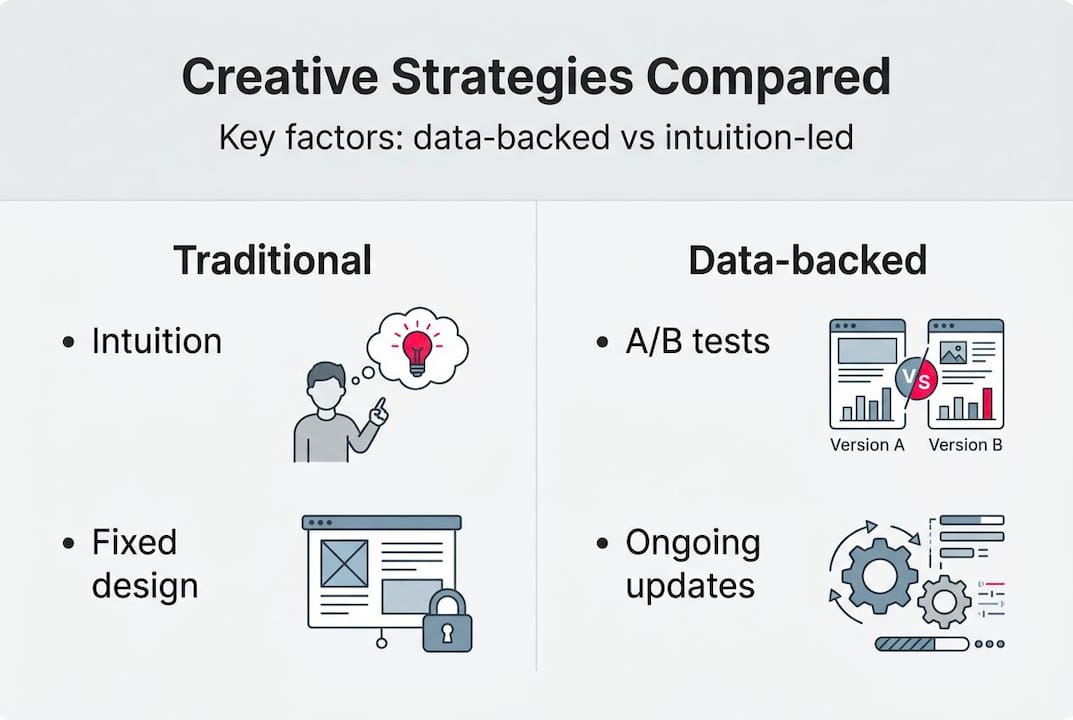
Here’s how data-backed creatives stack up against the traditional approach:
| Criteria | Traditional creatives | Data-backed creatives |
|---|---|---|
| Basis | Intuition, brand guidelines | Performance data, audience signals |
| Speed to insight | Weeks post-launch | Continuous, near real-time |
| Reliability | Inconsistent | Repeatable and improving |
| Scalability | Limited by team capacity | Scalable with automation |
| Measured outcomes | Vanity metrics | CTR, CPA, ROAS, LTV |
The difference is not just philosophical. It changes how your team allocates time, budget, and creative energy.
Top benefits of data-backed creatives for performance marketers:
- Improved ROI: Every iteration is informed by what already worked, compounding gains over time.
- Reduced risk: You validate concepts before committing significant media spend.
- Repeatability: Winning formulas can be templated and reused across campaigns and channels.
- Faster learning cycles: Structured testing shortens the gap between hypothesis and proof.
- Creative fatigue mitigation: Data signals when an ad is wearing out so you can rotate before performance drops.
This is the foundation. Once your team understands what data-backed creatives actually are, the ROI case becomes much easier to make.
Why data-backed creatives drive ROI in 2026
The business case is not theoretical. Brands using data-driven creative saw up to a 47% lift in click-through rates and significant ROI gains compared to teams relying on intuition-based design. That kind of performance gap is not a rounding error. It is the difference between a campaign that scales and one that stalls.
The mechanism behind these gains comes down to three compounding forces. First, iterative testing means you are never stuck with a losing creative for long. Each test cycle produces a new performance baseline, and your creative quality ratchets upward with every round. Second, audience insights gathered through ad feedback analysis let you understand not just what performed, but why, so you can apply those lessons across future campaigns. Third, creative fatigue is one of the most underestimated killers of ad ROI. Data tells you exactly when frequency is eroding performance, so you can swap creatives before your cost-per-acquisition climbs.
“The brands winning on paid social in 2026 are not the ones with the biggest creative budgets. They are the ones with the tightest feedback loops between data and design.”
Pro Tip: Don’t just test your hero image. The highest-impact variables are often your offer framing, your CTA verb, and the first three seconds of your video. Most teams ignore these in favor of surface-level visual tests and leave significant performance gains on the table.
The compounding effect is what makes this approach so powerful for e-commerce teams. A 10% CTR improvement in month one feeds into a better creative brief in month two, which produces a 15% gain, and so on. Over a full quarter, the gap between data-backed and intuition-based teams grows wide enough to define market share.

The workflow: How to create data-backed creatives
Knowing that the ROI is real, let’s break down how you can actually build and test data-backed creatives in 2026. Performance marketers rely on A/B testing, creative automation platforms, and structured feedback loops to iteratively develop high-performing ads. Here is a five-step framework you can implement immediately.
-
Form a hypothesis. Start with a specific, testable question. “Will a fear-of-missing-out headline outperform a benefit-led headline for our retargeting audience?” Vague briefs produce vague data. Sharp hypotheses produce actionable answers.
-
Generate creative variants rapidly. Use AI-powered ad generators to produce multiple versions of each asset quickly. This is where steps to create high-impact ad creatives become critical. Speed matters because the faster you generate variants, the more tests you can run per quarter.
-
Run structured A/B or multivariate tests. Change one variable at a time in A/B tests so you know exactly what drove the result. Multivariate testing works when you have sufficient traffic volume and want to test combinations simultaneously.
-
Collect and clean your data. Pull performance data at statistically significant thresholds. Do not call a winner after 200 impressions. Set minimum sample sizes before your test begins so confirmation bias does not sneak into your analysis.
-
Iterate based on insights. Apply what you learned to the next creative brief. Document the winning elements, retire the losers, and build a growing library of validated creative components.
Pro Tip: Use consistent naming conventions for every ad variant from day one. Include the hypothesis, variable tested, and date in the asset name. When you are managing hundreds of creatives across campaigns, clean metadata is the difference between actionable reporting and a chaotic spreadsheet.
This loop does not end. The best-performing teams treat creative development as a continuous process, not a campaign-by-campaign sprint.
Frameworks & tools: Scaling data-backed creatives with AI
To go from a handful of tests to full-funnel creative optimization, you need the right frameworks and automation. Creative automation and AI platforms have made rapid creative testing and iteration possible at scale for top brands. Here is how the leading platforms compare:
| Platform type | Core function | Supported channels | Unique benefit |
|---|---|---|---|
| AI ad generators | Generate image, video, copy variants | Meta, Google, TikTok, LinkedIn | Speed and volume at low cost |
| Creative automation suites | Template-based variant production | Meta, Display, YouTube | Brand consistency at scale |
| Audience simulation tools | Pre-launch creative testing via personas | All major platforms | Validate before media spend |
| Analytics integrations | Performance data aggregation | Cross-platform | Unified reporting and insights |
The complete guide to creative automation covers platform selection in depth, but here are the essential automations every performance marketing team should have running:
- Automated iteration: New variants generated based on top-performer attributes without manual briefing.
- Multivariate testing pipelines: Systematic testing of copy, visual, and format combinations at scale.
- Real-time reporting dashboards: Performance data surfaced automatically so teams act on signals, not gut feel.
- Creative fatigue alerts: Automated flags when frequency thresholds or engagement drop-off patterns signal ad exhaustion.
When selecting tools, match the platform to your team’s actual workflow. A two-person DTC brand needs speed and simplicity. An agency managing thirty client accounts needs robust variant management and white-label reporting. Enterprise teams need synthetic persona testing and behavioral data integration. There is no single right answer, but there is a right answer for your context.
Case studies: Real-world results with data-backed creatives
The best way to understand the power of data-backed creatives is to see them in action. Successful e-commerce brands use data-directed creative decisions for big wins in conversion and engagement. Here are three patterns we see consistently across high-performing teams.
DTC apparel brand: A mid-sized fashion brand replaced its gut-feel creative process with a structured testing program across Meta. By systematically testing three headline variants and two visual formats per campaign, they reduced CPA by 31% in 90 days while increasing ROAS from 2.1x to 3.4x.
SaaS growth team: A B2B software company used audience simulation to pre-test six ad concepts before launch. Two concepts that the internal team loved scored poorly with synthetic personas mirroring their ICP. They cut those before spending a dollar on media and redirected budget to the top two performers, resulting in a 22% lower cost-per-trial.
Performance agency: An agency managing e-commerce clients built a creative automation pipeline that generated 40 variants per client per month. Structured reporting identified winning creative DNA across accounts, which informed briefs for the following month. Average client CTR improved 28% over two quarters.
Common success factors across these examples:
- Clear hypotheses before any creative is produced
- Minimum viable testing windows with pre-set sample size thresholds
- Cross-functional alignment between creative and media buying teams
- Documented creative libraries that preserve institutional knowledge
“The moment we stopped treating creative as art and started treating it as a product to be tested and iterated, our results became predictable.”
A fresh take: What most marketers miss about data-backed creatives
Here is the uncomfortable truth that most data evangelists skip: data tells you what worked in the past with the audience you already reached. It does not always tell you what will break through with a new segment or in a saturated market. The teams that win long-term are not the ones who follow the data blindly. They are the ones who know when to trust a bold, hypothesis-driven outlier that the data cannot yet support.
Most teams also dramatically underuse qualitative signals. You have quantitative data on CTR and CPA, but are you reading your comment sections? Are you analyzing the language your best customers use in reviews? That qualitative layer often surfaces the emotional insight that makes a creative truly land, and it rarely shows up in a performance dashboard.
Pre-testing ad creatives before launch is one way to bridge this gap, combining structured data with simulated audience reactions before you commit budget.
Pro Tip: Schedule one “creative leap” test per quarter. Pick a concept that your data does not fully support but your instinct says could resonate. Run it with a small budget. Sometimes the outlier becomes your next control.
Take your creatives further with AI-powered tools
If you are ready to put data-backed creative strategies into practice, the right tools make the difference between a process that scales and one that stalls at ten variants per month.
POPJAM.IO gives performance marketers and e-commerce teams a full creative automation workflow: generate platform-native ad assets with the AI ad generator, validate concepts before launch using the free ad testing tool, and manage the entire iteration cycle through the creative automation platform. From hypothesis to high-performing creative, every step is faster, more informed, and built for teams that cannot afford to waste media budget on guesswork.
Frequently asked questions
What are the main benefits of data-backed creatives?
They consistently improve ROI, reduce wasted ad spend, and enable rapid, evidence-based optimization. Brands using data-driven creative saw up to a 47% lift in click-through rates alongside significant ROI gains.
How do data-backed creatives differ from traditional ad design?
Traditional design relies on intuition and past experience, while data-backed creatives are continuously tested and refined using real campaign performance data, making results more predictable and repeatable.
What tools can help me create data-backed ad creatives?
Look for AI-powered ad generators and creative automation platforms that support fast iteration, A/B testing, and built-in analytics to close the loop between data and design.
How do I know if my creative is performing well in a data-backed workflow?
Track CTR, CPA, ROAS, and engagement metrics consistently, then iterate based on what the data shows. Performance marketers rely on structured feedback loops to identify winners and retire underperformers before they drain budget.