

Cut Review Cycles in One Quarter: Agency Creative Workflow with AI
Standardize briefs, name decision owners, and add AI pretesting to cut review cycles this quarter with an agency creative workflow playbook.

An agency creative workflow is the repeatable path a project takes from brief to launch, and if you fix one thing first, fix this: standardize the intake brief and name a single decision owner at every review gate. Everything else in this guide builds on that one change. We’ll walk through the phases, the roles, the fixes for common bottlenecks, and where lightweight AI pretesting slots in to save you review cycles later.
TL;DR:
- Standardizing the intake brief with objectives, metrics, and a single decision owner at each review gate reduces ambiguity and prevents wasted review cycles.
- Mapping only two to three repetitive project types and applying fixed review windows with named approvers accelerates workflow implementation and shows measurable improvements quickly.
- Automating manual, repetitive tasks and managing integration debt by choosing compatible tools with audit trails minimizes delays and quality issues in the process.
- Using lightweight AI pretesting generates multiple creative variants and filters out weaker options before human review, cutting down revisions and approval time.
- Regularly measuring KPIs like cycle time, revision count, and on-time delivery helps track progress, make data-driven adjustments, and ensures the workflow stays effective over time.
Table of Contents
- The Phases Every Creative Project Should Move Through
- The Building Blocks You Need to Standardize First
- A Step-by-Step Plan to Formalize Your Workflow This Quarter
- Where Agency Workflows Break Down and How to Fix Them
- Choosing Systems That Support the Workflow, Not Fight It
- Turning Workflow Data Into KPIs You Can Actually Act On
- Where AI Pretesting Fits Into Production and QA
- What It Actually Takes to Make a New Workflow Stick
- Where POPJAM Fits Into Your Existing Workflow
- A Few Places to Go Deeper
- Sources
- FAQ
The Phases Every Creative Project Should Move Through
Think of your workflow as a production line, not a series of one-off sprints. According to Smartsheet’s breakdown of agency workflows, a creative workflow typically moves through definition and planning, creation and development, review and approval, and launch and evaluation. Add a debrief, and you’ve got a system that actually gets smarter over time instead of repeating the same mistakes on every project.
Here’s what each phase needs to function:
- Definition and planning: intake happens here, a named brief owner captures objectives and success metrics before anyone opens a design tool.
- Scheduling: milestones get mapped against real team capacity, not wishful thinking, using a repeatable timeline template.
- Creative production: drafts move through internal quality checks with clear version control, so nobody is second-guessing which file is current.
- Review and approval: timeboxed cycles with a single decision owner replace the free-for-all where six stakeholders each weigh in separately.
- Launch and evaluation: release tasks get checked off against a measurement plan set during the definition phase, not invented after the fact.
- Debrief: the team captures what worked and what didn’t, and turns reusable assets into templates for next time.
Wrike’s guide to creative workflow management makes a point worth repeating: structured workflows improve predictability and cut the time agencies lose to unclear briefs and ad-hoc reviews. That’s the whole game. Predictability is what lets you quote timelines with confidence and hit them.
The debrief phase gets skipped more than any other, usually because everyone’s already onto the next fire. That’s a mistake. Academic research on creativity management points to iterative evaluation and multi-stakeholder debriefs as a real lever for improving future creative output, not just a box-checking exercise.

The Building Blocks You Need to Standardize First
A workflow only works if its components are consistent across every project, not reinvented each time a new brief lands. Four things need to be locked down before you touch a project management tool.
A robust brief includes objectives, target audience, KPIs, constraints, and brand anchors. If any of those five are missing, the brief is sent back for revision before production starts, no exceptions. Ambiguity at this stage is the single biggest source of wasted rounds later.
Approval structure needs shorthand everyone understands. RACI or DACI frameworks work because they force you to name who’s Responsible, who’s Accountable, who’s Consulted, and who’s Informed, and critically, who actually signs off on the final deliverable. One name, not a committee.
- File and version naming: a consistent convention (project_asset_v3_final) plus a shared asset bank eliminates the “which file is current” scramble.
- Handoff checklists: every transition between phases gets a short checklist so nothing falls through when a project changes hands.
- Capacity planning: map your team’s actual hours against incoming demand weekly, not per project, so you can see bottlenecks before they hit.
- Brief templates: a copy-paste creative brief template removes the friction of starting from a blank page every time.
Get these four right and most of your downstream chaos disappears before it starts.
A Step-by-Step Plan to Formalize Your Workflow This Quarter
You don’t need a six-month transformation project to fix this. You need a focused pilot, real numbers, and the discipline to iterate. Here’s how to do it in one quarter.
- Map your current projects. Look at the last quarter’s work and identify one or two project types that repeat often enough to standardize, like social campaign packages or landing page refreshes.
- Build minimum viable phase gates. For each project type, write a short deliverable checklist per phase. Keep it to the essentials: what must exist before the project moves forward, nothing more.
- Set fixed review windows. Give reviewers 48 hours, not “whenever they get to it.” Name one approver per gate, and build an escalation rule for when that approver goes dark.
- Pilot with two live projects. Run the new structure on two real projects, not a hypothetical. Track cycle time, revision count, and on-time delivery from day one.
- Iterate based on what you measure. After the pilot, look at where time actually went. Adjust the checklist, the review window, or the approver, then run it again.
Pro Tip: Run your pilot for three to six projects, not just one or two, because a single project won’t give you a real trend. This lines up with guidance from the Project Management Institute, which found that structured process and clear decision ownership boost operational outcomes for teams rolling out new ways of working.
The temptation here is to build the perfect system before you launch it. Resist that. A workflow that’s live and imperfect beats a perfect workflow still sitting in a slide deck. Your first pilot will surface problems you couldn’t have predicted from a whiteboard session, and that’s the point.

One more thing worth saying plainly: this only works if leadership treats the pilot as real work, not a side project people squeeze in between client fires. If the team senses the new process is optional, it becomes optional, and you’re back where you started in six weeks.
Where Agency Workflows Break Down and How to Fix Them
Most agency bottlenecks trace back to five repeat offenders, and each one has a fix that doesn’t require new headcount.
- Weak briefs: enforce minimum required fields (objective, audience, KPI, constraint, brand anchor) and bounce anything incomplete back before production starts.
- Slow review cycles: timebox every review window and build an automatic escalation rule if the approver doesn’t respond within it.
- Scope creep: use a short change-control checklist that requires a client signature before any added request enters production.
- Integration debt: every extra tool you bolt onto your stack adds authentication steps, monitoring needs, and new failure points, so budget real time for the glue work between systems.
- Time-hungry manual tasks: look for the repetitive steps eating creative hours, like manual variant creation or resizing, and automate or pretest them before they reach a human reviewer.
Pro Tip: Template-driven briefs paired with fixed review windows are one of the fastest, cheapest changes you can make, and agencies that adopt both together tend to see review cycles shrink noticeably within a single pilot.
Integration debt deserves extra attention because it’s invisible until it isn’t. Adding a fourth or fifth tool to your stack doesn’t just add a login screen, it adds a new place for handoffs to fail silently.
Choosing Systems That Support the Workflow, Not Fight It
You don’t need to chase every new tool on the market. You need five categories covered, and you need them to talk to each other cleanly.
Your stack should include intake forms for capturing briefs consistently, a task or project management system for tracking phase gates, a digital asset management (DAM) tool or shared asset bank for version control, a review and approval system with a visible audit trail, and automation or orchestration tools that handle the repetitive glue work between the others.
- Single source of truth: every asset lives in one place, with one current version, so nobody is chasing files across email threads.
- Permission hierarchies: access controls match your DACI structure, so the person who approves is the only one who can actually approve.
- Audit trail: every approval leaves a timestamp and a name attached to it, which matters the moment a client asks “who signed off on this?”
- Platform-native exports: whatever you’re producing needs to leave your system ready for its destination, whether that’s Meta, Google, TikTok, or a client’s CMS.
Tool reviews on Capterra’s listing for Wrike consistently point to integrations and usability as the deciding factors when teams pick project management software, which tracks with what agencies report in practice. The tool that wins isn’t the one with the most features, it’s the one your team will actually use every day without a workaround.
Turning Workflow Data Into KPIs You Can Actually Act On
If you’re not measuring the workflow, you’re guessing whether your changes helped. Five KPIs cover most of what matters: cycle time (how long a project takes from brief to launch), throughput (how many projects clear the pipeline per period), revision count (how many rounds a deliverable needs before approval), on-time delivery rate, and client satisfaction.
| KPI | Where to capture it | Review cadence |
|---|---|---|
| Cycle time | Project management tool logs | Weekly |
| Throughput | Project management tool logs | Monthly |
| Revision count | Review and approval system | Weekly |
| On-time delivery | Project management tool logs | Monthly |
| Client satisfaction | Post-project client survey | Monthly |
Run small experiments before rolling out a change agency-wide. A timeboxed pilot on two or three projects, or an A/B split where one team uses the new review window and another sticks with the old one, tells you fast whether a change actually lowers cycle time or just feels faster.
Where AI Pretesting Fits Into Production and QA
Lightweight AI pretesting slots neatly into the review phase, and it’s specifically built to cut down the subjective back-and-forth that eats agency hours. Instead of five stakeholders debating which headline “feels right,” a creative automation platform can generate variants and test them against synthetic personas before a human review even starts.
- Generate: produce a handful of on-brand creative variants from your existing brief.
- Synthetic test: run each variant against simulated audience reactions to surface which resonates before spend.
- Select: bring only the top-performing variants into the human review gate.
- Finalize: lock the winning assets and route them straight to platform-native export.
This doesn’t replace your review gate, it feeds it better options, which means fewer rounds and faster sign-off.
What It Actually Takes to Make a New Workflow Stick
The workflow itself isn’t the hard part. Getting your team to keep using it after month two is. Leadership has to protect process work the same way it protects billable hours, otherwise the checklist quietly disappears the first time a deadline gets tight.
Resistance from creatives usually isn’t about the process itself, it’s about feeling boxed in. Involve them in designing the checklist rather than handing it down, and you’ll get real adoption instead of workarounds. Staff who help shape a new process are far more likely to actually follow it.
If you run one experiment first, make it the fixed review window with a named approver. Measure cycle time before and after. That single change tends to show results fast enough to build momentum for everything else.
— Doruk
Where POPJAM Fits Into Your Existing Workflow
If your review gate is where projects stall, that’s exactly where POPJAM plugs in. Instead of guessing which concept will land, you generate variants and test them against synthetic buyer personas before anything goes to a client or to spend, which means your review gate opens with fewer options and stronger ones.
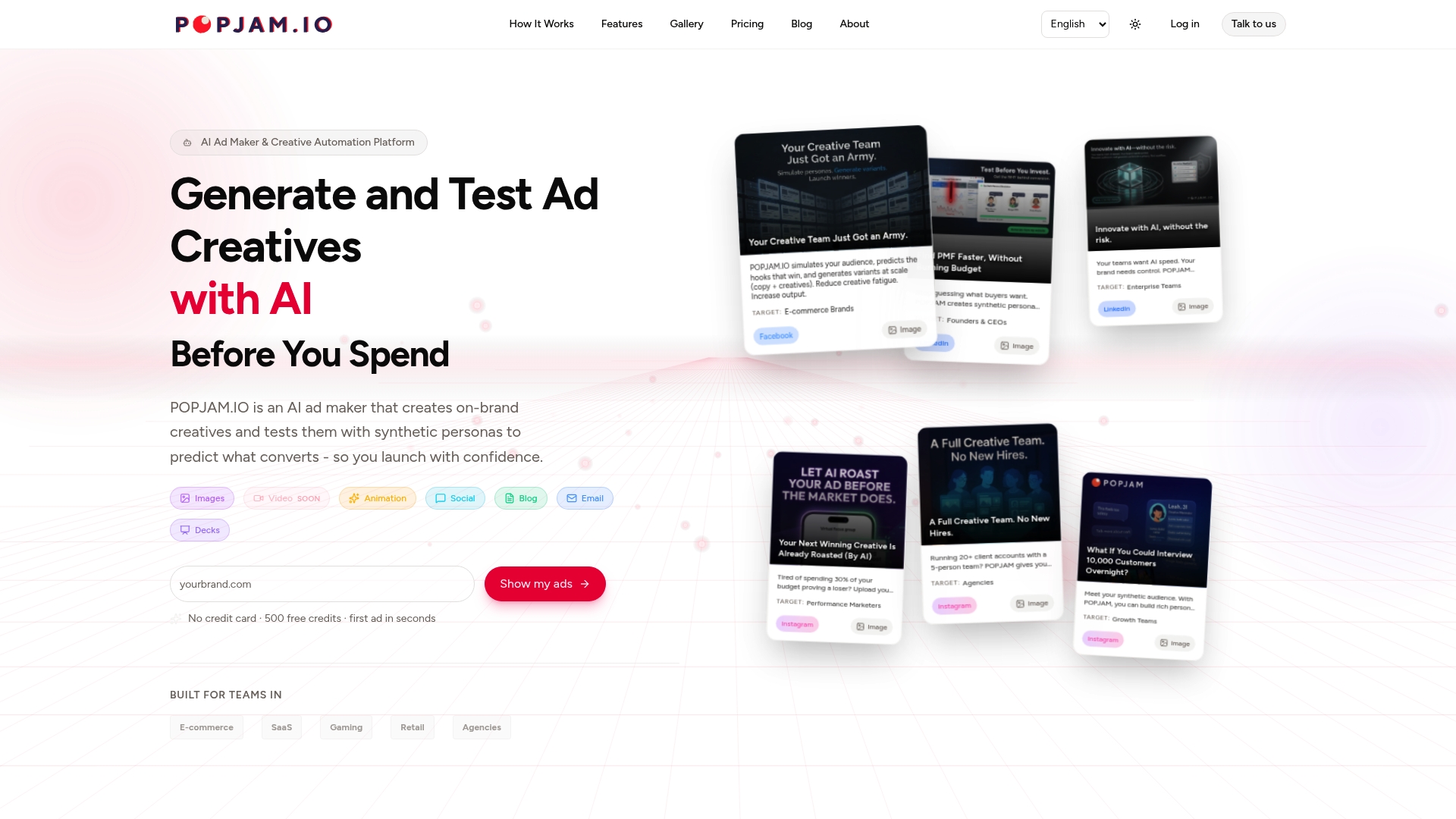
POPJAM supports concept testing, preflight creative QA, and an asset bank you can pull from project to project, cutting the guesswork out of the rounds that usually eat the most time. Plans start with a free option, with paid tiers available for scaling usage. Check POPJAM’s pricing to see which fits your team’s volume.
A Few Places to Go Deeper
For the canonical phase breakdown, see Smartsheet’s agency workflow guide. For brief templates you can copy directly, POPJAM’s creative brief examples and ad creative bank guide are both practical starting points.
Sources
- From Brief to Launch: The Creative Agency Workflow Guide — Smartsheet
- Creative Workflow Management: A Practical Guide — Wrike
- Boosting business acumen — Project Management Institute (PMI)
- Wrike on Capterra
FAQ
What are the 5 steps of the creative process?
Most agency creative processes move through definition and planning, creation and development, review and approval, launch and evaluation, and a debrief. Each phase has its own owner and deliverable, which is what keeps the process repeatable rather than reinvented on every project.
What are the 5 steps of workflow?
A typical workflow includes intake, planning and scheduling, production, review and approval, and launch, with a debrief often added as a sixth step to capture lessons. The exact labels vary by agency, but the sequence from brief to launch stays consistent.
How much do creative agencies charge per hour?
Agency hourly rates vary widely by market, specialty, and team seniority, and there’s no single standard figure that applies across the industry. Ask for a quote based on your specific project scope rather than relying on a general benchmark.
How does AI pretesting fit into an existing agency review process?
AI pretesting sits before the human review gate, generating creative variants and testing them against synthetic personas so only the strongest options reach your reviewers. Platforms like POPJAM are built specifically for this step, reducing the number of subjective rounds a deliverable needs before approval.
What’s the fastest way to reduce agency review cycles?
Timeboxing your review window and naming a single approver per gate is one of the fastest changes you can make, since it removes the ambiguity of who needs to weigh in and by when. Pairing that with pre-launch creative testing narrows the options reviewers see in the first place, which shortens the cycle further.