

Streamline your digital marketing creative process with AI
Learn how to streamline your digital marketing creative process with AI tools. Covers setup, step-by-step workflow, testing, and common pitfalls to avoid.


TL;DR:
- Manual workflows hinder campaign speed and increase costs, while AI enables rapid creative testing.
- Building a strong tech stack and quality data foundation is essential before adopting AI tools.
- Combining AI automation with human judgment maximizes creative impact and campaign performance.
Manual creative workflows are quietly killing campaign performance. When your team spends days briefing designers, waiting for revisions, and manually resizing assets for every platform, you’re burning budget before a single ad goes live. The good news: AI-driven creative tools have fundamentally changed what’s possible. You can now generate, test, and optimize ad creatives in hours instead of weeks. This guide walks through exactly what you need, how to structure your process, and how to avoid the pitfalls that trip up even experienced performance marketers. If you’re ready to move faster and spend smarter, this is your roadmap.
Table of Contents
- Essential requirements for AI-powered creative workflows
- Step-by-step: The modern digital marketing creative process
- Optimizing and testing ad creatives at scale
- Avoiding common pitfalls and maximizing creative impact
- Our perspective: Why a hybrid human-AI creative process wins
- Accelerate your creative process with POPJAM.IO AI tools
- Frequently asked questions
Key Takeaways
| Point | Details |
|---|---|
| AI accelerates workflow | Using AI tools can cut your creative development time by up to 10 times. |
| Creative process essentials | Success starts with clear goals, quality data, and team alignment before design begins. |
| Optimize and test continuously | The top-performing ad creatives result from rapid testing, analytics, and iterative improvements. |
| Hybrid approach works best | Combining AI efficiency with human storytelling yields the highest-impact marketing creatives. |
Essential requirements for AI-powered creative workflows
Before you overhaul your creative process, you need the right foundation. Jumping straight into AI tools without proper setup is like running paid ads without a tracking pixel. You’ll get output, but you won’t be able to measure or improve it.
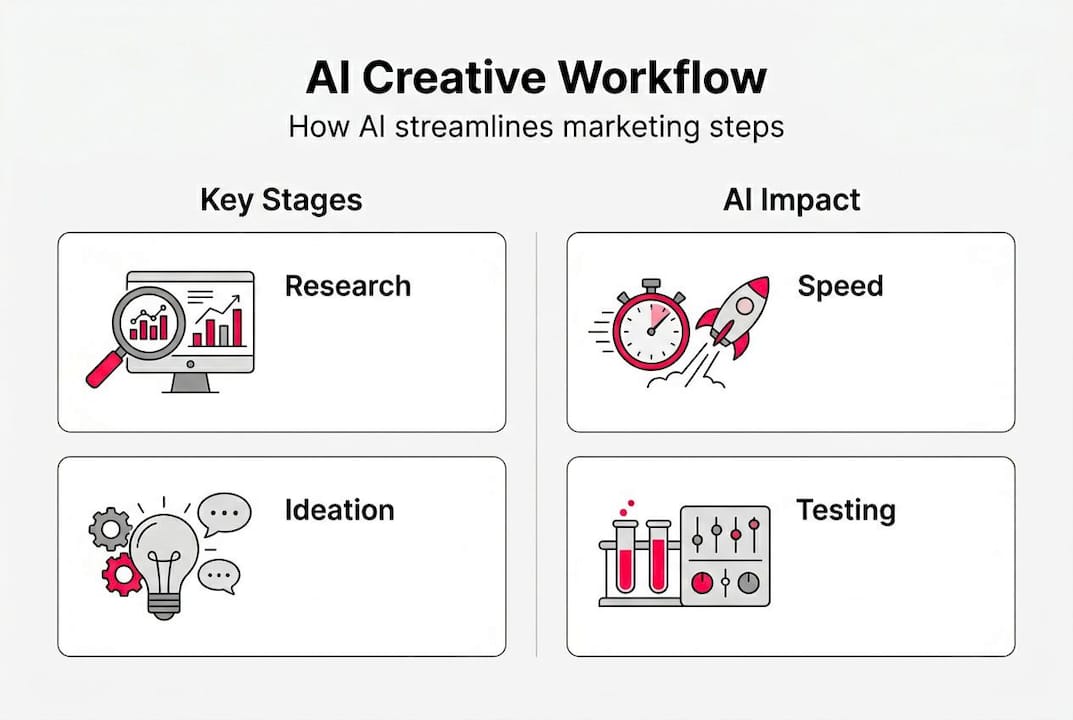
Start with your tech stack. You need a reliable AI-powered creative platform that can handle generation, iteration, and testing in one place. Understanding AI ad creative basics is a solid first step before evaluating tools. Platforms like POPJAM.IO are built specifically for this, offering image, video, and animation generation alongside audience simulation. According to AI ad tools compared, AI-driven tools enable fast variant creation and testing, letting you generate ad variants, resize, animate, and score ads in minutes rather than days.
Next, you need high-quality customer data. Audience definitions built on vague personas produce generic creatives. The more specific your behavioral, psychographic, and purchase data, the better your AI outputs will be. Pair this with a creative automation guide to understand how data flows into creative decisions.
Here’s a quick checklist of what you need before you start:
- A centralized AI creative platform with multi-platform export
- Clean first-party audience data (CRM, pixel, purchase history)
- Defined brand guidelines (voice, colors, visual style)
- A digital asset management (DAM) system for organizing iterations
- Team alignment on creative goals and approval workflows
| Requirement | Why it matters | Common gap |
|---|---|---|
| AI creative platform | Speeds up generation and testing | Teams use disconnected tools |
| Quality audience data | Feeds accurate targeting and personalization | Relying on outdated segments |
| Brand guidelines | Keeps AI outputs on-brand | Guidelines exist but aren’t digitized |
| DAM system | Tracks versions and prevents duplication | Files scattered across drives |
| Team alignment | Reduces revision cycles | Creative and media teams work in silos |
Pro Tip: Before onboarding any AI creative tool, audit your existing asset library. Clean, tagged, well-organized creative assets dramatically improve the quality of AI-generated outputs from day one.
Step-by-step: The modern digital marketing creative process
With the right tools and mindset in place, here’s how to transform your process from start to finish. Traditional creative frameworks, like the 5-stage creative model, still apply, but AI now compresses timelines and adds a feedback layer at every stage.
-
Define measurable creative goals. Use SMART objectives. “Increase ROAS” is not a goal. “Achieve a 3.5x ROAS on Meta prospecting ads within 30 days” is. Clear goals shape every creative decision downstream.
-
Research and segment your audience. Use AI tools to build psychographic profiles, not just demographic buckets. Platforms like POPJAM.IO let you create synthetic personas that simulate how different audience segments will respond to specific creative angles before you spend a dollar.
-
Rapid ideation with AI prompts. Feed your audience insights and brand guidelines into your AI platform and generate multiple creative directions at once. Instead of one concept per brainstorm session, you can produce 10 to 20 variants in the same time.
-
Design with automated templates and UGC formats. Select the strongest concepts and let AI build out platform-native formats: static images for Meta, vertical video for TikTok, display banners for Google. The AI creative ROI benefits are significant when you eliminate manual resizing entirely.
-
Deploy and test across channels. Launch your top variants simultaneously. Don’t wait for one platform to finish before starting another.
-
Analyze and optimize with AI feedback. Use predictive scoring and real campaign data together. Data-backed creatives consistently outperform gut-feel decisions when you build a feedback loop into your workflow.
| Stage | Traditional timeline | AI-assisted timeline |
|---|---|---|
| Audience research | 1 to 2 weeks | 1 to 2 days |
| Ideation and concepting | 3 to 5 days | 2 to 4 hours |
| Design and production | 1 to 2 weeks | 1 to 3 days |
| Testing and optimization | Ongoing, slow | Real-time, automated |
Pro Tip: Treat every creative launch as a learning event. Build your brief to include a hypothesis (“We believe this hook will outperform because…”) so your team captures strategic insights, not just performance numbers.
Optimizing and testing ad creatives at scale
Once creatives are launched, ongoing testing and improvement are the keys to bigger results. This is where most teams leave performance on the table. They launch, check results once, and move on. That’s a costly habit.
AI creative tools can generate and score variants for testing in minutes, including resizing and localization, driving faster campaign improvements than any manual workflow allows. Here’s how to build a real testing system:
- Run A/B/n tests, not just A/B. Test three to five variants simultaneously. More data points mean faster, cleaner conclusions.
- Isolate one variable per test. Change the hook, the visual, or the CTA. Not all three at once.
- Use predictive scoring before launch. AI scoring tools flag low-potential creatives before they waste budget.
- Set a minimum data threshold. Don’t call a winner before you have statistical significance. Most platforms need at least 1,000 impressions per variant.
- Rotate winning creatives on a schedule. Even top performers experience ad fatigue. Performance marketing best practices recommend refreshing creatives every two to four weeks in high-frequency campaigns.
Stat to know: AI-powered creative platforms can reduce the time to produce and test ad variants by up to 80%, giving performance marketers a significant speed advantage in competitive auctions.
Once you identify a high-performing variant, use AI to generate derivative versions: different color schemes, alternate headlines, new background images. You’re not starting over. You’re scaling what works. Tools like POPJAM.IO’s ad testing tool make this iteration loop fast and systematic. Combine that with data-driven ad testing principles and you have a repeatable engine for creative performance.

Pro Tip: Tag every creative with metadata (audience segment, platform, format, hook type) before launch. This makes post-campaign analysis much faster and reveals patterns across campaigns, not just within them.
Avoiding common pitfalls and maximizing creative impact
Even with powerful tools, success depends on avoiding the most common mistakes. The biggest one is treating AI as a replacement for strategy rather than an accelerant.
“Focusing on goal alignment, quality data, and continuous optimization avoids wasted effort and boosts campaign outcomes.”
Here are the pitfalls that consistently hurt AI-driven creative programs:
- Over-relying on automation without human review. AI generates at scale, but humans catch off-brand tone, cultural missteps, and messaging that technically scores well but feels wrong. Always have a human in the loop before final approval.
- Skipping audience definition. Vague targeting produces vague creatives. If your audience segment is “women aged 25 to 45,” your AI outputs will be equally generic. Go deeper with psychographic and behavioral data.
- Ignoring test data over time. Many teams run tests but never build a knowledge base from the results. Create a living document of creative learnings: what hooks work, what visuals underperform, what CTAs drive action for each audience.
- Launching too many variants without a clear hypothesis. More variants is not always better. Without a testing hypothesis, you collect data but gain no insight.
- Neglecting creative refresh cycles. Ad fatigue is real and fast. Audiences on Meta and TikTok can burn through a creative in under two weeks at high frequency.
The fix for most of these issues comes down to process discipline. Use data-backed creative tips to build structured review checkpoints into your workflow. AI handles the volume. Your team handles the judgment calls.
Our perspective: Why a hybrid human-AI creative process wins
Here’s what the tool comparison articles won’t tell you: the biggest performance gains don’t come from switching to AI. They come from changing how your team thinks about creative development.
Most marketers adopt AI tools and immediately try to replicate their old workflow faster. That’s the wrong move. AI doesn’t just speed up the old process. It makes entirely new workflows possible, like testing 15 audience-specific hooks before launch or running synthetic persona simulations to predict creative resonance. The deep dive on creative automation shows just how different this new model can look.
The marketers winning right now are the ones who use AI for volume and speed, then apply human judgment to strategy, brand voice, and emotional resonance. AI can tell you which headline scored highest. It can’t tell you whether that headline reflects your brand’s long-term positioning. That’s still a human call.
The real performance leap happens when machine feedback and human creativity reinforce each other in a tight loop. Test fast, learn fast, apply human insight to the learning, and repeat. That’s the hybrid model that consistently outperforms both pure automation and pure manual creative work.
Accelerate your creative process with POPJAM.IO AI tools
Ready to put these steps into action? POPJAM.IO gives performance marketers, agencies, and e-commerce teams everything they need to move from brief to live ad in a fraction of the time.
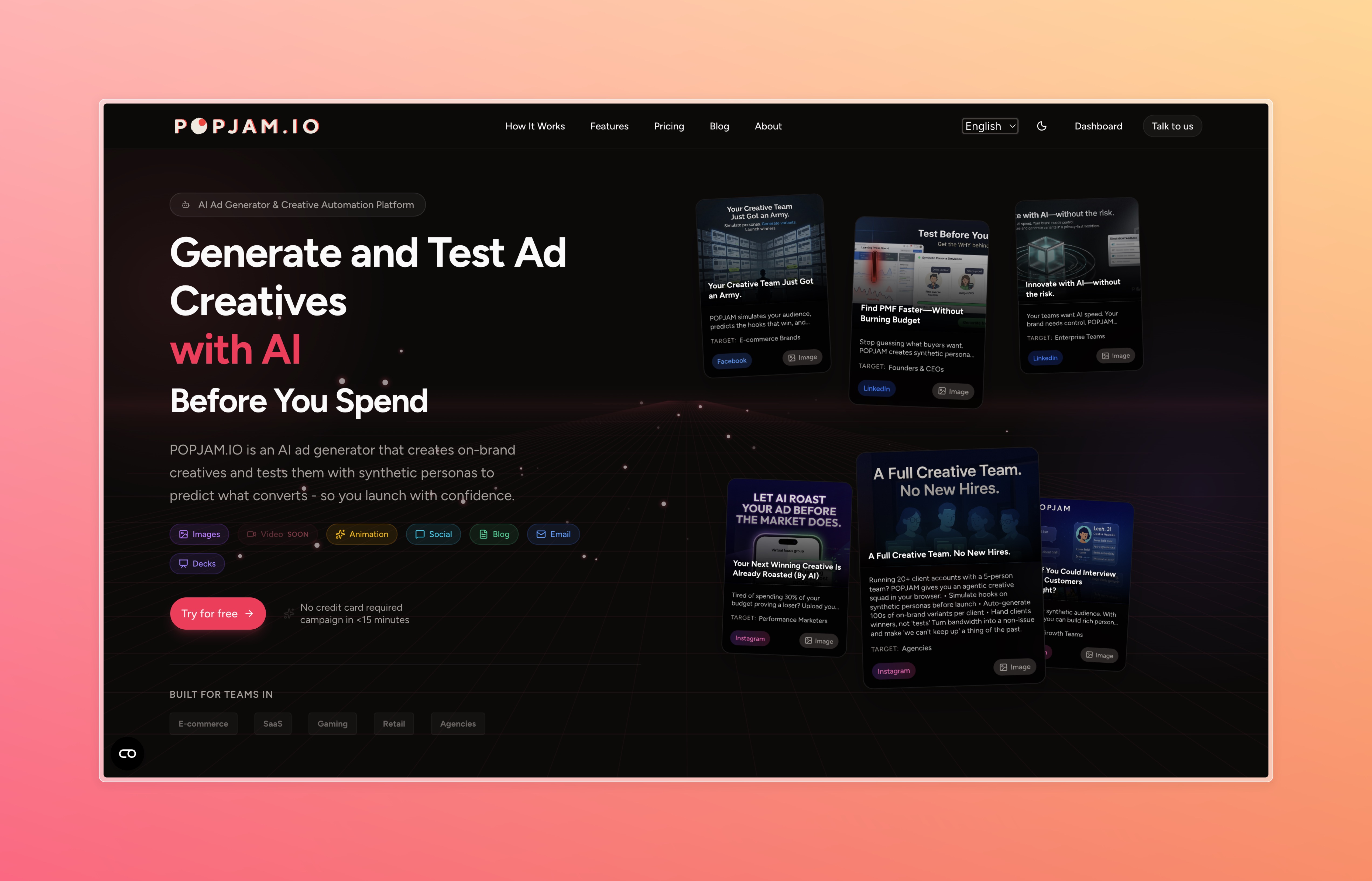
With POPJAM.IO’s AI ad generator, you can produce platform-native creatives for Meta, TikTok, Google, and more in minutes. The built-in ad testing tool lets you simulate audience reactions before you spend a dollar, and the creative automation suite handles resizing, variant generation, and performance scoring automatically. Whether you’re scaling a DTC brand or managing creative for multiple clients, POPJAM.IO removes the bottlenecks that slow campaigns down and replaces guesswork with data-backed decisions.
Frequently asked questions
What steps are included in the digital marketing creative process?
The process typically covers goal setting, audience research, ideation, design, execution, and optimization. Creative marketing frameworks like the 5-stage and 6-step models structure these phases to keep teams aligned and efficient.
How do AI tools improve creative development?
AI tools generate and test variants automatically, handle resizing across formats, and predict performance before campaigns go live, cutting production time dramatically compared to manual methods.
Which platforms offer robust AI creative solutions?
Leading platforms include POPJAM.IO, AdCreative.ai, BuyRadar AI, and The Brief. Tools like AdCreative.ai and BuyRadar AI are known for producing ads significantly faster than traditional workflows.
What’s the biggest mistake to avoid with AI creative workflows?
Don’t rely solely on automation. Combine AI speed with human review to catch off-brand outputs and maintain strategic alignment. Goal alignment and quality data are what separate high-performing programs from wasted spend.