

Ad Creative Bank: The 2026 Guide for Marketing Teams
An ad creative bank is a centralized digital repository where marketing teams store, organize, and draw inspiration from advertising creatives to accelerate campaign development. The industry term for this practice is “creative asset management,” and an ad creative bank serves as its operational core. Whether you’re running paid social for an e-commerce brand or managing a portfolio of SaaS clients, a well-built advertising creative repository cuts ideation time, reduces creative fatigue, and gives your team a repeatable system for producing ads that actually convert. Marketing teams report up to 50% reduction in ideation time when using centralized ad libraries as persistent swipe files. That number alone should make you rethink how you’re storing your creative assets right now.
What makes an ad creative bank effective?
An effective ad creative bank does more than collect screenshots. It organizes every entry around three mandatory data points: hook mechanic, proof device, and CTA structure. These three elements are what separate a useful creative assets library from a folder full of pretty images nobody ever opens again.

The hook mechanic describes how the ad opens and grabs attention. Common high-performing hooks include the “named fee attack” (calling out a specific competitor practice or industry pain point by name) and the “speed claim” (promising a result in a defined timeframe). The proof device is the evidence that makes the claim believable. Ads with specific dollar amounts outperform generic messaging in financial and e-commerce sectors. Specificity is the proof device doing its job. The CTA structure tells the viewer exactly what to do next and why now.
Here’s what a well-tagged entry in your creative content database looks like in practice:
- Hook mechanic: Speed claim (“Get approved in 60 seconds”)
- Proof device: Numeric specificity (“$0 fees for the first 12 months”)
- CTA structure: Urgency + benefit (“Start free today, no credit card required”)
- Platform tag: Meta Feed
- Campaign objective: Acquisition
- Audience segment: First-time buyers, 25–34
Pro Tip: Never save an ad to your bank without filling in all three data points. A creative with no hook analysis is just decoration.
Structured tagging and taxonomy are what make your bank searchable and reusable. Without them, you’re building a maze, not a library.
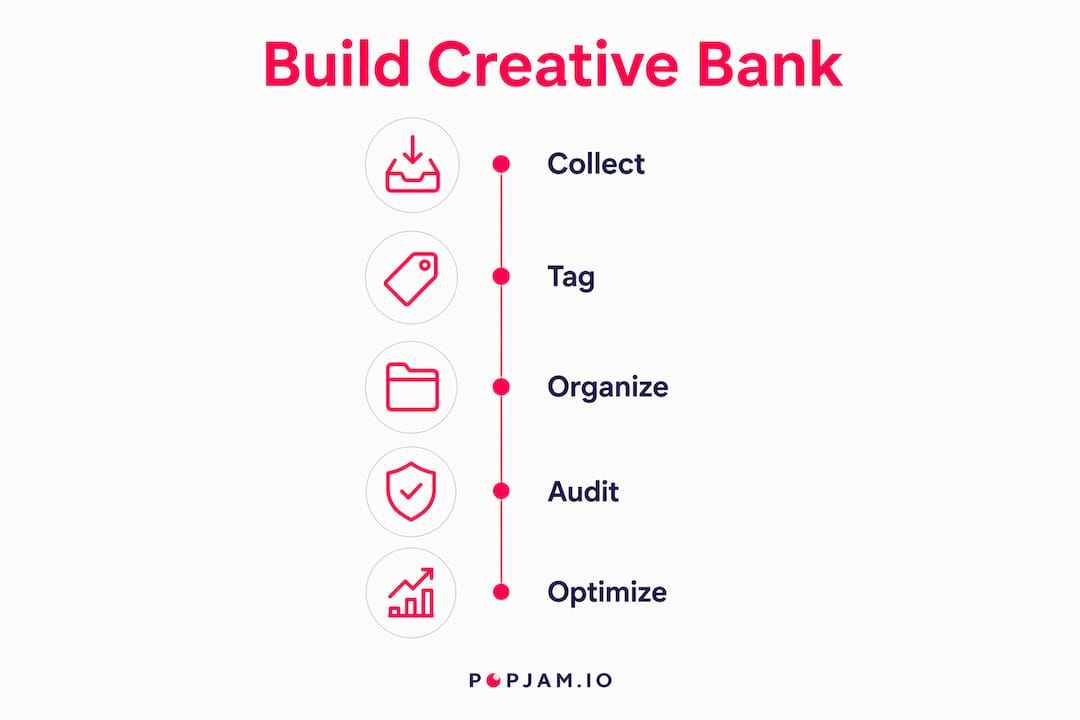
How to build an internal creative asset management system
Building a marketing asset vault that your team actually uses requires more than good intentions. It requires a system. The difference between a bank that gets used daily and one that collects digital dust comes down to structure, access, and integration.
-
Choose a centralized storage platform. Your creative assets library needs to live in one place, accessible to every team member. Cloud-based digital asset management tools work well here. The key is that everyone pulls from the same source.
-
Define your taxonomy before you upload anything. Tag every asset by platform (Meta, TikTok, Google Display), campaign objective (awareness, acquisition, retargeting), and audience segment (persona name or demographic bracket). Teams that treat creative banks as static folders lose 30–50% of potential efficiency due to version confusion. A taxonomy defined upfront prevents that loss entirely.
-
Implement version control. Every ad iteration needs a version number and a performance note. “V3, highest CTR in Q1 test” tells your team far more than “final_final_v2_USE THIS.”
-
Automate tagging where possible. AI tools can read creative files and suggest tags based on visual and copy patterns. This cuts the manual work of maintaining a large branding resource bank.
-
Integrate with your campaign launch workflow. Your bank should connect directly to the platforms where you publish ads. When a creative is approved, it should move from the bank to the campaign without manual re-uploading.
Pro Tip: Run a quarterly audit of your creative bank. Archive anything older than 18 months that has no performance data attached. Dead weight slows down searches and confuses new team members.
The goal is a living system, not an archive. Your creative automation workflow should feel like turning on a light, not digging through a filing cabinet.
How does AI improve ad creative banks for inspiration and optimization?
AI changes what a creative bank can do. Without AI, a bank is a reference library. With AI, it becomes a pattern recognition engine that tells you why certain ads work, not just that they worked.
AI-driven analysis helps marketers identify winning hooks and diversify creative angles to reduce fatigue. The practical result is that your team stops guessing which hook to try next and starts testing variations that AI has flagged as structurally similar to past winners.
“Marketers who save visuals without strategic hooks lose potential effectiveness. The bank should be built around pattern identification, not aesthetic inspiration. Every entry needs a deconstructed structure, not just a screenshot.”
Creative strategy principle from ad performance research
Here’s how AI-powered analysis maps to real outcomes in a creative bank:
| AI Function | What It Does | Outcome for Your Team |
|---|---|---|
| Hook pattern recognition | Identifies recurring hook mechanics in top performers | Faster brief writing |
| Proof device scoring | Flags ads with specific numeric claims vs. vague ones | Higher recall and trust |
| Creative fatigue detection | Alerts when an ad type is overused in your bank | Prevents audience burnout |
| Variation generation | Suggests new angles based on existing winning structures | More testable concepts |
| Audience alignment | Matches creative patterns to psychographic profiles | Better targeting precision |
Financial ads with specific numeric claims have 31% higher recall than generic messaging according to Nielsen (2025). AI surfaces those specifics automatically, so your team doesn’t have to manually audit every entry for proof device strength.
Creative fatigue is a major silent factor in ad decline. Well-maintained creative banks enable teams to test diverse approaches before committing budget. AI makes that testing systematic rather than reactive. The role of AI in ad creative generation has matured to the point where it can simulate audience reactions before a single dollar is spent on media.
What strategies help teams get the most from a creative bank?
A creative bank only pays off when it’s embedded in your daily workflow. The teams that get the most from their advertising creative repository treat it as a living document, not a one-time project.
- Use your bank as the first stop in every creative brief. Before writing a single line of copy, pull five to ten examples from your bank that match the campaign objective and audience. Pattern recognition starts here.
- Update your bank after every campaign. Add new creatives with full tagging and performance notes within 48 hours of a campaign ending. Recency matters because what worked last quarter may not work next quarter.
- Curate contrarian examples deliberately. Ads that challenge category norms overcome consumer skepticism more effectively than generic trust messaging. Keep a dedicated section in your bank for ads that open with a negative assumption and pivot to a promise. These are often the most powerful ad campaign inspirations you’ll find.
- Share your bank across teams. Designers, copywriters, media buyers, and strategists should all have access. A siloed bank is a broken bank.
- Track ideation time as a KPI. If your bank is working, your team should spend less time staring at blank briefs. Measure the time from brief kickoff to first creative concept and watch it shrink.
The brands that win in paid media aren’t necessarily the ones with the biggest budgets. They’re the ones with the best systems. An AI-powered creative suite paired with a well-maintained bank gives smaller teams the same structural advantage that large agencies have built over decades. Agencies specifically benefit from this, as AI for agencies has been shown to deliver measurable productivity gains and stronger campaign ROI.
Key Takeaways
A well-structured ad creative bank, built around hook mechanics, proof devices, and AI-driven pattern analysis, is the single most reliable system for reducing ideation time and improving campaign performance.
| Point | Details |
|---|---|
| Three mandatory data points | Tag every entry with hook mechanic, proof device, and CTA structure for reusable analysis. |
| Taxonomy prevents efficiency loss | Teams without structured tagging lose 30–50% of creative reuse efficiency to version confusion. |
| AI turns banks into pattern engines | AI identifies winning hook structures and flags creative fatigue before it costs you budget. |
| Contrarian ads belong in your bank | Ads that challenge category assumptions outperform generic trust messaging in engagement. |
| Measure ideation time | Track time from brief to first concept as a direct KPI for your creative bank’s effectiveness. |
Why most creative banks fail before they start
Here’s my honest take after watching dozens of marketing teams build creative banks: the problem is almost never the tool. It’s the mindset going in.
Most teams build their bank like a mood board. They save ads that look good. They screenshot things that feel inspiring. And then six months later, the bank is full of beautiful images with zero strategic context, and nobody uses it because nobody can find what they need. That’s not a creative bank. That’s a Pinterest board with a fancier name.
The shift that actually changes outcomes is treating every entry as a case study, not a sample. When I see a high-performing ad, I want to know the hook mechanic, the proof device, the CTA structure, and ideally the audience it ran against. Without that context, the creative is just decoration.
The other pitfall I see constantly is building the bank once and walking away. Creative banks go stale fast. Consumer behavior shifts, platform algorithms change, and what worked in Q1 may actively hurt you in Q3. The teams that win treat their bank like a product, with regular updates, audits, and a clear owner responsible for its health.
The future of creative asset management is AI-assisted and continuously updated. Deconstructing ads into hook, proof, and CTA components is the foundation. AI is the multiplier. And the teams that combine both will outpace everyone still posting and praying.
— Doruk
POPJAM makes your creative bank work harder
Building a creative bank is one thing. Testing what’s in it before you spend real budget is another. POPJAM’s AI ad generator lets you generate on-brand ad creatives and run them against Synthetic Personas before a single dollar goes to media. You get psychographic feedback on hook mechanics, proof devices, and CTA structures, exactly the data points your bank needs to stay useful.
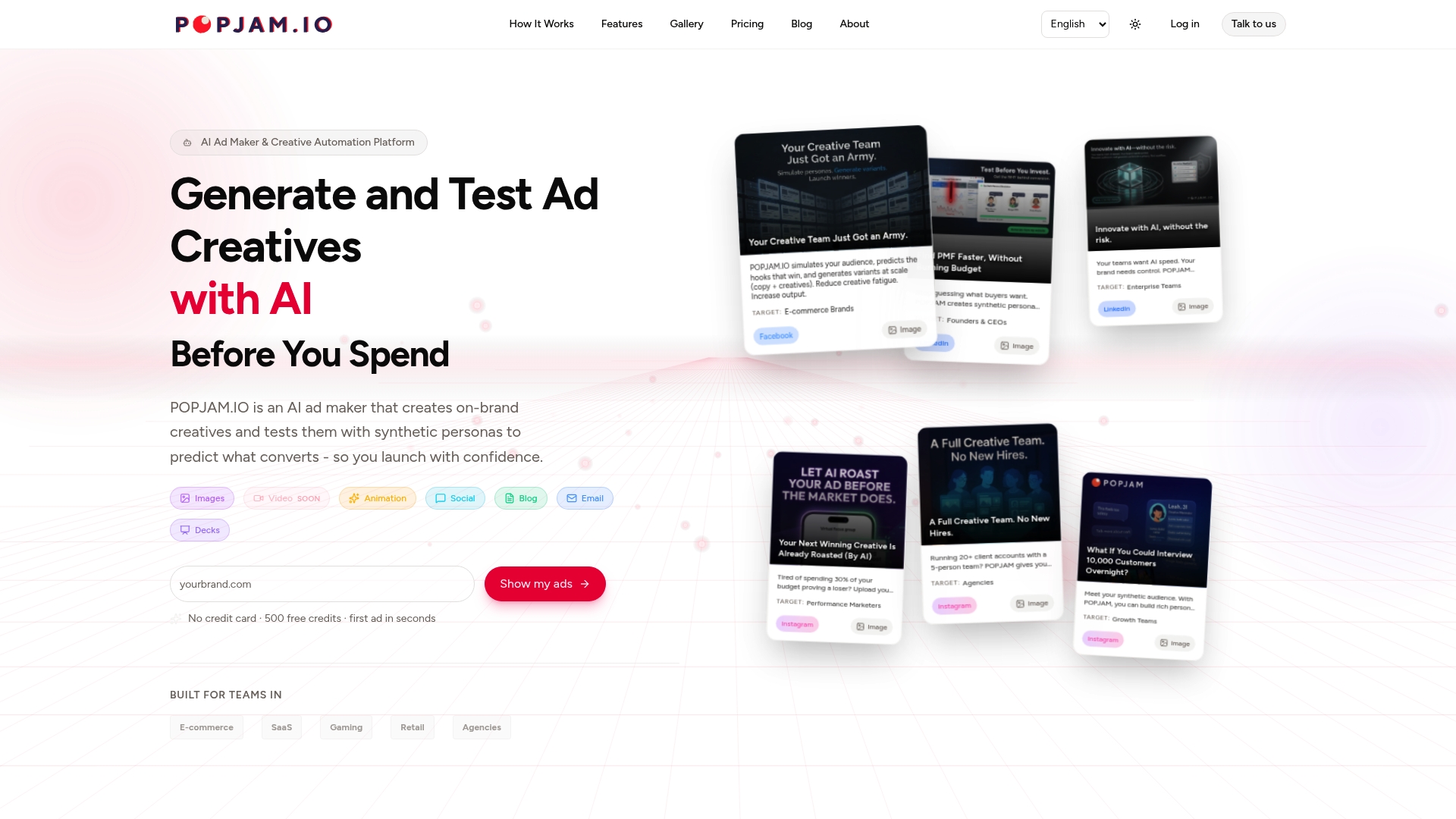
For agencies managing multiple clients, POPJAM’s agency ad testing platform integrates directly with creative workflows so your bank feeds into live campaigns without manual re-uploading. The result is a tighter loop between inspiration, generation, testing, and launch. If you’re serious about making your creative assets work, POPJAM is worth a look.
FAQ
What is an ad creative bank?
An ad creative bank is a centralized digital repository where marketing teams store, tag, and organize advertising creatives for inspiration and reuse. It functions as both a swipe file and an internal asset management system.
How does an ad creative bank reduce ideation time?
Centralized ad libraries used as persistent swipe files reduce ideation time by up to 50% for marketing teams. Quick access to tagged, analyzed examples means less time starting from scratch on every brief.
What data should every ad creative bank entry include?
Every entry should include the hook mechanic, proof device, and CTA structure, plus platform, campaign objective, and audience segment tags. Without these data points, the entry has limited strategic value.
How does AI improve a creative bank?
AI identifies winning hook patterns, scores proof device specificity, detects creative fatigue, and suggests testable variations based on past performance. It turns a static reference library into an active pattern recognition system.
How often should a creative bank be updated?
Add new creatives with full tagging and performance notes within 48 hours of each campaign ending. Run a full audit quarterly to archive outdated entries and keep the bank searchable and current.