

Qualitative Ad Feedback: PACT and AI Catch Flaws Prelaunch
See how qualitative ad feedback combines PACT copy testing and AI simulations to catch confusing messages and weak claims before media spend.

Qualitative ad feedback is the descriptive, in-their-own-words reaction people give to an ad: what they noticed, what confused them, what felt off-brand, what made them trust or distrust the pitch. We use it to explain why an ad performs the way it does, not just that it does, and to decide what to fix before the next round of spend. The real question isn’t whether to collect it, it’s which method fits your timeline this week.
TL;DR:
- Use surveys with open prompts or asynchronous video for fast reactions; reserve interviews or focus groups for questions needing deeper explanation.
- Screen respondents for recent category purchases and behavior rather than panel experience, and recruit from customer lists when relevant feedback matters more than reach.
- Test ads in cluttered feeds with repeated exposure, since effects may emerge after two or three viewings; isolated single viewings can mislead.
- Translate themes into hypotheses tied to a KPI, then test one change; qualitative evidence can support inexpensive fixes, but validate major budget shifts quantitatively.
- Use AI to cluster responses faster, but have a human check each theme against actual comments before treating it as a basis for decisions.
Table of Contents
- What Qualifies as Qualitative Ad Feedback
- Why Qualitative Ad Feedback Matters for Creative Decisions
- Practical Methods to Collect Qualitative Ad Feedback and When to Use Each
- Recruiting and Screening for Honest, Relevant Ad Feedback
- How to Analyze Qualitative Ad Feedback
- Triangulating Qualitative Findings With Quantitative Ad Data
- Scaling Prelaunch Feedback With Synthetic Personas
- Three Non-Negotiables for Your Next Ad Feedback Study
- Get Qualitative Feedback Before You Spend a Dollar on Media
- FAQ
- Sources
What Qualifies as Qualitative Ad Feedback
Qualitative ad feedback is any verbal or written reaction that describes how a person experienced an ad rather than how many people clicked it. For advertising specifically, that means comments on messaging clarity, visual focus, tone, pacing, and believability, the stuff a click-through rate can’t explain on its own.
Picture a respondent looking at a new product video and saying: “I thought this was for teenagers until the price flashed on screen,” or “the voiceover felt rushed, so I didn’t catch what the discount actually was.” Those are usable, specific, diagnostic statements. Compare that to a thumbs-up rating or a 7-out-of-10 appeal score: useful for ranking creatives, useless for knowing what to change.
A few patterns show up again and again in strong qualitative feedback:
- Comprehension gaps, where the viewer describes the ad’s message differently than the brief intended.
- Emotional mismatches, where the tone reads as pushy, cold, or inauthentic to the audience.
- Visual confusion, where attention lands on the wrong element, like a background prop instead of the product.
- Credibility flags, where claims feel exaggerated or the testimonial seems staged.
Quantitative signals, by contrast, tell you an ad underperformed; they rarely tell you which scene, line, or visual choice caused it. That gap is exactly where descriptive feedback earns its keep, and it’s why most serious ad feedback analysis workflows pair the two rather than picking one.
Why Qualitative Ad Feedback Matters for Creative Decisions
Numbers tell you what happened. Words tell you why. A dip in click-through rate could mean the hook was weak, the thumbnail misled people, or the offer felt irrelevant, and only descriptive feedback separates those explanations. When a creative underperforms, qualitative input points you toward the lever worth pulling instead of a round of blind variations.
Three moments in a campaign’s life call for it specifically:
Prelaunch screening catches message confusion, tone mismatches, and credibility problems before a single dollar goes to media. Mid-campaign troubleshooting explains a sudden drop in engagement that your dashboard can flag but never diagnose. Post-campaign learning turns a finished flight into a reusable playbook: which hooks landed, which visuals got skipped, which claims felt believable.
The payoff compounds. Teams that build qualitative checkpoints into their process tend to iterate faster, because they’re not reshooting an ad from scratch, they’re fixing the one scene or line that caused the confusion. That precision also cuts spend waste: instead of testing five full variations to find a winner, you test one informed revision based on what people actually said. And it clarifies prioritization, since a strong theme mentioned by multiple respondents outranks a single opinion from a stakeholder meeting.
None of this replaces performance metrics. A click-through rate still tells you an ad is winning. Qualitative feedback tells you whether it’s winning for the reason you intended, which matters when you’re deciding what to scale next.

Practical Methods to Collect Qualitative Ad Feedback and When to Use Each
Different methods answer different questions, and timeline usually decides which one fits.
Open-ended surveys scale well when you need verbatim reactions from a large group quickly. A single prompt like “describe what you think this ad is trying to tell you” generates hundreds of usable responses within a day or two, though the depth per response is shallower than an interview.
One-on-one interviews dig into the “why” behind a reaction. They’re slower and more expensive per respondent, but they’re the right tool when a survey theme needs unpacking, like understanding exactly which word in a headline triggered distrust.
Focus groups surface group sense-making, how people’s opinions shift when they hear others react. They’re useful for exploring brand perception broadly, but group dynamics can suppress honest dissent, so we treat focus group findings as directional rather than conclusive.
Usability walkthroughs and think-alouds work well for video ads and landing page flows, where you want to know exactly where attention drops or confusion starts, moment by moment.
In-context feed simulation and multiple-exposure tests matter because real audiences rarely see an ad once in a clean, distraction-free environment. The Pechmann and Andrews copy-testing review notes that ad effects often emerge only after two or three exposures, so tests embedded in clutter and repeated exposures tend to produce more realistic feedback than a single, isolated viewing.
Remote asynchronous options, like video diaries or user-generated reaction clips, give you natural, unscripted language without scheduling a live session, which is handy for distributed teams working across time zones.
- Match the method to your timeline: surveys and asynchronous video for speed, interviews and focus groups when you have days, not hours.
- Never rely on a single method for a high-stakes launch decision; combine at least two.
Pro Tip: Run a quick open-ended survey first to spot themes, then follow up with two or three interviews to understand the strongest one.
Recruiting and Screening for Honest, Relevant Ad Feedback
The biggest threat to usable qualitative feedback isn’t the question you ask, it’s who you ask. Frequent survey takers and professional panel respondents tend to give polished, generic answers because they’ve seen dozens of similar prompts before. Research on respondent quality warns against this exact bias and recommends screening for category relevance and recent behavior instead of how often someone participates in panels.
A tight screener matters more than a big sample. Useful screener questions include:
- How often have you purchased or used a product in this category in the last three months?
- Can you describe the last ad you remember seeing for a similar product?
- Have you participated in more than five paid research studies in the past month?
For most ad concept tests, a modest number of well-screened respondents per segment is usually enough to reach thematic saturation, the point where new interviews stop surfacing new ideas. If themes still feel unclear at that point, expand by segment rather than by raw count.
Proprietary audience lists (your own customers or newsletter subscribers) tend to give more category-relevant, candid feedback than general panels, though panels offer faster turnaround and broader reach. Whichever you choose, get clear consent for how responses will be used, and keep any personally identifiable information out of shared reports.
How to Analyze Qualitative Ad Feedback
Analysis starts before you read a single response: define what you’re trying to learn, tied directly to the creative brief. “Does the headline communicate the core benefit?” is a workable analytic objective. “What do people think of the ad?” is not, because it won’t tell you what to change.
From there, a stepwise coding workflow keeps analysis consistent across reviewers:
- Open coding: read through responses and label recurring ideas in your own words, without forcing them into predefined categories yet.
- Axial coding: group those labels into broader categories, like “message clarity” or “visual focus.”
- Theme synthesis: name the two or three dominant themes that explain most of the feedback, and note how often each appears.
A tagging scheme built around creative elements, headline, hero visual, credibility signals, and call-to-action clarity, makes it far easier to turn themes into fixes. The Handbook of Qualitative Research Methods in Marketing recommends exactly this kind of diagnostic-category coding, paired with a clear link from each code to a testable creative change.
AI-assisted clustering and summarization can speed up the first pass, grouping similar verbatims and surfacing candidate themes in minutes instead of hours. The same handbook is clear that these tools work best as assistants, not replacements: a human reviewer should confirm each cluster against actual exemplar quotes before it becomes a decision.
Two quality checks keep the process honest. First, when more than one person is coding, check inter-coder agreement, do two reviewers tag the same response the same way often enough to trust the scheme. Second, link every theme back to a KPI it plausibly affects, so “credibility concerns” connects to conversion rate, not just to a vague sense that the ad “felt off.”
Pro Tip: Keep three to five exemplar quotes per theme in your final report. Stakeholders remember a vivid verbatim far longer than a percentage.
Triangulating Qualitative Findings With Quantitative Ad Data
Qualitative themes become powerful when you connect them to a measurable outcome. If several respondents said a headline felt “confusing,” that’s a hypothesis: message clarity is hurting click-through rate. If multiple people called an offer “generic,” that maps to a hypothesis about conversion rate at the landing page.
A practical workflow looks like this:
- Translate each major theme into a specific, testable hypothesis.
- Design a small follow-up test, often a simple A/B swap of the element in question, to check whether fixing it moves the metric it’s tied to.
- Treat qualitative evidence alone as sufficient when the fix is low-risk and low-cost, like rewording a confusing line, but validate with a quick quantitative check before a major budget shift.
- Scale the winning version once the small test confirms the qualitative read; iterate again if it doesn’t.
This loop, feedback, hypothesis, small test, scale or iterate, keeps teams from overreacting to a single opinion while still acting fast on strong, repeated themes. For a deeper look at this pairing, our piece on quantitative ad testing walks through how a structured prelaunch test can confirm what the qualitative round only hinted at, and our guide to ad concept testing covers how to structure the earliest round of this loop before creative production even starts.
Scaling Prelaunch Feedback With Synthetic Personas
Live qualitative research is precise but slow to scale. Running ten interviews for every new ad variation isn’t realistic for most teams shipping weekly creative. That’s where synthetic personas, AI-built psychographic profiles trained to simulate how a specific audience segment reacts, extend what a small qualitative study can cover.
The MADE framework found that AI-generated ad stimuli can match professionally produced ads on quality and realism when proper validation checks are applied, which is the same bar synthetic-persona feedback needs to clear to be useful: manipulation checks, ecological validity, and transparency about what’s AI-generated versus human-sourced.
A practical prelaunch workflow combines both: run a creative through synthetic-persona simulation first to catch obvious messaging or tone problems fast, then confirm the strongest signals with a small round of live interviews or an open-ended survey before committing media spend.
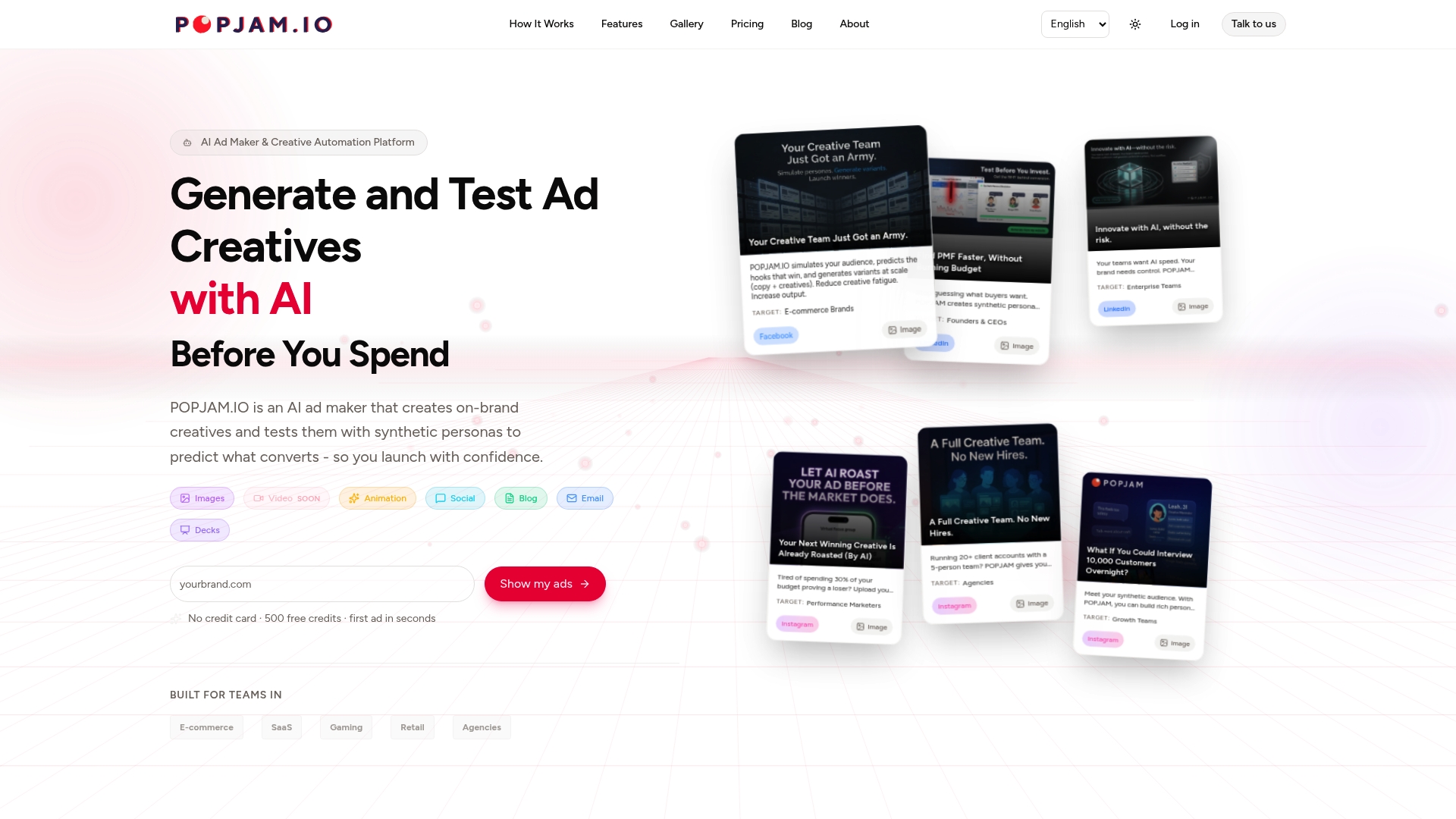
This is the gap we built POPJAM.IO to close. Our platform generates on-brand ad creatives and tests them against synthetic buyer personas before launch, simulating audience reactions across psychographic segments so teams get descriptive, theme-rich feedback in hours instead of weeks. We feed those synthetic reactions directly into moderator guides and open-ended survey prompts for the live round that follows, so the qualitative study starts with sharper questions instead of a blank page. For teams exploring privacy-conscious simulation specifically, our breakdown of privacy-safe audience modeling covers how that pretest process holds up under real data protection requirements.

Three Non-Negotiables for Your Next Ad Feedback Study
Running a lot of these studies teaches you where corners actually cost you. Three things I never skip, no matter how tight the timeline:
Objective alignment: know exactly which creative decision the feedback needs to inform before you write a single question. Right sample: screen for category relevance over panel tenure, every time. Exposure realism: never judge an ad in a sterile viewing environment if it will actually run in a cluttered feed.
Here’s the runbook I hand to anyone running a fast qualitative ad test:
- Write one analytic objective tied to the creative brief.
- Screen respondents for recent category behavior, not survey experience.
- Expose the ad in a realistic context, ideally with at least two exposures.
- Code open coding to themes within 24 hours of collection, while context is fresh.
- Link each theme to a KPI and a proposed fix before sharing results.
— Doruk
Get Qualitative Feedback Before You Spend a Dollar on Media
We built this platform so creative teams don’t have to choose between speed and depth. Generate on-brand ad variations, run them against synthetic buyer personas, and read descriptive, theme-level feedback on messaging, tone, and visual focus before any media budget goes out the door. It’s the same triangulation workflow this guide walks through, just compressed from weeks into hours.
Plans start with a free tier and scale through multiple pricing levels, with credit packs available for teams that need extra generation volume. See what fits your workflow on the AI ad generator page.
FAQ
What is an example of qualitative feedback?
A respondent saying “the voiceover felt rushed so I couldn’t tell what the discount was” is qualitative feedback: it describes a specific reaction rather than a score. Open-ended survey responses, interview transcripts, and think-aloud comments during a video walkthrough all count as examples.
What’s the difference between qualitative and quantitative feedback?
Qualitative feedback describes how someone experienced an ad in their own words, while quantitative feedback measures outcomes with numbers like click-through rate or a rating scale. One explains why something happened, the other confirms that it happened.
What are 5 examples of qualitative data?
Common examples include open-ended survey verbatims, interview transcripts, focus group discussion notes, think-aloud comments during a usability walkthrough, and video diaries where respondents react on camera. Each gives descriptive detail that a numeric score can’t capture on its own.
What are qualitative remarks?
Qualitative remarks are descriptive, non-numerical comments people give about an experience, like noting that an ad’s tone “felt pushy” or its message was “hard to follow.” In advertising research, these remarks are typically coded into themes, such as message clarity or credibility, to guide creative changes.
Sources
- Copy test methods and principles (Pechmann & Andrews, 2010) — FTC-hosted paper
- The MADE framework for AI-generated experimental stimuli (UvA repository)
- Study/report on respondent quality and screening (PMC article)
- Handbook of Qualitative Research Methods in Marketing (Edward Elgar, 2024)