

Ad Teams: Privacy Safe Audience Modeling to Pretest Ads in 48–72 Hours
Ad teams can pretest creative with GDPR compliant synthetic personas and get decision ready results in 48–72 hours, cutting wasted ad spend.

Privacy-safe audience modeling is synthetic-persona pre-testing that lets you screen ad variants before any media dollars go out the door. Instead of guessing which headline or CTA will land, you run your creative through AI-built personas grounded in real customer data, and you cut the weak concepts before they ever hit a live campaign. This workflow can incorporate GDPR-compliant testing with a turnaround suitable to fit inside a normal sprint, not a research quarter.
TL;DR:
- Synthetic personas grounded in real customer communications provide more accurate feedback than demographic guesses, improving pre-test reliability.
- Pre-screening ad variants reduces wasted budget by filtering out ineffective headlines and CTAs before live deployment, especially for high-volume creative campaigns.
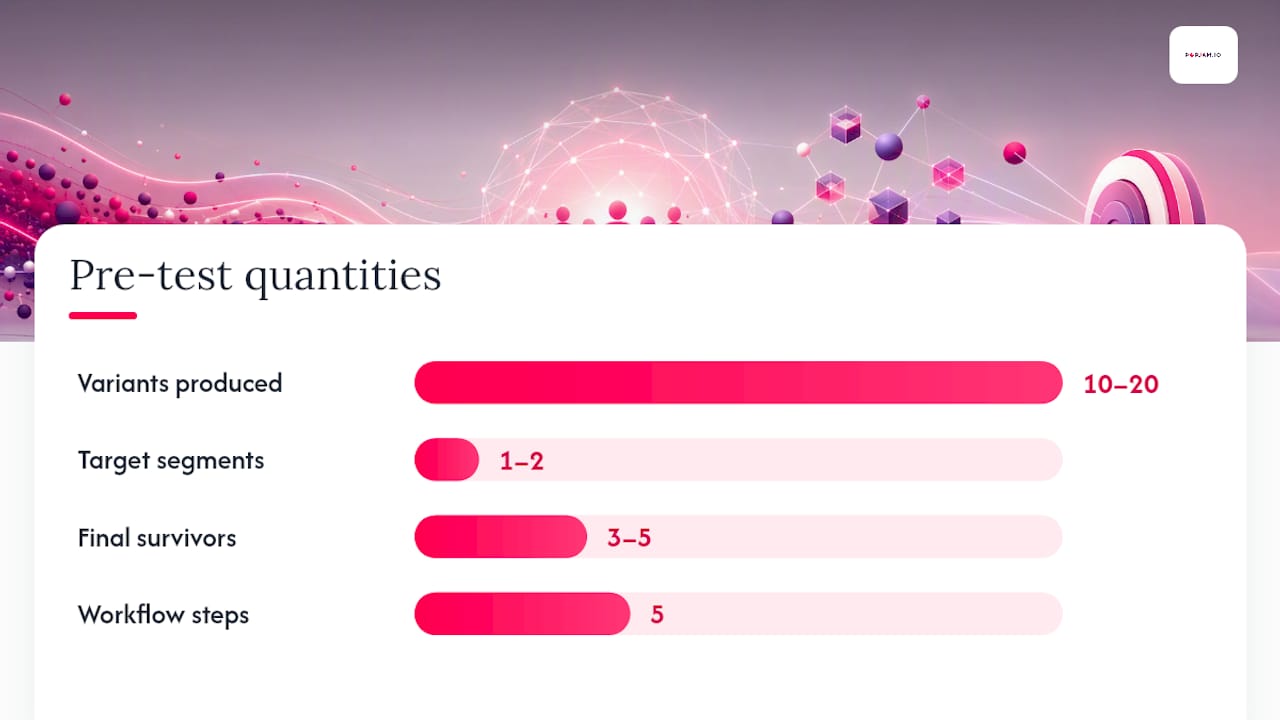
- The process involves generating 10 to 20 variants, building targeted panels, and scoring for clarity and objections within 48 to 72 hours, with top performers advancing.
- Synthetic testing is best for concept selection, messaging clarity, and multi-variant pruning, but cannot assess experiential factors like page load speed or visual impact.
- Grounding sources such as support tickets and open-ended surveys significantly increase predictive validity, making synthetic panels a disciplined pre-screening tool rather than a full predictor.
Table of Contents
- What Is Privacy-Safe Audience Modeling, and Why Does It Matter?
- When Should You Use This in Your Creative Pipeline?
- How Do You Run a Synthetic Pre-Test Step by Step?
- How Do You Design Grounded Panels and Prompts That Actually Work?
- Where Do Synthetic Panels Fall Short?
- What Performance Teams Get Wrong About This
- Test Your Ad Creative Before You Spend a Dollar on Media
- Sources
- FAQ
What Is Privacy-Safe Audience Modeling, and Why Does It Matter?
Synthetic personas are AI models trained to react like a specific customer segment, built from real survey answers, interview transcripts, or support tickets rather than raw personal data. That grounding is what separates a useful synthetic panel from a chatbot guessing at “what a 35-year-old dad might think.” Once you have that panel, you run creative variants past it before spending a dollar on media.

This is where the terminology gets misused. Synthetic pre-screening filters weak concepts. It does not forecast exact conversion rates. Treat the output as a triage tool, not a crystal ball, and you’ll use it correctly.
The evidence backs the triage framing specifically. Teams that run many variants through synthetic panels and keep only the clearest performers end up sending a stronger pool into live A/B tests, which raises the floor on what even gets tested. Done right, this also catches tone and cultural missteps that would otherwise slip through to a live audience, according to Forbes reporting on synthetic persona testing.
What synthetic pre-testing is good for, in practice:
- Killing dead-on-arrival headlines before they burn impressions
- Flagging confusing CTAs before a real audience sees them
- Surfacing tone problems a copywriter might miss on a deadline
- Narrowing 15 variants down to the 3 or 4 worth real budget
When Should You Use This in Your Creative Pipeline?
Privacy-safe audience modeling earns its place at specific moments in the pipeline, not every moment. Here’s where it does real work:
- Concept selection. When you have five creative directions and a limited production budget, synthetic panels tell you which two or three are worth building out fully.
- CTA wording. Small phrasing shifts (“Get Started” versus “See Your Price”) are exactly the kind of language nuance synthetic personas read well.
- Multi-variant pruning. If you’re staring down 20 headline options for one campaign, this is faster than any live test could ever be.
- Messaging clarity checks. Before launch, ask whether the average reader actually understands your value proposition. Synthetic panels answer that fast.
Skip synthetic testing when the question is experiential. Interactive design, page speed, and novelty effects need a live audience to register at all. A synthetic persona can’t tell you whether a slow-loading carousel annoys anyone, because it never waits for anything to load.
The clearest operational trigger is volume: high variant counts, thin live-test budgets, or channels where CPM makes every test impression expensive. That’s exactly where pre-screening pays for itself.
How Do You Run a Synthetic Pre-Test Step by Step?
The workflow below follows a five-step sequence used across the synthetic-audience testing methods which performance teams have converged on, adapted for a privacy-first setup.
- Generate broadly, not narrowly. Produce 10 to 20 variants across headlines, CTAs, and short-form copy. Always include your current control so you have a baseline to beat, not just a pile of new ideas.
- Assemble grounded panels for one or two target segments. Build synthetic personas from real material tied to those segments, not generic demographic guesses. One core segment plus one secondary segment is usually enough.
- Run every variant through the panel. Don’t just ask what people like. Ask what they understood and where they hesitated.
- Score for clarity and objections, then cut hard. Keep the top 3 to 5 survivors. Everything else gets shelved, not deleted. You might reuse the copy angle later.
- Document your grounding sources, your prompts, and the metrics you used to score. This step gets skipped constantly, and it’s the one that makes your next test faster. Then validate the survivors with a short human sample and a real live A/B test.
Pro Tip: Keep a running log of which grounding sources produced the most predictive panels. After three or four campaigns, you’ll know exactly which data (churn surveys, support tickets, interview notes) actually correlates with what wins in live traffic, and you’ll stop wasting time on sources that don’t.
Five steps, one afternoon, zero media spend burned on concepts that were never going to work.
How Do You Design Grounded Panels and Prompts That Actually Work?
The quality of your synthetic panel depends almost entirely on what you ground it in. Vague personas built from demographic assumptions produce vague, unhelpful feedback. Real reader material produces real signal.
Strong grounding sources include:
- Interview transcripts from actual customer calls
- Open-ended survey answers (the free-text box, not the multiple choice)
- Churn reasons pulled from cancellation flows
- Support tickets that reveal actual points of confusion
Grounding synthetic panels in real reader language is the most practical lever a small team has to raise predictive validity, and it doesn’t require any new engineering work. You just need to go dig up the transcripts you already have sitting in a support inbox.
Prompt design matters just as much as the source material. A short persona descriptor plus a direct instruction to respond as a reader, not an analyst, produces far more honest reactions. Explicitly allow indifference as a valid answer. Personas that are only allowed to be enthusiastic will lie to you.
For your question set, stick to three categories: comprehension (“what does this ad mean to you?”), expectation (“what would you expect to happen after you click this?”), and friction (“what would stop you from clicking?”). Comprehension divergence between variants is the strongest predictor of which one will actually perform differently once it’s live, so weight that question heavily.
Pro Tip: Prompt your personas to act like a skeptical, mildly annoyed buyer scrolling past ten other ads, not an eager analyst studying your creative. Enthusiastic personas hide the friction you’re trying to find.
When you’re unsure which segment to run, calibrate against a segment you already understand, like your existing Meta lookalike audiences. If the synthetic panel’s reactions track with what you already know about that group, you can trust its read on a newer, less understood segment. Reviewing how buyer personas get built in the first place is a useful refresher if your segment definitions have gotten stale.
Where Do Synthetic Panels Fall Short?
Synthetic pre-testing has real limits, and pretending otherwise is how teams end up trusting a number they shouldn’t.
- Synthetic scores are directional pre-screens, not conversion forecasts. A variant scoring higher in synthetic testing is a candidate worth testing live, not a guaranteed winner.
- Watch for WEIRD tilt (western, educated, industrialized, rich, democratic), where model training data skews toward a narrower slice of the world than your actual customer base.
- Over-polished, uniformly positive answers are a red flag, not a good sign. Real audiences are messier than that.
- Synthetic personas cannot judge experiential details like load speed, animation feel, or genuine novelty effects. Those require a live audience physically waiting for a page to render.
Every synthetic pre-test needs a human check on the back end: a short live sample for design and experiential questions, then a full live A/B test for the survivors. If your synthetic results and your live results diverge sharply, that’s not a failure. It’s a signal to revisit your grounding material, your prompts, or which candidates you selected in the first place. Practitioner experience across synthetic testing consistently treats this as a pre-screen that makes human testing more efficient, never a replacement for it.
What Performance Teams Get Wrong About This
Most teams treat synthetic persona testing as either magic or nonsense, and both takes miss the actual value. The magic camp expects a clean conversion prediction and gets burned when live results don’t match. The nonsense camp writes off the whole method after one bad grounding attempt and goes back to launching on instinct, which is the more expensive mistake by far.
The real skill here isn’t the AI. It’s the discipline of grounding your panel in something real and asking the right three questions instead of “do you like this?” Teams that get sloppy with grounding get personas that agree with everything, which is worse than no data at all because it feels like confidence.
What I’d push back on is the idea that this replaces judgment. It doesn’t. It replaces the worst kind of guessing, the kind where you launch 15 variants live and let media spend tell you which ones were bad ideas. POPJAM was built around that exact gap: generate on-brand creative, run it against synthetic personas grounded in real behavior, and hand teams a shortlist before a single impression gets bought. The GDPR-compliant testing and the 48-72 hour window aren’t incidental. Speed is the entire point of moving pre-screening earlier in the pipeline.
— Doruk
Test Your Ad Creative Before You Spend a Dollar on Media
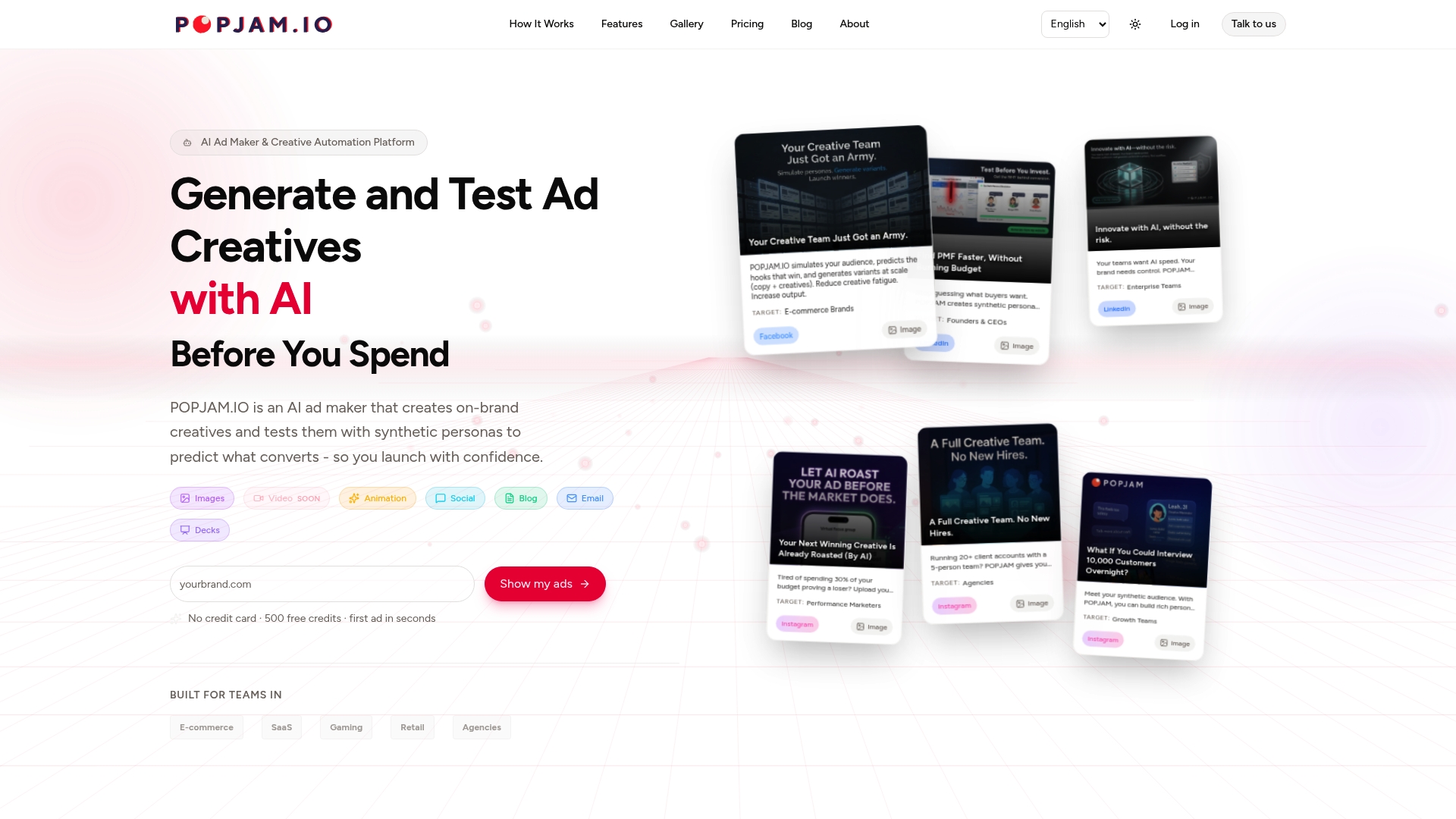
This platform provides a direct route to privacy-safe audience modeling by integrating survey, persona, and prompt tools. Users can generate on-brand creative for Meta, Google, TikTok, LinkedIn, or Reddit, run it against synthetic personas grounded in real behavioral signals, and get a ranked shortlist within a GDPR-compliant workflow.
If you’re running high creative volume through an agency or a growth team, this is the step that used to eat a week and a testing budget. Now it fits into an afternoon. Check the pricing plans, which range from a Free tier up through Starter at 29 € per month, Essential at 99 € per month, and Business at 399 € per month, and see which tier matches how many variants you’re pushing through each month. If you want to see the workflow applied to your exact use case first, the AI ad generator for agencies page walks through it in more detail. Either way, the next step is the same: stop shipping creative on instinct and start screening it before spend.
Sources
- Synthetic Personas Done Right Reduce Creative Risk And Maximize Upside | Forbes
- Synthetic audiences: where they help, where they stop, and how to run one | Audiencers
FAQ
What Is Privacy-Safe Audience Modeling?
It’s the practice of using AI-built synthetic personas, grounded in real customer data, to pre-screen ad creative before it runs live. The goal is filtering weak concepts early, using methods like Personia’s synthetic pre-screening approach, not predicting exact conversion numbers.
Can Synthetic Personas Replace Live A/B Testing?
No. Synthetic panels narrow your candidate pool, but the top survivors still need a real human sample and a live A/B test before you scale spend behind them. Treating synthetic scores as final results is the most common mistake teams make with this method.
How Long Does a Synthetic Pre-Test Take?
A full pre-test cycle, from generating variants to getting a scored shortlist, typically takes a day or two when the panel is already grounded. POPJAM’s platform runs GDPR-compliant testing with a 48 to 72 hour turnaround for decision-ready results.
What Data Should I Use to Ground a Synthetic Panel?
Use real reader material: interview transcripts, open-ended survey responses, churn reasons, and support tickets. Grounding in actual customer language, rather than demographic assumptions, is what makes a synthetic panel’s feedback worth acting on.
How Much Does POPJAM Cost?
POPJAM offers a Free plan alongside paid tiers: Starter at 29 € per month, Essential at 99 € per month, and Business at 399 € per month, with Enterprise pricing available on request. Credit packs for extra generation start at 10 € for 1,000 credits, listed on the pricing page.