Image vs Video Ads: Which Format Wins in 2026?
Image vs video ads: what the research says about clicks, cost and conversions, when each format wins, and how to test both before you spend a dollar.

Neither format wins every time. Video tends to win on attention, reach and engagement. Static images tend to win on cost per click and cost per acquisition in direct response campaigns. The right pick depends on your funnel stage, your audience and your creative. The only reliable way to know is to test both against each other.
That’s the honest answer, and it’s less satisfying than “video always wins.” So let’s dig into the evidence, see where each format earns its budget, and build a testing setup that stops you from guessing.
TL;DR
- Video usually earns more attention and engagement. Static images often deliver cheaper clicks and conversions for direct response.
- Results flip by context: a narrative video beat an optimized image in one HubSpot test, while the same image beat a listicle-style video.
- Short video wins. In one attention study, 15-second ads earned 2.8 times the active attention of 30-second ads.
- Running both formats together can beat running either alone.
- Test before you scale. Pre-launch simulation and platform experiments keep you from posting and praying.
Table of Contents
- The Quick Comparison
- What the Research Says About Attention
- What the Research Says About Clicks and Conversions
- A Real Head-to-Head: What HubSpot Found
- When Video Ads Earn Their Budget
- When Image Ads Are the Smarter Call
- Why the Best Answer Is Often Both
- How to Test Image vs Video Fairly
- Our Perspective: Stop Arguing Format, Start Testing Ideas
- Make Both Formats Faster With POPJAM
- FAQ
- Sources
The Quick Comparison
Here’s the scorecard before we get into the nuance.
| Factor | Image (static) ads | Video ads |
|---|---|---|
| Attention | Lower on average | Higher on average |
| Engagement | Strong on saves, shares and reactions in some data | Strong on reach and cost per interaction in some data |
| Click cost | Often cheaper for direct response | Can be cheaper per view, pricier per purchase |
| Production effort | Fast and cheap to make and iterate | Slower and costlier to make |
| Best funnel role | Top of funnel, conversion pushes, rapid testing | Storytelling, remarketing, product demos |
| Creative fatigue | Fast, but cheap to refresh | Slower in many cases, expensive to refresh |
Treat that table as a starting hypothesis, not a law. The studies below show why.
What the Research Says About Attention
Video’s biggest edge is attention. A 2022 study reported by VideoWeek covered 128,000 mobile ads shown to 4,400 volunteers in the U.S., U.K., Canada and Australia. Video formats averaged 2.73 seconds of active attention, against 1.5 seconds for mobile image formats.
Two details matter for your planning:
- Non-video interscroller ads were an exception at 3.3 seconds. A big, well-placed static unit can out-earn a video.
- 15-second video ads generated 2.8 times more active attention than 30-second videos.
So “video beats image” is really “short video in a good placement beats a small image.” Placement, screen area and duration all move the needle.
Academic work points the same way on engagement. A 2025 student experiment at Gettysburg College with 88 participants found higher engagement and purchase intention for video than for static images among college students. It’s a small sample, so read it as a signal, not proof.

What the Research Says About Clicks and Conversions
This is where it gets spicy, because the data disagrees with itself.
Evidence that favors video
- Amazon Science reported in 2023 that, across audiences in 15 countries, click-through rates were 17.7 times higher for Sponsored Brands video than for static images.
- VidMob’s analysis of more than 8,000 retail and e-commerce ads, covered by Marketing Dive in 2020, found video drove a 48% higher sales rate than static images.
- A 2019 Smaato and Liftoff study of 3 trillion ad requests found video ads in mobile apps had CTRs 7.5 times higher than display ads.
- A 2022 Bowling Green State University honors project on a breakfast brand found video drove the most add-to-carts and conversions, particularly among audiences already familiar with the brand.
Evidence that favors images
A 2024 study using Facebook Business Manager data, published by IGI Global, found video performed better on reach, impressions and cost per interaction. Image ads, though, outperformed on comments, reactions, saves and shares.
Many practitioners also report that video wins cheap views while images win cheap purchases, especially in direct response. Treat those reports as anecdotal until your own account says otherwise.
How do you reconcile all this?
The studies measure different things on different platforms in different years. Amazon’s sponsored ads, in-app mobile display, and a Facebook feed are not the same environment. A big multiple on CTR also doesn’t guarantee a better cost per purchase. Nobody can promise you the same numbers, and these figures are not a forecast for your account.
A Real Head-to-Head: What HubSpot Found
One of the most useful pieces of evidence is also the most modest. In its 2025 Facebook tests, HubSpot found video didn’t always beat images. An optimized static image beat one listicle-style video. But a narrative video beat that same image, earning the most clicks and a 3% lower cost per click.

The lesson: the creative idea matters more than the container. A weak video loses to a strong image, and a strong story beats a decent image. Format is one variable among many, and the hook, the offer and the angle usually move results more.
When Video Ads Earn Their Budget
Video makes the most sense when you need the viewer to understand something, or feel something, before they buy.
- Product demos. If your product needs motion to make sense (an app flow, a tool, a texture, a fit), video shows it in seconds.
- Storytelling and emotion. Brand moments, founder stories and customer reactions land better with movement and sound.
- Remarketing. Warm audiences already know you. The Bowling Green project’s results among familiar audiences fit that pattern.
- Upper-funnel reach. If you’re paying for attention, video tends to earn more of it per impression.
- Complex offers. SaaS and subscription products often need a 10-second explanation that a still can’t carry.
Length and the First Seconds
If you go video, keep it tight. The VidMob study found 10- to 15-second spots had a purchase rate 19% higher than average and 184% higher than one- to five-second spots. Combine that with the attention data above, and the sweet spot looks short but not tiny.
Sound is the other trap. Amazon’s researchers found response depended on unmuting and viewing time, and muted CTRs rose substantially after five seconds. Their advice: make the ad work unmuted even briefly, or make sure it plays at least five seconds on mute. In practice, that means captions, visual hooks and a clear point before the sound ever matters.
VidMob’s research also suggests that for direct response video, putting text in the first three seconds and using a specific CTA like “shop” can boost conversion rates. If you’re deciding how long each cut should be for your goal, this guide to matching brand video length to your goal is a handy companion. And for the call to action itself, these notes on crafting effective CTAs for conversions apply to video end cards as much as to static ads.
When Image Ads Are the Smarter Call
Static ads aren’t the budget option you settle for. They’re a precision tool.
- Direct response. When the offer is simple and the audience is ready, a clean image with a sharp headline often delivers the cheaper click and conversion.
- Rapid iteration. You can produce dozens of static variants in the time one video takes. That means more angles tested per dollar.
- Cold prospecting. Images are quick to scan, which suits a feed where people decide in a flicker.
- Lean budgets and teams. No shoot, no editor, no waiting.
- Refreshing against fatigue. Swapping a headline or background is cheap, so you can rotate fresh creative before performance dips.
If you want a deeper playbook on this side, we wrote a marketer’s guide to static ads. And for inspiration across both formats, browse these social media ad examples that boost engagement.
Why the Best Answer Is Often Both
Here’s the plot twist the “versus” framing hides: the formats do different jobs.
Amazon Science found that brands adding Sponsored Brands video to their static sponsored ads saw a 25% higher CTR and 10% higher year-over-year sales growth. Google’s U.S. geo-experiment for SHEIN points the same direction: combining display ads with TrueView for Action video ads drove 5% incremental sales and roughly 50% lower cost per acquisition than the target. Display brought shoppers to the site, while video boosted sales and brand interest.
A practical way to split the work:
- Prospecting: lead with static variants to find angles cheaply.
- Winners: turn the best-performing image concepts into short videos.
- Retargeting: use video to tell the fuller story to people who already know you.
- Evaluation: judge the mix by blended cost per acquisition and incremental sales, not by each format’s click rate in isolation.
How to Test Image vs Video Fairly
Most bad conclusions come from bad tests. A few rules keep yours clean.
- Change one thing. Same offer, same audience, same headline, same CTA. Only the format differs.
- Match the goal metric. Judge conversion campaigns on cost per acquisition, not on views or likes. Video often wins cheap views and loses on purchases, or the other way around.
- Give each ad enough budget. One that never exits the learning phase tells you nothing.
- Use platform experiments. Google Ads Demand Gen experiments can test image and video creative in a clean environment that randomly assigns users to isolated groups. Google also announced upcoming Performance Max experiments to measure the uplift from adding image, text and video assets to product-feed-only campaigns.
- Beware mixed ads. When a single ad carries both an image and a video, the platform may favor one. Test them as separate ads when you want a clean read.
We also wrote a walkthrough on Google Ads creative testing with experiments and persona tests if you want the step-by-step.
Test Before You Spend
Live tests cost real money. Every losing variant takes budget with it. That’s the problem pre-launch testing solves: you screen creatives with simulated audiences first, then put live spend behind the ones most likely to land. We break down the logic in why pre-testing ad creatives cuts costs and in our piece on data-driven ad creatives. You can also try our free AI ad testing tool on a creative you already have.
Our Perspective: Stop Arguing Format, Start Testing Ideas
If you know us, you know we’ve been heads-down in the cave on this problem for a while. Here’s where we’ve landed.
The image vs video debate is mostly a proxy for a better question: which idea will resonate with this specific buyer? Format is the wrapper. The hook, the angle and the proof inside the wrapper do the heavy lifting, which is exactly what the HubSpot test shows. A narrative video beat an optimized image, and the same image beat a listicle video.
So we don’t tell teams to pick a side. We tell them to stop posting and praying. Generate a spread of concepts, in both static and video formats, and put them in front of synthetic buyer personas before a dollar goes live. Simulated reactions won’t replace a live campaign, and we’d never say they do. They help you cut the obvious losers early and walk into your live test with stronger candidates.
A few habits we’d encourage:
- Start with static to explore angles quickly, then invest in video for the angles that earn it.
- Keep videos short and make the first seconds carry the message, with or without sound.
- Judge by the metric tied to your goal, not the flashiest one.
- Refresh creative before fatigue sets in, because it always arrives.
Format questions get easier when you have evidence on your own audience instead of someone else’s benchmark.
— Doruk
Make Both Formats Faster With POPJAM
POPJAM is an AI ad maker that generates on-brand creatives and tests them against synthetic buyer personas before you launch. You can work with images, video, animation, social posts, email and presentations, with exports built for Meta, Google, TikTok, LinkedIn and Reddit.
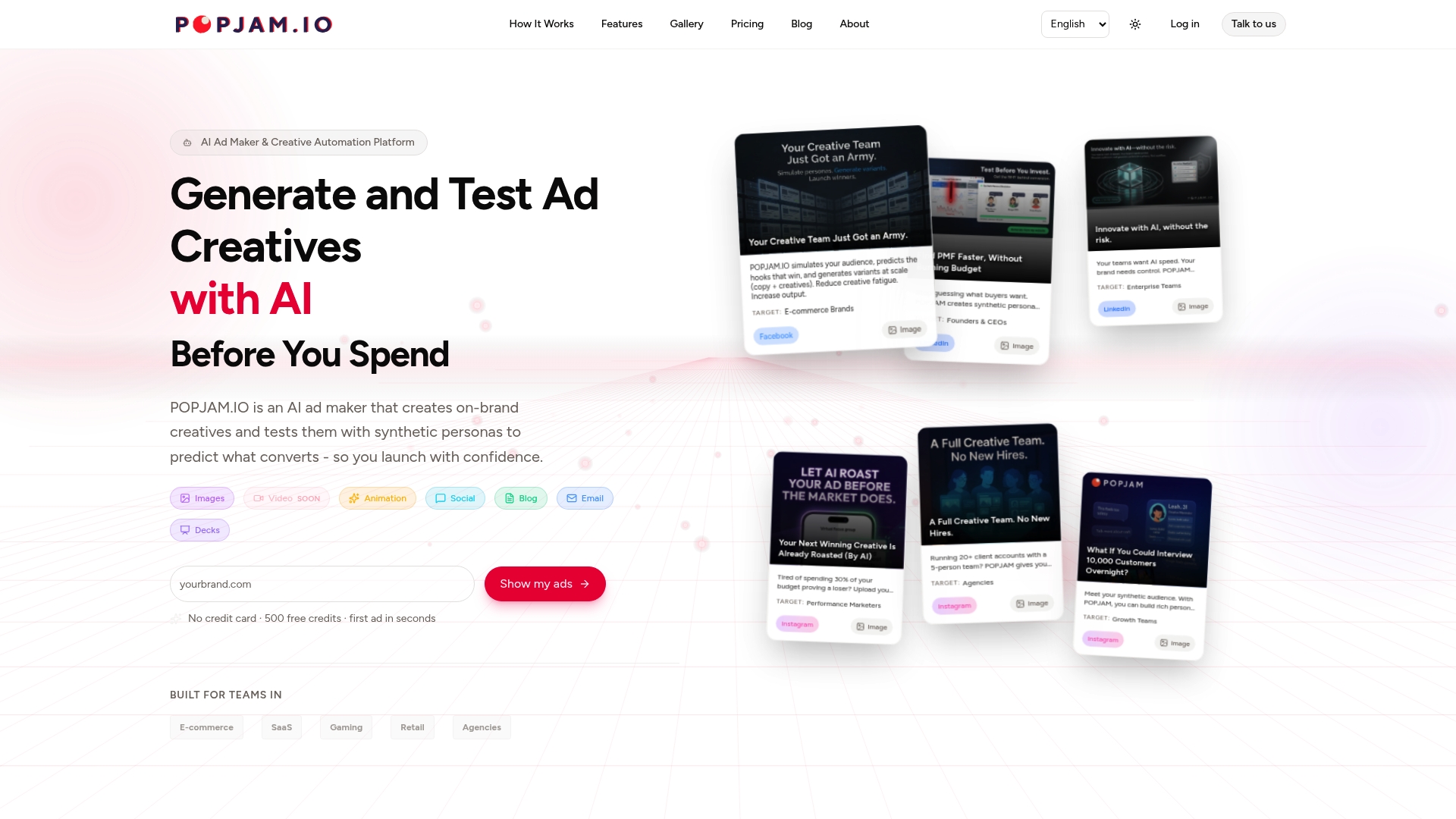
If your team is starting with static, our AI image ad generator is the quickest way to spin up variants. If you want the full workflow from generation to validation, see the AI ad maker. Agencies juggling many clients can look at our AI ad generator for agencies.
Plans on our pricing page include a Free tier, Starter at €29 per month, Essential at €99 per month and Business at €399 per month, plus an Enterprise option. Extra generation is available through credit packs, from 1,000 credits for €10 to 10,000 credits for €100, each a one-off purchase.
FAQ
Are video ads better than image ads?
Not across the board. Video tends to win on attention, reach and engagement, while images often win on cost per click and cost per acquisition for direct response. Study results conflict because platforms, goals and creative quality differ. Run a test on your own account.
Which is better for e-commerce, video or static ads?
It depends on the product and funnel stage. Static ads are quick to produce and well suited to testing many angles. Video helps when a product needs demonstration or when you’re retargeting warm shoppers. VidMob’s analysis of retail and e-commerce ads found video drove a higher sales rate, but your own cost per purchase should make the final call.
How long should a video ad be?
Short usually beats long. One attention study found 15-second ads earned 2.8 times more active attention than 30-second ones, and VidMob found 10- to 15-second spots had a purchase rate well above one- to five-second spots. Design for the first five seconds even with the sound off.
Can I run image and video ads in the same campaign?
Yes, and it often helps. Amazon Science found brands adding video to static sponsored ads saw higher CTR and sales growth. Use static to find angles and prospect, and video to tell the fuller story to warmer audiences. Evaluate the combined result, not each format alone.
How do I test video vs static ads without wasting budget?
Change only the format, keep the audience and offer identical, and judge on your goal metric. Use platform experiments such as Google Ads Demand Gen experiments for clean splits. Screening creatives with simulated personas before launch cuts the number of losing variants you pay to learn from.
Sources
- Do Mobile Video Ads Drive Attention? (VideoWeek)
- Click or Skip? How Ad Format and Disclosure Shape Engagement (Gettysburg College)
- Sponsored brands video rings up clicks and sales (Amazon Science)
- Video ads drive a 48% higher sales rate than static ads (Marketing Dive)
- Study: Video ads see 7.5X higher CTR than display (Marketing Dive)
- Paid Advertising: Understanding How Ad Format and Visuals Impact Performance (Bowling Green State University)
- Facebook Ads Interaction Campaigns: Video Format vs. Image Format (IGI Global)
- Video or Images: Which Performs Better in Facebook Ads? (HubSpot)
- How SHEIN drove sales and brand interest with online video ads (Think with Google)
- Video Action Campaigns are being upgraded to Demand Gen (Google Ads Help)
- New Performance Max features: Assets experiments (Google Ads Help)