

Social media ad examples that boost engagement in 2026
Explore top social media ad examples across Facebook, TikTok, LinkedIn, and more. Learn what makes them work and how to apply those lessons to your campaigns.


TL;DR:
- Effective social media ads are evaluated based on metrics like engagement, CTR, conversion rate, and CPA.
- Successful examples often use platform-specific formats like carousels, shoppable posts, challenges, or short humor ads.
- Performance is driven by high-frequency testing, creative variation, and platform-tailored strategies, aided by AI tools.
Performance marketers know the feeling: you’ve seen every carousel format, every countdown timer, every “swipe up” hook so many times that nothing feels fresh anymore. Ad fatigue is real, and the platforms keep raising the bar. The challenge isn’t finding ad examples, it’s finding ones worth learning from. This article breaks down a curated set of social media ad examples across Facebook, Instagram, TikTok, LinkedIn, and YouTube, evaluates what makes each one work, and gives you a practical framework for applying those lessons to your own campaigns without just copying what someone else already did.
Table of Contents
- How to evaluate social media ad effectiveness
- Top social media ad examples and key features
- Comparing creative approaches across social platforms
- Situational recommendations for ad campaign optimization
- What most marketers overlook: The real source of effective ad inspiration
- Test and optimize with POPJAM’s AI-powered ad tools
- Frequently asked questions
Key Takeaways
| Point | Details |
|---|---|
| Use proven criteria | Evaluate ads based on originality, impact, and platform fit for better campaign selection. |
| Mix creative formats | Experiment with unique ad examples across social channels to drive higher engagement. |
| Leverage AI tools | AI-powered platforms accelerate creative testing and help find campaign winners fast. |
| Adapt, don’t just copy | Iterative testing and platform adaptation trump simple trend imitation for ad success. |
How to evaluate social media ad effectiveness
Before you can learn from great ad examples, you need a reliable way to judge them. Not every viral ad is a good ad. Some rack up likes but drive zero conversions. Others look boring but quietly generate a 4x return on ad spend. The difference comes down to how you evaluate them.
Start with the metrics that actually matter for your goal:
- Engagement rate: Likes, comments, shares, and saves relative to impressions. High engagement signals that the creative resonated emotionally.
- Click-through rate (CTR): The percentage of people who saw the ad and clicked. A strong CTR means the message and offer were compelling enough to act on.
- Conversion rate: Of the people who clicked, how many completed the desired action? This is where creative quality meets landing page alignment.
- Cost per acquisition (CPA): The real bottom line. Lower CPA with consistent volume means the ad is working efficiently.
Beyond numbers, evaluate the creative itself. Ask whether the ad communicates one clear idea in the first two seconds. Check if the visual style matches the brand without feeling like a stock photo. Confirm that the call to action tells the viewer exactly what to do next. Ads that score well on all three tend to outperform those that nail only one.
Pro Tip: When reviewing ad examples for inspiration, build a simple scoring rubric: rate each ad from 1 to 5 on clarity, originality, emotional pull, and brand fit. This removes gut-feel bias and helps you identify patterns across winning creatives.
One practical approach is using AI ad generation to rapidly prototype variations based on what high-scoring examples have in common. Instead of guessing which element drove performance, you can isolate variables and test them systematically. That’s how you move from inspiration to actual results.
Top social media ad examples and key features
With a solid evaluation framework in place, let’s look at specific ad examples that demonstrate what great execution looks like across platforms.
Facebook carousel ad: Interactive storytelling A DTC skincare brand ran a six-card carousel that walked users through a before-and-after transformation, one step per card. Each card had a single sentence of copy and a product image. The final card was a direct purchase CTA. The format worked because it rewarded curiosity. Users who swiped through all six cards were already invested, making them far more likely to convert than cold traffic.
Instagram shoppable post: Visual commerce A fashion retailer tagged every item in a lifestyle photo, letting users tap directly to product pages without leaving the feed. The key creative decision was using a real-looking photo rather than a studio shot. It blended into organic content, which reduced the “this is an ad” resistance that kills CTR.
TikTok branded hashtag challenge: UGC at scale A beverage brand launched a challenge asking users to show their “first sip reaction.” Within 72 hours, the hashtag had millions of views driven almost entirely by user-generated content (UGC). The brand’s only investment was the seed video and the prize. The creative lesson: give your audience a simple, repeatable action and let them do the work.
LinkedIn sponsored content: Data-driven B2B messaging A SaaS company ran a sponsored post leading with a specific statistic relevant to their target buyer, CFOs at mid-market companies. The headline was a number, not a question. The body copy was two sentences. The CTA linked to a gated report. Short, specific, and credible. Effective ad creatives drive higher conversion rates, and this format proves it by removing fluff and leading with proof.
YouTube bumper ad: Six seconds of humor A subscription service ran a six-second bumper that opened with an absurd visual, delivered the punchline in three seconds, and showed the logo for the final two. No voiceover. No product demo. Just a memorable moment. Recall rates for bumper ads that use humor outperform informational formats by a significant margin.
Pro Tip: Use an ad testing tool to simulate how each of these formats performs with your specific audience before committing media budget. Pair it with an AI persona generator to stress-test creative assumptions against synthetic versions of your target buyer.
Comparing creative approaches across social platforms
Looking at individual examples is useful. But comparing them side by side reveals patterns that are harder to see in isolation.

| Platform | Best format | Creative strength | Engagement driver |
|---|---|---|---|
| Carousel | Sequential storytelling | Curiosity and swipe momentum | |
| Shoppable post | Visual commerce | Native-looking content | |
| TikTok | Hashtag challenge | UGC amplification | Community participation |
| Sponsored content | Data credibility | Authority and specificity | |
| YouTube | Bumper ad | Rapid recall | Humor and brevity |
A few patterns stand out immediately. Platforms with a visual-first feed (Instagram, TikTok) reward ads that look like organic content. Platforms with a professional or intent-driven context (LinkedIn, YouTube pre-roll) reward ads that lead with value or a strong hook in the first second.
Here’s what that means in practice:
- Facebook and Instagram share an ad manager but serve different creative needs. Facebook users tolerate more copy and longer formats. Instagram users scroll faster and respond to cleaner visuals.
- TikTok is the only platform where the audience actively wants to participate in the ad itself. Challenge formats and duet-friendly content outperform passive video.
- LinkedIn is where specificity wins. Vague value propositions get ignored. Concrete numbers and named job titles in the copy dramatically improve relevance.
- YouTube bumper ads work best when they don’t try to explain anything. One idea, one emotion, one brand impression.
Testing different creative formats can maximize campaign ROI, which is why running platform-specific variations rather than repurposing one asset everywhere is worth the extra production effort. A creative automation platform can cut that effort significantly by generating platform-native variants from a single brief. Combine that with AI creative testing to validate which variant wins before you scale spend.
Situational recommendations for ad campaign optimization
Knowing what works in general is useful. Knowing what works for your specific situation is what actually moves your numbers. Here’s how to match format to context.
| Campaign goal | Recommended platform | Recommended format | Budget tier |
|---|---|---|---|
| Brand awareness | TikTok, YouTube | Challenge, bumper | Low to mid |
| Lead generation | LinkedIn, Facebook | Sponsored content, lead form | Mid to high |
| Direct purchase | Instagram, Facebook | Shoppable post, carousel | Any |
| Retargeting | Facebook, YouTube | Dynamic product, skippable | Low |
Use this table as a starting point, not a rule. Your audience data should always override general recommendations.
Here’s a practical sequence for optimizing a campaign from scratch:
- Define the single goal for the campaign. Awareness, leads, or purchases. Never mix them in one ad set.
- Select two to three formats that fit the goal and platform based on the table above.
- Generate creative variants for each format, changing one variable at a time: headline, visual, or CTA.
- Run a pre-launch simulation using AI tools to predict which variant is most likely to resonate with your target persona.
- Launch with a small test budget and let the data confirm or reject your hypothesis before scaling.
- Sequence your ads across the funnel. Awareness creative first, then retargeting with a more direct offer for users who engaged.
Automated creative testing platforms accelerate optimization decisions, which means you spend less time waiting for statistical significance and more time scaling what’s already working. An ad testing platform built for performance marketers can cut your time-to-decision in half by surfacing winning variants faster.
What most marketers overlook: The real source of effective ad inspiration
Here’s the uncomfortable truth: most marketers treat ad inspiration like a shortcut. They find a campaign they admire, reverse-engineer the format, and assume the results will follow. They rarely do.
The reason is that what you see in a successful ad is the output of dozens of failed iterations you never saw. The brand that nailed the six-second bumper probably tested fifteen versions before landing on the one that worked. The skincare carousel that converted at 8% started as a three-card concept that flopped.
Performance wins often come from high-frequency testing rather than copying others. The marketers who consistently outperform their benchmarks aren’t the ones with the best taste in ad examples. They’re the ones who test the most, learn the fastest, and adapt without ego.
This is where innovative ad creation tools change the game. Instead of spending three weeks producing a single creative to test, you can generate ten variants in a day, simulate audience response, and enter the market with a data-backed hypothesis. That’s not just faster. It’s a fundamentally different way of working that compounds over time.
Test and optimize with POPJAM’s AI-powered ad tools
The examples and frameworks in this article are only as useful as your ability to act on them quickly. POPJAM.io gives performance marketers the infrastructure to do exactly that.
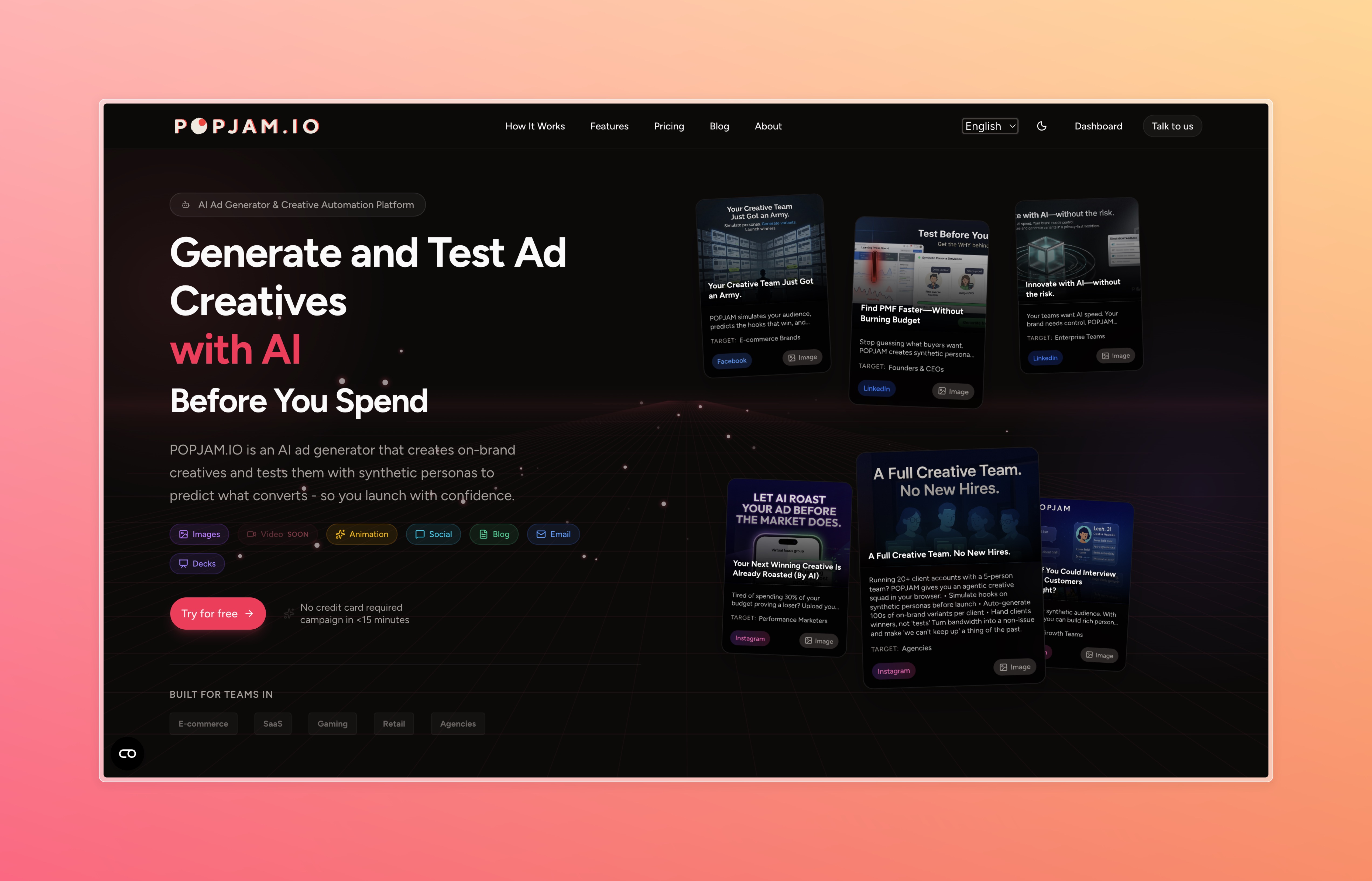
With POPJAM’s AI ad generator, you can produce platform-native creatives across Meta, TikTok, LinkedIn, and YouTube from a single brief. The free ad testing tool lets you simulate audience response before you spend a dollar on media. And the creative automation platform handles variant generation at scale, so your team spends less time producing and more time optimizing. Stop guessing. Start testing with data behind every decision.
Frequently asked questions
What makes a social media ad stand out?
Ads stand out when they combine originality, strong visuals, and a clear call to action that drives high engagement. Creative originality is what separates ads that get remembered from ones that get scrolled past.
How do performance marketers select the best ad examples to emulate?
Marketers prioritize ads with demonstrated results, relevant formats, and brand-aligned messaging. Platform-specific ad formats yield varying conversion rates, so format fit matters as much as creative quality.
What role does AI play in social media ad optimization?
AI accelerates creative development, automates testing, and identifies winning formats before you commit budget. Automation tools can improve creative testing speed significantly, reducing the time between idea and validated result.
Which social media platform delivers the best ad engagement?
The best platform depends on your target audience and campaign goals, as each offers unique engagement strengths. Campaign results vary significantly by platform, which is why testing across channels before scaling is always the smarter move.