

Ad Sentiment Analysis: When to Change Creative, Targeting, or Spend
See how ad sentiment analysis turns comments, surveys, and support feedback into decisions on creative, targeting, and spend, with POPJAM in the workflow.

Sentiment analysis lets you detect how people actually feel about an ad, happy, annoyed, skeptical, excited, and turn that signal into a clear next step: iterate the creative, adjust targeting, or scale spend with confidence with insights from the role of AI in marketing strategies. It works before launch, catching emotional mismatches in a concept, and after launch, flagging shifts in comments or reactions before they show up as a CTR drop. Used well, it shortens the gap between “something feels off” and “here’s what we changed.”
TL;DR:
- A multimodal study of over 30,000 annotated ads found 44% balanced accuracy on five second clips and a 75% average AUC for full ads.
- For live campaigns, sample a soft launch after 48 to 72 hours, then act only on sustained sentiment shifts paired with falling CTR or ROAS.
- Negative reactions tied to an identifiable creative element call for an edit; mixed sentiment with healthy CTR and conversion rates points toward retargeting instead.
- Validate models against human annotations from your ads; request emotion breakdowns because happiness and sadness are easier to detect than contempt or disgust.
- Anonymize support and survey data, remove identifiers before analysis, set retention limits, and distinguish public comments from responses collected with explicit consent.
Table of Contents
- What Ad-Focused Sentiment Analysis Actually Measures
- Where to Find Ad Sentiment Signals
- Common Methods and Metrics Behind Ad Sentiment Tools
- A Step-by-Step Workflow for Measuring Ad Sentiment
- Turning Sentiment Signals Into Campaign Decisions
- What the Research Says About Emotion Detection and Ad Language
- What to Look for in a Sentiment and Ad Tech Stack
- Customer Support Feedback as an Early Ad Signal
- Using Surveys and Panels to Pressure-Test Creative Before Launch
- AI Sentiment Analysis Versus Traditional A/B Testing
- Handling Privacy and Ethics in Ad Sentiment Analysis
- What I’ve Learned About Using Sentiment Signals Well
- How POPJAM Fits Into a Sentiment-Driven Workflow
- FAQ
- Sources
What Ad-Focused Sentiment Analysis Actually Measures
When we talk about sentiment analysis for ads, we’re really talking about a few distinct outputs, and knowing the difference matters once you start acting on them.
Sentiment is the broad positive, negative, or neutral read on a piece of text or a viewer reaction. Valence is a finer-grained version of that: a numeric score for how positive or negative a response leans, rather than a flat label. Discrete emotions go further still, naming specific states like joy, anger, surprise, or disgust rather than just pointing in a direction. And in video ads specifically, researchers track emotion jumps, sudden shifts in viewer reaction within a single ad, often tied to a specific scene, line, or visual beat.
These signals come from several modalities, each with its own strengths:
- Comments and replies on the ad itself, which capture raw, unprompted reaction.
- Reviews and star ratings, useful when the ad links to a product page.
- Customer support transcripts, which surface complaints or confusion tied back to a campaign.
- Survey and panel responses, which let you ask direct questions about a concept.
- Image and video frames paired with captions or voiceover text, which is where multimodal analysis comes in.
A multimodal signal combines two or more of these, typically visual and textual, because a single channel often misses the point. A viewer might write a neutral comment while their facial expression (captured in panel testing) shows clear frustration, or a video’s visuals might read as upbeat while the voiceover language skews anxious. Multimodal models fuse these inputs to catch what text alone would miss, which is part of why fine-grained multimodal fusion models tend to outperform text-only or image-only approaches on ad-specific datasets.
Where to Find Ad Sentiment Signals
Collecting sentiment data is less about one perfect source and more about layering a few complementary ones.
- Ad comments and platform reactions. Comments, emoji reactions, and shares on the live ad are your fastest read on real-world sentiment, though volume varies a lot by budget and placement.
- Brand and product mentions. Monitoring mentions across social platforms and review sites catches sentiment that doesn’t show up directly on the ad post.
- Survey and panel responses. Structured questions to a recruited panel give you controlled, comparable sentiment data before you spend a dollar on media.
- Customer support transcripts. Support tickets and chat logs tied to a campaign period often reveal confusion or frustration that never makes it into a public comment.
- Annotated datasets for model validation. When you’re evaluating a vendor’s model, ask whether it was trained and validated on ad-specific data rather than generic social text, since the two don’t always transfer cleanly.
A few practical notes apply across all of these. API access and export formats vary widely, so confirm you can pull structured data (CSV, JSON) rather than relying on dashboard screenshots. Sampling cadence matters too: a soft launch sampled over 48 to 72 hours tends to surface early emotion trends without waiting for a full campaign cycle to play out. And because much of this data involves real people’s opinions and sometimes contact details from support systems, privacy handling (anonymization, consent basis, retention limits) needs to be part of the collection plan from day one, not an afterthought.
Common Methods and Metrics Behind Ad Sentiment Tools
Most ad sentiment tools rely on one of four method families. Lexicon-based approaches score text against a dictionary of positive and negative words, fast but shallow. Supervised classifiers learn from labeled examples (this comment is positive, this one is negative) and generalize from there. Transformer-based language models capture context and tone far better than older methods, which is why they’ve become the default for text sentiment. And multimodal fusion models combine visual, audio, and text signals, which matters most for video ads where tone and visuals can contradict the words on screen.
When you’re evaluating any of these, a few metrics come up constantly:
- Precision and recall tell you how often the model’s positive calls are actually correct, and how many true positives it catches overall.
- Balanced accuracy adjusts for uneven classes, important when most ad reactions skew neutral and only a minority are strongly emotional.
- AUC (area under the curve) measures how well a model separates one emotion from another across different thresholds.
One of the more detailed looks at this comes from a multimodal CNN study on video ads, which trained its model on a large dataset of over 30,000 ads annotated by viewers and found a mean balanced accuracy around 44% on 5-second clips, rising to a robust average AUC of 75% when evaluating full ads. That gap matters: short clips are harder to classify reliably than a complete ad, but they’re also where emotion jumps are easiest to pinpoint for editing purposes.
The same research found uneven performance across emotions: happiness and sadness were detected more reliably than contempt or disgust. That’s a practical warning for marketers. If a vendor reports an overall accuracy number without breaking it down by emotion, ask for the breakdown, because a tool that’s excellent at spotting joy might be mediocre at catching disgust, and that gap could matter a lot for a campaign built around a cautionary or problem-aware message. The same research also notes that ads eliciting strong emotional reactions tend to be shared and engaged with more than twice as often as those that don’t, which is part of why emotion detection, not just polarity, has become the more useful lens for creative decisions.
A Step-by-Step Workflow for Measuring Ad Sentiment
Here’s a practical sequence that works whether you’re testing a single concept or running sentiment checks across an entire campaign calendar.
- Define success metrics first. Decide what a “good” sentiment outcome looks like for this specific campaign: is it reduced confusion, higher perceived trust, or stronger emotional pull toward a call to action? Map each sentiment signal to a campaign goal before you collect a single data point.
- Choose your data sources and sampling plan. Pick a mix of panel testing, soft-launch sampling, and ongoing social monitoring. A panel of a few hundred respondents is usually enough for directional signal on a prelaunch concept, and a 48-to-72-hour soft launch window gives you early read on live reactions.
- Select your analysis approach and set thresholds. Decide whether you need simple positive/negative labeling or full emotion classification, and set thresholds for what counts as a meaningful shift (not every dip in sentiment warrants action). Run a quick validation check: spot-check a sample of model outputs against human judgment before trusting it at scale.
- Translate results into action. Sustained negative sentiment tied to a specific creative element usually means a targeted edit. Negative sentiment paired with strong performance metrics might mean you retarget rather than rework. Clear positive sentiment plus healthy performance is your scale signal.
- Set a monitoring cadence. Weekly checks work for always-on campaigns; daily checks make more sense during a launch window. Set automated alerts for sustained sentiment shifts rather than reacting to every daily fluctuation, which tends to create noise rather than insight.
Pro Tip: Validate your sentiment model on a small labeled sample from your own ad history before trusting it on a new campaign, since general-purpose sentiment models don’t always transfer cleanly to advertising-specific language.
Turning Sentiment Signals Into Campaign Decisions
Sentiment data only earns its place in a workflow once it changes what you do next. The real skill is pairing it with performance metrics so you’re not reacting to noise.
A few decision patterns tend to hold up well:
- Rework the creative when sentiment is negative and tied to a specific, identifiable element (a line, a visual, a claim) rather than a vague overall dislike.
- Retarget instead of rework when sentiment is mixed but performance metrics like CTR and conversion rate remain healthy, since the ad may simply be reaching the wrong segment.
- Pause and investigate when sentiment turns sharply negative at the same time CTR or ROAS drops, since that combination usually signals a real problem rather than a sampling quirk.
- Scale with confidence when sentiment is consistently positive and CVR holds steady across a soft-launch sample.
A useful escalation rule: sustained negative sentiment combined with a falling CTR over several days is a strong enough signal to trigger a creative test, not just a monitoring note. On its own, a short-term sentiment dip rarely justifies pulling a campaign, since normal day-to-day variation in comments and reactions can look dramatic in isolation. The combination of qualitative sentiment and quantitative performance is what separates a real signal from background noise, and audience research methods that pair sampling discipline with sentiment tracking tend to catch real shifts earlier than performance metrics alone.
What the Research Says About Emotion Detection and Ad Language
The strongest evidence on video ad emotion comes from a study using a multimodal CNN trained on tens of thousands of annotated ads, which found that emotion detection accuracy climbs substantially when you look at a full ad rather than a short clip, and that some emotions (happiness, sadness) are simply easier to detect reliably than others.
Text matters just as much as video. A separate study of over 21,000 Instagram ads found that linguistic features predict click-through rate differently depending on product category: supplement ads saw higher CTR from risk- and discrepancy-related language, while cosmetic ads performed better with visual and positive-emotion language. That’s a reminder that sentiment interpretation isn’t one-size-fits-all. A sentiment model tuned for one vertical can mislead you in another.
AI-driven representations must be substantiated, and limitations on AI accuracy should be disclosed conspicuously to avoid deceptive trade practices. Federal Trade Commission
That guidance matters for anyone using AI sentiment tools in marketing decisions, since claims about what a model can detect need to hold up to scrutiny, not just sound impressive in a pitch deck.
This is the gap synthetic persona testing is built to close. Rather than waiting for live comments to tell you a concept missed the mark, simulating audience reactions against psychographic profiles before spend gives you a directional read on emotional response earlier in the process, catching mismatches that would otherwise only surface after the budget is already spent.
What to Look for in a Sentiment and Ad Tech Stack
A sentiment tool is only as useful as how well it plugs into the rest of your ad workflow. A short checklist helps here:
- Multimodal input support, so you’re not limited to text when the creative itself is visual or video.
- Taxonomy control, meaning you can adjust or extend the emotion categories to match your category’s language.
- Explainability, so you can see which words, scenes, or moments drove a given sentiment score.
- API exports in standard formats, so sentiment data flows into your BI tools rather than living in a separate dashboard.
- Platform-native output compatibility, so creative changes informed by sentiment can go straight back into Meta, Google, TikTok, LinkedIn, or Reddit campaign managers.
Integration generally follows three patterns: prelaunch simulation feeding directly into your creative platform, in-flight sentiment alerts routed to your campaign manager for fast reaction, and periodic exports feeding a BI dashboard for longer-term trend tracking. Configuration should follow your objective: a brand-awareness campaign might prioritize emotion breadth, while a direct-response campaign cares more about sentiment tied tightly to specific CTA language.
Customer Support Feedback as an Early Ad Signal
Support tickets and chat transcripts are an underused source of ad sentiment, mostly because they live in a different system from your marketing stack. But when a campaign drives a spike in a specific type of complaint, confusion about pricing, frustration with a claim that oversold a feature, that’s sentiment data just as real as a comment on the ad itself.
The advantage here is specificity. A support transcript usually explains exactly what confused or upset someone, rather than just flagging that they felt negative. If multiple tickets reference the same phrase or visual from a recent ad, that’s a strong signal the creative is setting the wrong expectation.
Pulling this into your sentiment workflow doesn’t require sophisticated tooling at first. Tagging support tickets by campaign or date range and scanning for recurring themes during a launch window is often enough to catch a mismatch early. Over time, running the same NLP classification you use on public comments against anonymized support text gives you a more structured version of the same insight, and it tends to surface problems days before they show up as a performance dip in the ad platform itself.
Using Surveys and Panels to Pressure-Test Creative Before Launch
Surveys and recruited panels remain one of the most direct ways to measure sentiment before a creative goes live, because you can ask specific questions rather than waiting for organic reaction. A short panel test, showing a concept to a few hundred people and asking about clarity, appeal, and emotional response, gives you controlled data that public comments never will, since panel respondents aren’t self-selected the way commenters are.
The tradeoff is speed and realism. Panels take longer to set up than scanning live comments, and stated survey responses don’t always match real behavioral reaction to the same creative in the wild. That’s why panel sentiment works best as a prelaunch filter, catching the clearest misses, rather than a final verdict on performance.
Synthetic persona testing offers a faster version of the same idea: instead of recruiting and waiting on a live panel for every concept variant, you can simulate reactions against defined psychographic profiles to get a directional read in a fraction of the time, reserving live panels for concepts that clear that first filter. That combination, fast synthetic screening followed by a smaller live panel for the finalists, tends to catch more creative problems than either method alone.
AI Sentiment Analysis Versus Traditional A/B Testing
Traditional A/B testing answers a narrow question well: which version performed better on a specific metric, over a specific budget, in a specific window. It’s reliable, but it’s also slow and expensive, since you need real spend and real impressions before you get an answer, and it tells you almost nothing about why one version won.
Sentiment analysis answers a different question: how did people feel, and what specifically drove that feeling. It can run before a dollar is spent, using panels or synthetic personas, and it surfaces the “why” that A/B testing leaves out, a confusing line, an off-putting visual, a mismatched tone.
The two aren’t really competitors. A/B testing confirms which version wins on hard performance numbers; sentiment analysis helps you understand the emotional mechanics behind that win and generate better variants to test in the first place. Teams that run sentiment checks before building A/B variants tend to enter the test with stronger candidates, since the weakest emotional misses get filtered out before any budget is committed. Our guide to what AI creative analysis can and can’t tell you goes deeper on where each method’s limits sit.

Handling Privacy and Ethics in Ad Sentiment Analysis
Sentiment analysis runs on real people’s words and reactions, which means privacy and consent aren’t optional details, they’re part of doing the work responsibly. Comments scraped from a public post sit in a different legal and ethical category than survey responses collected with explicit consent, or support transcripts that may contain personal information.
A few practices matter in practice. Anonymize data wherever the analysis doesn’t require identity, strip personal identifiers before data reaches any model or dashboard, and set clear retention limits so sentiment data doesn’t sit indefinitely in a system it wasn’t intended for. When synthetic personas are used to simulate reactions instead of surveying real people, that sidesteps a layer of consent complexity entirely, since no personal data from real respondents is being processed in the first place.
Regulatory attention here is increasing. Federal Register guidance has reiterated that steering AI outputs toward undisclosed objectives, or overstating what a model can reliably detect, can raise the same deceptive-practice concerns that apply to any marketing claim. Treat sentiment tool accuracy claims the way you’d treat any performance claim: ask for the evidence, and disclose limitations rather than letting a vendor’s confidence stand in for proof.
What I’ve Learned About Using Sentiment Signals Well
Sentiment adds real value when it’s tied to a specific decision, not when it’s tracked as a vanity metric. The moment a team starts checking sentiment scores without a plan for what action a shift would trigger, it becomes noise dressed up as insight.
Governance matters more than most teams expect going in. Sample sizes need to be big enough to trust, sentiment categories need to stay consistent across campaigns so trends are comparable, and sentiment should never override core KPIs like CVR or ROAS, it should explain them.
A short starting checklist: define the decision each signal will trigger before collecting data, validate any model against a small human-labeled sample from your own ads, and always read sentiment alongside performance, never alone.
— Doruk
How POPJAM Fits Into a Sentiment-Driven Workflow
We built POPJAM around the exact gap this workflow keeps running into: catching emotional misses before spend, not after.
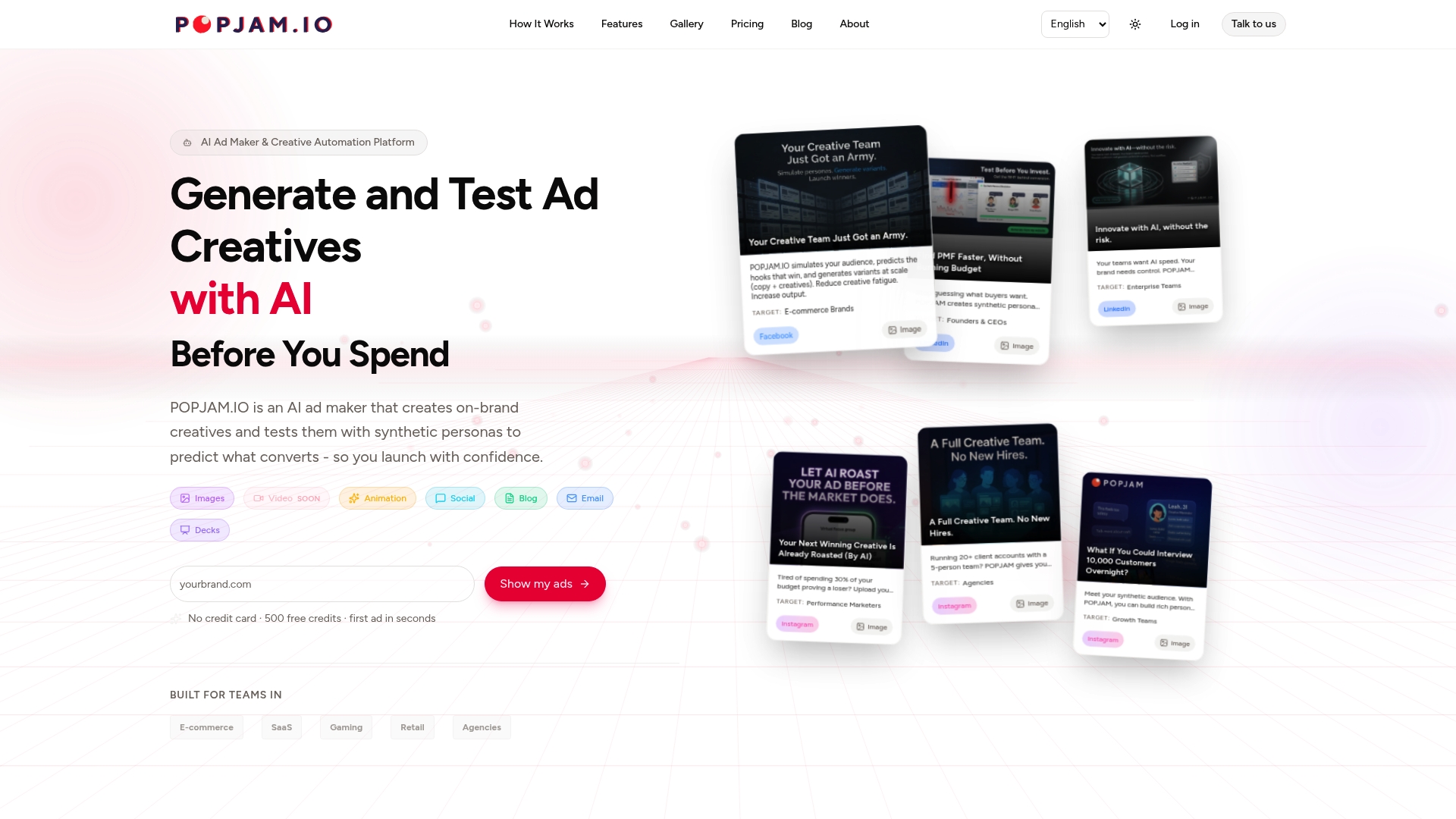
Inside the platform, you can:
- Generate ad creatives for image, video, and social formats without starting from a blank page.
- Simulate audience reactions using synthetic personas built from psychographic profiles, to see likely emotional responses before launch.
- Use that simulated feedback to inform data-driven creative decisions, helping to reduce wasted ad spend and speed up iteration compared to waiting on live results.
Check our pricing or explore the AI ad generator to see how prelaunch testing fits your next campaign.
FAQ
How does NLP analyze sentiment in social media posts and business documents?
NLP models process text through stages like tokenization, context modeling, and classification to assign a sentiment label or emotion category to each piece of text. Modern approaches rely on transformer-based language models, which read surrounding context rather than scoring individual words in isolation, making them more accurate on nuanced or sarcastic language than older lexicon-based methods.
What is brand sentiment?
Brand sentiment is the overall emotional tone people express toward a brand across comments, reviews, mentions, and support interactions. It’s typically tracked as a trend over time rather than a single score, since one week of negative sentiment tied to a specific event means something different than a sustained decline.
What is the best social media monitoring tool with sentiment analysis?
There’s no single tool that fits every team, since the right choice depends on which platforms you monitor, your budget, and whether you need text-only or multimodal (image and video) sentiment detection. Look for taxonomy control, explainability, and export options that match your existing ad tech stack rather than choosing based on name recognition alone.
What is sentiment analysis in simple terms?
Sentiment analysis is a way of using software to read text, images, or video and determine whether the reaction behind it is positive, negative, or neutral, and sometimes which specific emotion is driving that reaction. For ads, it turns scattered comments, survey answers, and reactions into a signal you can act on.
Does POPJAM replace the need for live A/B testing?
No, synthetic persona simulation through POPJAM is designed to filter and strengthen creative concepts before they enter an A/B test, not to replace the test itself. It helps surface the weakest emotional misses early, so the variants you do test with real budget start from a stronger position.
Sources
- Decoding viewer emotions in video ads - PMC
- Federal Trade Commission’s Proposed Policy Statement Concerning the Suppression of Accuracy In Artificial Intelligence Systems
- Federal Register, Volume 91 Issue 128 (Tuesday, July 7, 2026)