

Top audience research methods to boost campaign performance
Discover the top audience research methods to optimize your ad campaigns. Learn how to evaluate, combine, and apply techniques that drive real performance results.


Picking the wrong audience research method doesn’t just waste budget. It sends your entire campaign strategy in the wrong direction. Performance marketers and e-commerce brand managers face a real problem: there are dozens of research approaches available, and each one promises clarity. But not every method fits every goal, timeline, or team size. The difference between a campaign that converts and one that drains spend often comes down to how well you understood your audience before launch. This guide breaks down the top methods, gives you a clear framework for evaluating them, and shows you how to combine them for maximum campaign impact.
Table of Contents
- How to evaluate audience research methods
- Customer interviews and direct conversations
- Internal data analysis: Quantitative behavioral insights
- Surveys and polls for scalable validation
- Review mining: Unfiltered audience insights
- A fresh perspective: Combining methods for real-world impact
- Connect research findings with smarter ad optimization
- Frequently asked questions
Key Takeaways
| Point | Details |
|---|---|
| Blend qualitative and quantitative | Combining interviews, analytics, surveys, and reviews delivers deeper audience insights for campaign optimization. |
| Leverage internal analytics | Using website and CRM data informs segmentation and benchmarks for improving ad targeting. |
| Scale with surveys | Surveys and polls validate findings and segment audiences quickly for large-scale campaigns. |
| Mine reviews for language | Review mining uncovers pain points and messaging that resonates with your target market. |
| Align research with business goals | Start every research process by clarifying campaign goals and the ideal customer profile. |
How to evaluate audience research methods
Before you commit to any method, you need a consistent way to judge it. Not all research is created equal, and the wrong fit can cost you weeks of effort with little to show for it.
Here are the five criteria that matter most when evaluating any audience research approach:
- Accuracy: Does the method produce reliable, representative data, or is it prone to bias and noise?
- Scale: Can you gather enough responses to draw statistically meaningful conclusions?
- Speed: How quickly can you collect and act on findings within a campaign cycle?
- Cost: What is the total investment in time, tools, and incentives?
- Depth of insight: Does the method reveal why people behave a certain way, or just what they do?
Qualitative methods like interviews go deep but don’t scale easily. Quantitative methods like surveys and analytics scale well but can miss the emotional context behind behavior. Neither is universally better. The smartest approach is knowing when to use each one.
For example, if you’re launching a new product line, you need qualitative depth first to understand language and motivation. If you’re optimizing a campaign already in flight, quantitative behavioral data gives you faster, more actionable signals. Internal data sources provide quantitative behavioral insights and customer benchmarks that are hard to replicate with external methods alone.
When you combine methods, you get context from qualitative research and confidence from quantitative data. That combination is what separates campaigns built on assumptions from those built on evidence. Strong refining marketing messages work always starts with layered research, not a single data point.
Pro Tip: Always define your business goal and your current audience profile before selecting a research method. The method should serve the goal, not the other way around.
Customer interviews and direct conversations
If you want to understand your audience at a deep level, nothing beats a real conversation. Customer interviews are the most direct way to hear the exact words your audience uses to describe their problems, desires, and hesitations.
Here’s what makes interviews so powerful for campaign work:
- You capture real language that can be used verbatim in ad copy and landing pages
- You uncover nuanced pain points that surveys and analytics never surface
- You get context-rich motivation, meaning you understand not just what people want but why they want it
- You can probe for specific examples that reveal patterns across your audience
The key to a productive interview is asking open-ended questions. Instead of asking “Do you find our product useful?”, ask “Walk me through the last time you tried to solve this problem.” That shift opens up stories, not yes/no answers.
Interviews are especially valuable when you’re validating a new campaign angle or testing a messaging shift. If three out of five customers describe the same frustration using the same phrase, that phrase belongs in your next ad headline. Customer interviews uncover pain points, motivations, and exact language used by audiences in ways no algorithm can replicate.
“Direct conversations let you hear exactly what matters to your audience.”
Best practices for getting the most out of interviews:
- Keep sessions to 30 minutes to respect your audience’s time
- Record every session with permission so you can review for patterns later
- Aim for at least 8 to 10 interviews before drawing conclusions
- Look for repeated phrases and emotional triggers across multiple conversations
Pro Tip: After each interview, write a one-paragraph summary of the single most surprising thing you heard. Reviewing these summaries across all interviews often reveals the insight that changes your entire campaign direction.
Internal data analysis: Quantitative behavioral insights
Once you have qualitative context, it’s time to validate and scale those insights with numbers. Your internal data sources are one of the most underused assets in audience research.

Internal data sources including website analytics, CRM records, email metrics, and support transcripts provide quantitative behavioral insights that reflect actual customer behavior, not self-reported opinions.
Here’s a simple four-step process for turning raw internal data into campaign-ready insights:
- Gather data from all available sources: Google Analytics, Hotjar heatmaps, HubSpot or Salesforce CRM, email open and click data, and customer support transcripts.
- Identify patterns by looking for consistent behaviors across segments, such as high bounce rates on specific pages or recurring support questions about the same feature.
- Benchmark performance by establishing baseline metrics so you can measure the impact of creative changes over time.
- Feed insights into creative testing by using behavioral patterns to inform ad angles, formats, and calls to action.
Here’s how different internal sources compare in terms of what they reveal:
| Data source | What it reveals | Best use case |
|---|---|---|
| Website analytics | Traffic patterns, bounce rates, conversion paths | Funnel optimization, landing page testing |
| CRM data | Purchase history, segment behavior, lifetime value | Audience segmentation, upsell targeting |
| Support transcripts | Common objections, recurring frustrations | Ad copy, FAQ content, objection handling |
| Email metrics | Subject line resonance, content engagement | Messaging validation, creative angle testing |
The real power of internal data is that it reflects what your audience actually does, not what they say they’ll do. Leveraging feedback analysis from support and CRM data can expose hidden segments that your top-of-funnel campaigns are completely ignoring.
Surveys and polls for scalable validation
Surveys sit at the intersection of speed and scale. Once you’ve gathered qualitative insights from interviews and behavioral signals from analytics, surveys let you test those findings across a much larger audience.
Here’s why surveys work well for performance marketers:
- Fast to deploy: A well-structured survey can go live within hours using tools like Typeform, SurveyMonkey, or Google Forms
- Easy to segment: You can filter results by demographics, purchase behavior, or acquisition channel
- Quantifiable: Results translate directly into percentages and trends you can act on
- Flexible: Use them for appeal testing, message ranking, or segment-level preference mapping
The structure of your survey matters as much as the questions. Start with broad context questions, move to specific preference or behavior questions, and close with open-ended fields for unexpected insights. Avoid leading questions that push respondents toward a particular answer.
Incentives are a proven lever for improving response rates. Surveys with incentives get up to 50% higher completion rates, which means your data is more representative and your conclusions are more reliable. Even a small reward, like a discount code or entry into a giveaway, can dramatically improve participation.
Surveys are particularly useful for target market analysis when you need to benchmark audience sentiment before and after a campaign, or when you’re testing the appeal of two different creative directions before committing budget to either.
Pro Tip: Always include one open-ended question at the end of your survey. The free-text responses often contain the most actionable language for ad copy and creative briefs.
Review mining: Unfiltered audience insights
Reviews are one of the most honest data sources available to marketers. People write reviews when they feel strongly, which means the language is raw, specific, and emotionally charged. That’s exactly what you want for ad creative.
Review mining from platforms like Amazon, G2, Trustpilot, and Reddit reveals unfiltered pain points, objections, and success criteria written entirely in customer language. You’re not interpreting what customers mean. You’re reading exactly what they said.
Here’s what to look for when mining reviews:
- Pain points: What problems were people trying to solve before finding the product?
- Feature requests: What do customers wish the product did better?
- Language patterns: Which phrases appear repeatedly across unrelated reviewers?
- Common objections: What almost stopped people from buying?
Here’s how review mining compares to other research methods:
| Method | Data type | Scale | Cost | Depth |
|---|---|---|---|---|
| Review mining | Unfiltered qualitative | High | Low | Medium |
| Customer interviews | Rich qualitative | Low | Medium | High |
| Surveys | Structured quantitative | High | Low to medium | Low to medium |
The benefits of review mining for market research for e-commerce are significant:
- Unfiltered data with no moderator bias
- Scalable across thousands of reviews without additional cost
- Exposes market gaps that competitors haven’t addressed in their messaging
- Directly applicable to ad hooks, landing page headlines, and email subject lines
Reddit threads deserve special attention. Subreddit discussions often contain long-form explanations of why people made a purchase decision, which gives you narrative-level insight that even interviews sometimes miss.
A fresh perspective: Combining methods for real-world impact
Here’s what most articles on audience research won’t tell you: picking one method and sticking with it is the single biggest mistake performance marketers make. Conventional wisdom often pushes teams toward the method that feels most familiar, whether that’s analytics because it’s already set up, or surveys because they’re easy to send. But real campaign wins come from layering methods together.
The most effective research stack we’ve seen looks like this: interviews for context and language, analytics for behavioral benchmarks, surveys for scaled validation, and review mining for raw emotional signals. Each method fills a gap the others leave open.
The practical lesson is this: map every research finding to a specific creative testing cycle. Don’t let insights sit in a spreadsheet. If an interview reveals a recurring objection, build an ad variant that addresses it directly. If analytics show a drop-off at a specific funnel stage, create a creative that speaks to the hesitation happening at that moment.
“Campaign wins are built on layered insights, not one-off findings.”
Using creative testing strategies that are grounded in blended research means you’re not guessing at what will resonate. You’re testing hypotheses built on real evidence. That’s a fundamentally different, and more profitable, way to run campaigns.
Connect research findings with smarter ad optimization
You’ve done the research. Now the real work is turning those insights into creative that performs.
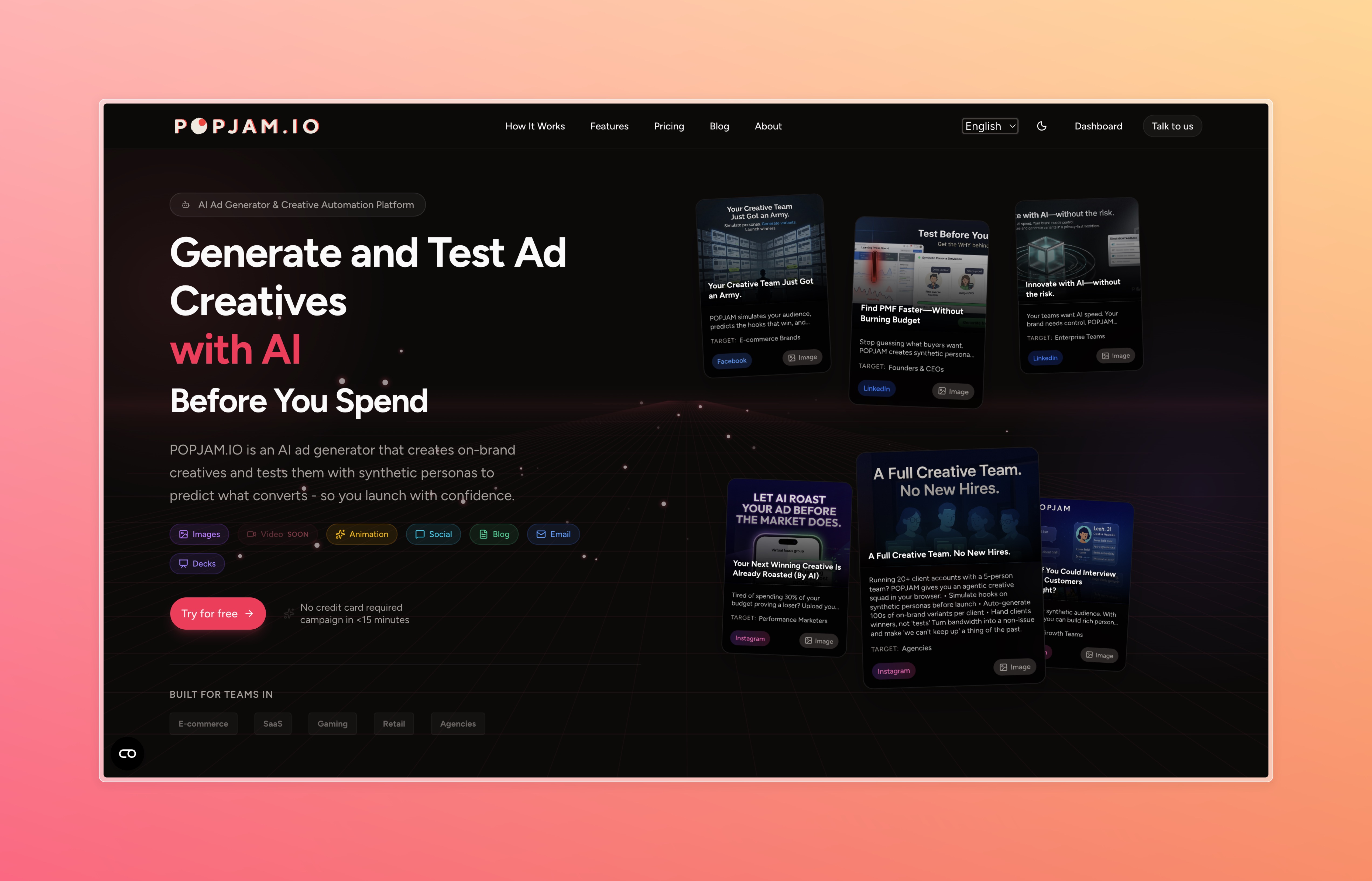
POPJAM’s AI ad generator platform is built exactly for this moment. Feed your research findings into the platform and generate platform-native ad creatives across Meta, TikTok, Google, and more. Use synthetic personas to simulate how different audience segments will respond to your creative before you spend a dollar. Test hooks, headlines, and formats at speed with free AI marketing tools designed for performance marketers. When you’re ready to scale, explore AI creative testing pricing that fits teams of every size. Stop guessing. Start validating.
Frequently asked questions
What is the best method for audience research?
The most effective approach combines qualitative interviews, quantitative analytics, survey validation, and review mining for full-spectrum insights rather than relying on any single method.
How can I scale audience research for large campaigns?
Use surveys and polls with segmentation tools and incentives. Scalable quantitative validation through structured surveys with completion incentives gives you reliable data across large, diverse audiences.
What are common mistakes to avoid in audience research?
Relying on a single method or skipping behavioral analytics entirely are the most costly errors. Website analytics and CRM data often reveal hidden segments and motivations that qualitative methods alone will miss.
How can review mining improve campaign messaging?
Mining reviews from platforms like Amazon, G2, and Reddit surfaces real objections and pain points in customer language, making ad creative immediately more relevant and resonant with your target audience.