

Why pre-test ad creatives: maximize results & cut costs

TL;DR:
- Creative quality influences up to 70% of ad performance variability.
- AI-based pre-testing predicts audience reactions to optimize creatives before launch.
- Implementing pre-testing improves ROI, reduces waste, and speeds up creative iteration.
Most performance marketers launch campaigns on instinct, gut feel, or last quarter’s data. That’s a costly gamble. Creative quality accounts for 47-70% of ad performance variability, meaning the single biggest lever you control is the creative itself, not your bid strategy or audience targeting. Yet most teams skip pre-testing entirely, burning budget on ads that were never going to work. This article breaks down why AI-driven pre-testing is now the sharpest tool in a performance marketer’s kit, how it works, and how to put it into practice starting with your next campaign.
Table of Contents
- The true impact of ad creative on campaign performance
- What is ad creative pre-testing and how does it work?
- Key benefits of pre-testing ad creatives with AI
- How to implement pre-testing in your ad workflow
- Why pre-testing is now table stakes for performance marketers
- Drive stronger results with AI-powered creative testing
- Frequently asked questions
Key Takeaways
| Point | Details |
|---|---|
| Creative drives ROI | Ad creative accounts for the majority of campaign performance—much more than targeting or channel selection. |
| AI pre-testing saves money | Testing with AI prevents wasted budget by filtering out weak ads before they go live. |
| Data-backed campaigns win more | Marketers who pre-test with AI report up to 287% higher returns on ad spend. |
| Implementation is scalable | Modern tools let you test thousands of ad variations efficiently and integrate results into your workflow. |
The true impact of ad creative on campaign performance
There’s a persistent myth in performance marketing: if you nail your targeting, the creative will carry itself. It won’t. Targeting gets your ad in front of the right person. The creative determines whether that person stops scrolling, clicks, and converts. Without strong creative, even the most precise audience segment is just an expensive list of people who ignored your ad.
The numbers back this up hard. Creative quality drives 47-70% of ad performance variability across paid channels. That’s not a small edge. That’s the majority of your campaign’s fate sitting in the hands of your design and copy decisions. Every dollar you put toward audience research or bid optimization is working against a ceiling set by your creative quality.
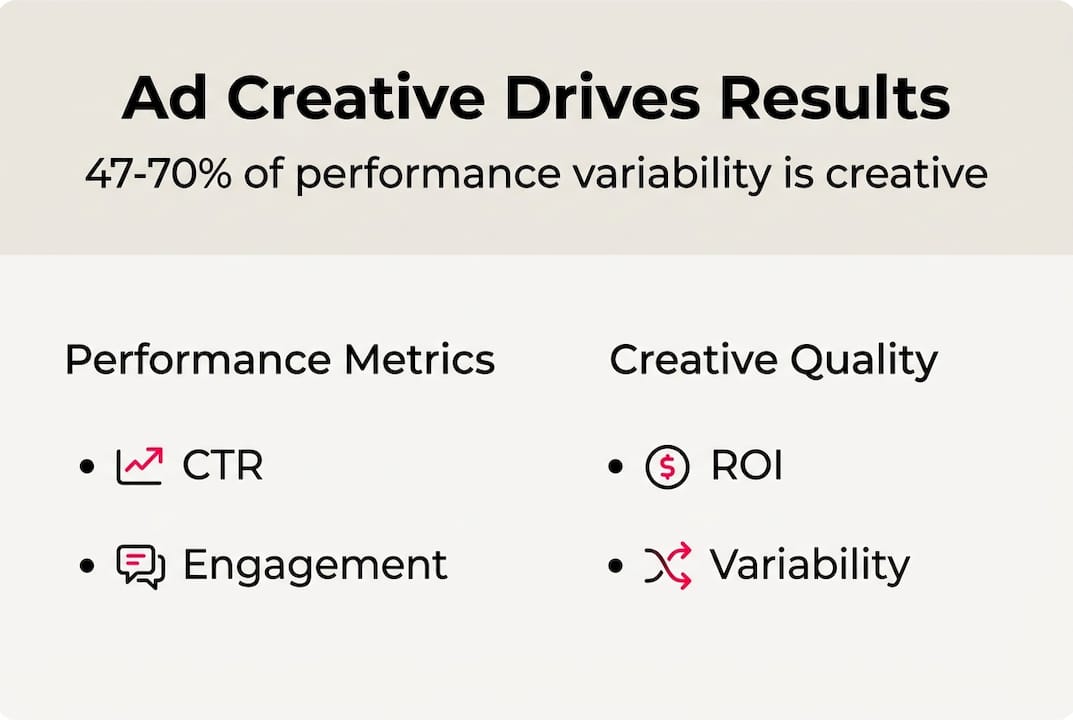
Consider what happens when brands get this wrong. A DTC apparel brand might run a flawless retargeting funnel, only to watch it underperform because the hero image feels generic and the headline doesn’t speak to a real pain point. The targeting was fine. The creative killed the campaign.
Here’s what creative quality directly affects:
- Click-through rate (CTR): Weak creative means fewer clicks, regardless of placement.
- Engagement rate: Low engagement signals poor relevance to platforms, raising your CPM.
- Conversion rate: Ads that don’t resonate emotionally or rationally rarely convert.
- Cost per acquisition (CPA): Poor creative inflates CPA by wasting impressions on non-converting traffic.
- Ad fatigue speed: Weak creatives burn out faster, forcing more frequent, expensive replacements.
The brands seeing consistent ad ROI gains are not necessarily spending more. They’re investing more deliberately in the creative layer. They treat creative as a data problem, not just a design problem. And they’ve learned that creating high-impact ads starts long before the campaign goes live.
“The creative is the targeting. In a world of algorithmic delivery, the ad itself tells the platform who to find.” This is the operating reality for modern paid media teams.
If you’re still treating creative as an afterthought to media buying, you’re leaving the biggest performance variable on the table.
What is ad creative pre-testing and how does it work?
Pre-testing means evaluating your ad creatives before you spend a single dollar on live media. Traditionally, this involved focus groups, manual review panels, or small-scale A/B tests that took weeks and cost thousands. The feedback was slow, the sample sizes were small, and by the time results came in, the campaign window had often passed.

AI has completely changed this. Modern AI ad creative explained platforms can simulate audience reactions at scale, running thousands of creative variations through predictive models in hours, not weeks. The result is actionable data before you commit budget, not after you’ve burned it.
Here’s how a standard AI pre-testing workflow looks in practice:
- Upload your creative assets. Images, video, copy, and format variations go into the platform.
- Define your target audience. The AI builds synthetic personas that reflect your real audience’s psychographics and behaviors.
- Run simulated exposure. The platform exposes each creative variant to the synthetic audience and measures predicted reactions.
- Analyze performance signals. You get predicted CTR, engagement likelihood, emotional response, and purchase intent scores for each variant.
- Iterate before launch. Low-scoring variants get revised or cut. High-scorers move forward to live media.
- Export and deploy. Winning creatives go directly to your ad platform of choice.
This is not guesswork with extra steps. AI-driven pre-testing enables testing thousands of variants quickly, surfacing patterns that no human review panel could catch at that speed or scale.
The best ad creative pre-testing guide will tell you that the output is only as useful as your interpretation. Most marketers look at the top-line score and move on. The real insight is in the variance: why did one hook outperform another? What emotional trigger drove the difference? That’s where creative strategy gets sharper.
Pro Tip: When reviewing pre-test data, don’t just pick the highest scorer. Look at which creative performed consistently across multiple audience segments. Consistency signals durability, not just a lucky match with one persona.
The right ad testing tools make this process fast enough to run on every campaign, not just your biggest launches.
Key benefits of pre-testing ad creatives with AI
The most obvious benefit of pre-testing is avoiding waste. If a creative is going to underperform, you want to know that before you spend $50,000 on media, not after. But the advantages go well beyond damage control.
E-commerce brands have reported 287% ROAS improvement after implementing AI pre-testing into their creative workflow. That’s not a marginal gain. That’s a business-transforming shift driven by knowing which ads work before the campaign clock starts.
Here’s a direct comparison of traditional versus AI-driven pre-testing:
| Factor | Traditional pre-testing | AI-driven pre-testing |
|---|---|---|
| Speed | 2-6 weeks | Hours to days |
| Scale | Dozens of variants | Thousands of variants |
| Cost | High (panels, research) | Low (automated) |
| Accuracy | Variable, subjective | Data-driven, consistent |
| Iteration speed | Slow | Real-time |
| Audience coverage | Limited sample | Broad synthetic personas |
Beyond the table, here’s what AI pre-testing actually unlocks for your team:
- Faster creative iteration: You can test, learn, and revise in a single day instead of waiting weeks for live data.
- Data-driven creative decisions: Gut feel gets replaced by predicted performance scores tied to real audience behavior patterns.
- Scalable variant testing: Test 50 hooks, 10 visuals, and 5 CTAs simultaneously without blowing your media budget.
- Early fatigue detection: Identify creatives likely to burn out fast before they eat your frequency budget.
- Confidence at launch: Teams move faster when they know the creative has already been validated.
The hidden benefit most teams miss is the compound effect. When you consistently launch stronger creatives, your account history improves, your relevance scores rise, and platforms reward you with lower CPMs. Boosting ROI with ad data is not just about one campaign. It’s about building a performance flywheel that gets cheaper and more effective over time.
Looking at engagement-boosting ad examples from brands using AI pre-testing, the pattern is consistent: validated creatives outperform unvalidated ones at every stage of the funnel.
How to implement pre-testing in your ad workflow
Knowing the benefits is one thing. Building the habit into your workflow is another. Here’s a practical, step-by-step approach to making pre-testing a standard part of how your team operates.
- Audit your current creative process. Map where decisions are made on gut feel versus data. These are your highest-risk points.
- Choose your pre-testing platform. Look for tools that offer synthetic audience simulation, multi-format support, and direct integration with your ad platforms. Ad pre-testing tools built for performance marketers will save you setup time.
- Prepare a creative brief with variants in mind. Brief your creative team to produce multiple hooks, visuals, and copy angles from the start, not as an afterthought.
- Upload and configure your test. Set your audience parameters, define success metrics (CTR, engagement, purchase intent), and run the simulation.
- Review results by segment. Don’t just look at averages. Check how each creative performs across different audience personas.
- Select and refine winners. Use pre-test data to cut weak variants and sharpen the top performers before launch.
- Launch and track live performance. Compare real-world results to pre-test predictions. Over time, this calibration makes your pre-test models more accurate.
Here’s what the data typically looks like before and after implementing pre-testing:
| Metric | Before pre-testing | After pre-testing |
|---|---|---|
| Average CTR | 0.8% | 1.6% |
| Engagement rate | 2.1% | 4.3% |
| CPA | $42 | $27 |
| Creative revision cycles | 4-5 rounds | 1-2 rounds |
AI-driven pre-testing enables this kind of systematic improvement by removing the guesswork from each launch. Pair this with a solid automation platform for creatives and your team can scale output without scaling headcount.
Pro Tip: The most common mistake when scaling pre-testing is testing too many variables at once without a clear hypothesis. Test one creative dimension at a time (hook, visual, CTA) so you know exactly what drove the result.
Why pre-testing is now table stakes for performance marketers
The old “test and learn” model assumed you had time and budget to fail publicly. You’d launch, watch the data roll in over two weeks, kill the losers, and scale the winners. That process made sense when CPMs were cheap and competition was low. Neither of those conditions exists anymore.
Here’s the uncomfortable truth we’ve learned: the cheapest CPM is completely meaningless if the creative doesn’t convert. You can win the auction and lose the customer in the same second. Brands that are scaling profitably in 2026 are not outbidding their competitors. They’re out-creating them, and they’re doing it with validated assets before a single impression is served.
The biggest missed opportunity when you skip pre-testing is not just the wasted spend. It’s the growth breakthrough you never discovered because a winning creative concept got buried under a weak execution that never got tested properly. Some of the highest-performing ads we’ve seen look counterintuitive on paper. They only survived because pre-testing data overruled the internal “this doesn’t feel right” instinct.
AI narrows the gap between high-performing and lagging brands faster than any other tool in the stack. A smaller DTC brand with a rigorous pre-testing process will consistently outperform a larger brand running on instinct. The AI-powered ROI lessons from brands that adopted this early are clear: pre-testing is not a nice-to-have. It’s the new baseline.
Drive stronger results with AI-powered creative testing
If you’re ready to stop guessing and start launching ads you already know will perform, POPJAM.io is built for exactly that. The platform combines an AI ad generator with synthetic audience simulation, so you can go from creative concept to validated, launch-ready assets in hours.
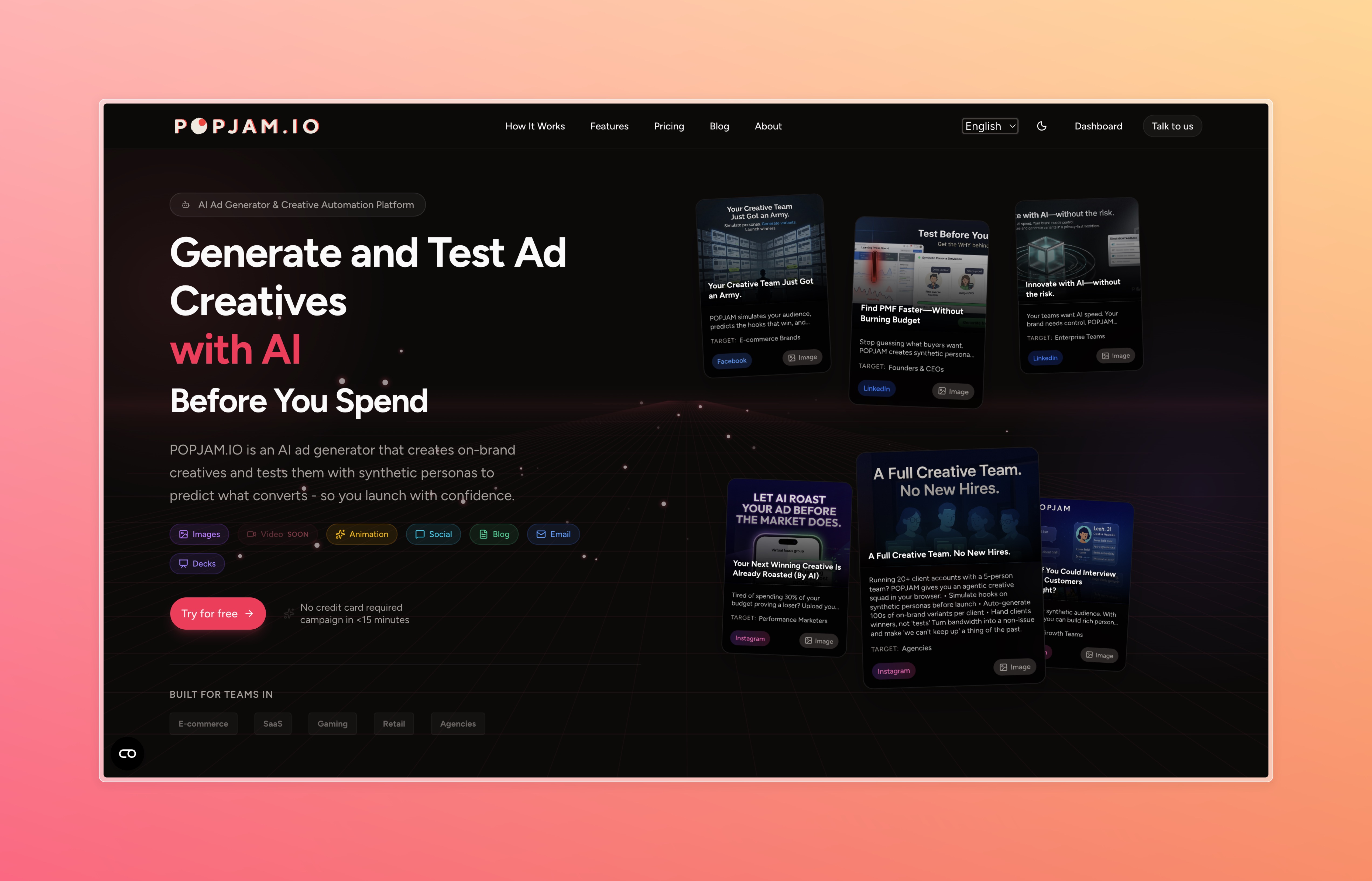
With creative automation tools that handle image, video, and copy generation across Meta, TikTok, Google, and more, your team can produce and pre-test more variants without burning out. And you can start with free ad testing to see exactly how your current creatives score before committing to a full workflow change. Pre-testing shouldn’t be a barrier. With POPJAM, it’s the fastest path to campaigns that actually deliver.
Frequently asked questions
What exactly is AI-driven ad creative pre-testing?
AI-driven pre-testing analyzes ad variations in a simulated environment to predict likely real-world performance before launch. It uses synthetic personas and predictive models to score creative variants on metrics like CTR and purchase intent, so you know what works before spending on media.
Does pre-testing really impact ROI for e-commerce brands?
Yes. E-commerce brands have reported up to 287% ROAS improvement after adopting AI-powered pre-testing, driven by launching only validated creatives and cutting underperformers before they drain budget.
How many ad variations can AI pre-test at once?
AI systems can test thousands of variants in parallel, far outpacing any manual review process. This makes it practical to test every hook, visual, and copy combination before a single dollar goes to live media.
What metrics should I look for in pre-test reports?
Focus on predicted CTR, engagement rate, and purchase intent uplift. Since creative quality drives 47-70% of performance variability, these signals are your strongest early indicators of which variants will win in the real world.
Is pre-testing a must for every campaign size or type?
Pre-testing is highly recommended for any campaign where budget efficiency matters. Given that creative quality accounts for nearly 70% of ad performance variability, even small campaigns benefit from knowing which creative will actually resonate before launch.
Recommended
- Free Ad Testing Tool | Test Ads Before You Spend | POPJAM.IO
- How to Test Ad Creatives Before Launch (2026 Guide) | POPJAM.IO Blog
- How to create high-impact ad creatives: steps & testing | POPJAM.IO Blog
- POPJAM.IO - AI Ad Generator & Creative Testing Platform | Test Before You Spend
- Optimize Email ROI 2025: Proven Tactics for E-Commerce Brands