

Defining behavioral audience data for smarter ad targeting
Learn how behavioral audience data powers smarter ad targeting in 2026. Discover collection methods, activation strategies, and privacy-first frameworks for performance marketers.


TL;DR:
- Behavioral audience data captures user actions and intent beyond demographic labels.
- Proper collection, segmentation, and activation of behavioral data improve ad targeting and ROI.
- Ethical considerations, privacy laws, and proactive strategies are vital for effective behavioral marketing in 2026.
Demographic data tells you someone is a 35-year-old woman in Chicago who earns $80,000 a year. It does not tell you she abandoned her cart twice this week, binge-watches product reviews before buying, and only converts on weekends. That gap between who someone is and what they actually do is exactly where most ad campaigns lose money. Behavioral audience data refers to user actions like purchases, site visits, and engagement patterns, and in 2026 it is the signal layer separating high-performing campaigns from wasted spend. This guide breaks down what behavioral data is, how to collect and activate it, and where most marketers still get it wrong.
Table of Contents
- Case Studies: Real-World Paid Media Wins with Behavioral Data
- What is behavioral audience data?
- How is behavioral audience data collected and segmented?
- Nuances and challenges in using behavioral data
- Integrating and activating behavioral data for maximum performance
- Why the behavioral marketing playbook must change in 2026
- Next steps: Power your campaigns with AI-driven behavioral insights
- Frequently asked questions
Key Takeaways
| Point | Details |
|---|---|
| Behavioral data defined | Understanding real user actions enables sharper audience segmentation than demographics alone. |
| Modern segmentation tools | Marketers leverage first-party tracking, ML-powered clustering, and privacy-first CDPs to build actionable audiences. |
| Privacy and practical pitfalls | Avoid over-personalization and data silos; always use ethical, privacy-first approaches for behavioral data. |
| Unified campaign activation | Integrating behavioral, contextual, and creative data increases marketing performance and closes post-cookie gaps. |
Case Studies: Real-World Paid Media Wins with Behavioral Data
E-commerce, ROI goal: switching from static demographic sets to AI-driven, self-optimizing behavioral audiences lifted ROI 4x and cut customer acquisition costs by 52%.
B2B SaaS, pipeline goal: Amazon’s behavioral propensity modeling, built on purchase and browsing history rather than demographics, is credited with driving 35% of its total sales, a sign of how far intent-based targeting scales when applied consistently.
What is behavioral audience data?
With the need for more precise targeting, let’s clarify what behavioral audience data actually means and how it differs from traditional audience data.
Behavioral audience data is the record of what people do rather than who they are. It captures actions across digital and physical environments, from clicking a product page to walking into a store. Where demographic data labels a person, behavioral data reveals intent. That distinction matters enormously when you are optimizing bids, writing ad copy, or deciding which creative to run.
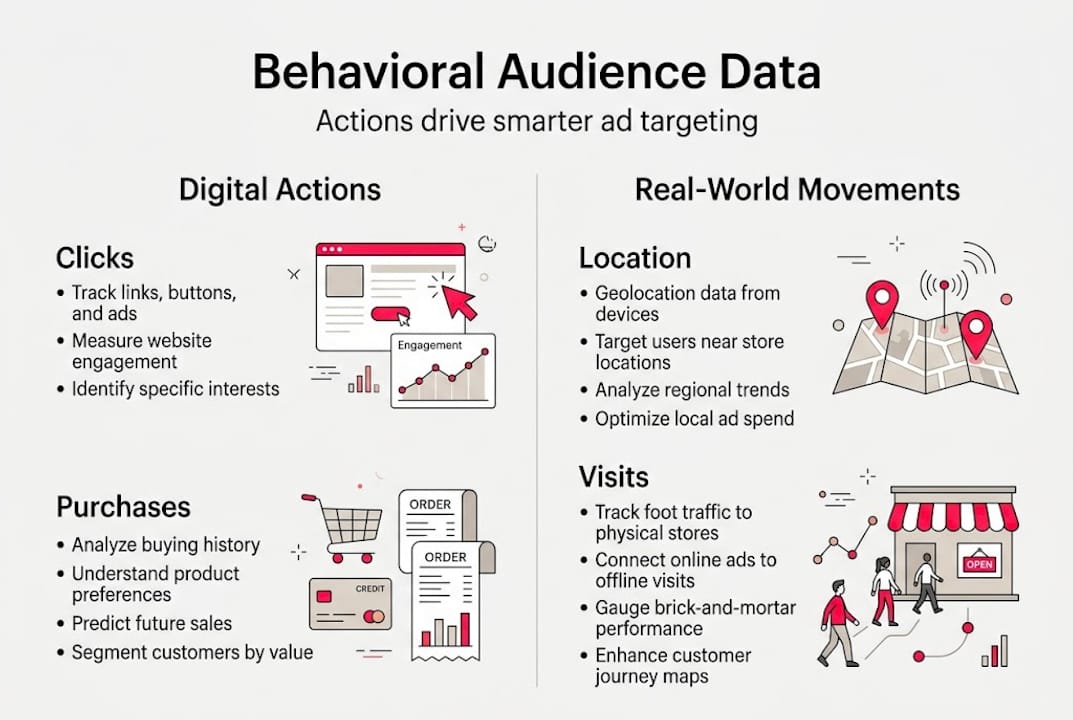
Behavioral audience data includes digital actions like clicks and purchases as well as real-world movements like location visits. Think of it as a continuous stream of signals that, when read correctly, tells you exactly where a buyer is in their decision journey.
Here is a quick comparison to anchor the difference:
| Data type | Example signal | What it tells you |
|---|---|---|
| Demographic | Age 28, male, NYC | Who the person is |
| Behavioral | Visited pricing page 3x | Purchase intent level |
| Contextual | Reading a fitness article | Current mindset/topic |
| Intent | Searched “best running shoes” | Active research phase |
The key actions that generate behavioral data include:
- Page visits and scroll depth on your website or landing pages
- Clicks and add-to-cart events in e-commerce flows
- Form fills and email opens across nurture sequences
- Repeat purchases and subscription renewals that signal loyalty
- Video watch time and pause points on ad platforms
- Location check-ins and in-store visits from mobile data
Why does this matter so much right now? Because audience research methods have evolved well beyond surveys and focus groups. Marketers who rely on data-backed marketing consistently outperform those running on assumptions. And with data-backed creatives becoming the standard, behavioral signals are now the raw material for every high-converting ad. The creative automation guide shows how teams are already feeding behavioral inputs directly into their production pipelines.
How is behavioral audience data collected and segmented?
Collection has gotten more sophisticated, and more complicated, since third-party cookies started disappearing. Here is the checklist advanced teams run through, with the tools behind each step.

Collection checklist:
- Ad platform pixels: deploy first-party pixels on Meta and Google to capture browsing depth, content engagement, and purchase patterns directly from your own properties
- Web analytics and email engagement: track high-intent signals like pricing page visits, content downloads, and webinar attendance instead of defaulting to demographic lists
- CDP unification: pipe pixel, analytics, and email events into a Customer Data Platform (CDP) to unify cross-channel behavior under a single user ID
- ML clustering: apply pattern recognition to form behavioral clusters, such as users who repeatedly view the same product or who re-engage from mobile within 48 hours
- eRFM scoring: score users with an enhanced Recency, Frequency, Monetary value (eRFM) model to rank who is most worth targeting right now
- Platform-specific segmentation: use Meta for social behavioral signals and Google for search and cross-device intent, since advanced teams typically run both rather than picking one
Platform picks by team size:
| Team type | Where to start |
|---|---|
| SaaS (lean team) | A single CDP plus eRFM scoring to prioritize trial users before adding clustering |
| E-commerce | Meta and Google pixels feeding a CDP, with ML clustering on cart and browsing behavior |
| Agencies | A CDP that supports multiple client workspaces, paired with platform-native segmentation on each client’s primary channel |
Server-side tracking can recover 15-30% of signals lost after the cookie deprecation. That is not a rounding error. For a $500,000 monthly ad budget, that signal recovery translates directly into measurable ROAS improvement.
Pair it with a CDP that supports consent management and you have a compliant, durable data foundation, a core piece of performance marketing best practices. AI in performance marketing is accelerating how quickly teams can act on these signals once they are clean and unified.
Nuances and challenges in using behavioral data
Behavioral data is powerful precisely because it is personal. Used carelessly, it creates legal exposure, audience distrust, and campaigns that feel invasive rather than relevant.
Post-cookie privacy challenges, data silos, small audience segments, and over-personalization trip up even experienced teams. The 2026 legislation landscape has tightened further, with several US states adding behavioral data explicitly to their consumer privacy frameworks.
Consent management steps:
- Map your data sources so every pixel, CDP feed, and email platform has a documented consent basis before it touches a live campaign
- Sync consent status in real time between your CDP and ad platforms, so a withdrawn consent removes a user from active segments immediately, not at the next sync
- Set a data freshness limit and retire segments built on signals older than 30-60 days in fast-moving categories
- Separate sensitive categories like health searches, financial distress signals, and location near medical facilities into a governance track with stricter access controls
Bias audit steps:
- Check cluster composition after ML segmentation to see whether a behavioral cluster is quietly acting as a proxy for a protected attribute
- Test segment stability across demographic cuts to confirm a behavioral pattern holds the same meaning for different groups
- Flag inferred sensitive attributes like health status, race, or religion drawn from behavioral proxies, and remove them from the targeting input
- Review LLM-based personalization separately whenever the underlying data set includes sensitive behavioral signals, since that combination carries the highest risk
Common mistakes that undercut all of the above:
- Ignoring data silos where your CRM, ad platform, and CDP hold conflicting user records
- Over-segmenting into audience clusters too small to achieve statistical significance
- Skipping fairness checks before launch instead of simulating how a segment will be treated across variations
Sensitive behaviors, including health searches, financial distress signals, and location patterns near medical facilities, must be handled under stricter data governance. Inferring these traits and using them for targeting is not just ethically questionable. In many jurisdictions it is now illegal.
Pro Tip: Run a creepiness audit on your highest-performing segments before every launch. If a human reviewer would find the targeting rationale uncomfortable to explain out loud, your audience probably will too. Precision is a feature. Surveillance is a liability.
Integrating and activating behavioral data for maximum performance
Activation is where behavioral data turns into revenue. The flow moves from collection through segmentation into your DSP or ad platform, where it powers targeting, bid adjustments, and creative personalization.
Prioritize AI-driven dynamic audience creation over static lists, since continuous optimization keeps performance intact as behaviors shift. Unifying behavioral data across Meta, Google, and your own web analytics improves real-time targeting updates, cross-device tracking, and reduces audience overlap.
Platform-by-platform notes:
- Meta: strongest for social behavioral signals like engagement, video watch time, and on-platform purchase actions
- Google: best for search intent and cross-device purchase journeys, so pair it with Meta rather than choosing one
- LinkedIn: build audiences from content consumption, website journeys, and webinar attendance instead of filtering by title and industry
- TikTok and Reddit: feed watch-time and engagement signals into the same CDP pipeline so segments stay consistent with your other channels
A LinkedIn example to model: a B2B sales product campaign swapped demographic filters for behavioral targeting, uploading lists of users who had consumed competitor content and sales automation guides. That shift produced an 8:1 deal conversion advantage over the demographic approach, and a follow-up campaign using content consumption, website journeys, engagement patterns, and webinar data drove a ninefold improvement in monthly deal volume.
The stepwise approach behind that result: identify companies actively researching the category, collect data on individuals consuming relevant content, build behavioral custom audiences from that data, then launch ads directly to the high-intent segment.
The activation sequence to run across your stack:
- Collect first-party behavioral events via server-side tracking
- Segment users in your CDP using ML clustering and eRFM scoring
- Activate segments in your DSP with behavioral bid multipliers
- Personalize creatives using data-driven ad creatives matched to segment behavior
- Test variations using synthetic personas for ad testing before committing budget
- Optimize using ad feedback analysis and iterate on creative and audience simultaneously
Combining contextual and behavioral targeting in a privacy-first environment helps close a 5-8% performance gap versus behavioral alone, a gap that compounds across a full campaign flight. Check out social media ad examples to see how top performers pair these signals in platform-native formats.
Why the behavioral marketing playbook must change in 2026
Most performance teams are still running audience strategies built for a world that no longer exists. They segment by age and interest, layer on a retargeting pixel, and call it behavioral targeting. It is not. It is demographic targeting with a behavioral label on it.
The real shift in 2026 is from reactive segmentation to predictive simulation. Waiting for post-campaign reports to understand what worked is the equivalent of steering by looking out the rear window. The teams winning right now are simulating outcomes before launch, using AI to model how specific behavioral segments will respond to specific creative variations. Creative automation in 2026 is not just about speed. It is about building feedback loops that get smarter with every campaign cycle.
Privacy fragmentation is not a problem to solve once. It is a permanent condition to design around. That means your behavioral data strategy needs to be agile, first-party by default, and simulation-driven rather than observation-dependent. The marketers who embrace this now will have a structural advantage that compounds every quarter.
Next steps: Power your campaigns with AI-driven behavioral insights
Understanding behavioral audience data is one thing. Activating it at speed, with the right creative, on the right platform, before you burn budget, is another challenge entirely.
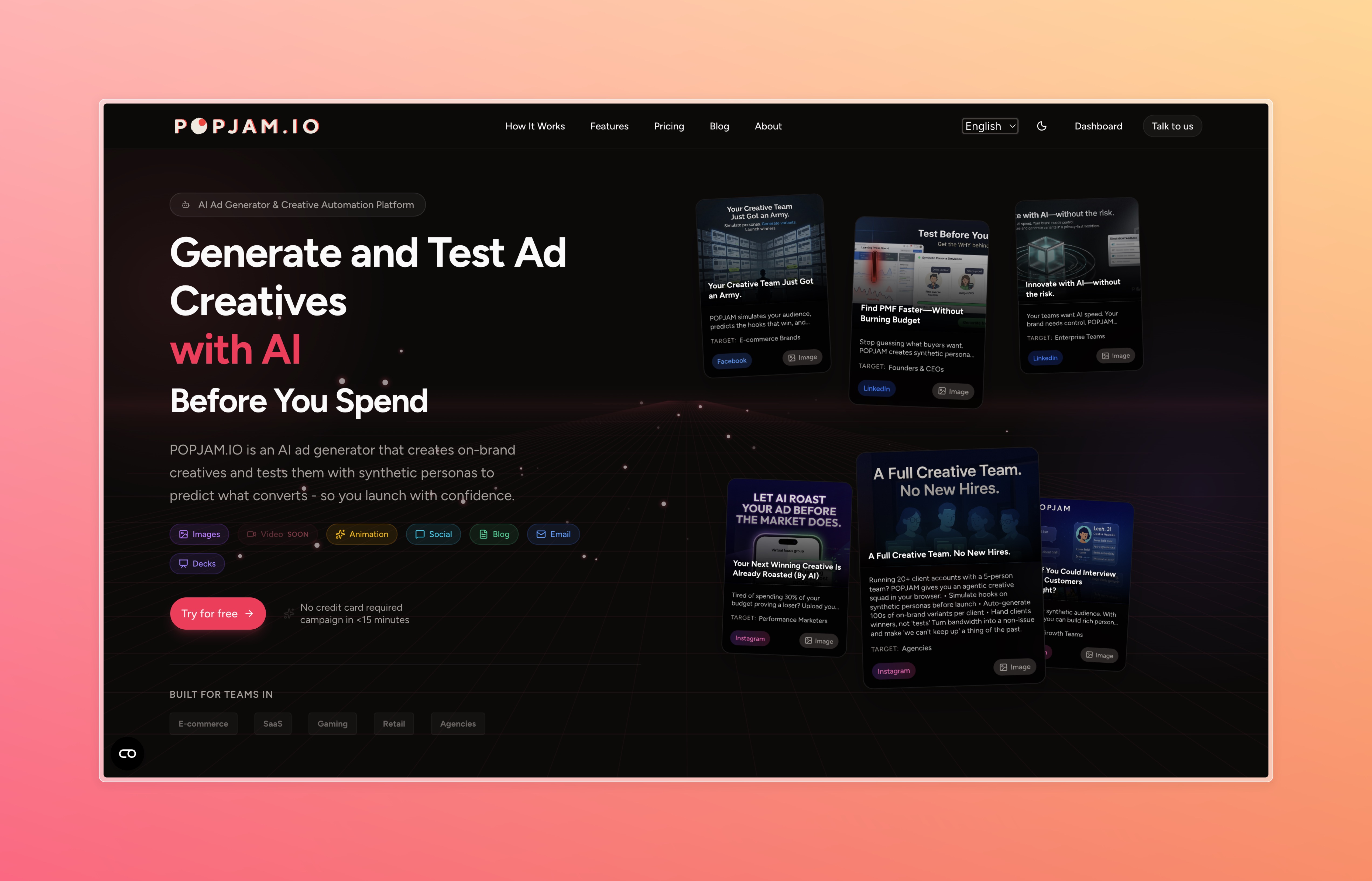
POPJAM.io connects behavioral insights directly to your creative workflow. Build psychographic synthetic personas from your behavioral data, simulate how different audience segments respond to ad variations, and export winning creatives to Meta, TikTok, Google, and more, all before you spend a dollar on live traffic. Whether you need an AI ad generator, a dedicated ad testing tool, or a full creative automation platform, POPJAM gives performance marketers the infrastructure to move from data to deployed campaign faster than any manual process allows.
Frequently asked questions
What are the main sources of behavioral audience data?
First-party sources like pixels, CDPs, and server-side tracking are the primary collection points, capturing user actions across digital channels without relying on third-party cookies.
How do marketers use behavioral data to improve ad campaigns?
Marketers segment users by actions and intent, then activate those segments in DSPs and CDPs for personalized retargeting, churn prediction, and creative testing that is matched to real behavioral patterns.
What privacy risks exist in behavioral audience targeting?
Over-personalization and sensitive inferences are the biggest risks. Avoiding LLMs on sensitive behavioral data and building consent-first data pipelines keeps you compliant and protects audience trust.
Can behavioral data still work without third-party cookies?
Absolutely. With server-side and first-party tracking, teams can recover 15-30% of signals that would otherwise be lost, making cookieless behavioral targeting both viable and scalable.
How do contextual and behavioral targeting work together?
Combining both approaches closes a 5-8% performance gap compared to using behavioral data alone, giving you stronger full-funnel coverage in privacy-first environments.