

Top performance marketing best practices for results
Discover top performance marketing best practices for 2026. Learn how to set KPIs, test creatives, automate campaigns, and scale results with AI-powered tools.


TL;DR:
- Success in 2026 performance marketing relies on setting clear KPIs, testing, and automation.
- Data-driven creative testing and audience segmentation significantly improve campaign ROI.
- Continuous measurement, iteration, and rapid experimentation are key for maintaining competitive advantage.
Performance marketers in 2026 are managing more channels, more creative formats, and more audience signals than ever before. The pressure to produce winning ads faster while spending less is relentless. Yet most teams still rely on gut instinct for creative decisions and scramble to interpret data after campaigns go live. That reactive approach costs real money. This article breaks down the best practices that actually move the needle: from setting the right KPIs and running structured creative tests, to using automation and segmentation to scale what works. Follow this framework and you’ll spend less time guessing and more time growing.
Table of Contents
- Establish clear objectives and KPIs
- Optimize creative with data-driven testing
- Leverage audience segmentation and personalization
- Embrace automation for efficiency and scale
- Measure, analyze, and iterate for continuous improvement
- Our perspective: The golden rule for performance marketing in 2026
- Take your performance marketing to the next level
- Frequently asked questions
Key Takeaways
| Point | Details |
|---|---|
| Set actionable KPIs | Defining, monitoring, and adjusting key performance indicators is foundational to optimizing your campaigns. |
| Test creatives relentlessly | Frequent creative testing and automation unlock continuous performance improvements and higher ROI. |
| Prioritize audience targeting | Segmentation and personalization help deliver the right message to the most valuable customers. |
| Automate for scale | Leveraging campaign automation drives efficiency and lets you focus on strategic optimization. |
| Learn and iterate | Review data, experiment, and update tactics regularly for lasting marketing success. |
Establish clear objectives and KPIs
Every high-performing campaign starts with a clear answer to one question: what does success actually look like? Without that answer, you’re optimizing in the dark. Aligning campaigns with specific, measurable KPIs improves overall ROI, yet many teams skip this step and jump straight to execution.
The most commonly tracked performance marketing KPIs include:
- Click-through rate (CTR): Measures how compelling your ad is at driving action.
- Conversion rate: Tracks how many clicks turn into purchases, sign-ups, or leads.
- Cost per acquisition (CPA): Shows what you’re paying to win each new customer.
- Return on ad spend (ROAS): Reveals the revenue generated for every dollar spent on ads.
The problem isn’t knowing these metrics exist. It’s tying them to specific business objectives before a campaign launches. Use the SMART framework to structure every goal: Specific, Measurable, Achievable, Relevant, and Time-bound. Instead of “increase sales,” write “achieve a 3.5x ROAS on Meta within 30 days for the summer collection.”
Revisit your KPIs at least weekly during active campaigns. Markets shift, creative fatigue sets in, and audience behavior changes. A KPI that made sense in week one may need recalibration by week three. Build that flexibility into your planning process from the start.
Pro Tip: Set up automated dashboards using AI marketing tools that surface KPI changes in real time. Catching a CPA spike on day three beats discovering it on day fourteen when budget is already gone.
Optimize creative with data-driven testing
Once your goals are set, the creative you deploy is your growth engine. Here’s how to make every asset count.

Most performance teams run some version of A/B testing, but few do it systematically. Structured testing means isolating one variable at a time, collecting statistically meaningful data, and applying learnings to the next round. Regular creative testing improves engagement rates and campaign ROI by removing opinion from the equation.
Here’s a prioritized order for what to test first:
- Headline: This is the first thing your audience reads. Small word changes can produce dramatic CTR swings.
- Hero image or video: Visual format and subject matter drive initial attention more than any other element.
- Call-to-action (CTA): “Shop now” versus “Get yours today” can meaningfully shift conversion rates.
- Ad format: Static versus video versus carousel often produces surprising results by audience segment.
- Offer framing: Percentage discount versus dollar amount versus free shipping each land differently depending on your audience.
The table below shows typical performance lifts by variable type based on industry benchmarks:
| Variable tested | Average CTR lift | Average conversion lift |
|---|---|---|
| Headline | 15-25% | 8-12% |
| Hero image/video | 20-40% | 10-18% |
| CTA copy | 5-15% | 6-14% |
| Ad format | 10-30% | 8-20% |
| Offer framing | 8-20% | 12-25% |
Using an AI ad generator dramatically expands your testing capacity. Instead of producing three creative variants per week, teams can generate dozens, pre-screen them against synthetic audience personas, and only spend budget on the strongest performers. Pair that with creative automation to resize and reformat winners across platforms without manual production work.
Pro Tip: Use your ad testing tool to rotate winning creatives every 10 to 14 days. Even strong ads decay. Refreshing before fatigue sets in keeps your CPMs stable and your audience engaged.
Leverage audience segmentation and personalization
With high-performing creatives ready, delivering them to the right audience is the next lever to pull.
Audience segmentation means dividing your total addressable market into smaller groups based on shared characteristics, then tailoring your message for each group. The broader your targeting, the more generic your creative has to be. Generic creative performs generically.
Effective segmentation approaches include:
- Behavioral segmentation: Group users by purchase history, browsing patterns, or engagement with previous ads.
- Demographic segmentation: Age, location, income level, and device type all influence what messaging resonates.
- Value-tier segmentation: Separate high-lifetime-value customers from one-time buyers and market to each differently.
- Funnel-stage segmentation: Cold audiences need awareness content. Warm retargeting audiences need proof and urgency.
Personalized campaigns see higher conversion rates, and the gap between personalized and generic campaigns keeps widening as ad platforms reward relevance with lower CPMs.
The practical challenge is building and maintaining accurate personas at scale. That used to require expensive research or lengthy data collection cycles. AI-powered tools now let you build synthetic personas from behavioral data in hours, not weeks. An AI persona generator can map psychographic traits, motivations, and objections for each segment, giving your creative team a precise brief instead of a vague demographic bucket.
Refresh your segments at least once per quarter. Customer behavior evolves, especially in e-commerce where seasonal trends and new product launches shift purchase intent rapidly. Stale segments produce stale results.
Embrace automation for efficiency and scale
Having mastered creative and segmentation, scaling impact relies on efficient execution. Automation is the modern solution.
Automation in campaign management increases scale and reduces manual errors, freeing your team to focus on strategy instead of repetitive tasks. The key is knowing which tasks to automate first.
High-impact automation priorities:
- Budget allocation: Automated rules shift spend toward top-performing ad sets in real time without manual intervention.
- Bid management: Smart bidding strategies on Meta and Google optimize for your target CPA or ROAS continuously.
- Creative rotation: Automatically swap in fresh creatives when frequency or fatigue signals spike.
- Audience refresh: Sync CRM data to ad platforms automatically to keep lookalike and retargeting lists current.
Here’s how leading automation approaches compare:
| Automation type | Key benefit | Best for |
|---|---|---|
| Smart bidding | Real-time CPA/ROAS optimization | Scaling proven campaigns |
| Dynamic creative | Auto-assembles best-performing elements | High-volume e-commerce |
| Rule-based budget shifts | Reduces wasted spend on underperformers | Multi-campaign management |
| AI creative generation | Produces variants at scale pre-launch | Testing-heavy teams |
The creative automation platform approach goes further by connecting creative production directly to performance data. When a variant underperforms, the system flags it. When one outperforms, it scales it. That feedback loop used to take days of manual analysis. Now it runs continuously.
Start with one or two automation tasks, measure the impact, and expand from there. Trying to automate everything at once usually creates more confusion than efficiency.
Measure, analyze, and iterate for continuous improvement
None of the above works without robust analysis and ongoing tweaks. Here’s how to keep improving.
Frequent measurement is not optional. Build custom dashboards that surface your core KPIs daily, and schedule a structured weekly review to interpret what the data is telling you. Attribution data is especially important: knowing which touchpoint actually drove the conversion helps you allocate budget where it earns the most.
A structured iteration process looks like this:
- Analyze: Pull performance data and identify the biggest gaps between target and actual KPIs.
- Decide: Form a clear hypothesis about what change will close that gap.
- Implement: Launch the change as a controlled test, not a wholesale overhaul.
- Measure: Give the change enough time and traffic to produce statistically valid results before drawing conclusions.
“The brands that win in performance marketing are not the ones with the biggest budgets. They’re the ones with the fastest learning loops.”
Consistently analyzing performance and making data-driven changes increases marketing ROI over time. The compounding effect of small, consistent improvements beats any single campaign breakthrough.
Common pitfalls to avoid: sticking with underperforming assets because they took effort to produce, and testing too many variables at once so you can’t isolate what actually worked. Discipline in your testing process is what separates teams that improve from teams that just stay busy.
Our perspective: The golden rule for performance marketing in 2026
Here’s the uncomfortable truth most performance marketing content won’t say out loud: there is no single best practice that will save your campaigns. The marketers who consistently outperform their peers are not the ones who found the perfect bidding strategy or the magic creative format. They’re the ones who built a system for learning faster than everyone else.
Channel tactics change every quarter. Platform algorithms shift. Audience behavior evolves. What worked in Q1 may be obsolete by Q3. The only durable competitive advantage is the speed at which your team can test a hypothesis, extract a signal, and apply it to the next campaign.
This means treating every campaign as an experiment, not a production. It means involving both creative and data teams from day one, not handing off a brief and waiting for results. It means investing in automation in marketing not because it’s trendy, but because it compresses your learning cycle from weeks to days.
Pro Tip: Document every test result, even the failures. A library of what doesn’t work for your audience is just as valuable as a swipe file of winners. It prevents your team from repeating expensive mistakes and accelerates onboarding for new hires.
The brands that will dominate e-commerce advertising in 2026 are building systems right now. Not chasing features. Not copying competitors. Building repeatable processes for rapid, disciplined experimentation.
Take your performance marketing to the next level
Ready to put these best practices into action? The right technology makes the difference between knowing what to do and actually doing it at scale.
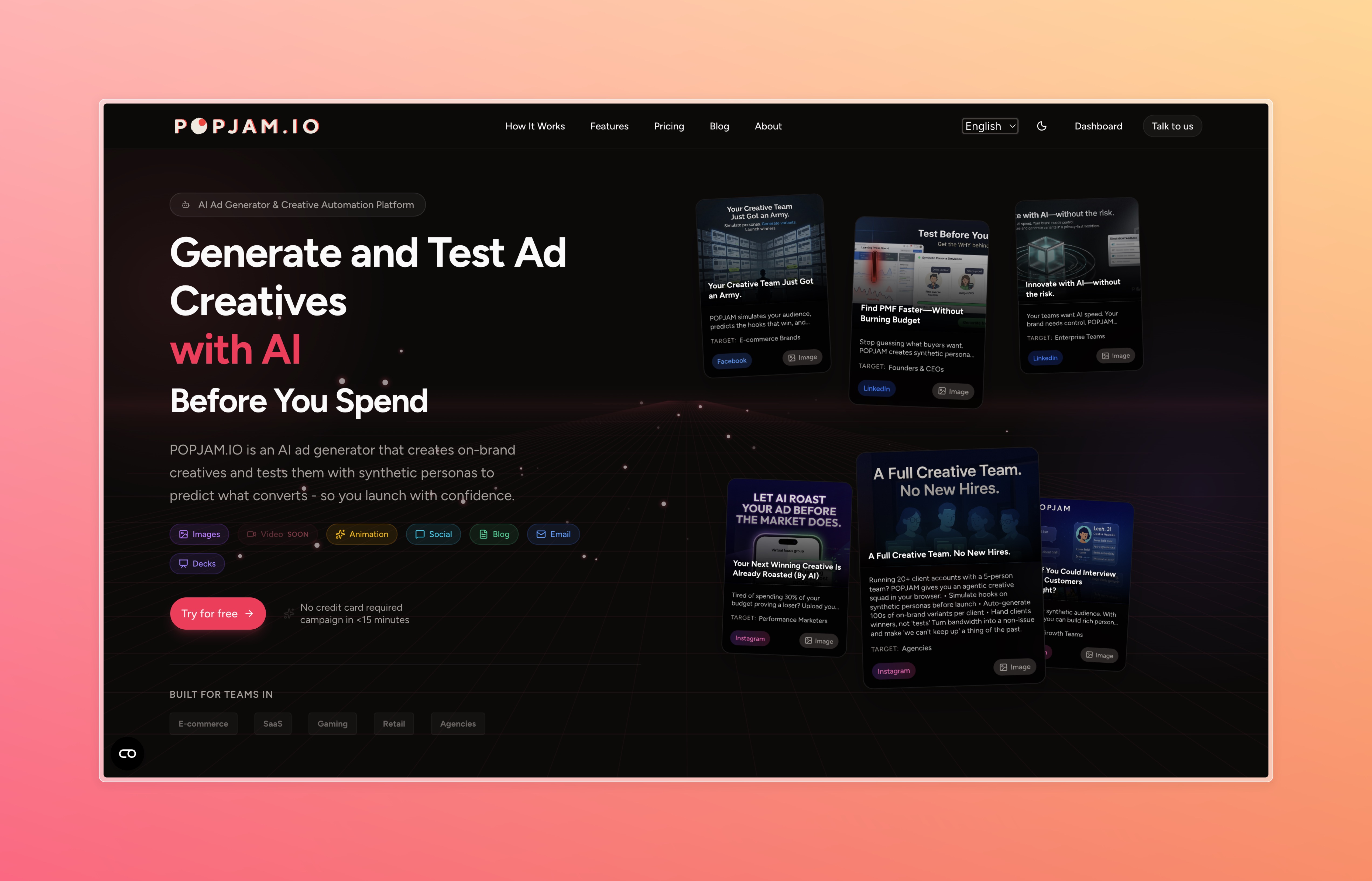
POPJAM.IO brings together everything covered in this article into one connected workflow. Use the AI ad generator to produce platform-native creatives in minutes, then validate them against synthetic audience personas before spending a dollar. Run structured tests with built-in ad testing tools and push winners live through the creative automation platform. For e-commerce teams that need to move fast without sacrificing creative quality or budget efficiency, POPJAM.IO is built exactly for that workflow.
Frequently asked questions
What is the most important performance marketing KPI?
ROAS is the central KPI for judging paid campaign efficiency, but the most critical metric always depends on your specific business objective. Start with ROAS and layer in CPA and conversion rate for a complete picture.
How often should I update my ad creatives?
Frequent creative testing prevents ad fatigue and improves engagement, so aim to refresh creatives every one to two weeks. Monitor frequency and CTR trends as early warning signals that a creative is burning out.
What are quick-win automation tasks for performance marketers?
Automation of routine tasks delivers notable efficiency for media buyers. Start with budget allocation rules, automated bid adjustments, and creative rotation to see the fastest gains with the least setup complexity.
Why is audience segmentation vital to campaign success?
Personalized campaigns see higher conversion rates because segmentation lets you match the right message to the right audience at the right moment. Generic targeting forces generic creative, which drives up costs and drives down relevance scores.