

What is data-backed marketing? Unlock higher ROI
Learn what data-backed marketing is, how it works, and how to apply evidence-driven strategies to optimize ad creatives, improve targeting, and increase ROI.


TL;DR:
- Data-backed marketing uses customer data and performance metrics to guide decisions instead of gut feeling.
- It enables precise targeting, smarter ad spend, and faster creative iterations through structured testing.
- Success requires balancing data insights with creative intuition and moving quickly to test and adapt.
Marketing has never been a pure guessing game, but too many teams still run campaigns on instinct alone. The brands pulling ahead in 2026 are the ones treating every creative decision as a hypothesis to test, not a bet to place. Data-driven marketing replaces gut feeling with evidence, using customer behavior, performance metrics, and real audience signals to guide every move. In this article, you’ll get a clear definition of data-backed marketing, see how it works in practice, and walk away with actionable strategies to sharpen your targeting and creative output.
Table of Contents
- Defining data-backed marketing: What it is and why it matters
- How data-backed marketing works: Process, sources, and tools
- Benefits and challenges: Data-backed marketing in the real world
- Applying data-backed marketing: Strategies for creative optimization and targeting
- A new mindset: Why blending data, creativity, and speed wins in 2026
- Move faster with smarter data-backed tools
- Frequently asked questions
Key Takeaways
| Point | Details |
|---|---|
| Evidence-driven decisions | Data-backed marketing replaces guesswork with insights for more reliable results. |
| First-party data focus | Prioritizing first-party and zero-party data keeps campaigns compliant and effective. |
| Balance data with creativity | The best outcomes combine measurement with rapid creative experimentation. |
| Pitfalls to avoid | Bad data, data silos, and over-analysis can undermine even the best strategies. |
| Faster optimization | Agile testing and automation tools let you improve performance at scale. |
Defining data-backed marketing: What it is and why it matters
Now that you’re aware of marketing’s shift from gut feeling to data-backed choices, let’s break down exactly what that means.
Data-backed marketing, also called data-driven marketing, is the practice of using customer data, behavioral patterns, and performance metrics to make marketing decisions. Instead of launching a campaign because it “feels right,” you’re acting on evidence. That evidence might come from click-through rates, purchase history, audience segmentation models, or real-time creative performance signals.
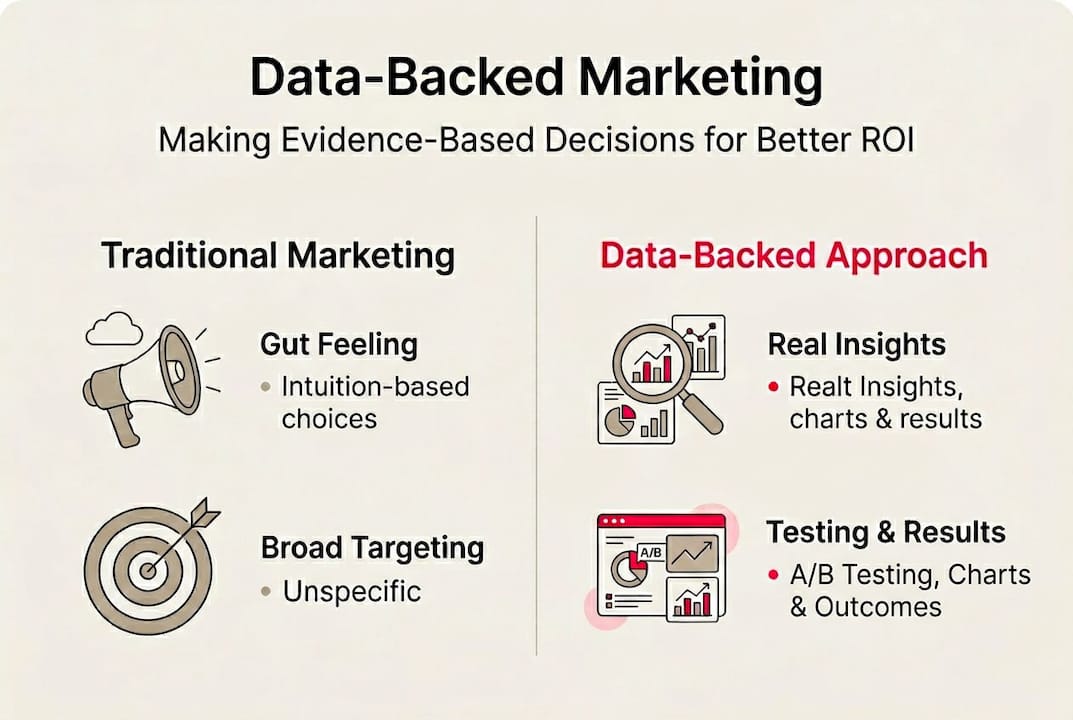
The contrast with traditional marketing is sharp. Traditional approaches rely on broad demographic assumptions, creative instinct, and post-campaign measurement that often comes too late to course-correct. Data-backed marketing aligns strategies with actual customer behaviors and performance metrics, enabling far more precise targeting and personalization at scale.
| Approach | Decision basis | Measurement timing | Targeting precision |
|---|---|---|---|
| Traditional marketing | Intuition, demographics | Post-campaign | Broad |
| Data-backed marketing | Behavioral data, metrics | Real-time or near real-time | Granular |
Here’s what makes up the core of a data-backed marketing system:
- Customer data: Purchase history, browsing behavior, CRM records
- Behavioral insights: How audiences interact with ads, landing pages, and content
- Performance metrics: CTR, ROAS, conversion rate, cost per acquisition
- Segmentation models: Grouping audiences by intent, stage, or psychographic profile
A practical example: imagine you’re running paid social for a DTC skincare brand. Instead of guessing which creative angle works best, you pull first-party data on your top 20% of buyers. You find they respond to ingredient-focused messaging, not lifestyle imagery. You build your next campaign around that insight, and your cost per purchase drops 30%. That’s data-backed marketing in action.
For teams looking to build on this foundation, exploring performance marketing best practices gives you a structured framework to layer data into every stage of your funnel.
How data-backed marketing works: Process, sources, and tools
With a clear definition in mind, let’s look at how data-backed marketing is put into practice, from data collection to activation.
The first decision you’ll make is where your data comes from. Not all data sources carry the same weight, especially now that privacy regulations limit third-party data, pushing teams toward first-party and zero-party collection.

| Data type | Example | Privacy compliance | Reliability |
|---|---|---|---|
| First-party | Website analytics, CRM | High | High |
| Zero-party | Survey responses, quiz data | Very high | Very high |
| Second-party | Partner data sharing | Medium | Medium |
| Third-party | Data brokers | Low (shrinking) | Low |
Once you know your sources, the process follows a clear sequence:
- Collect: Gather data from your owned channels, pixels, CRM, and direct audience interactions.
- Analyze: Use analytics platforms to surface patterns, segments, and performance gaps.
- Hypothesize: Form a specific, testable assumption based on what the data shows.
- Act: Launch a targeted campaign, creative variant, or audience test.
- Iterate: Measure results, feed findings back into the next cycle.
The tools that power this workflow include analytics platforms like Google Analytics 4, marketing mix modeling (MMM) software, CDP platforms for audience management, and creative testing tools that let you validate concepts before spending budget. Connecting your audience research methods to your creative pipeline is where most teams find the biggest efficiency gains.
Pro Tip: Before you analyze anything, audit your data quality. Dirty data, duplicate records, or misattributed conversions will send your strategy in the wrong direction fast. Clean inputs produce reliable outputs. If you want to see how this connects to creative decisions, the process of testing data-driven creatives is a natural extension of this workflow.
Benefits and challenges: Data-backed marketing in the real world
Building on how it works, it’s essential to know where data-backed marketing excels and where pitfalls can cost you.
The benefits are real and measurable. When your campaigns are built on verified audience signals, you stop wasting impressions on people who will never convert. You allocate budget toward the channels and creatives that actually move the needle. Personalization becomes scalable, not a manual effort.
Key benefits:
- Laser-focused audience targeting based on intent and behavior
- Smarter ad spend with measurable ROAS improvement
- Faster creative iteration driven by real performance signals
- Personalization at scale without proportionally increasing team size
- Reduced guesswork in budget allocation across channels
But the challenges are just as real. 47% of marketing spend is wasted on poor data, and 51% of CTOs admit they distrust their own marketing data. That’s a significant problem when your entire strategy depends on data being accurate.
Common pitfalls include:
- Data silos: When your CRM, ad platform, and analytics tool don’t talk to each other, you’re making decisions on incomplete pictures.
- Privacy hurdles: Tightening regulations around cookies and third-party tracking require constant strategy updates.
- Analysis paralysis: Too much data without a clear decision framework leads to inaction, not optimization.
- Bad data inputs: Misattributed conversions or bot traffic skew your metrics and mislead your strategy.
“Balance data with creative intuition. The best campaigns use data to validate direction, not replace the bold ideas that make audiences stop scrolling.”
Pro Tip: Run a quarterly data audit across all your sources. Unify your CRM, ad platform data, and analytics into a single reporting layer. Fragmented data is the silent killer of otherwise solid strategies. Reviewing ad feedback analysis alongside your metrics helps you catch blind spots before they compound. For inspiration on what good execution looks like, data-backed creative examples show how leading teams close the loop between insight and output.
Applying data-backed marketing: Strategies for creative optimization and targeting
Understanding benefits and challenges is only half the battle. Here’s how to put data-backed methods to work for your campaigns.
The most effective performance marketers don’t just collect data. They build systems that turn data into creative decisions quickly. Here’s a practical sequence to follow:
- Segment your audience by behavior, not just demographics. Use purchase history, engagement patterns, and intent signals to build tighter audience groups.
- Run structured A/B tests on creative variables. Test one element at a time: headline, visual format, CTA, or offer framing. Keep everything else constant.
- Use marketing mix modeling (MMM) to understand which channels actually drive conversions, especially in a cookieless environment.
- Activate dynamic content that adapts messaging based on audience segment or funnel stage.
- Iterate in short cycles. Weekly or biweekly creative reviews beat quarterly overhauls every time.
For creative optimization specifically, the goal is to test before you spend. Prioritize first-party data and MMM for privacy-compliant, accurate attribution. This means building a feedback loop where every creative asset gets validated against real audience signals before full budget commitment.
Targeting best practices:
- Layer behavioral data over demographic filters for sharper audience matching
- Use lookalike audiences built from your highest-value customer segments
- Suppress recent converters to avoid wasting spend on already-acquired customers
- Test platform-specific creative formats to match native behavior on Meta, TikTok, or LinkedIn
Pro Tip: Pair structured data insights with qualitative market feedback. Quantitative data tells you what is happening. Qualitative signals tell you why. Together, they produce campaign breakthroughs that neither source achieves alone. If you haven’t explored pre-testing ad creatives before launch, that’s the single highest-leverage habit you can build into your workflow. Combining that with a solid creative automation guide helps you scale without sacrificing quality.
A new mindset: Why blending data, creativity, and speed wins in 2026
Here’s the uncomfortable truth most data evangelists won’t say out loud: data alone doesn’t win campaigns. It narrows the field. It reduces waste. But the creative idea that stops someone mid-scroll? That still comes from a human who understands culture, emotion, and timing in ways no dashboard can fully capture.
The marketers we see outperforming their benchmarks in 2026 aren’t the ones with the most data. They’re the ones who move fastest with the data they have. They form a hypothesis, test it quickly, and adapt without waiting for statistical perfection. They treat every campaign as a learning cycle, not a final answer.
Conventional wisdom says “let the data decide.” But over-indexing on data creates a different kind of paralysis: you wait for certainty that never comes, while competitors ship, learn, and iterate ahead of you. Even the most data-mature brands start with a bold creative hypothesis, then use data to validate or kill it fast. The edge is in the speed of that loop, not the volume of inputs. Explore how AI and marketing transformation is reshaping this cycle for forward-thinking teams.
Move faster with smarter data-backed tools
Ready to accelerate your own data-backed marketing? Here’s how to move from theory to practice at speed.
POPJAM.io is built for exactly this workflow. The platform lets you generate platform-native ad creatives, build psychographic synthetic personas that mirror your real audience, and run AI-driven simulations to validate creative concepts before a single dollar is spent. Instead of waiting on manual testing cycles, you get fast, structured feedback that connects your data insights directly to creative output.
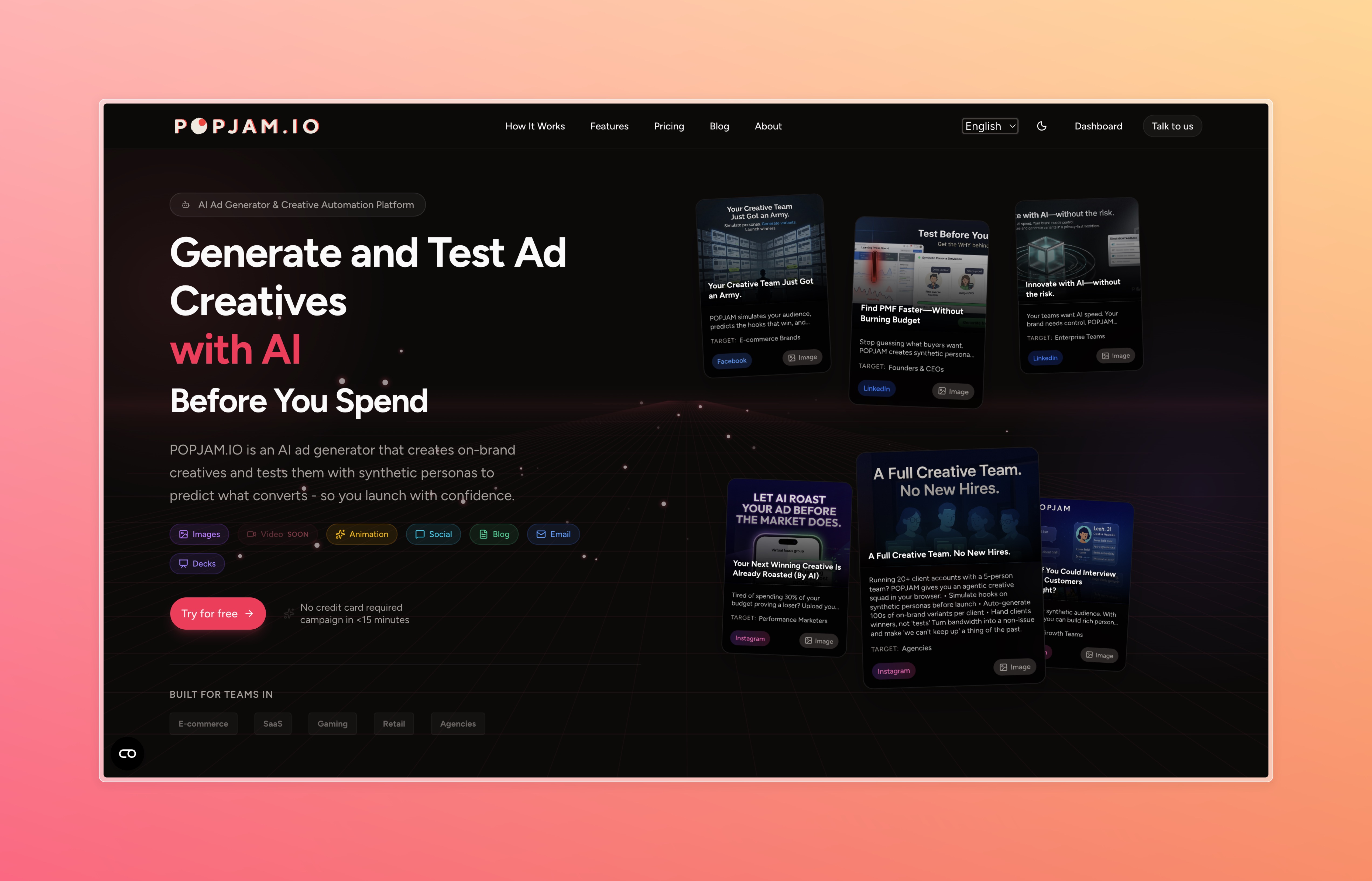
Whether you need an AI ad generator to scale creative variants, a free ad testing tool to pre-validate hooks, or a full creative automation platform to streamline your entire production pipeline, POPJAM.io gives performance marketers the infrastructure to act on data faster and with more confidence.
Frequently asked questions
How is data-backed marketing different from traditional marketing?
Data-backed marketing replaces intuition with evidence, using actual customer behavior and campaign performance to guide decisions rather than broad demographic assumptions or creative gut feeling.
What types of data are most valuable for digital marketing today?
First-party and zero-party data lead the pack because privacy regulations drive a shift away from third-party sources, making direct audience relationships your most reliable and compliant asset.
What are the biggest mistakes to avoid with data-backed marketing?
The most costly mistakes are acting on poor data quality that wastes nearly half of marketing budgets, maintaining siloed data systems that produce incomplete insights, and over-analyzing instead of testing and moving forward.
How does data-backed marketing impact creative strategy?
It gives you a structured way to test, personalize, and rapidly iterate on creative assets so each variation is validated against real audience signals before full deployment.
Is data-backed marketing suitable for small and midsize businesses?
Absolutely. Affordable analytics tools, simple A/B testing frameworks, and first-party data from your own customers make data-backed marketing accessible and effective at any business size.