
On this page
On this page
Video ad generation means turning a product, a URL or a brief into finished video ads with AI, then checking which version deserves your budget. The generating part is now the easy part. The part that saves money is what happens before you press publish: building a few distinct variations, testing them one variable at a time, and running accuracy and disclosure checks. Here’s how I’d do it, start to finish.
TL;DR
- Most advertisers are already doing this: the IAB reported in 2025 that 86% of ad buyers were using or planning to use generative AI to build video ad creative.
- Start with strong inputs (product shots, a clear offer, brand rules, one audience), not with a tool.
- Change one variable per test (hook, visual or offer), keep budgets equal, and give each test 72 to 96 hours.
- Export natively for each platform instead of resizing one video everywhere.
- Check claims, rights and disclosure before launch, and test ads against synthetic personas first so you stop “posting and praying.”
Table of Contents
- What video ad generation actually involves
- What you need before you generate anything
- Step by step: from brief to finished video ad
- Adapting one video ad for Meta, TikTok, YouTube and Google
- Testing variations without wasting ad spend
- Which metrics to judge video ads by
- Pre-launch checks: accuracy, rights, disclosure and policy
- Perspective: why we test before we generate more
- How to build a repeatable workflow
- Try it: generate and test your first video ads
- Common mistakes to avoid
- FAQ
- Sources
What video ad generation actually involves
If you know me, you know I hate the “post and pray” routine. You spend a week on a video, publish it, and wait to see whether the algorithm likes it. Generative AI changes the first half of that story. It can take a product page, a few images or a written concept and produce a storyboard, motion, voiceover and captions in minutes instead of weeks.
The industry has noticed. The IAB’s July 2025 U.S. report found that 86% of ad buyers were using or planning to use generative AI to build video ad creative, and buyers projected that GenAI creative would make up 40% of all ads by 2026. So the question is no longer whether to use AI for video ads. It’s how to use it without burning budget on mediocre output.
A good workflow has four stages:
- Inputs: product, offer, audience, brand rules.
- Generation: several distinct concepts, not one.
- Pre-launch testing: filter the weak ones before they cost anything.
- Live testing and iteration: structured experiments that feed the next round.
Most tools only cover stage two. That’s the gap we built POPJAM to close, and I’ll come back to it below.
What you need before you generate anything
AI doesn’t fix a vague brief. It produces a polished version of the vagueness. Before you open any generator, collect these:
- Product visuals. Clean photos, a product page URL, or existing footage. Real product shots keep the ad believable and cut down on odd-looking AI output.
- One clear offer. A discount, a free trial, a guarantee you can really honor. Pick one per video.
- One audience segment. “Busy parents buying their first air fryer” beats “everyone who cooks.”
- Brand rules. Colors, fonts, tone of voice, words you never use, claims you can’t make.
- A single goal. Purchases, trial sign-ups, or leads. The goal sets the call to action and the metric you’ll judge by.
- A list of hooks. Three to five opening lines or visuals for the first two seconds. This is where most video ads win or lose.
If you’re starting from a URL, the generator reads the page for product details and benefits. Check what it pulled before you accept anything. Outdated prices or features on a page become outdated prices or features in your ad.
Step by step: from brief to finished video ad
1. Write the brief in plain words
One paragraph. Who is it for, what problem does the product solve, what’s the offer, what should the viewer do next? If a colleague can’t summarize it back to you in one sentence, the AI won’t do better.
2. Generate several concepts, not one
Ask for different angles: problem-solution, social proof, demo, founder story, comparison. Concepts should differ in meaning, not just in color. Variation in concept is what gives you something to learn from.
3. Build variations around a single change
This is where generation becomes useful for testing. The IAB found that advertisers use GenAI creative enhancement to make versions for different audiences (42%), change visual styles (38%) and increase contextual relevance (36%). Scale is the big advantage: one winning concept can become a dozen controlled variants in an afternoon.

4. Add voiceover, captions and an end card
Most people watch social video with sound off or low, so captions carry real weight. Put the offer and call to action on the final frame, and keep brand elements consistent across versions.
5. Review like a skeptical customer
Watch every video at full speed, then frame by frame on anything involving hands, text or logos. AI still stumbles there. Read every on-screen word. Confirm that the product looks like your product.
6. Export in platform-native formats
The next section covers this, because it matters more than most teams think.
Adapting one video ad for Meta, TikTok, YouTube and Google
A video that works on one platform often flops on another, because people use each one differently. Resizing is not adapting. Here’s the practical approach.
| Platform | Typical viewing mindset | What to adapt |
|---|---|---|
| Meta (Reels, Stories, Feed) | Scrolling, short attention, sound often off | Vertical 9:16 for Reels and Stories, captions on screen, offer visible early |
| TikTok | Entertainment first, ads that feel native win | Vertical full screen, creator-style pacing, hook in the first seconds, less polish |
| YouTube | Mix of lean-back and intent-driven viewing | A hook that works before a skip option appears, a clear brand mention early, horizontal or vertical depending on placement |
| Google (Search and Display video, Performance Max) | Intent-driven, often paired with text or product feeds | Message match with keywords and landing page, multiple aspect ratios supplied |
Before you build, open each platform’s ad specs page and check the current aspect ratios, file types, maximum lengths and safe zones. Those requirements change, so treat any number in a blog post as a starting point and confirm it in the ad manager you’ll actually use. The safe zones matter most: platform buttons and captions cover parts of the screen, and an AI-generated video that ignores them can hide your own offer.
A tool that exports platform-native versions saves hours here. POPJAM generates and exports for Meta, Google, TikTok, LinkedIn and Reddit, so each placement gets a version built for it. You can see how that works on our AI video ad generator page.
Testing variations without wasting ad spend
Generating fifty videos is easy. Spending money on fifty videos is how budgets vanish. Here’s a structure that keeps you honest.
Change one thing at a time
Effective AI creative pipelines change only one variable per test, such as the hook, the visual treatment or the offer. If you change the hook and the offer together and one wins, you won’t know why. You’ll just have a winner you can’t repeat.
Keep budgets equal, and give tests time
The same guide recommends comparing challengers in equal-budget A/B sets for 72 to 96 hours. That’s long enough to gather conversion data, while still catching creative fatigue before it distorts the result. Don’t call a winner after six hours because one video got a lucky burst of clicks.
Stop early only when the evidence is real
To reduce waste, practitioners can use sequential or Bayesian methods to stop tests early once credible evidence builds up. The same source suggests using incremental lift where possible instead of raw click-through comparisons. If that sounds heavy, the simple version is this: set your stopping rule before the test starts, not after you’ve seen the numbers.
Keep an eye on where testing is heading
The Displaying.cloud team argues that A/B testing in 2026 is moving toward continuous, policy-driven rollouts built into ad-buying platforms, rather than one-off experiments. For you, that means a test never really ends. Winners become the control, and the next challenger arrives.
Which metrics to judge video ads by
Pick metrics by the funnel stage, then read them together.
- Hook rate (3-second views divided by impressions): Did the opening earn attention?
- Hold rate or average watch time: Did the story keep it?
- Click-through rate: Did the message and offer prompt action?
- Cost per acquisition and return on ad spend: Did it make money?
- Frequency and CTR decay over time: Is the creative wearing out?
Click-through rate alone can mislead. A field experiment with 21,328 existing customers of an Indian retailer found that GenAI-personalized avatar videos lifted click-through by 9.4 percentage points over personalized image ads, and by 6.5 points over generic videos. That’s a strong signal that personalized video can beat static formats, though the study involved existing customers of one retailer in India, so treat it as a direction to test in your own market, not a promise.
To use results in the next round, write down a one-line learning after every test: “Problem-first hooks beat feature-first hooks for this audience.” Then build the next batch around that learning. Teams that skip this step end up re-testing the same ideas every month.
Pre-launch checks: accuracy, rights, disclosure and policy
This is the part that doesn’t get enough airtime. AI makes it quick to produce an ad that looks finished and says something wrong.
- Accuracy: Every price, spec, result and testimonial must be true and current. If the video says “ships free,” it must.
- Substantiation: Any performance or health claim needs evidence you can produce. The AI doesn’t carry that burden. You do.
- Brand safety and likeness: Confirm that synthetic avatars, voices and music are licensed for commercial use under your tool’s terms, and that nothing resembles a real person without permission.
- Disclosure: Follow each platform’s rules on labeling AI-generated or altered content, and any requirements for paid partnerships if creators are involved.
- Platform policy: Read the ad policies for your category before launch. Rejected ads waste time, and repeated violations can put an account at risk.
Regulators are watching advertising closely. In 2023 the FTC sent orders to eight social media and video-streaming platforms asking how they screen deceptive paid ads, and the orders also sought information about generative AI and shoppable ads. And on August 27, 2026, the FTC said Cox Media Group, MindSift and 1010 Digital Works would pay $930,000 to settle allegations that they falsely claimed to target localized ads using conversations captured from consumers’ smart devices. The lesson for advertisers: claims about your product, and about how your targeting works, need to hold up. If you have legal questions about a specific claim, ask a qualified advertising attorney before you run it.
Keep a human in the loop. The MIT and University of Missouri experiment describes AI making personalization economically scalable, but inside a workflow where the marketing team kept control over message content. That’s a good model: AI drafts and scales, people approve.
Perspective: why we test before we generate more
Here’s what I believe after watching a lot of teams adopt AI video tools. Generation got cheap, and that created a new problem: too many options and no way to choose. If you can make fifty videos before lunch, the bottleneck moves from production to judgment.
That’s why POPJAM is built around testing, not just creating. We generate on-brand ad creatives, then run them against synthetic buyer personas that simulate how your audience may react, so you can refine your ads before real money is on the line. Our approach is designed to replace guesswork with psychographic feedback, and to cut the creative fatigue that comes from launching and hoping.
Does a simulation replace live testing? No, and we don’t pitch it that way. It narrows the field. You walk into your live A/B test with stronger candidates, and your budget goes to learning instead of weeding out obvious misses.
The tools that only generate leave you right back at “post and pray.” The tools that generate and validate give you a loop: create, simulate, launch the best, learn, repeat. That loop is the whole game.
Doruk
How to build a repeatable workflow
Here’s a simple weekly rhythm that works for e-commerce brands, SaaS teams and agencies alike.
- Monday: brief and generate. Produce five to eight concepts around one audience and one offer.
- Tuesday: pre-test. Run concepts against synthetic personas, drop the weakest, and fix the notes that repeat.
- Wednesday: launch. Put the top two or three live in equal-budget sets, changing one variable.
- Thursday to Sunday: let it run. Resist tinkering during the 72 to 96 hour window.
- Next Monday: read, record, repeat. Write the learning, promote the winner to control, and brief the next challengers.
Agencies get extra value here, because the same loop can run across many clients with each client’s brand rules loaded. Research on AI productivity gains for agencies points the same direction: automation frees up time for strategy and client work. If that’s your world, our AI ad generator for agencies page covers how teams use it across accounts.
If motion ads that aren’t full video suit your product better, such as animated product loops, look at our AI animated ad generator. For a bigger comparison of the field, our roundup of the best AI ad creative tools lays out the options.
Try it: generate and test your first video ads
If you want to run this workflow without stitching three tools together, POPJAM does the generating and the pre-launch testing in one place. You start on the Free plan, which has no published price, and move up when you need more volume. Paid plans on our pricing page are Starter at €29 per month, Essential at €99 per month and Business at €399 per month, with Enterprise available on request. If you only need a burst of creative, credit packs run from €10 for 1,000 credits to €100 for 10,000 credits, one-off.
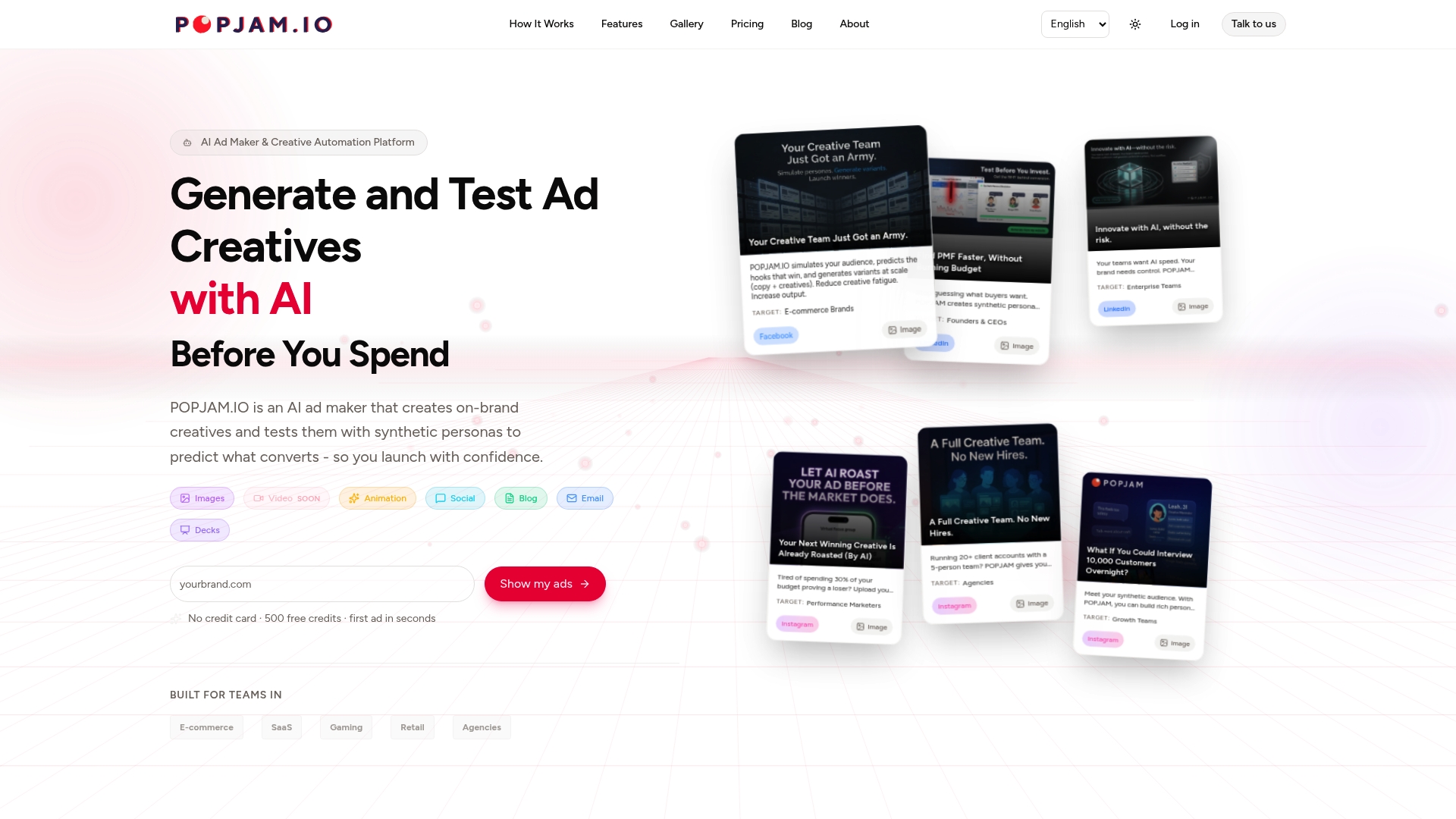
Want a quick look first? Try our free ad testing tool, or head to the AI video ad generator and build your first short video ad. I’d love to hear what you make.
Common mistakes to avoid
- Generating one video and calling it a test. You need contrast between concepts to learn anything.
- Changing everything at once. New hook, new offer and new visuals in one swap tells you nothing.
- Ignoring the first two seconds. If the hook fails, the best offer never gets seen.
- Skipping platform-native exports. A horizontal video squeezed into a vertical placement looks like an afterthought.
- Trusting the AI’s facts. It will happily write a confident wrong claim.
- Letting winners run forever. Even great creative fatigues. Plan the replacement before the decline.
FAQ
What is video ad generation?
It’s the process of using AI to turn inputs like a product page, images or a written brief into finished video ads, often with voiceover, captions and platform-ready formats. The best workflows also include testing, so you know which version to put money behind.
Can AI video ads really perform as well as filmed ones?
Sometimes, and it depends on the product and the audience. The MIT field experiment found GenAI-personalized avatar videos beat both personalized image ads and generic videos on click-through, but it was a single retailer study in India. Test AI versions against your current best ad in your own account.
How many video variations should I test at once?
Start with two to four challengers against your control, each changing one variable, with equal budgets. More variants split your spend thin and stretch the time it takes to reach a reliable read.
Do I need to disclose that a video ad is AI-generated?
Rules depend on the platform and on what the ad shows. Read the current ad policies for each platform you run on, and make sure any claims, testimonials and endorsements in the ad are truthful. For legal questions about a specific ad, talk to an advertising attorney.
What does it cost to start?
POPJAM has a Free plan, and paid plans start at €29 per month on Starter, according to our pricing page. Extra credits are sold as one-off packs if you need more creative generation.
Sources
- IAB: Nearly 90% of advertisers will use Gen AI to build video ads
- AI-Generated Creative for Paid Ads: The 2026 Ecommerce Guide
- AI Video Creative Pipeline: Dev Guide
- Video Ads That Engage Consumers? (MIT IDE)
- FTC: orders to social media and video streaming platforms
- FTC: CMG Media Corporation, In the Matter of
- AI for agencies: 3.2x ROI and real productivity gains