

Generative AI for Ads: Create and Test Faster in 2026
Discover how generative AI for ads can speed up your creative workflow. Create tests faster and validate messaging with predictive insights.

Generative AI for ads automates the full idea-to-execution creative workflow and surfaces predictive performance signals you can act on before a single dollar goes live. This week, try generating five copy variants for your best-performing ad set. Next, pilot a pre-launch test against synthetic buyer personas to validate which creative actually resonates. And before you scale, set one governance guardrail: every AI-generated asset needs a human sign-off before activation.
The short-term wins that matter most right now:
- Speed: Cut creative production time from days to hours by generating copy, images, and video concepts from a single prompt.
- Scale: Run 10x more creative variants in a test cycle without adding headcount.
- Test volume: Validate messaging against audience segments before spend, not after.
Table of Contents
- How are marketers actually using generative AI for ads today?
- What do you actually gain, and where does it go wrong?
- What do real campaigns look like when generative AI is involved?
- How do you run a generative AI ad pilot step by step?
- What governance and brand-safety practices should you have in place?
- What does industry research say about AI in advertising right now?
- What should your generative AI advertising tech stack include?
- Key Takeaways
- The part most teams get wrong about AI-generated ads
- POPJAM turns AI-generated ads into validated creative before you spend
- Useful sources
- FAQ
How are marketers actually using generative AI for ads today?
The honest answer: across almost every creative task in the production pipeline. AI in digital advertising now touches copy, image, motion, and video, and the workflows are maturing fast.
Copy generation is the most common entry point. Teams feed a landing page URL, a tone prompt, and a few brand guidelines into a text LLM, and get back headline variants, body copy, and CTA options in seconds. Microsoft Advertising’s Copilot, for example, generates ad copy for Responsive Search Ads and Performance Max asset groups directly from a landing page URL and optional tone instructions.
Image and motion creative follow a different path. Diffusion models like Stable Diffusion and DALL-E generate static visuals from text prompts, while newer text-to-video tools produce short-form clips from a brief or storyboard description. StackAdapt documents automated resizing, background generation, and AI-assisted concepting as live production capabilities, not future roadmap items.
Dynamic Creative Optimization (DCO) is where generative AI compounds its value. Instead of producing one ad, teams generate a library of modular assets: multiple headlines, multiple images, multiple CTAs. A DCO engine then assembles and serves the best-performing combination in real time based on audience signals. The workflow looks like this:
- Prompt-driven ideation and draft generation
- Human curation of the strongest variants
- Pre-launch validation against audience personas
- A/B or multivariate testing at scale
- Scaled activation with real-time DCO assembly
Predictive signals enter at step three. AI tools can score creative quality, estimate audience fit, and forecast early performance before a campaign goes live. That’s the shift from reactive to predictive advertising: you’re not waiting for CTR data to tell you a creative failed. You’re catching it earlier.
What do you actually gain, and where does it go wrong?
The benefits are real. The failure modes are equally real, and ignoring them is how teams waste the time they just saved.
The upside
Faster ideation is the most immediate win. What used to take a creative team a week of briefing, concepting, and revision can compress into a single afternoon. That speed compounds: more ideas tested means more data, which means smarter decisions faster.

Personalization at scale is the second major gain. Salesforce identifies targeting and personalization as one of the five core AI advertising applications, and for good reason. Generative tools can produce localized variants, audience-specific messaging, and format-adapted assets without proportional increases in creative cost.
Predictive optimization closes the loop. When you combine generation with pre-launch scoring, you stop spending media budget on creative you could have filtered out earlier.
The failure modes
Brand drift is the most common problem. When you generate at volume, the model’s interpretation of your brand voice can wander. Headline 47 might sound nothing like Headline 1, and both came from the same prompt.
Hallucinated claims are a legal and trust risk. LLMs can generate product claims, statistics, or feature descriptions that are plausible-sounding but factually wrong. Every piece of AI-generated copy needs a human fact-check before it runs.
Training-data copyright exposure remains an open legal question in the United States. Images generated from models trained on unlicensed data carry potential IP risk, particularly for brands in regulated categories.
Overfitting to short-term signals is a subtler trap. If you optimize creative purely on early CTR, you can train your campaigns toward clickbait that doesn’t convert. Measurement needs to go deeper than the first click.
Industry note: IAB Europe’s research found widespread AI tool adoption alongside a persistent gap in formalized, marketing-specific governance. Most teams are using the tools. Far fewer have the policies to use them safely.
Pro Tip: To limit brand drift without slowing iteration, lock your brand voice into a reusable prompt template: include your tone adjectives, three example headlines you love, and two you’d never run. Attach it to every generation request. Variance drops significantly when the model has concrete positive and negative examples, not just abstract guidelines.
What do real campaigns look like when generative AI is involved?
Here are four compact examples that show what’s actually happening in production, not in demos.
Amazon Sponsored Brands with AI-generated images. Amazon’s own generative ad solutions let sellers generate lifestyle images from product data. Campaigns using AI-generated images in Sponsored Brands reported measurable ROAS and adoption improvements. The human review step that made the biggest difference: editors removed any image where the product looked distorted or the background context felt off-brand. That single curation pass separated high-performing assets from the ones that would have hurt trust.

End-to-end commercial from a prompt. Tools like Renderforest’s AI commercial generator can produce a full short-form commercial, including voice, visuals, and structure, from a text prompt. The practical use case for brand teams is rapid concept validation: generate three 15-second spots from different angles, screen them internally, and only invest in full production for the one that clears the bar.
Static to motion creative expansion. A common workflow for e-commerce brands: start with a high-performing static image ad, feed it into a motion tool to add subtle animation, and test the animated variant against the original. In multiple reported cases, the motion variant improved view-through rates without any additional photography or design work. The key human edit was adjusting the animation speed so it didn’t feel jarring on mobile.
- The AI generated the motion layer and the initial copy variants.
- The human reviewer adjusted pacing, removed one distracting visual element, and rewrote the CTA.
- The revised creative outperformed the static original on view-through conversion.
DCO for localization. A SaaS brand running campaigns across three U.S. regional markets used generative tools to produce market-specific copy variants from a single master brief. The DCO engine served the right variant by geography. The human step that mattered most: a native reviewer in each market checked idiom and tone before activation, catching two phrases that read as awkward in the regional context.
How do you run a generative AI ad pilot step by step?
A pilot doesn’t need to be complicated. Six to eight weeks is enough to get real signal. Here’s the sequence that works.
- Define your objective and KPIs. Pick one campaign goal: CTR improvement, CPA reduction, or creative test velocity. Attach a number to it before you start.
- Select your channel and format. Start with one platform (Meta or Google) and one format (static image or short copy). Complexity compounds fast; narrow scope produces cleaner data.
- Choose your generation tool. Match the tool to the format: a text LLM for copy, a diffusion model or integrated platform for images, a text-to-video tool for short clips. For teams that want generation and pre-launch testing in one place, POPJAM’s creative automation platform covers both.
- Build a small test library. Generate 10–20 creative variants. Apply your brand prompt template. Have a human reviewer cull the library to the 5–8 strongest before any spend.
- Run pre-launch validation. Test your shortlisted creatives against synthetic audience personas before activating. This is where you catch messaging mismatches that CTR data would only reveal after budget is spent.
- Measure and iterate. Track creative-level CTR, view-through conversion, and incremental lift where your platform supports it. After two weeks of live data, compare against your baseline KPI and adjust.
Timeline and resourcing:
A small in-house team (one marketer, one designer) can run this pilot in six weeks. An agency engagement typically compresses the setup to two weeks but adds coordination overhead. Budget for generation credits (usually usage-based), two to four hours of creative review time per week, and a modest test media budget, typically $1,500–$5,000 depending on the platform and audience size.
Measurement checklist:
- Creative-level CTR (per variant, not campaign average)
- View-through conversion rate for video and motion formats
- Incremental lift testing where the platform supports holdout groups
- Signal-based forecasting scores from your pre-launch tool vs. actual post-launch performance (to calibrate your model over time)
For a deeper campaign-level framework, the AI advertising campaigns guide covers extended measurement approaches worth bookmarking.
What governance and brand-safety practices should you have in place?
Most teams skip this until something goes wrong. Don’t. A governance checklist takes an afternoon to build and saves real money.
Policy checklist
| Policy Area | What to Define |
|---|---|
| Model sourcing | Which AI models are approved for use; vendor vetting criteria |
| Training-data rules | Confirm licensed or cleared training data for image generation |
| Disclosure | When and how to disclose AI-generated content per platform policy and FTC guidance |
| Copyright review | Human IP review before any generated image or video goes live |
| Human sign-off gates | Who approves AI-generated copy, images, and video before activation |
| Escalation path | Who decides when a creative is flagged for legal or compliance review |
Risk matrix
| Risk | Likelihood | Impact | Mitigation |
|---|---|---|---|
| Hallucinated product claims | Medium | High | Mandatory fact-check on all AI-generated copy |
| Copyright exposure (images) | Medium | High | Use licensed-data models; log model source for every asset |
| Brand drift | High | Medium | Brand prompt template + human curation pass |
| Bias in targeting or creative | Low | High | Periodic creative audit; diverse reviewer panel |
| Privacy exposure | Low | High | No PII in prompts; GDPR-compliant persona simulation |
| Regulatory flag (FTC/platform) | Low | High | Disclosure policy aligned with current FTC and platform rules |
IAB Europe’s governance research confirms that the gap between AI adoption and formalized policy is the most common organizational risk. The Errant Agency practical guide offers concrete policy language examples worth adapting for your own team.
Pro Tip: Keep an audit log for every AI-generated asset: record the model used, the prompt, the generation date, and the name of the human reviewer who approved it. Run a monthly spot-check of 10% of your live AI-generated ads against your brand guidelines. That cadence catches drift before it becomes a pattern.
What does industry research say about AI in advertising right now?
The adoption numbers are significant, and the channel implications are specific.
eMarketer forecasts that more than 80% of AI-related advertising in 2026 will appear adjacent to AI-generated content rather than inside standalone AI chatbot inventory. That’s a channel-selection signal: if you’re planning where to run AI-assisted campaigns, the action is in traditional digital placements alongside AI content, not in chatbot ad units.
IAB Europe’s research documents high levels of AI tool usage across marketing organizations alongside a persistent gap in marketing-specific governance. The practical interpretation: your competitors are generating at volume. The ones who will outperform are the ones who combine generation speed with pre-launch validation and a governance layer that prevents costly mistakes.
What this means for your priorities:
Channel selection: Concentrate AI-driven creative testing on Meta, Google, TikTok, and LinkedIn, where DCO and creative variant testing are native capabilities. The chatbot ad inventory story is still early.
Creative testing volume: The teams winning with generative AI aren’t running two variants. They’re running 15–20 and letting pre-launch scoring narrow the field before spend.
Governance priority: The research gap isn’t in tools. It’s in policies. Teams that build a governance layer now will have a structural advantage as platform disclosure requirements tighten.
POPJAM’s 2026 marketing playbook addresses exactly this gap: combining generation with synthetic-persona pre-launch testing so teams validate messaging before it hits live audiences, closing the loop between creative output and audience fit.
What should your generative AI advertising tech stack include?
The right stack depends on what you’re producing, not on which tools have the best marketing. Here’s how to think about the categories.
Tool categories and what they do
Text LLMs for copy (GPT-4o, Claude, Gemini): Generate headlines, body copy, CTAs, and ad scripts. Best used with a brand prompt template and a human curation pass.
Diffusion and vision models for images (DALL-E 3, Stable Diffusion, Adobe Firefly): Generate static visuals from text prompts. Adobe Firefly’s commercially licensed training data reduces IP risk compared to open-source alternatives.
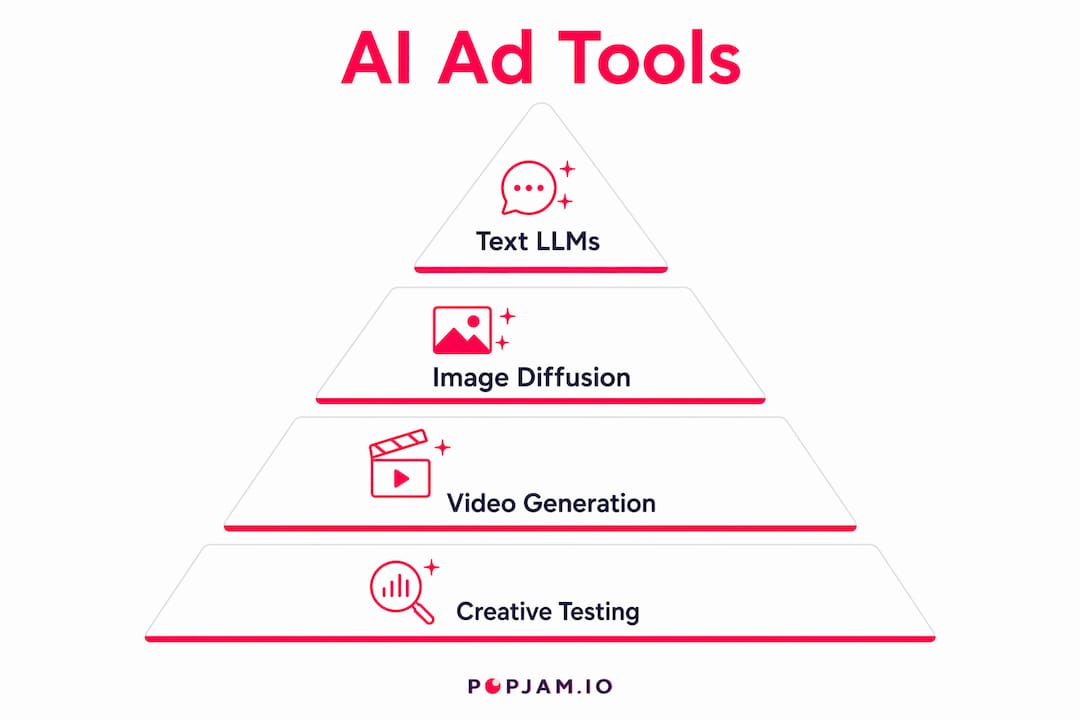
Text-to-video tools for short ads: Produce short-form video concepts and clips from prompts or storyboards. Useful for rapid concept validation before committing to full production.
DCO engines: Assemble and serve modular creative combinations in real time. Native to most major ad platforms; also available as standalone tools for cross-platform campaigns.
Creative testing and simulation platforms: Validate creative performance before spend using synthetic personas or predictive scoring. This is the category most teams underinvest in.
Decision matrix
| Capability | Why It Matters |
|---|---|
| Brand safety controls | Prevents hallucination and drift at generation time |
| Format support | Must cover your active channels: Meta, Google, TikTok, LinkedIn |
| API and platform integration | Reduces manual asset transfer; enables DCO workflows |
| Pre-launch testing and simulation | Catches underperforming creative before budget is spent |
| Cost model | Generation credits vs. flat subscription; match to your volume |
For teams that want generation and pre-launch testing in one platform, POPJAM’s AI ad maker covers on-brand creative generation, synthetic persona simulation, and pre-launch validation across Meta, Google, TikTok, LinkedIn, and Reddit. It’s the recommended starting point for teams that want to close the gap between “we generated a lot of ads” and “we know which ones will actually work.”
Integration note: Connect your generation tool to your ad platform via API where possible. Manual asset upload is the bottleneck that erases the speed advantage. Most major platforms, including Microsoft Advertising, Meta, and Google, offer asset ingestion APIs that support automated creative delivery.
Key Takeaways
Generative AI for ads delivers its highest ROI when generation speed is paired with pre-launch testing and a governance layer that keeps humans in the decision loop.
| Point | Details |
|---|---|
| Start with one format | Pilot on a single channel and format to get clean data before scaling. |
| Require human review | Every AI-generated asset needs a curation pass before activation to prevent brand drift and hallucinated claims. |
| Test before you spend | Pre-launch validation against synthetic personas catches underperforming creative before media budget is committed. |
| Measure at the creative level | Track CTR and conversion per variant, not campaign averages, to identify what’s actually working. |
| Use POPJAM for generation and testing | POPJAM combines on-brand creative generation with synthetic-persona pre-launch testing in one platform. |
The part most teams get wrong about AI-generated ads
Here’s what I keep seeing: teams adopt generative AI tools, get excited about the volume they can produce, and then skip the validation step entirely. They generate 30 ads, pick their five favorites by gut feel, and push them live. That’s not a generative AI strategy. That’s just faster guessing.
The real shift happens when you treat AI as a predictive augmentation layer, not a production shortcut. Generation is step one. Scoring and validation are steps two and three. The teams that are actually reducing CPA and improving ROAS aren’t the ones generating the most creative. They’re the ones testing the most creative before it goes live.
There’s also a governance conversation that most marketing leaders are avoiding. The IAB Europe research is clear: adoption is high, policies are thin. That gap will close, and it will close through platform enforcement and regulatory pressure, not through voluntary best practices. Building your governance layer now, audit logs, disclosure policies, human sign-off gates, is a competitive move, not a compliance burden.
One more thing: don’t let the tool selection conversation become a distraction. The question isn’t which LLM generates the best copy. It’s whether your team has a repeatable workflow that connects generation to testing to measurement. The workflow is the asset. The tools are interchangeable.
POPJAM turns AI-generated ads into validated creative before you spend
Most teams using generative AI for ads are still flying blind. They generate fast, but they don’t know which creative will actually land until the media budget is gone. POPJAM changes that equation.
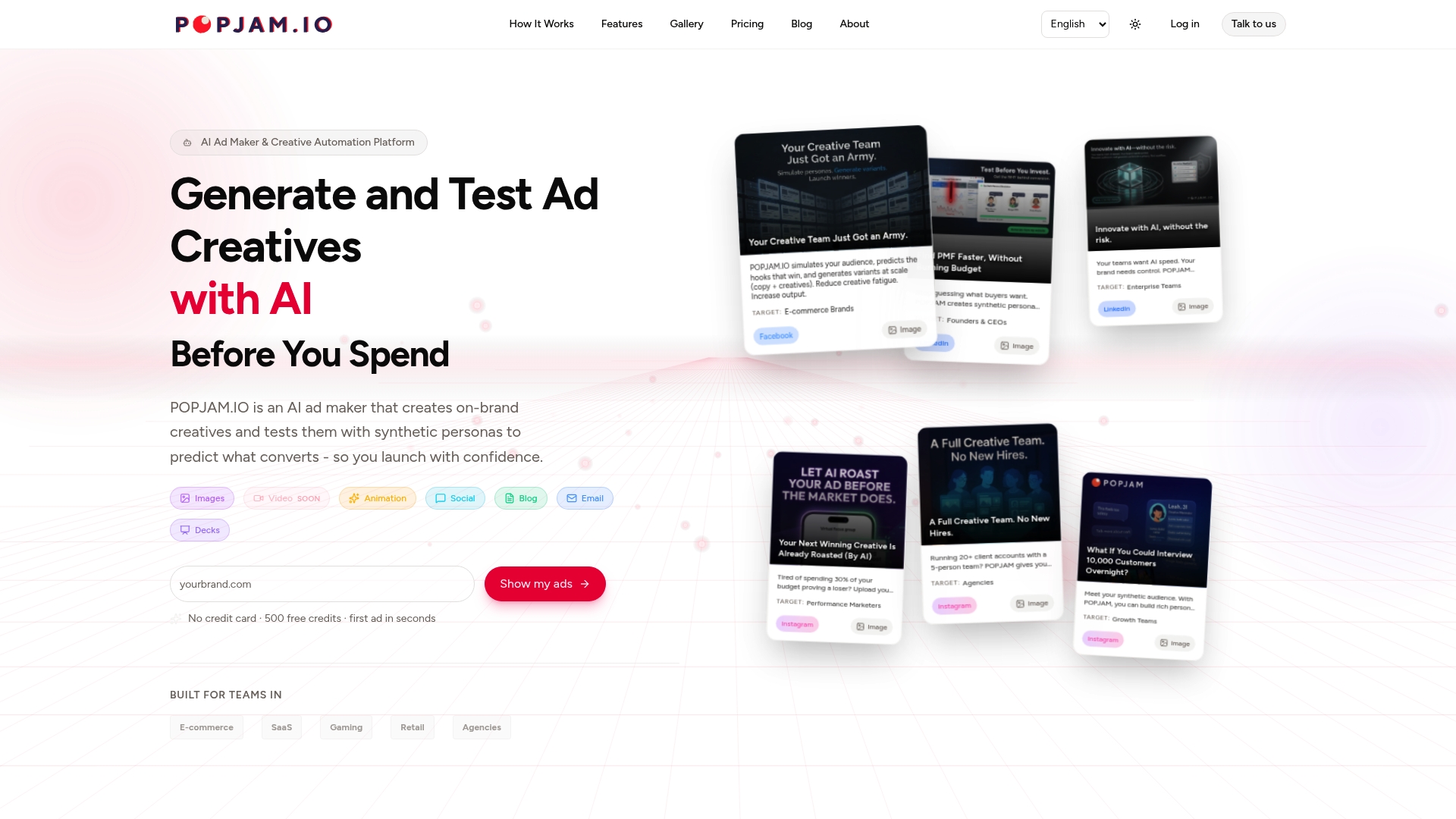
POPJAM generates on-brand ad creatives across Meta, Google, TikTok, LinkedIn, and Reddit, then tests them against Synthetic Personas built from real psychographic profiles before a single impression is served. You get qualitative and quantitative feedback on which variants resonate with your specific audience segments, so you’re not picking winners by gut feel. The result: higher test velocity, less creative waste, and campaigns that start with validated messaging instead of hopeful assumptions.
Whether you’re an e-commerce brand, a SaaS team, or an agency managing multiple accounts, POPJAM’s free ad testing tool is the fastest way to see the difference between generating ads and knowing which ones will work. Try it now and validate your next creative before you spend.
Useful sources
- IAB Europe: The Impact of AI on Digital Advertising — Primary industry research on AI adoption rates and governance gaps across marketing organizations.
- eMarketer: US AI Advertising Forecast 2026 — Channel-level forecast showing where AI-related ad spend will concentrate in 2026.
- StackAdapt: AI in Advertising — Practical platform-level guide to DCO workflows, automated resizing, and AI-assisted production.
- Salesforce: AI in Advertising — Overview of the five core AI advertising use cases with benefits and risk considerations.
- Amazon Ads: Generative AI Creative Solutions — Live example of integrated ad-console generation with reported performance data.
- POPJAM.IO: Generative AI for Marketing Playbook — Practical 2026 guide to combining generation with pre-launch testing and synthetic persona validation.
- Errant Agency: How to Use AI in Marketing — Agency-level governance and risk management guidance with practical policy language.
FAQ
How is generative AI used in advertising?
Generative AI automates creative production across copy, images, video, and dynamic creative assembly, and adds predictive scoring to identify which variants are likely to perform before campaigns go live. StackAdapt documents automated resizing, AI-assisted concepting, and DCO integration as current production capabilities.
What AI tools can generate ads?
Text LLMs like GPT-4o and Claude handle copy; diffusion models like DALL-E 3 and Adobe Firefly generate images; text-to-video tools produce short-form clips. POPJAM combines generation with pre-launch testing and synthetic persona validation in one platform, covering Meta, Google, TikTok, LinkedIn, and Reddit.
Can you use AI for commercial advertisements?
Yes. Tools like Renderforest’s AI commercial generator can produce a full short-form commercial, including voice, visuals, and structure, from a text prompt. Human review before activation remains essential for brand accuracy and legal compliance.
What is the best AI to use for ads?
The right tool depends on your format and workflow. For teams that want to generate on-brand creatives and validate them against synthetic audience personas before spending, POPJAM’s AI ad maker is the recommended starting point. For copy-only needs, GPT-4o or Claude with a brand prompt template is a strong baseline.
Where will most AI advertising appear in 2026?
eMarketer forecasts that more than 80% of AI-related advertising in 2026 will appear adjacent to AI-generated content rather than inside AI chatbot inventory, making traditional digital placements the primary channel for AI-assisted campaigns.