

How to build target personas for campaign success
Learn how to build target personas that improve ad ROI. A step-by-step framework for performance marketers and e-commerce brand managers to create, validate, and apply personas for better campaign results.


TL;DR:
- Precise target personas improve ad relevance, reducing costs and increasing conversions.
- Building personas requires combining demographic, behavioral, psychographic, and purchase data.
- Ongoing validation and iteration are essential for maintaining effective, up-to-date personas.
You’ve set the budget, launched the creatives, and waited. The clicks trickle in, but conversions stay flat. Sound familiar? Generic audience targeting is one of the biggest silent killers of ad spend in e-commerce. When your ads speak to everyone, they resonate with no one. Building precise target personas is the fix, and it’s more systematic than most marketers realize. This guide walks you through a proven framework: from gathering the right data, to building personas step by step, to validating them against real campaign results so your ad budget finally works as hard as you do.
Table of Contents
- Understanding the role of target personas in performance marketing
- Preparation: Data and resources needed to create target personas
- Step-by-step process to build actionable target personas
- Validating, refining, and applying personas for campaign optimization
- The real reason most e-commerce personas fail
- How POPJAM.IO makes building and testing personas effortless
- Frequently asked questions
Key Takeaways
| Point | Details |
|---|---|
| Define relevant personas | Persona accuracy directly drives ad campaign performance and ROI. |
| Gather useful data | Gather recent campaign, behavioral, and demographic data for actionable insights. |
| Follow a set process | Use a clear step-by-step workflow to build and validate target personas. |
| Test and refine regularly | Routinely test personas with real ad campaigns and update based on real results. |
| Leverage smart tools | Modern AI tools can streamline persona creation and ongoing optimization for marketers. |
Understanding the role of target personas in performance marketing
A target persona is not just a demographic checkbox. It’s a richly detailed, semi-fictional representation of your ideal customer built from real behavioral, psychographic, and transactional data. Contrast that with a generic audience, which might be “women aged 25 to 44 interested in fitness.” A true persona goes deeper: she’s a 31-year-old urban professional, shops on mobile between 7 and 9 PM, abandons carts when shipping costs appear late, and responds to social proof over discounts.
Why does that distinction matter for your bottom line? Because ad ROI and creative relevance are directly tied to how well-developed your personas are. Shallow targeting leads to irrelevant creatives, higher cost-per-acquisition, and wasted impressions. Precise personas let you write copy that addresses real objections, choose visuals that match actual lifestyles, and select platforms where your buyers already spend time.
Here’s what skipping persona development typically costs performance marketers:
- Higher CPAs because creative messaging misses the emotional triggers that drive purchase decisions
- Low click-through rates caused by ads that feel generic or tone-deaf to the audience’s actual concerns
- Ad fatigue from running the same broad creatives to audiences with wildly different motivations
- Wasted A/B tests where you’re testing the wrong variables because you don’t know what your audience actually cares about
Conversely, a strong persona turns every creative decision into a calculated move. One DTC skincare brand shifted from broad “skin care” interest targeting to persona-driven segments built around specific purchase behaviors and skin concerns. Their click-through rate improved by over 40% within two months, simply because the messaging finally matched the mindset of the buyer.
“The difference between a persona and a demographic is the difference between a conversation and a monologue. Personas give your ads a voice that speaks directly to someone real.”
Using solid audience research methods alongside data-driven ad creatives transforms persona-building from a one-time workshop exercise into a living campaign asset.

Preparation: Data and resources needed to create target personas
Before you start persona-building, gather the right information and resources. Jumping in without organized data is how you end up with personas that describe an imaginary customer instead of a real one.
The four essential data types for e-commerce persona work are:
- Demographics: Age, location, gender, income range, and device usage patterns from your analytics platform
- Psychographics: Values, lifestyle choices, interests, and attitudes, typically sourced from surveys or social listening tools
- Purchase history: Average order value, category preferences, purchase frequency, and cart abandonment patterns from your store data
- Behavioral data: On-site navigation paths, email engagement rates, retargeting response rates, and ad interaction data
Combining behavioral audience data with survey responses dramatically improves persona accuracy over relying on either source alone. Behavioral data tells you what customers do. Survey data tells you why. You need both.
| Resource type | Description | Recommended tool |
|---|---|---|
| Web analytics | Page views, sessions, conversion funnels | Google Analytics 4 |
| CRM/purchase data | Order history, LTV, product affinity | Shopify, Klaviyo |
| Survey platform | Direct audience feedback, motivations | Typeform, SurveyMonkey |
| Social listening | Organic conversation themes | Brandwatch, Sprout Social |
| AI persona builder | Synthesize data into structured personas | AI persona generator |
A common blindspot: marketers pull data from only one channel. If your paid social data doesn’t match your email list behavior, that’s a signal you have multiple distinct segments, not a data error. Treat that as an opportunity, not a problem.
Pro Tip: Start with your last 90 days of campaign data rather than historical averages. Recent data reflects current audience behavior and platform algorithm shifts, making your personas immediately actionable rather than historically accurate but practically stale.
Step-by-step process to build actionable target personas
Once you’ve gathered your data, it’s time to build personas step by step. This isn’t about creating a polished slide deck for a quarterly review. It’s about producing a working document that shapes every creative and targeting decision.
-
Collect and centralize your data. Pull analytics exports, CRM reports, and survey responses into one workspace. Avoid working from memory or gut instinct at this stage. Raw data only.
-
Segment by key behavioral and attitudinal traits. Look for natural clusters: high-value repeat buyers versus one-time purchasers, mobile-first shoppers versus desktop researchers, discount-motivated versus quality-motivated customers. These clusters become your persona foundations.
-
Build draft personas around each segment. Give each one a name, a one-sentence summary, core motivations, biggest objections to buying, preferred content formats, and the platforms where they’re most active. Keep it to one page per persona.
-
Validate and fill research gaps. Most effective personas blend quantitative and qualitative research. If your data shows a segment exists but you don’t understand why they buy, run a short 5-question survey or pull customer review themes to fill that gap.
-
Finalize and visualize. Format each persona for easy team use. Add a representative photo, key quote, and a “day in the life” snapshot so your creative team can picture a real human, not a spreadsheet row.
A sample persona outline looks like this:
- Name: Urban Maya
- Age/location: 29, Chicago
- Motivation: Convenience and social validation
- Biggest objection: Skeptical of product quality without reviews
- Best channels: Instagram Stories, TikTok
- Purchase trigger: User-generated content and limited-time offers
“Personas are most powerful when every team member, from copywriter to media buyer, can describe the target customer in the same words.”
Pro Tip: Before you finalize personas, run them by your customer service or sales team. They talk to real buyers daily and will immediately flag anything that feels off or missing.
Validating, refining, and applying personas for campaign optimization
Now, turn your draft personas into campaign-driving assets with these validation and application strategies. A persona that sits in a shared drive without ever influencing a targeting decision is wasted effort.
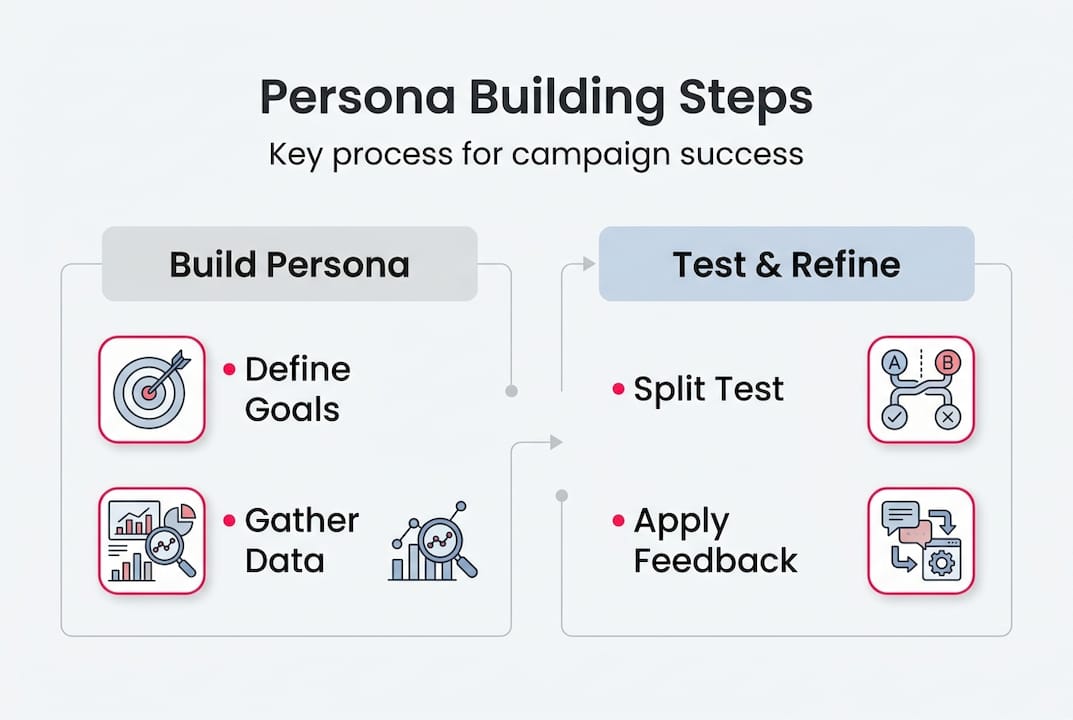
The first validation method is running a persona-split test. Create two ad sets with identical budgets but audiences built around different personas. Track not just CTR, but also scroll-stop rate, conversion rate, and return on ad spend. Let the data tell you which persona description was accurate.
Testing personas against real campaign results alongside synthetic focus groups produces higher accuracy than either method alone. Synthetic personas allow you to simulate audience reactions before you spend a dollar in live media, which compresses the feedback loop significantly.
| Validation method | Speed | Cost | Accuracy |
|---|---|---|---|
| Live A/B campaign split | Slow (2 to 4 weeks) | High | High if budget is sufficient |
| Customer interviews | Medium (1 to 2 weeks) | Medium | High but limited sample |
| Synthetic persona simulation | Fast (hours) | Low | High with good base data |
| Social listening audit | Medium | Low to medium | Moderate |
For ongoing refinement, build these habits into your workflow:
- Review persona accuracy after every major campaign by comparing predicted versus actual audience response
- Update psychographic assumptions whenever a new content format or platform trend shifts your audience’s engagement patterns
- Retire outdated personas rather than patching them indefinitely; a persona more than 12 months old without updates is likely misleading your team
- Flag creative fatigue signals as persona decay indicators: dropping CTR on previously high-performing creatives often means the audience has shifted
Applying personas to creative work means briefing your designers and copywriters with persona context, not just platform specs. The difference in output quality is significant.
The real reason most e-commerce personas fail
Here’s the uncomfortable truth: most persona projects fail not because of bad data, but because of how teams treat the final document. Marketers spend weeks building a beautifully formatted persona deck, then file it away and never revisit it. The persona becomes a historical artifact rather than a live campaign input.
The real problem is the assumption that personas are a deliverable instead of a process. Documentation without ongoing validation is the root cause of wasted ad spend, not the initial persona quality. A rough persona that gets updated every six weeks beats a polished one that was finalized in January and ignored through December.
The other mistake is building personas in isolation from campaign feedback. Your data-backed creatives are constantly generating signals about what your audience responds to. If those signals aren’t feeding back into your persona assumptions, you’re flying blind. Embrace messy, iterative updates. Personas that look a little rough because they’ve been revised three times are exactly the ones driving results.
How POPJAM.IO makes building and testing personas effortless
Ready to put these persona-building strategies into action? Here’s how POPJAM.IO can help.
Manually cycling through data exports, surveys, and creative revisions takes time most performance teams don’t have. POPJAM.IO’s AI ad generator pairs directly with synthetic persona profiles so you can generate platform-native creatives that are already matched to your target audience’s psychology before launch.
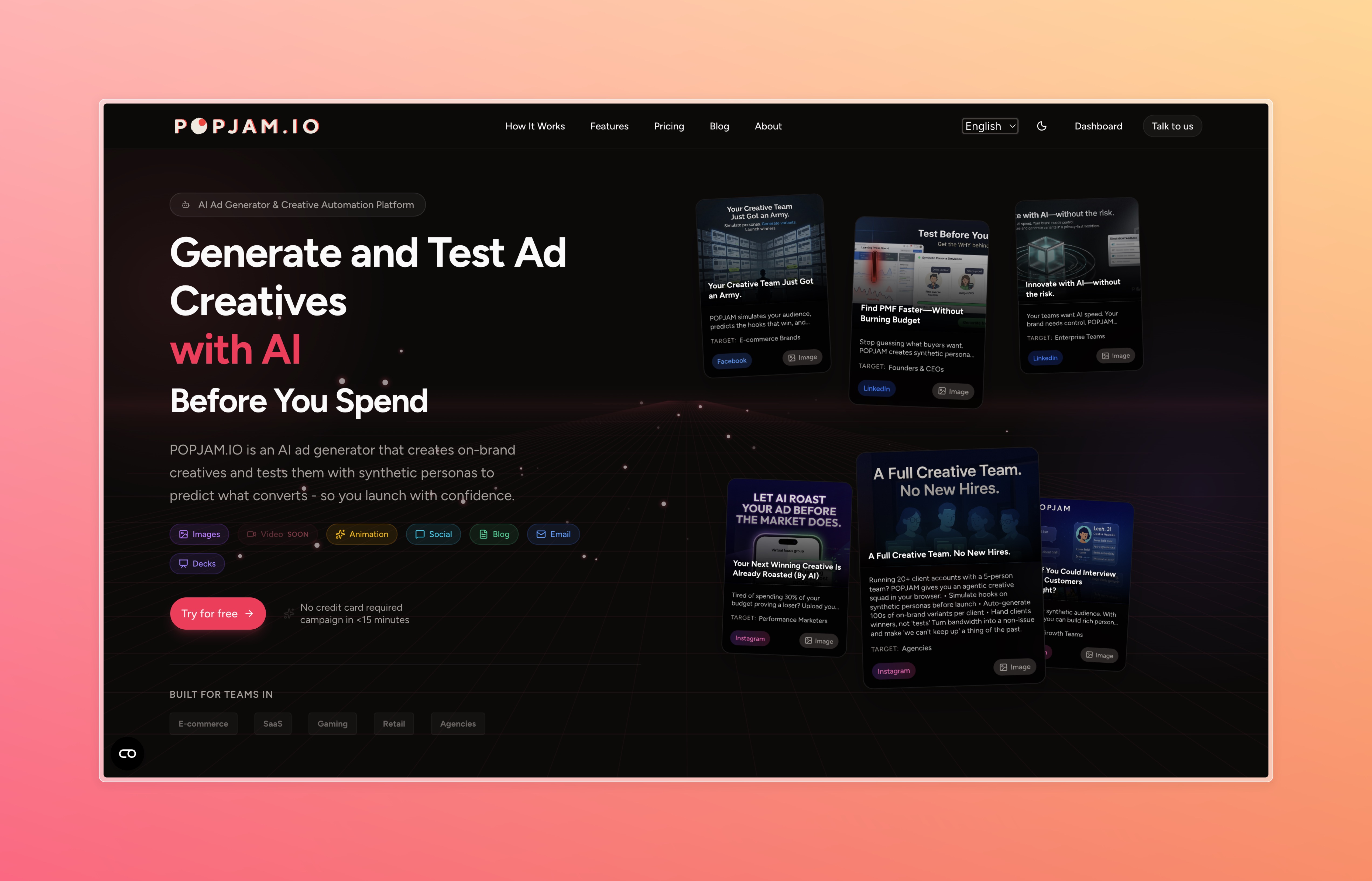
With POPJAM.IO’s ad testing tool, you simulate how each persona responds to ad variations without burning live budget. The result is faster creative approval cycles, fewer wasted impressions, and campaigns that connect from day one. As a full creative automation platform, POPJAM.IO compresses weeks of persona-to-creative workflow into hours, giving your team more time to optimize and less time guessing.
Frequently asked questions
What is the minimum data set needed to build a target persona?
A reliable target persona needs at least demographics, behavioral data, and key purchase drivers from your e-commerce analytics. Even a basic combination of these three sources produces far more actionable personas than demographic data alone.
How often should performance marketers update target personas?
Update personas every quarter or after major campaigns, since audience behavior and platform dynamics shift quickly. Ongoing data refreshes are essential to keeping your personas relevant rather than historically accurate but practically outdated.
What if my persona insights contradict campaign results?
Treat the contradiction as a valuable signal, not a failure. Blending quantitative and qualitative research helps you identify whether your persona assumptions or your targeting setup needs adjustment.
Do I need expensive software to create personas?
No. Many marketers start with spreadsheets or a free AI persona generator before graduating to more advanced tools. Starting simple and iterating is far better than waiting for the perfect software stack.