

GDPR Compliant Ad Testing: Rank Ads in 48 to 72 Hours
Compare synthetic persona panels with no persona ranking, track provenance, and test ad variants in 48 to 72 hours before launch using privacy safeguards.

GDPR-compliant ad testing, as we use the term, means running your ad creatives through synthetic persona simulation and privacy-first audience modeling before a single dollar hits a live campaign. You get a ranked list of your strongest variants, complete with risk-flag transcripts, in 48 to 72 hours. We built POPJAM around exactly this workflow, and it’s faster than waiting on a focus group.
TL;DR:
- A 2026 study found no persona ranking better predicted aggregate clicks, with about 49% top choice accuracy versus roughly one third for ten personas.
- Use persona panels to uncover segment specific objections, cultural friction, or confusing language, rather than relying on them for aggregate click rankings.
- Require consented, aggregated, or synthetic inputs, documented provenance, opt out checks, and audited differential privacy; synthetic testing alone does not guarantee privacy.
- Check minimum detectable effect and validate the top two or three variants with a holdout A/B or landing page split test before committing full spend.
- Start with a complete variant set, one control, and a single KPI; require ranked results, explanatory transcripts, and confidence signals.
Table of Contents
- Quick Checklist: What a Privacy-First Synthetic Persona Ad Test Must Include
- How Synthetic Persona Testing Works and When to Use It Versus a No-Persona Ranker
- Privacy Safeguards and Content Provenance for GDPR-Compliant Testing
- Practical 48 to 72 Hour Workflow to Run Privacy-First Pre-Launch Tests
- Metrics, Validation, and How to Act on Test Results
- Why Privacy-First Synthetic Testing Matters for Performance Teams
- Getting Started with POPJAM for GDPR-Compliant Testing
- FAQ
- Sources
Quick Checklist: What a Privacy-First Synthetic Persona Ad Test Must Include
Before you run anything, confirm your test setup covers the basics. Skipping one of these is how teams end up with results they can’t trust or defend.
- Inputs: a full variant inventory, a control version, and one clear KPI like CTR proxy, engagement signal, or comprehension score.
- Privacy essentials: consented or aggregated source data, explicit PII exclusion, provenance tracking on every output, and a logged opt-out check.
- Outputs: a ranked variant list, full persona transcripts explaining the “why,” and a confidence signal on each rank.
- Team roles: someone owns the creative brief, someone owns the privacy sign-off, and someone owns the handoff to media buying, with a shared timeline everyone agrees to upfront.
Pro Tip: Never ask a synthetic persona to just pick a favorite. Personas tend to over-affirm whatever’s in front of them, so ask for an interview-style explanation of hesitations and objections instead.
How Synthetic Persona Testing Works and When to Use It Versus a No-Persona Ranker
Synthetic persona testing works by conditioning a language model on a psychographic profile, running your creative past that profile, and aggregating the reactions into a rank or score. Some setups use a single model with no persona framing at all, just a zero-shot ranking of which variant performs best.

Here’s the twist: a 2026 sim-to-real study found that a no-persona zero-shot ranker actually outperformed a ten-persona panel when it came to predicting aggregate click probability, with top-1 accuracy around 49% versus about a third for the persona panel. That’s a meaningful gap for anyone leaning hard on persona chat transcripts as their main ranking tool.
So where does that leave your workflow?
- Use a no-persona ranker for fast, aggregate CTR-style triage across a large batch of variants.
- Reserve persona panels for segment-level work: cultural tone checks, objection-finding, and catching anything that reads as confusing or offensive to a specific group.
Each method answers a different question, and mixing them up is where most pre-launch tests go wrong.
Privacy Safeguards and Content Provenance for GDPR-Compliant Testing
Running synthetic tests doesn’t automatically make them privacy-safe. The safeguards you build in are what make the difference.
Differentially private synthetic data adds a provable privacy guarantee by injecting controlled statistical noise into outputs, which protects individuals in any underlying dataset. It’s a real safeguard, but it’s technically hard to implement correctly, which is why vetted libraries and outside audits matter more than a vendor’s word alone.
A provable privacy guarantee is the bar to ask for. NIST’s own guidance frames differential privacy as promising but demanding, not a box you check once and forget.
Provenance matters just as much. NIST’s content transparency guidance describes labeling, watermarking, and audit trails as the core tools for tracing where a simulated reaction actually came from, and those same tools reduce disputes later when someone asks how a result was generated.
Before you trust a vendor’s output, ask them to document:
- Whether training or conditioning data is consented, aggregated, or fully synthetic.
- What provenance or labeling trail exists for each generated transcript.
- How they handle secure storage and re-identification risk.
Practical 48 to 72 Hour Workflow to Run Privacy-First Pre-Launch Tests
Here’s the operational version, broken into steps you can actually assign to people on your team.
- Assemble and define. Gather your variant set, lock in one KPI, and choose your method: no-persona ranking for broad triage, persona panels for tone and objection work.
- Run and log. Execute the simulation, collect ranked outputs and full persona transcripts, and log provenance and opt-out checks as you go, not after the fact.
- Filter and prepare. Cut the bottom performers, keep your top variants, and format the survivors for platform-native experiments on whichever channel you’re launching on.
- Hand off. Give media buyers the ranked list, the transcripts, and the confidence signals, then decide whether a lightweight live A/B still makes sense before full spend.
Pro Tip: Build your opt-out and privacy checks into step two, not as a final audit. Catching an issue after you’ve already handed creative to media buying costs you the whole cycle.
That full loop, start to finish, is what we mean when we talk about a 48 to 72 hour GDPR-compliant testing cycle: fast enough to fit inside a normal sprint, thorough enough to defend later.
Metrics, Validation, and How to Act on Test Results
Not every signal your test produces deserves equal weight. Trust the model’s rank score and predicted click probability first, since those map most directly to the research finding on aggregate performance. Treat persona objections as a second, qualitative layer, useful for catching tone problems the ranker alone would miss.
- Primary signal: model rank score and predicted click probability.
- Secondary signal: persona-flagged objections or cultural friction points.
- Validation step: a holdout live A/B test or a landing-page split test on your top two or three variants.
- Statistical caution: check your minimum detectable effect before declaring a live test conclusive. Small samples lie.
Pro Tip: Treat synthetic testing as triage, not proof. Eliminate the weakest variants with confidence, but confirm your top picks with a lightweight live test before committing full budget.
If your top-ranked variant still underperforms in a live holdout, that’s a signal to revisit the creative concept itself, not just swap headlines.
Why Privacy-First Synthetic Testing Matters for Performance Teams
Synthetic testing earned its place in our own workflow because it cuts the guesswork out of the riskiest part of a launch: the first 72 hours after creative goes live. We built POPJAM to treat simulation as a triage layer, not a verdict. It tells you which variants deserve real budget, not which one is objectively “best” forever.
If you’re responsible for a launch calendar, our guide to synthetic personas is worth a look before your next test.
— Doruk
Getting Started with POPJAM for GDPR-Compliant Testing
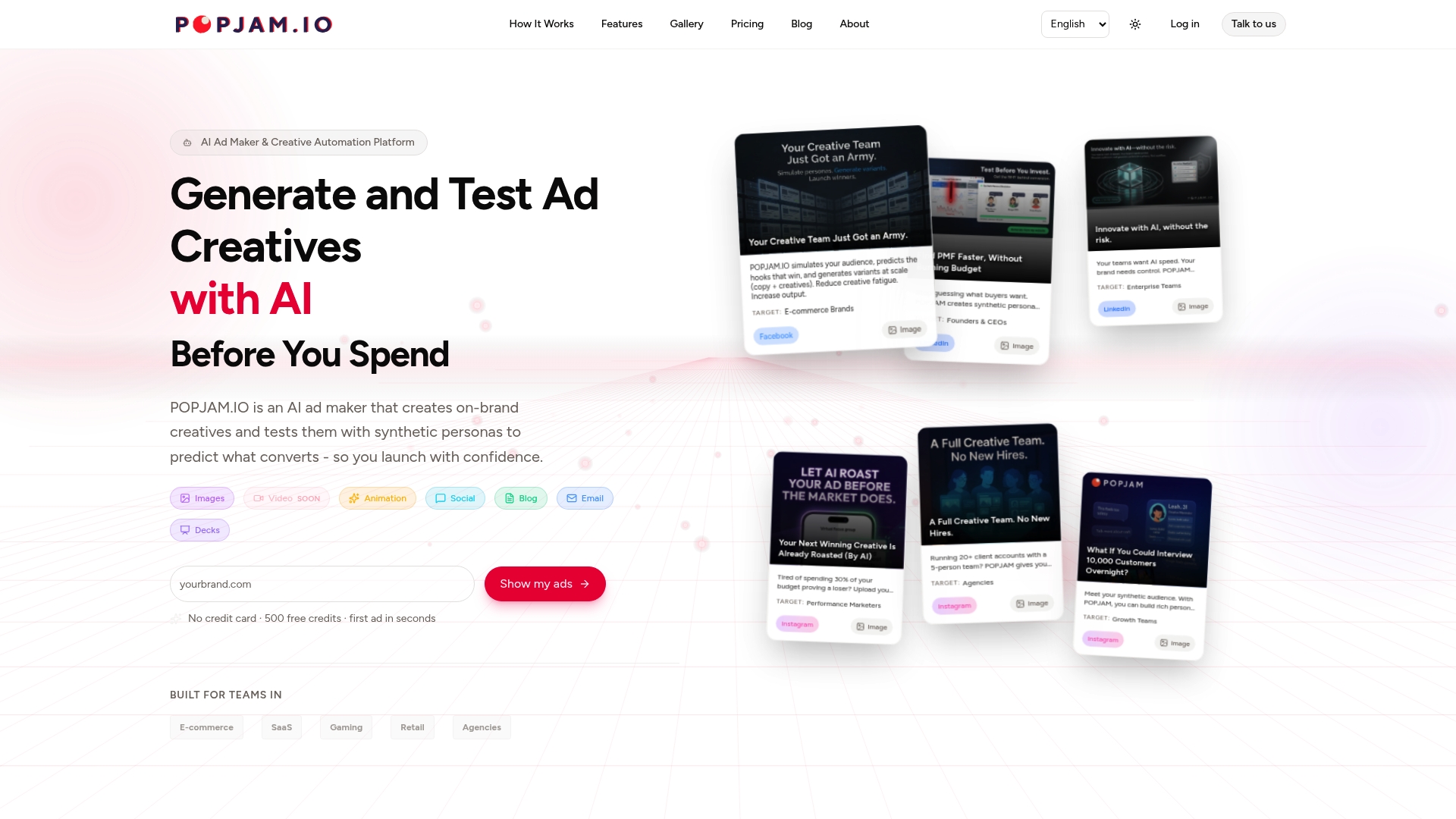
We built POPJAM to run the exact workflow above: synthetic persona simulation and GDPR-compliant audience modeling that returns ranked creative choices in 48 to 72 hours, complete with opt-out checks and platform-native exports for Meta, Google, TikTok, LinkedIn, and Reddit.
If you’re drafting ad copy before you simulate it, this guide to Google Ads copy that converts is a solid companion piece for getting your variants in shape first.
Our Free plan is the easiest way to see the workflow firsthand, and our Starter plan runs 29 € per month for teams ready to test regularly. Head to our AI ad generator to build and test your first batch of creatives before your next spend decision.
FAQ
What does GDPR-compliant ad testing actually mean?
It means testing ad creatives against synthetic buyer personas and privacy-first audience simulation before launch, rather than collecting or processing real personal data from live audiences. This approach relies on consented, aggregated, or fully synthetic inputs instead of individual user data.
How long does privacy-first synthetic ad testing take?
A full pre-launch test cycle typically runs 48 to 72 hours from variant submission to ranked results and persona transcripts. That timeline covers simulation, provenance logging, and opt-out verification, not just the model run itself.
Are synthetic personas more accurate than a no-persona ranker?
Not necessarily. A 2026 sim-to-real study found a no-persona zero-shot ranker hit just under 50% top-1 accuracy on aggregate click ranking, compared to about a third for a ten-persona panel, though persona panels still catch tone and cultural issues a ranker alone can miss.
What privacy safeguards should a vendor document?
Ask for documentation on differential privacy methods, data provenance and labeling trails, and how consented or aggregated inputs are stored. NIST’s guidance on differentially private synthetic data outlines the core techniques worth requesting proof of.
Can synthetic testing replace live A/B testing entirely?
No. Synthetic testing works best as a triage step that eliminates weak variants before spend, while a lightweight live A/B or landing-page split test still confirms which top performer earns full budget.
Sources
- Do Synthetic Personas Predict Real Audience Response? A Sim-to-Real Study Where a No-Persona Baseline Beats Persona-Based Copy Simulation
- Differentially private synthetic data | NIST
- Reducing Risks Posed by Synthetic Content: An Overview of Technical Approaches to Digital Content Transparency