

48–72 Hour GDPR Ad Testing for Marketers: Fast Privacy First Triage
Pretest ad creative in 48–72 hours with GDPR safe synthetic personas. Privacy first, academic validated checks to confirm winners before media spend.

GDPR ad testing, in the sense that matters to your team, means testing ad creative against AI-generated synthetic personas instead of real user data, so you get a directional read on what will land before a single euro or dollar hits Meta or TikTok. The verdict: it works well as an early filter, not as a final scorecard. Academic studies show synthetic samples track real audience trends but skew positive, so treat the output as a fast gut check. POPJAM builds this exact workflow into its platform.
TL;DR:
- Synthetic ad testing tends to overestimate positive responses and shows less variability than real audiences, so it should only serve as an early directional filter.
- Building detailed personas with demographic, psychographic, and behavioral traits across multiple segments improves the reliability of synthetic response predictions.
- A typical 48 to 72 hour workflow involves creating personas, running tests, reviewing results, and conducting minimal live holdouts to confirm findings before full deployment.
- Synthetic testing is most effective for quickly killing poor ad ideas early in the process rather than for precise measurement before large media investments.
- Pair synthetic results with small-scale live tests and qualitative feedback to triangulate insights and make confident media spend decisions.
Table of Contents
- What Is GDPR-Compliant Synthetic Ad Testing?
- How Do You Design a Synthetic Ad Test?
- How Do You Interpret Synthetic Test Results Without Getting Fooled?
- What Does a 48 to 72 Hour Testing Workflow Look Like?
- Why Speed Beats Perfection in Early Creative Testing
- Test Your Ads Before You Touch Your Media Budget
- Sources
- FAQ
What Is GDPR-Compliant Synthetic Ad Testing?
Here’s the plain version: instead of running your three ad concepts past a live panel of actual humans (whose data you’d then need to store, secure, and justify under GDPR), you run them past AI-generated personas built from psychographic profiles, purchase intent signals, and behavioral archetypes. No real names, no real inboxes, no real cookies. Just a simulated buyer who reacts the way your actual audience segment tends to react.

The personas aren’t guesses pulled from thin air. They’re built from attribute stacks, things like income bracket tendencies, brand affinity patterns, and stated values, then prompted to react to your creative the way a real member of that segment would. This is where the “synthetic respondent” research gets interesting, and also where you need to keep your expectations honest.
The strongest independent validation comes from two places worth knowing by name:
- The NIM digital twins study found synthetic respondents approximate aggregate trends reasonably well, but they tend to overestimate positive ratings and show reduced variance compared to real humans.
- The ASPIRE study benchmarked LLM-based synthetic sampling against a sizable U.S. sample and found above-chance accuracy in matching responses, but again, systematically lower variance and more positive sentiment than real people gave.
Translation: synthetic testing is genuinely useful for early-stage concept triage, narrowing five creative directions down to two. It is not a substitute for the kind of precise, high-stakes measurement you’d want before a seven-figure media buy.
How Do You Design a Synthetic Ad Test?
A good synthetic test lives or dies on how carefully you build the persona brief and how you structure the prompt. Sloppy inputs produce confident-sounding nonsense. Here’s the sequence that actually holds up.
- Define your personas with three layers. Demographics alone (age, location, income) are too thin. Add psychographic traits (risk tolerance, brand loyalty, aesthetic preference) and behavioral cues (recent purchase category, platform habits, scroll speed tendencies). A persona like “32, urban, values sustainability, price-sensitive but will pay more for a brand story” gives the model something real to react to.
- Build a sample mix, not a single persona. Run each ad past four to six distinct personas that represent your actual audience segments, not one idealized buyer. Variance across personas is itself a signal.
- Structure your prompt in three parts. Start with the persona brief, then the creative exposure (describe or attach the actual ad), then a response schema. Asking for a raw Likert scale (“rate 1 to 5”) tends to produce compressed, overly generous scores. Asking for semantic mapping, “which of these three competitor ads does this feel closest to, and why?”, tends to surface sharper, more honest signal, according to the same NIM research cited above.
- Test formats consistently. Static image, short video, and carousel each need their own exposure description, but keep the response schema identical across formats so you can compare apples to apples.
- Map your metrics to platform KPIs before you run anything. If your real goal is click-through rate on Meta, don’t just ask personas if they “like” the ad. Ask what action they’d take next, and score that against your actual funnel stage.
Pro Tip: Run the same creative through two different persona sets, one that matches your current buyers and one that matches your aspirational segment. The gap between their reactions often tells you more than either score alone.
How Do You Interpret Synthetic Test Results Without Getting Fooled?
Synthetic outputs come dressed in the confidence of a spreadsheet, which is exactly why they’re dangerous if you take them at face value. The NIM study and the ASPIRE benchmark both flagged the same pattern: synthetic respondents lean positive and cluster tightly, meaning your five personas might all rate an ad a 4 out of 5 when real humans would spread from 2 to 5.
Watch for three specific failure modes:
- Low inter-persona variance. If every persona in your set gives nearly identical scores regardless of how different their profiles are, the model is defaulting to generic positivity rather than genuinely differentiating.
- Inconsistent qualitative notes. A persona that rates an ad highly but writes a comment questioning its clarity is telling you the numeric score isn’t trustworthy on its own.
- Implausible responses. Watch for personas praising details that don’t exist in your creative. That’s a sign the model is pattern matching rather than actually “seeing” the ad.
The fix isn’t to abandon synthetic testing. It’s to triangulate. Pair synthetic results with a small live holdout audience, even just a few hundred impressions on a low-budget Meta test, or a handful of qualitative user interviews. ASPIRE’s own authors point to exactly this: small live checks remain the most reliable way to confirm what synthetic testing suggests before you scale spend.
Set a decision rule ahead of time. If synthetic scores cluster tightly and the live holdout confirms direction, greenlight the spend. If synthetic scores disagree sharply with qualitative comments, go back to the drawing board before you touch a media budget.
What Does a 48 to 72 Hour Testing Workflow Look Like?
Speed is the entire point of synthetic testing, so the workflow should feel like a sprint, not a research project. Here’s a template that fits inside three days.
Before you start:
- Build your persona roster (four to six profiles matching real segments)
- Name and version your creative assets clearly so results map back cleanly
- Decide your measurement plan and pass/fail thresholds in advance
- Run a quick privacy review confirming no real user data enters the process
The schedule:
- Day 1: Finalize personas and creative variants. Run the synthetic test batch. Owner: creative or growth lead.
- Day 2: Review outputs for variance and qualitative flags. Cross-check against your decision rules. Owner: performance marketer.
- Day 2 to 3: If results pass, launch a small live holdout at minimal spend to confirm. If they fail, revise creative and rerun.
- Day 3: Make the go or no-go call on full budget deployment.
On the privacy side, the operative principle is data minimization by design. Since synthetic testing never touches real personal data, there’s no PII to anonymize in the first place, but if your process ever incorporates real customer feedback alongside synthetic results, the EDPB’s pseudonymisation guidelines are worth a read: pseudonymisation has to be shaped to the actual use case and documented, not applied as a generic checkbox. POPJAM’s own breakdown of this workflow goes deeper into the 48 to 72 hour testing cycle if you want the extended version.
Why Speed Beats Perfection in Early Creative Testing
I’ll say the quiet part out loud: most marketing teams treat pre-launch testing like it needs to be airtight, and that instinct kills more good ads than bad creative ever does. You don’t need certainty at the concept stage. You need a fast, honest signal that tells you which two of your five ideas deserve real budget.
That’s the tradeoff synthetic testing forces you to accept. It won’t nail your exact conversion rate. It will tell you, in under 72 hours and without touching a single real user’s data, whether your hook is landing or falling flat. POPJAM built its testing cycle around that exact tradeoff, fast triage, not final judgment, because waiting two weeks for a “perfect” read usually means you’ve already burned the budget you were trying to protect. Use it for what it’s good at: killing bad ideas early. Don’t ask it to replace the live test entirely.
— Doruk
Test Your Ads Before You Touch Your Media Budget
POPJAM is the alternative to guessing which creative will work: it generates on-brand ad creative and runs it past synthetic buyer personas before you spend a single dollar on Meta, Google, TikTok, LinkedIn, or Reddit. Instead of launching three variants and hoping, you get psychographic feedback on each one first.
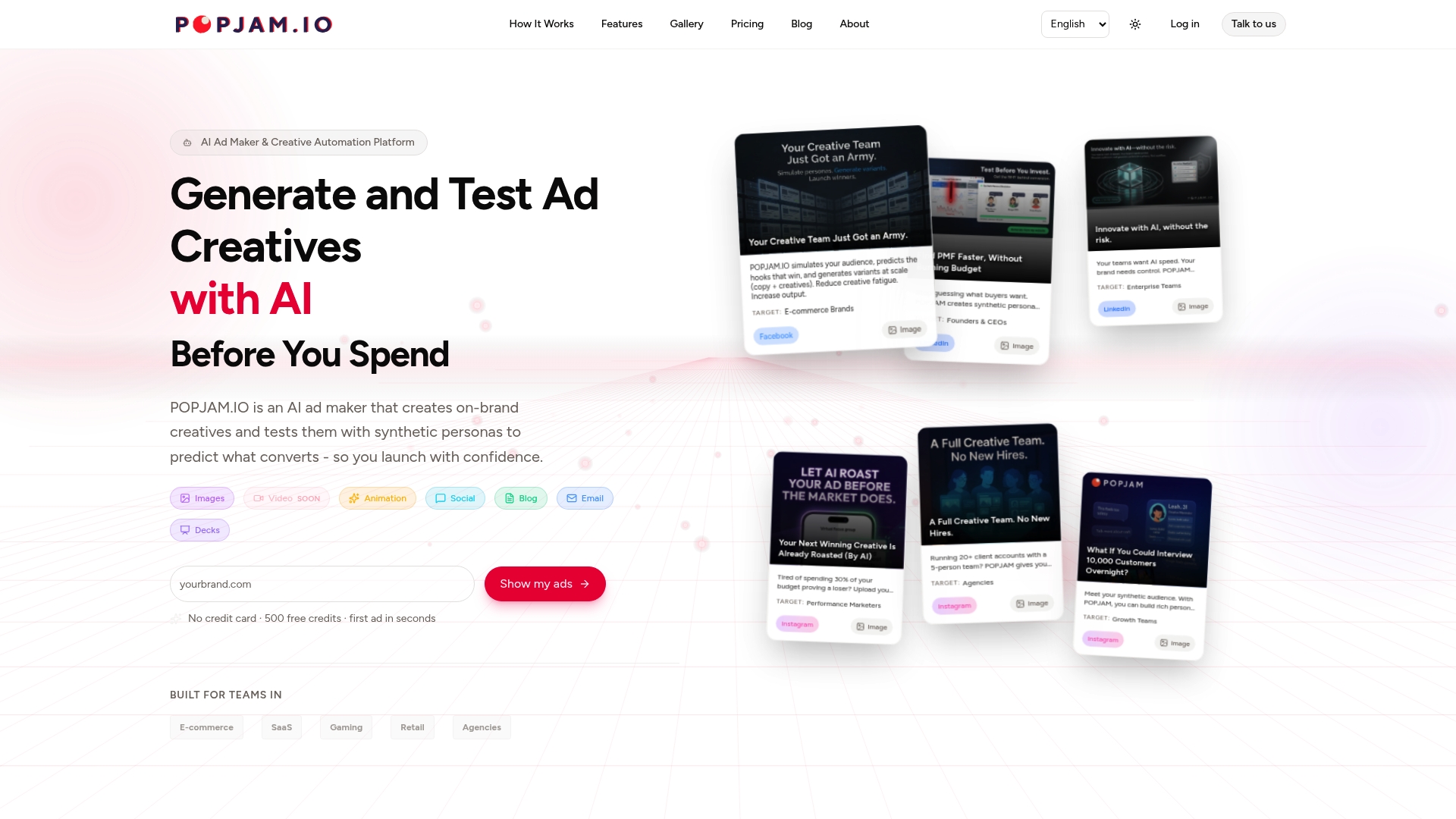
Performance marketers and agencies managing multiple client accounts get the most out of this, since testing five concepts synthetically costs a fraction of testing five concepts live. If you’re running creative for an agency roster, the agency-focused ad generator is built around exactly that workflow. Every test runs on synthetic personas rather than real user data, which keeps your pre-launch process privacy-aware by design.
Plans start with a Free tier, and paid options include various subscription levels. For current pricing details, see the pricing page. Check the full pricing breakdown or head straight to the AI ad generator to run your first test this week.

Sources
The academic backbone for this playbook comes from the NIM digital twins study and the ASPIRE benchmark. For the regulatory side, the EDPS orientations on generative AI cover documentation expectations. For campaign alignment once your creative passes testing, Baby Love Growth’s guide to planning digital campaigns is a solid next stop.
- Leaving Insight to Digital Twins? Promise, Progress and Limits of Synthetic Respondents | NIM
- EDPB guidelines on pseudonymisation
FAQ
What Is GDPR Ad Testing?
GDPR ad testing refers to pre-launch ad validation using AI-generated synthetic personas instead of real user data, so teams get feedback on creative direction without processing personal information. It works by simulating how different audience segments would react to an ad before any media spend occurs.
Is Synthetic Persona Testing Actually Accurate?
Synthetic personas approximate real aggregate trends reasonably well, but research from NIM found they tend to overestimate positive ratings and show less variance than real humans. Treat synthetic results as a directional filter for early concept testing, then confirm strong candidates with a small live holdout.
How Long Does a Synthetic Ad Test Take?
A full synthetic test cycle, from persona setup to a go or no-go decision, typically fits inside a 48 to 72 hour window. POPJAM’s own GDPR-aware testing process is built around that same timeframe.
How Much Does POPJAM Cost?
POPJAM offers a Free plan and several paid subscription tiers. For current pricing details, see the pricing page. Full details are on the pricing page.
Does Synthetic Testing Replace Live A/B Testing?
No. Academic reviews recommend synthetic sampling as a complement to traditional testing, not a replacement, especially for high-stakes or precise audience measurement. Use it to narrow your creative options first, then confirm the winner with a small live budget test.