

Measure by Clicks, Not Opens: Email Creative Testing for 2026
A 2026 playbook for email creative testing: prioritize clicks and conversions, require 95% confidence for winners, and validate creative with prelaunch...

Run an A/B test when you’re checking one variable at a time, and switch to multivariate or fractional-factorial designs when you need to see how several elements interact. Either way, build your decision around clicks, replies, and conversions, not opens, because Apple Mail Privacy Protection preloads tracking pixels and inflates open data before anyone actually reads your email. Lock in your sample size and stop rule before you hit send.
TL;DR:
- Set a 95% confidence threshold before launch; treat 85% to 95% as directional evidence, and consider results below 85% inconclusive.
- Estimate sample size from historical click rates and minimum worthwhile lift, randomize at send level, and avoid holidays or unusual campaign timing.
- Repeated dashboard checks raise false positive risk; precommit to an end date, while fractional factorial designs reduce cells when several factors need testing.
- Revenue per send can overturn a winner chosen by click volume; exclude clicks logged within seconds of delivery because scanners may produce them.
Table of Contents
- A/B Testing vs Multivariate Testing: Which One Do You Actually Need?
- Which Creative Elements Should You Test First?
- How Do You Design a Test That Holds Up?
- Why Peeking at Results Early Ruins Your Test
- Which Metrics Can You Actually Trust in 2026?
- A Compact Runbook: From Hypothesis to Rollout
- Catching Creative Problems Before You Ever Hit Send
- Turning Test Results Into Real Creative Improvements
- What Tools Actually Support This Kind of Testing?
- What Do Successful Email Creative Tests Look Like?
- Speed and Rigor Don’t Have to Fight Each Other
- A Faster Way to Validate Creative Before You Spend
- FAQ
- Sources
A/B Testing vs Multivariate Testing: Which One Do You Actually Need?
A/B testing compares two versions of one variable, like subject line A versus subject line B, while everything else stays fixed. It’s fast, easy to read, and perfect when you want a clean answer to a single question.
Multivariate testing changes several elements at once (subject, hero image, CTA) and measures how they interact. We get richer insight, but we need bigger lists and more design cells to pull it off cleanly.
Here’s how the two stack up in practice:
- A/B testing works best with smaller lists, tight timelines, and one clear variable you want to isolate.
- Multivariate testing fits larger lists where you can afford more send variations and want to understand combined effects.
- ESP constraints matter: many platforms cap the number of variants per campaign, so check your version limits before you design a multivariate grid.
- Speed versus depth is the real trade-off: A/B gets you a fast, confident answer; multivariate gets you the “why” behind the winner.
If you’re stuck between the two, ask whether you’re optimizing a single lever or trying to understand how your creative elements work together.
Which Creative Elements Should You Test First?
Not every element deserves equal attention. Some moves the needle more than others, and testing in the wrong order wastes cycles you don’t have.
- Subject line: Compare short, curiosity-driven lines against longer, benefit-led ones.
- Preheader text: Test a direct continuation of the subject versus a standalone teaser.
- CTA text and placement: Swap “Shop Now” for “See the Collection,” or move the button above the fold.
- Hero image or asset: Test a lifestyle photo against a product-only shot, or an image-heavy layout against a text-first one.
- Template and layout: Single-column versus multi-column, or a long scroll versus a condensed above-the-fold design.
- Copy length: Short, scannable copy against a longer, story-driven version.
- Personalization tokens: First name in the subject line versus no personalization at all.
Before you build anything, write the hypothesis down: “Shortening the subject line from 60 to 30 characters will lift click rate by at least 10%.” A hypothesis without a minimum lift threshold just invites you to call any result a win.
Pro Tip: Test the element with the highest production cost last, after cheaper variables like subject lines have already told you what resonates.
How Do You Design a Test That Holds Up?
A test only matters if the result survives scrutiny. That starts with picking a confidence threshold before you look at a single number.
Statology’s guidance treats 95% confidence as the standard for calling a result significant, with 85% to 95% as directional rather than conclusive, and anything below 85% as effectively inconclusive.

Most senders never hit true statistical significance on a single send: a 95% confidence threshold is the bar worth defending, but a result in the 85-95% range still tells you something worth acting on, carefully.
A few rules keep your setup honest:
- Estimate your sample size before launch using your historical click rate and the minimum lift you’d act on; when a calculator isn’t handy, a rough heuristic is that smaller expected lifts need proportionally larger lists to detect.
- Avoid testing on days with unusual send cadence (holidays, post-sale lulls) since timing noise can masquerade as a creative win.
- Randomize assignment at the send level, not by segment or region, to prevent list composition from contaminating the result.
- Hold out a control group when you’re testing a change you plan to roll out broadly, so you have a clean baseline to compare against.
Why Peeking at Results Early Ruins Your Test
Checking your dashboard every few hours feels responsible. It’s actually one of the fastest ways to convince yourself a loser is a winner.
Repeated peeking inflates false positives because every additional look is another chance for random noise to cross your significance line. The fix is to precompute your sample size and wait, or switch to a sequential or Bayesian framework built for continuous monitoring.
Multiple comparisons create a related problem: test five elements at once with five separate A/B splits, and you’ve multiplied your odds of a false positive. Fractional-factorial designs solve this by testing several factors with far fewer cells, trading some precision on higher-order interactions for a manageable experiment size.
- Decide your sample size and end date before launch, not after watching the first day’s numbers.
- Use fractional-factorial or sliced designs when testing more than two variables, so your email client and device splits don’t quietly skew the result.
- Weigh practical significance against statistical significance: a confirmed 2% lift might not be worth the production cost of a redesigned template.
Pro Tip: When a result lands in the 85-95% directional zone, treat it as a lead for your next test, not a reason to rebuild your template library.
Which Metrics Can You Actually Trust in 2026?
Open rate has been quietly broken since Apple rolled out Mail Privacy Protection, and it hasn’t gotten more reliable since. MPP preloads tracking pixels at delivery, which means a huge share of recorded “opens” happen before a human ever sees the email, and on-device AI summaries now often replace the preview entirely.

Open rate now functions as an upper bound on deliverability, not a measure of engagement: the real story lives in what people do after the message lands.
Here’s where to put your trust instead:
- Clicks, replies, and conversions are the primary decision metrics for any creative test running in 2026.
- Revenue per send gives you a bottom-line check that survives inbox noise better than any engagement proxy.
- Flag clicks that land within a few seconds of delivery as likely bot or scanner activity, and strip them out before you compute a winner.
- Use your ESP’s MPP-exclusion toggle, where available, to keep Apple Mail’s inflated opens out of your open-based reporting.
Automations built on open-triggers need rewiring too. Shift sunset logic and re-engagement flows to click-based or time-based signals, since an open trigger built on pre-MPP assumptions will fire on emails nobody actually read.
A Compact Runbook: From Hypothesis to Rollout
Most testing programs don’t fail because of bad statistics. They fail because nobody wrote down the process, so each test reinvents the wheel.
- Write the hypothesis tied to one primary KPI and a minimum detectable lift you’d act on.
- Build assets with clear naming conventions (subject_A, subject_B) so nobody mixes up variants mid-analysis.
- QA render across major clients including Gmail, Outlook, and Apple Mail, with a mobile-first check since most opens happen on a phone.
- Run the test for the full predetermined duration, resisting the urge to call it early.
- Apply your decision rule (95% confidence, or 85-95% as directional) before declaring a winner.
- Roll out gradually, watching the winning variant’s performance hold up outside the test environment.
- Retire the creative on a cadence rather than running it until performance visibly drops, since creative fatigue tends to set in predictably once an audience has seen a concept repeatedly.
Pro Tip: Build your next test’s hypothesis while the current one is still running, so your team never sits idle between learning cycles.
Catching Creative Problems Before You Ever Hit Send
Live testing tells you what worked after the fact. A pre-launch check tells you what’s likely to fail before it costs you a single send.
Synthetic persona testing simulates how different audience segments might react to a creative, surfacing brand-fit issues, unclear headlines, or a buried CTA before the email goes anywhere near a real inbox. It’s a useful complement to live A/B and multivariate testing, not a replacement for it.
A few checks worth running pre-launch:
- Confirm your CTA is visible in the first viewport on mobile, not just desktop.
- Check your plain-text fallback reads cleanly, since not every client renders HTML the way you expect.
- Review whether your opening line gives Apple Intelligence’s AI summary enough substance to represent your offer accurately.
Our pre-launch creative scorecard walks through this process in more detail.
Turning Test Results Into Real Creative Improvements
A winning variant is only useful if you understand why it won. Treating every test result as a standalone verdict, instead of a data point in a pattern, is how teams end up with a pile of “winners” that don’t actually teach them anything.
Start by separating the specific change from the underlying principle. If a shorter subject line beat a longer one, the lesson isn’t “always write short subject lines.” It might be that your audience responds to clarity over cleverness, or that your list skews toward mobile readers who see less of a long subject before it truncates. Write that principle down before you move to the next test.

Look for consistency across tests, not just magnitude within one. A pattern where direct, benefit-led subject lines beat curiosity-driven ones across four separate tests is a finding you can build a creative brief around.
When a test lands in the directional zone rather than the confident 95% range, don’t discard it. Bank it as a weak signal and look for it to repeat in your next test before treating it as settled. Our creative testing framework covers how to sequence these tests so each one builds on the last instead of starting from zero.
Translate findings into your next brief in concrete terms: not “shorter copy performed better” but “lead with the benefit in the first six words, keep body copy under 50 words, and put the CTA above any secondary content.” Specific instructions survive handoffs between strategists and designers. Vague takeaways don’t.
What Tools Actually Support This Kind of Testing?
Most major email service providers, including Mailchimp, Klaviyo, and HubSpot, offer native A/B testing for subject lines and basic content splits. Multivariate and fractional-factorial testing usually requires either a more advanced ESP tier or a dedicated experimentation layer, since the design and analysis demands go beyond a simple two-version split.
For statistical rigor, some teams lean on general-purpose A/B testing calculators to check significance before trusting a result, rather than relying on an ESP’s built-in “winner” badge, which doesn’t always disclose its confidence threshold.
For the pre-launch layer, where you want to catch problems before a test even goes live, synthetic persona simulation lets you validate creative direction, headline clarity, and CTA prominence against modeled audience feedback. It’s a different kind of tool than your ESP’s split-test feature. It’s built to catch issues earlier, before you’ve spent any list attention on a test that was doomed from the brief stage.
The right stack usually combines three layers: your ESP for execution and basic splits, a statistical framework for confidence checks, and a pre-launch validation step for anything with real production cost behind it.
What Do Successful Email Creative Tests Look Like?
The clearest wins in email testing tend to come from isolating one clear variable and tying the result to a concrete decision, not from sprawling redesigns tested all at once.
A common pattern: a team tests a short, direct subject line against a longer, benefit-stacked one. The short version wins on open-adjacent signals, but when the team checks clicks and conversions instead, the longer version actually drives more revenue per send because it pre-qualifies the reader before they click. That’s a case where trusting the deeper metric changed the actual decision.
Another frequent pattern involves CTA placement. Moving a CTA button above the fold on mobile often produces a measurable click lift, because a large share of recipients never scroll past the first screen on a phone. Teams that test this in isolation, without changing anything else, get a clean read on whether placement alone was the driver.
Fractional-factorial designs show up in cases where a team wants to test subject line, hero image, and CTA copy simultaneously without running eight separate full-factorial cells. SAS’s proceedings on multivariate testing walk through how a reduced set of test cells can still estimate main effects for each factor, which is often enough to guide a creative decision even without mapping every possible interaction.
Our own subject line testing playbook walks through a similar sequence step by step, from hypothesis to rollout.
Speed and Rigor Don’t Have to Fight Each Other
We’d rather see teams bank directional 85-95% signals fast, then protect brand cohesion over chasing a one-time lift that breaks consistency. Prioritize tests tied to revenue, not vanity metrics.
— Doruk
A Faster Way to Validate Creative Before You Spend
We built our platform around the gap this whole playbook keeps running into: live testing is rigorous but slow, and every test costs you real list attention and real spend before you know if a creative direction was even worth pursuing. Synthetic persona simulation lets you check brand fit, headline clarity, and CTA prominence against modeled audience feedback before a single email or ad goes out the door.
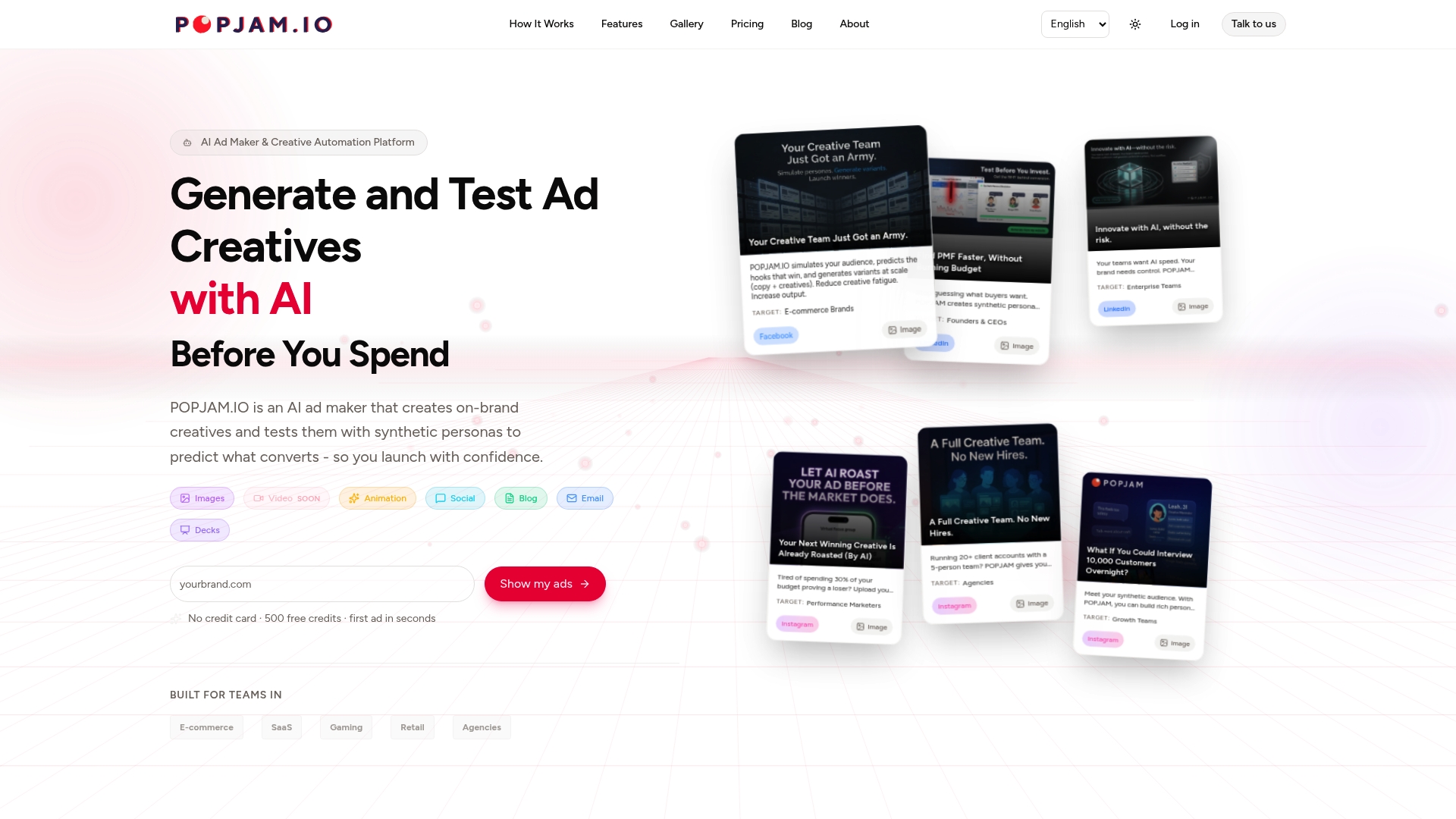
- We generate on-brand creative variants and test them against synthetic buyer personas before launch.
- We surface psychographic feedback so you can see what’s likely to resonate with a segment, not just guess.
- We support exports across major ad platforms alongside email and presentation formats.
If you’re already running the statistical playbook above, this is the layer that catches problems before they ever reach your list. Check pricing and plans to see what fits your team’s testing volume, with plans starting at Starter for 29 € per month.
FAQ
What is the most hacked email provider?
This question is outside the scope of creative testing and measurement, and we don’t have a sourced answer to offer here. For security guidance, consult your email service provider’s own documentation.
Is email blasting illegal?
Sending unsolicited bulk email can violate anti-spam laws depending on your jurisdiction and whether recipients consented to contact. The safest approach is to build permission-based lists and follow your regional regulations rather than relying on a blanket rule.
What is the 12 second rule for emails?
There’s no single, widely agreed definition of a “12 second rule” in email marketing, and we don’t have a source that defines it precisely. If you encounter the term, treat it as a rough shorthand for how little time you have to capture attention, not a fixed benchmark to test against.
Can you give me some examples of e-blasts?
Common e-blast formats include flash sale announcements, new product launches, and newsletter-style roundups sent to a full list at once. Each works best when the subject line and first line of body copy carry the core message, since many recipients will only see that much before deciding to click.
Sources
- Adapting to Apple Mail Privacy — Email Developer
- Finding the winning combination: an application of multivariate testing from digital marketing — SAS proceedings
- The peeking problem in experiments — GoPractice
- Apple Mail Privacy Protection in 2026: What your open rate actually means — Email Calculator