

Ecommerce Ad Testing Starts With Concepts, Not Button Colors
Test ecommerce ad concepts before variations, validate with buyer personas, then use conversion rate, ROAS, and CTR to decide when winners can scale.

Start with concept-first testing, then run structured variation tests, validate with persona panels before you spend, and scale only when early-signal thresholds clear. Watch conversion rate, ROAS (or incremental ROAS), and CTR first, in that order of importance. We built POPJAM.IO for the pre-launch validation step, so weak creatives get filtered out before they cost you money.
TL;DR:
- Each test should answer one goal: use surveys or lift studies for recall, CTR for resonance, and conversion rate plus ROAS for purchases.
- Use A/B tests for one clear change, multivariate tests only when traffic can support every combination, and holdouts to measure sales the ads actually add.
- Platform experiments can rank creatives but may overstate absolute value because they use platform attribution; verify channel impact with a holdout or lift test.
- Across 225 incrementality tests in 2025, 88.4% reached significance at 90% or higher confidence; inconclusive results more often reflect design problems than bad luck.
- Before scaling, require preset impression and conversion minimums, stable or falling cost per action, CTR gains without weaker landing page conversion, and gradual budget increases.
Table of Contents
- Which goals should your ecommerce ad tests be built around?
- What does a practical concept-first testing workflow look like?
- Which test design fits which question?
- Which metrics and early signals tell you who is winning?
- How much should you spend on tests, validation and scale?
- Which tools do you need, and where does POPJAM fit?
- Who is behind this playbook, and what backs it up?
- How do you turn psychographic feedback into creative changes?
- What do most testing programs get wrong?
- How POPJAM.IO helps you test creatives and cut wasted spend
- FAQ
- Sources
Which goals should your ecommerce ad tests be built around?
Every test starts with a question, and the question decides the design. Ecommerce teams usually chase three goals, and mixing them in one test is how budgets leak.
- Creative resonance: Do people stop, click and engage? CTR and engagement rate are the main signals, and a simple A/B comparison is usually enough.
- Brand and message recall: Does the ad stick? This needs a lift-style or survey-style design, because clicks alone will not tell you.
- Direct response: Does the ad produce purchases at an acceptable return? Conversion rate and ROAS are the judges, and you need enough conversion volume to trust them.
Platform guidance backs the same logic. Google Ads recommends aligning your bidding strategy to campaign goals, for example moving from Maximize clicks to Maximize conversions when purchases are the aim. If your test optimizes for clicks but your business needs sales, you will crown the wrong winner.
What does success look like? Benchmarks vary by category, price point and channel, so treat any universal CTR “target” with suspicion. The sturdier benchmark is about measurement quality:
Across 225 incrementality tests measured in 2025, 88.4% reached statistical significance at 90% or higher confidence. In plain terms, well-designed tests usually give you a readable answer, so a test that ends in “inconclusive” is more often a design problem than bad luck.
Write the goal, the primary metric and the decision rule down before you launch. Future you will thank present you.
What does a practical concept-first testing workflow look like?
Most teams do it backward. They polish one idea, test five button colors, and wonder why nothing moves. Big gains come from different ideas, not different shades. Here is the workflow we recommend:
- Test concepts. Pick three to six genuinely different angles (price anchor, social proof, problem-solution, lifestyle, founder story, comparison). Produce a rough version of each and run them against each other with equal budget. You are hunting for the angle, not the finish.
- Test variations. Take the winning concept and iterate in controlled A/B or multi-armed tests. Change one element family at a time: headline, thumbnail or hero image, offer framing, call to action.
- Validate before spend. Run candidate variants past a small human panel or synthetic buyer personas to filter noisy options. Anything that fails here never reaches your live budget.
- Scale on early signals. Promote only the variants that clear your pre-set thresholds, and keep a holdout so you can check that the lift is real.
Two habits keep this cheap. First, use micro-tests: a small, time-boxed budget per concept, with a hard stop date, so no single idea can eat your month. Second, reserve a holdout group that never sees the ad. Without it, you can credit an ad for sales that would have happened anyway.
Pro Tip: Write the “kill rule” before launch, such as “pause any concept that trails the leader’s CTR by a wide margin after its minimum impressions.” Deciding in advance removes the temptation to rescue your favorite.
For ideas to feed step one, our copy-ready ecommerce ad creatives give you a starting set of angles to pretest. And if you run on Google, our walkthrough on Google Ads creative testing with experiments and persona tests shows how the platform’s experiments fit around this workflow.
One more point on sequence. Concept testing is cheap because the creative is rough and the stakes are low. Variation testing is where precision matters. Validation is the insurance policy. Skipping the first step and jumping straight to variations is the most common reason teams burn budget polishing the wrong idea.
Which test design fits which question?
No single design wins every time. Pick based on the question, your traffic, and how much budget you can risk.
A/B tests. Use them when you want a clean answer to one question: does headline A beat headline B? Change one variable, split traffic evenly, and wait for enough conversions. A/B is the best choice for high-precision questions and for teams new to testing. Its limit is speed: you only learn about one change at a time.
Multivariate tests. These test several elements at once (say, three images times three headlines) and reveal how elements interact. The catch is sample size. Every extra combination slices your traffic thinner, so a multivariate test that looks thorough can end up underpowered on every cell. Reserve it for high-volume accounts where interactions genuinely matter, such as image and offer pairings.
Multi-armed (bandit) approaches. When you have many concepts and a tight budget, bandit-style allocation shifts spend toward the leaders as data arrives, instead of splitting evenly until the end. This is how a lot of automated platform tooling behaves. Google’s Smart Bidding, for instance, uses auction-time signals such as device, time of day and the creative being shown to set bids per auction. The tradeoff is clarity: because allocation keeps shifting, you learn less about why something won.
Holdout and lift tests. These measure incrementality: what happened because of the ad versus what would have happened anyway. Part of your audience is deliberately held out and compared with those who saw the ad. They cost more setup and some forgone reach, but they are the only design that answers “is this channel actually adding sales?”
A quick way to choose:
- Need a clean answer on one change? Run an A/B test.
- Testing interacting elements with heavy traffic? Consider multivariate, and budget for the sample.
- Many concepts, little money? Use a multi-armed approach and accept the lost nuance.
- Questioning whether the channel works at all? Invest in a holdout or lift test.
- No traffic for any of the above? Validate with personas first, then run a small A/B on the survivors.
Notice that these designs stack rather than compete. A realistic program uses bandit-style exploration for concepts, A/B tests for finalists, and a holdout test each quarter to keep everyone honest about incrementality.
One caution about platform-run experiments: they inherit the platform’s attribution. That is fine for ranking creatives against each other, but it can overstate absolute value. Use platform tests to rank, and use lift tests to verify.
Which metrics and early signals tell you who is winning?
Match metrics to goals, then add a second metric as a sanity check.
- Creative resonance: CTR and engagement rate first; cost per click as the check.
- Recall: Lift in aided recall or brand search; frequency as the check.
- Direct response: Conversion rate and ROAS first; cost per acquisition trend as the check.
- Incrementality: Incremental ROAS (iROAS) and lift versus holdout.
Early signals matter because waiting for full purchase data on every variant is expensive. Useful leading indicators include a clearly higher CTR with stable landing-page conversion, a falling cost per add-to-cart, and strong hold or watch rates on video. Treat these as filters, not verdicts: they help you stop failures early and prioritize likely winners, then purchase data confirms.
For stopping rules, set a minimum number of impressions and clicks before judging anything, and refuse to peek at day one. Google’s own optimization guidance suggests changing bids in small increments while monitoring results and using conversion tracking and reports to find top performers. The same patience applies to creative: small, measured moves beat panic edits.

The median incremental ROAS across those 225 tests in 2025 was 2.31x, with an interquartile range of 1.36x to 3.24x. That spread is the real lesson.
How to use it in practice:
- Treat 2.31x as a reality check for your own iROAS, not a promise. Your category, margin and funnel will shift it.
- If a test shows an iROAS far above the range, check your setup before celebrating.
- If a result sits below the lower bound, ask whether the issue is the creative, the audience or the offer, and test one at a time.
- Judge decisions against your margin. An iROAS that clears break-even for a high-margin product may lose money for a thin-margin one.
If your goal is to feed the right data into these decisions, our guide to ad feedback analysis covers turning raw reactions into ROI-focused calls. And keep your targeting tidy: a messy keyword or audience setup muddies test results, which is why even ecommerce keyword research deserves a look before you blame the creative.
How much should you spend on tests, validation and scale?
The point of budgeting rules is to protect your ROAS while you hunt for winners. A common heuristic divides spend among proven performers, iterations and bold experiments, with the proportions adjusted to fit the account. For ecommerce, we adapt it by adding a validation layer that costs far less than live spend.
A sample split for a test cycle:
- A small share of the cycle budget: pre-launch validation and concept micro-tests. Cheap, fast, and designed to kill weak ideas.
- A share: variation tests on the surviving concepts.
- The largest share: scaled spend on confirmed winners, with a holdout in place.
Deviate when the situation demands it. A brand launching a new product with no proven creative has no “70” to protect, so shift more into concept testing. A mature account with stable winners can drop experiments to a smaller slice and run them continuously.
Before approving scale, run this checklist:
- The variant has reached the minimum impressions and conversions you set before the test began.
- Cost per action is flat or falling across the test window, not just on one lucky day.
- CTR is meaningfully ahead of the control, and landing-page conversion has not slipped.
- Early signals and purchase data point the same direction.
- A holdout or lift check exists, or is scheduled, to confirm incrementality.
When you do scale, raise spend in steps rather than doubling overnight, and align the bid strategy to the goal. Google lists Target ROAS, Maximize Conversion Value and other strategies tied to specific objectives, so pick the one that matches what you are optimizing.
Pro Tip: Keep a standing “challenger” slot. Even in scale mode, give one small budget line to a fresh concept, so you always have the next winner warming up before the current one fatigues.
Which tools do you need, and where does POPJAM fit?
Think in categories rather than brands. A working ecommerce testing stack usually covers four jobs:
- Creative generators that produce on-brand concepts and variants quickly, in the formats each channel needs.
- Pre-launch validation and synthetic persona tools that simulate how target buyers react before any money is spent.
- Experiment tracking and lift testing to run holdouts, record results and compute incrementality.
- Ad ops and reporting to monitor spend, pacing and cost per action across platforms.
The most wasteful gap is usually the second one. Without pre-launch validation, every weak idea has to fail in public, on your budget. A practical recipe combines both worlds: generate several concepts, run them past persona panels, push the strongest into a platform experiment, then confirm the winner with a holdout. Live spend only touches ideas that have already survived a filter.
This is exactly the slot our platform is designed for. POPJAM.IO generates on-brand ad creatives and tests them against synthetic buyer personas, so you see psychographic reactions before launch. You can see how that works for online stores on our AI ad generator for e-commerce page.
When you evaluate any tool in this space, check for:
- Exportable persona test results you can share with your team or clients.
- Analytics integrations that fit how you already report.
- Platform-native export formats for Meta, Google, TikTok, LinkedIn and Reddit.
- GDPR-compliant persona simulation, so your validation process is not a compliance risk.
- Clear credit or plan pricing, so you can forecast cost per tested concept.
Pro Tip: Run a pilot with creatives from recent campaigns. If pre-launch validation had flagged the losers you already paid for, you have your business case.
Who is behind this playbook, and what backs it up?
I’m Doruk, and I build and write about creative testing for ecommerce and performance teams. The workflow above is the one I would hand a team that wants fewer expensive surprises, and it reflects the same thinking we put into our own product.
Here is what stands behind the validation step. We built POPJAM.IO around three capabilities: AI creative generation that stays on brand, pre-launch testing against synthetic buyer personas, and data-driven feedback that shows why a creative resonates with a segment, not just whether it did. The aim is measurable improvement in campaign performance and less creative fatigue, replacing guesswork with evidence.
When we share outcomes, the proof that matters is specific: how many concepts were screened, which were killed before launch, and how live results compared with the persona predictions. That is the standard to hold any testing vendor to, including us.
How do you turn psychographic feedback into creative changes?
Persona feedback is only useful if it changes the ad. Raw reactions like “felt pushy” or “not for me” need translating into edits, and a simple routine makes that fast.
Start by grouping feedback into themes: trust, relevance, clarity, urgency and price perception. Each theme maps to a specific creative lever:
- Trust concerns point to proof: reviews, guarantees, recognizable packaging, or a real customer in frame.
- Relevance gaps call for a sharper audience cue, such as naming the use case or showing the product in the buyer’s world.
- Clarity problems mean cutting copy, enlarging the product shot, and leading with a single benefit.
- Weak urgency suggests a clearer offer, deadline or scarcity cue, used honestly.
- Price friction is solved by reframing value (cost per use, bundle savings) rather than discounting by default.
Then rank changes by how many personas raised the issue and how cheap the fix is. Fix the common, cheap problems first, then retest the revised version against the original, so you know the edit actually helped.
Segment differences deserve their own note. If one persona loves the humor and another finds it flippant, you may need two cuts rather than a compromise. Splitting creatives by segment often beats one averaged ad that nobody loves.
Close the loop by comparing live results to the persona predictions. Where they diverge, adjust how you weigh future feedback. Over a few cycles your team develops a sharper instinct for which signals deserve action.
What do most testing programs get wrong?
Here is my take: the industry over-invests in the wrong end of the process. Teams argue about button colors and significance thresholds while running only one or two real ideas. The expensive mistake is a bad concept, and no amount of variation testing rescues it.
Conventional advice also treats testing as something you do after launch, with live money as the lab. That makes sense for platforms that sell you impressions, but it is a poor deal for your budget. A cheap filter before launch changes the math: fewer losers reach the auction, and your tests start from stronger candidates.
What is overrated? Chasing statistical perfection on tiny differences. A variant that wins by a hair rarely changes your business. What is underrated? Holdouts. The 2025 data shows most incrementality tests produce readable answers, yet many teams never run one and keep trusting platform attribution.
If you do one thing differently, run a real concept round before the next campaign: several different angles, small budget, hard kill rules. Everything downstream gets cheaper.
— Doruk
How POPJAM.IO helps you test creatives and cut wasted spend
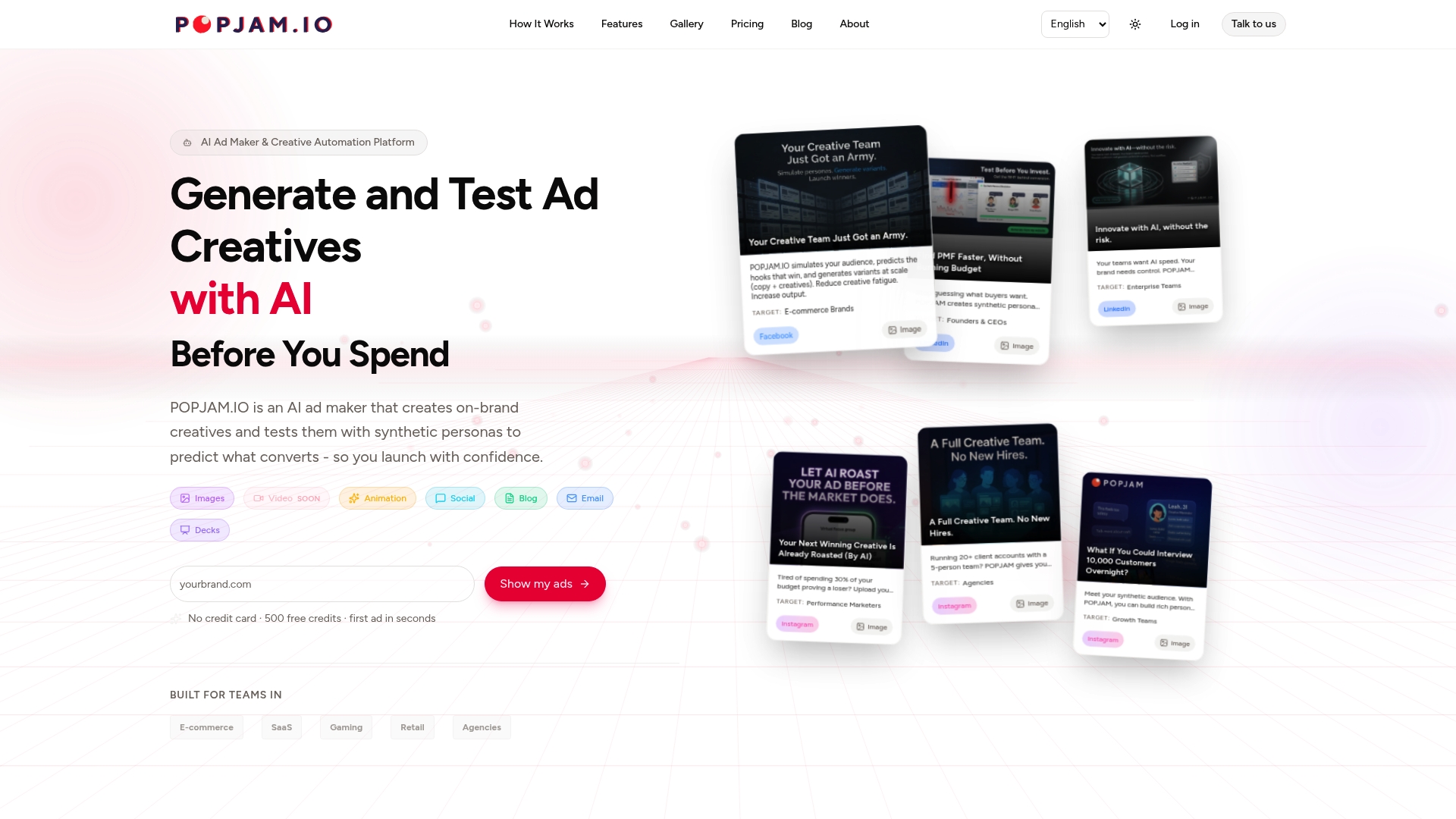
If you want the pre-launch step without building it yourself, we made it for you. Our platform generates on-brand ad creatives, tests them against synthetic buyer personas, and exports platform-native formats for Meta, Google, TikTok, LinkedIn and Reddit, so winners are ready to run.
- Performance marketers and growth teams: screen concepts before they touch your budget.
- Agencies: show clients evidence for a creative direction before launch.
- Small stores: start on the Free plan or Starter at 29 € per month, and move up to Essential or Business as volume grows. Enterprise suits larger teams.
See our AI ad generator in action, or compare plans on the pricing page.
FAQ
What is the best way to start ecommerce ad testing?
Start by testing three to six distinct concepts with equal small budgets before refining any details. Pick one primary metric per goal, set kill rules in advance, and only then move the winner into A/B variation tests.
How do I know when an ad test has enough data?
Set minimum impressions and conversions before launch, and avoid judging on day one. Well-run tests tend to be readable: 88.4% of 225 incrementality tests reached significance at 90% or higher confidence, so inconclusive results usually point to design or volume problems.
What is the 70/20/10 rule for ad budgets?
It is a heuristic for dividing spend among proven performers, iterations and bold experiments. The proportions can be adjusted to fit your account. For ecommerce, add a cheap pre-launch validation slice, and shift more toward testing when you have no proven winners yet.
Can I test ads without spending much money?
Yes. Use micro-tests with small capped budgets, and validate concepts with persona or small-panel pre-tests so weak variants never reach live spend. Then confirm the finalists with a short A/B test.