

Cookieless Audience Testing: Synthetic Personas Before Live Spend
Run cookieless audience tests with Privacy Sandbox APIs, server side events, and incrementality. Screen creative with synthetic personas before live ad spend.

Yes, you can and should run cookieless audience tests right now. The smartest path pairs Privacy Sandbox simulation, server-side event capture, and an incrementality holdout into one small pilot. Start there, measure what moves, and scale the methods that hold up under pressure.
TL;DR:
- Choose one primary KPI, such as incremental conversions, revenue per impression, or CPA, then select ARA simulation, server event capture, or an incrementality holdout.
- For ARA experiments, keep traffic groups disjoint and assign each its own bidding model; simulate historical conversions and verify deduplication keys before live spend.
- Track coverage, attributable conversions, revenue per impression, CPM, and ROI together; set a minimum detectable effect, calculate power, and report 95% confidence intervals.
- Use synthetic personas to screen creative and audience pairings in 48 to 72 hours, but treat pretesting as a filter, not a substitute for measurement.
- Run quarterly incrementality cycles, monthly ARA pilots, and continuous MMM updates; audit the measurement stack and build skills in experiment design and model validation.
Table of Contents
- A 3-Step Starter Checklist to Run a Cookieless Audience Test
- What Each Cookieless Testing Method Actually Measures
- Designing an A/B or A/A Experiment for the Attribution Reporting API
- Metrics and Statistical Checks That Tell You What’s Real
- Implementation Checklist Before You Launch Any Test
- [Privacy-Safe Pretesting Before You Spend on Live Experiments is key to efficient ad spend, and understanding how to optimize it starts with knowing audience segments — learn more in our audience targeting explained guide.](#privacy-safe-pretesting-before-you-spend-on-live-experiments-is-key-to-efficient-ad-spend-and-understanding-how-to-optimize-it-starts-with-knowing-audience-segments-learn-more-in-our-audience-targeting-explainedhttpsbabylovegrowthaienblogaudience-targeting-explained-boost-digital-marketing-results-guide)
- Our Take on Cadence and Team Readiness for Cookieless Validation
- Pretest Smarter With POPJAM.IO Before You Launch a Live Pilot
- FAQ
- Sources
A 3-Step Starter Checklist to Run a Cookieless Audience Test
You don’t need a six-month roadmap to get moving. You need three decisions made in the right order.
- Define your objective and primary KPI. Pick one: incremental conversions, revenue per impression, or CPA. Trying to optimize for all three at once is how pilots stall.
- Pick your measurement approach. Choose Attribution Reporting API (ARA) simulation, server-side event capture, or an incrementality holdout based on what you’re actually trying to learn.
- Size your sample and schedule the test. Decide on a randomization method, lock your test window, and run an A/A test first if your traffic volume allows it.
Pro Tip: Run the A/A test before you touch any real treatment arm. If two identical groups show a meaningful gap, your measurement setup has a leak, not your audience strategy.
What Each Cookieless Testing Method Actually Measures
Different methods answer different questions, and picking the wrong one is the fastest way to waste a testing cycle.
- ARA event-level and summary reports work well for direct conversion testing where Chrome support exists, giving you both granular and aggregated views of outcomes.
- Protected Audience and Topics function as on-device alternatives for audience selection, useful for remarketing-like targeting without third-party identifiers.
- Server-side event capture paired with consent-mode modeling improves coverage and cuts the data loss that happens at the browser level.
- Marketing Mix Modeling and geo-based incrementality tests give you channel-level ROI and causal lift estimates when you need the bigger picture rather than a single-campaign answer.
The IAB’s commerce media guidelines recommend matching the method to the causal rigor you need: experiments and geo-lift for high confidence answers, MMM for broader channel-level planning questions. That one framing decision shapes everything downstream.
Designing an A/B or A/A Experiment for the Attribution Reporting API
Getting ARA testing right starts with how you split your arms, not with the reporting dashboard.
- Control 1: your current cookie-based measurement setup, unchanged.
- Control 2 (optional): a no-cookie baseline, useful if you want to isolate the effect of removing cookies entirely.
- Treatment: ARA plus non-cookie data sources running in parallel.
The Privacy Sandbox measurement testing guide recommends keeping traffic slices disjoint and training separate bidding models per arm, since a shared model will reallocate impressions in ways that quietly confound your results. Before any live spend, simulate ARA using historical conversion records so you can check that your aggregation keys and batching strategy actually produce the granularity you need.
| Arm | Data source | Bidding model | Purpose |
|---|---|---|---|
| Control 1 | Third-party cookie + non-cookie data | Shared model excluded | Baseline comparison |
| Control 2 | No-cookie baseline | Separate model | Isolate cookie removal effect |
| Treatment | ARA + non-cookie data | Separate model | Measure ARA performance |
Deduplication keys and debug keys matter more than they sound. The integration guide flags duplicate reporting across platforms as a common pitfall when teams move off cookie-based deduplication, and debug keys let you verify that your mapping from source events to aggregatable reports is actually correct before you trust a single number from it.
Metrics and Statistical Checks That Tell You What’s Real
Once your test is running, the numbers you track determine whether you’re learning something or just watching noise.
- Track coverage, attributable conversions, revenue per impression, CPM, and ROI side by side rather than any single metric in isolation.
- Predefine your minimum detectable effect and run a power calculation before launch, then report results with 95% confidence intervals.
- Run sensitivity checks and falsification tests, and reconcile what the platform reports against what your experiment actually measured.
Pro Tip: If conversions drop but CPM improves, don’t panic and don’t celebrate. Read the shift through revenue per impression and incremental ROI together, since either metric alone can point you the wrong way.
The IAB’s guidelines ground this in a simple idea: a credible counterfactual and clean separation of signal from noise matter more than which specific tool you use to get there.

Implementation Checklist Before You Launch Any Test
A handful of technical gaps account for most corrupted cookieless experiments, and all of them are fixable before launch.
- Implement server-side event capture and pass consistent source event IDs across every system touching the data.
- Set up a debug and simulation pipeline for aggregatable reports, and test your batching and noise settings before relying on live numbers.
- Create deduplication keys wherever multiple ad platforms might report the same trigger event.
- Configure consent-mode modeling for non-consented traffic and keep your first-party identifier hygiene tight.
Server-side event capture paired with consent-mode modeling is the foundational layer most cookieless stacks are missing, and it’s worth building before you invest heavily in any single measurement method on top of it.
Privacy-Safe Pretesting Before You Spend on Live Experiments is key to efficient ad spend, and understanding how to optimize it starts with knowing audience segments — learn more in our audience targeting explained guide.
Live cookieless tests cost time, impressions, and patience. The smarter move is pretesting your creative and audience hypotheses before a single dollar hits an auction.
- Synthetic persona modeling lets you validate creative and audience pairings in 48 to 72 hours, well before a live test window opens.
- Pretesting your top creative variations against likely audience segments cuts the wasted impressions that otherwise pile up in your experimental arms.
- The practical flow: run pretests on synthetic personas, prioritize the strongest segments for ARA or incrementality pilots, then scale whatever wins.
This kind of privacy-safe audience modeling gives your team a filter before the real test, so you’re not burning sample size on creative that never had a chance.
Our Take on Cadence and Team Readiness for Cookieless Validation
We’d run quarterly incrementality cycles, monthly ARA pilots, and continuous MMM updates running in the background the whole time. The skills worth building are experiment design, data engineering, and model validation, since none of this holds up without people who can spot a confound before it wrecks a quarter’s data. Treat the measurement stack itself as something to audit routinely, not something you set once and trust forever.
— Doruk
Pretest Smarter With POPJAM.IO Before You Launch a Live Pilot
Running cookieless tests well means protecting your sample size for ideas worth testing, and that’s exactly where synthetic persona testing earns its place. We built our platform so you can validate creative and audience pairings against synthetic buyer personas before any impression goes live, cutting the guesswork out of which variants deserve a spot in your ARA or incrementality pilot.
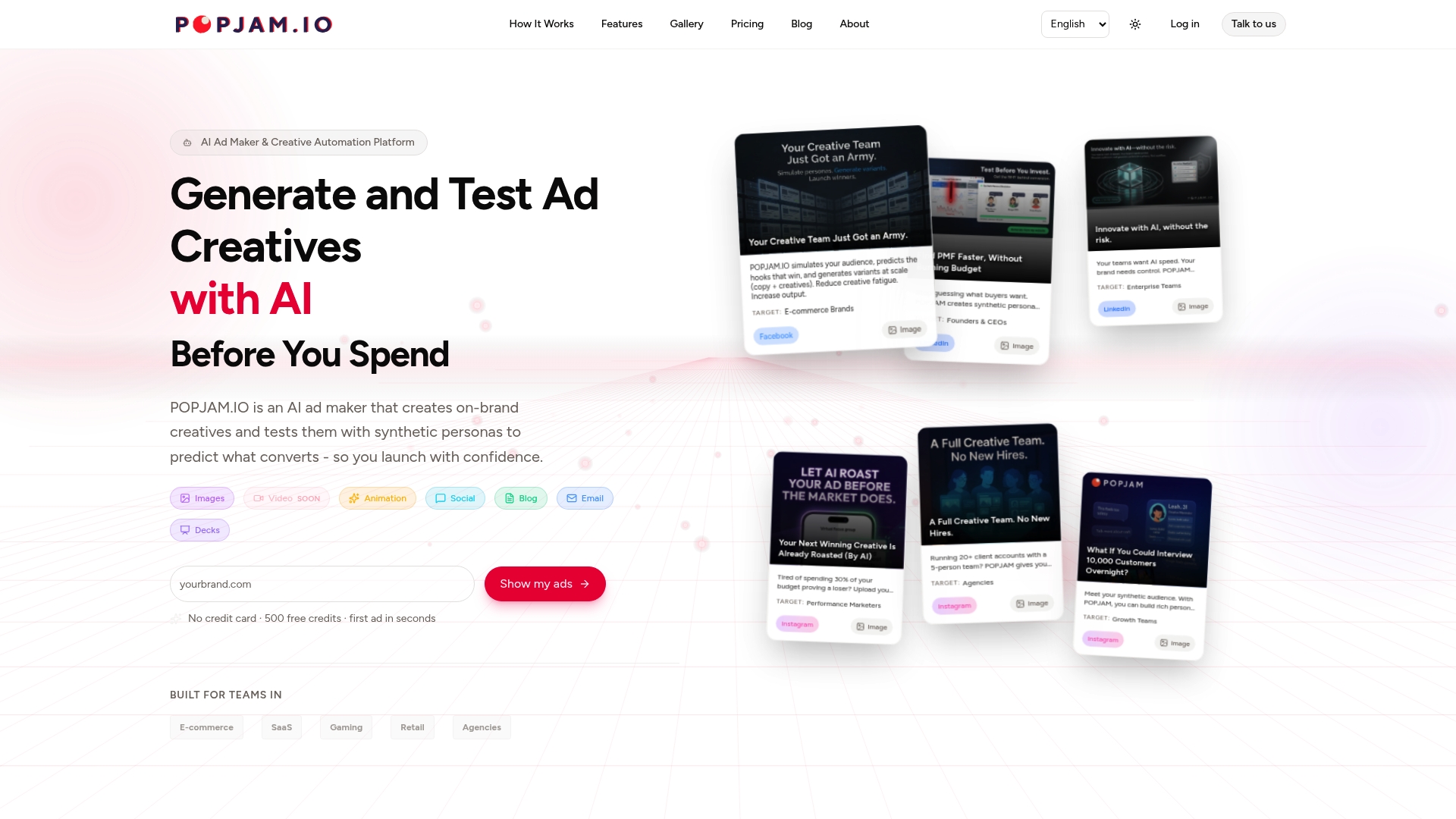
Our workflow fits naturally into Google Ads creative testing processes, helping you prioritize which segments and creative directions are worth the live spend. Plans start with a Free tier, and paid options range across multiple subscription levels, with credit packs available for teams that need extra generation volume. Check our pricing page or try the AI ad generator to see how a pretest round changes what you send into your next pilot.
FAQ
What is cookieless audience testing?
Cookieless audience testing means measuring and validating audience targeting without relying on third-party cookies, using methods like Privacy Sandbox APIs, server-side event capture, and aggregate measurement such as MMM. It typically runs as a controlled experiment comparing a treatment group against a cookie-based or no-cookie control.
How do I start testing without third-party cookies?
Start small: define one primary KPI, choose a single measurement method such as ARA simulation or an incrementality holdout, and run an A/A test first to confirm your setup is clean. From there, size your sample, lock a test window, and compare results against your existing cookie-based baseline.
What is the Attribution Reporting API and how do I test it?
The Attribution Reporting API is part of Privacy Sandbox and generates event-level and summary reports for conversion measurement without third-party cookies. The recommended approach is to simulate ARA using historical conversion records first, verifying aggregation keys and batching before running it against live traffic.
Can synthetic personas replace live audience testing?
Synthetic personas are best used as a pretest layer, not a replacement for live measurement. They help you validate creative and audience hypotheses in 48 to 72 hours so your live ARA, server-side, or incrementality test only spends impressions on ideas that already showed promise.
What metrics show if a cookieless test is working?
Compare coverage, attributable conversions, revenue per impression, CPM, and ROI rather than any single number in isolation.
Sources
- Privacy Sandbox private advertising system overview
- Guidelines for incremental measurement in commerce media | IAB
- Master cookieless advertising: strategies for tracking success | Trackingplan