Audience Simulation for Ads: How It Works and When to Trust It
Audience simulation lets you test ads on synthetic buyers before you spend. See how it works, what research says about accuracy, and how to use it safely.

Audience simulation is a way to predict how a group of buyers will react to an ad before you put money behind it. Instead of launching and hoping, you build synthetic personas, show them your creative, and read their reactions. It’s fast and cheap, and it’s good at ranking rough ideas. It’s not a replacement for real customers, and the research is clear on where it breaks.
I’ll walk through what it is, what goes in and comes out, what the evidence says about accuracy, and how we’d fit it into a real testing workflow.
TL;DR
- Audience simulation uses AI-built synthetic personas to react to your ad creative before launch, so you can cut weak concepts without paying for impressions.
- Inputs are a brand brief, an audience definition and the creative. Outputs are ratings, written reactions and a ranking of your variants.
- Academic work shows synthetic respondents catch broad patterns but run too positive and vary less than real people.
- Use simulation for early, iterative, lower-stakes decisions. Confirm the finalists with a small live test.
- Treat it as augmentation of human input, never a swap for it.
Table of Contents
- What Audience Simulation Means in Advertising
- How AI Audience Simulators Generate Reactions
- Inputs and Outputs You’ll Actually Work With
- How Accurate Is a Simulated Audience?
- Where Simulation Helps Most
- Where It Falls Short
- A Workflow That Respects the Limits
- Our Perspective
- Try Audience Simulation on Your Own Ads
- FAQ
- Sources
What Audience Simulation Means in Advertising
In advertising, audience simulation means modeling a target segment as a set of AI agents, then asking those agents how they’d respond to a piece of creative. Each agent carries a profile: age band, interests, motivations, objections, shopping habits. You show the agent a headline, an image or a video, and it reacts in words and scores.
The phrase also shows up in other places. Search it and you’ll find public speaking practice with virtual reality crowds, where a simulated audience helps a speaker rehearse. That’s a different use. Here we’re talking about the marketing version: simulated buyers, not simulated spectators.
It sits in the same family as synthetic research, digital twins and synthetic personas. The core idea is old. Marketers have always pretested ads with focus groups and surveys. The new part is that the panel is generated by a language model, so you get an answer in minutes instead of weeks.
A small example makes this concrete. A fitness app has four ad ideas and one budget. One public open-source project, Creative Pretest Lab, frames exactly that problem: run AI personas against all four ads in a simulated feed, shortlist the front-runners, then confirm the top one or two with a small live A/B test before committing spend. That last step is the part many people skip.

How AI Audience Simulators Generate Reactions
Most simulators follow the same loop.
- Define the audience. You describe a segment, or the tool builds personas from your customer data, reviews and market inputs.
- Give each persona context. Values, pain points, price sensitivity and platform habits get written into the persona’s prompt.
- Expose the persona to the ad. The model sees the creative in a format close to the placement, such as a feed post or a short video.
- Collect the reaction. The persona rates it, says what it noticed, and says what would stop it from clicking.
- Aggregate. Reactions get rolled up across personas into a ranking and a list of recurring objections.
The quality of every step depends on the model and on how well the personas reflect the real segment. That second point matters more than people think. A 2024 Digiday piece on U.S. Bank describes AI audience avatars used during strategic-brief and early-concept development, while human teams kept control of production. The same article quotes brand consultant Allen Adamson warning that an incorrectly modeled target can produce a precise but misplaced bullseye. Great aim at the wrong audience is still a miss.
Why the persona layer is the weak spot
A recent arXiv paper, Do Synthetic Personas Predict Real Audience Response?, reports something worth sitting with: a no-persona baseline ranked copy variants better than persona-based simulation. In other words, bolting on a persona description didn’t automatically make the prediction better. Personas need real grounding, or they’re costume changes on the same underlying model.
That’s why we put so much emphasis on how personas are built and checked, not just on how many you can spin up.
Inputs and Outputs You’ll Actually Work With
If you’ve never run a simulation, the workflow is simpler than the jargon suggests.
What goes in
- Brand context: voice, offer, price points, claims you can and can’t make.
- Audience definition: the segment, its motivations and objections. First-party data helps most.
- Creative: images, video, animation, social posts, email or slides. Several variants at once is the point.
- Platform and goal: a Meta feed ad asks different questions than a LinkedIn sponsored post.
What comes out
| Output | What it tells you | How to use it |
|---|---|---|
| Variant ranking | Which creative resonates most with the segment | Cut the bottom half before launch |
| Quantitative ratings | Relative appeal, clarity, purchase intent | Compare variants, not absolute scores |
| Qualitative feedback | Why a persona liked or ignored it | Rewrite hooks, fix confusing claims |
| Objection list | Recurring reasons not to act | Address in copy or landing page |
| Segment differences | Which personas respond to which angle | Split creative by audience |
A rule we hold ourselves to: read the ratings as relative. A score of 8 out of 10 doesn’t mean eighty percent of buyers will love it. It means this variant beat the others among these simulated people.
How Accurate Is a Simulated Audience?
Accurate enough to be useful for ranking, not accurate enough to forecast results. Here’s what the evidence says.
Researchers at NIM, in Leaving Insight to Digital Twins?, found that synthetic respondents captured broad patterns but struggled with nuance. Their ratings ran systematically more positive than real ones, with the largest bias toward well-known brands. The same work flags overgeneralization, socially desirable responses and less variation than real participants. It also notes that synthetic survey data may be better suited to early-stage or lower-stakes applications.
The practical takeaways:
- Expect inflated enthusiasm. If every variant scores well, the scale is generous, not your ads. Look at the gaps between variants.
- Be skeptical for big, familiar brands. The bias is strongest there.
- Don’t read the spread as real-world variance. Synthetic panels disagree with each other less than humans do.
Graham Page, quoted in a Quirks article on grounding synthetic data, makes a point I like: digital twins don’t increase your real sample size, and treating synthetic data as equal to human data can mislead you. The same piece describes models trained on their own output drifting from reality. Fresh, real inputs keep a simulator honest.
Bain reaches a similar place in its look at synthetic customers: they can support marketing and ad testing, but should augment, not replace, insight from real customers.
Where Simulation Helps Most
Given those limits, where does it earn its keep?
Early concept filtering. You have twelve hooks and room to test three. Simulation narrows the field in an afternoon. This is the lowest-risk use and the best return.
Iteration. Rewrite, re-run, rewrite. Because a run is cheap, you can go through five rounds before anyone sees a live impression. Quirks puts it this way: real people are useful for new ideas, while synthetic models suit iterative optimization or cases where speed matters more than accuracy.
Catching obvious problems. Confusing offers, off-tone copy, an image that doesn’t match the claim. Personas flag these quickly.
Segment angles. Testing which message lands with which persona before you build separate ad sets.

Privacy-sensitive work. Simulation doesn’t need individual-level tracking data. We cover that angle in our posts on privacy-safe audience modeling and cookieless audience testing.
By team type
- E-commerce brands can screen product angles, offers and visuals before a seasonal push. Our retail ad generator page shows how that looks.
- Agencies juggling many accounts can show clients a ranked shortlist with reasoning attached. See how we approach it on the agency page.
- SaaS founders with no design team and little budget can try positioning angles quickly before paying for LinkedIn clicks.
- Gaming and app teams can compare store-style creatives and trailers; we have a gaming-specific page.
Where It Falls Short
Be honest with yourself about these.
- It can’t tell you real demand. A persona saying it would buy isn’t a purchase.
- It misses the platform itself. A 2024 peer-reviewed review of 133 online platform studies, cited here, warns that platform ad tests may lack true random assignment, since delivery algorithms optimize separately for each ad. Observed differences may reflect audience composition, not just creative quality. That cuts both ways: live tests are noisy too, so neither method is a perfect oracle.
- It leans positive. Covered above.
- It rewards what the model already knows. Truly novel concepts are harder for a model to judge than familiar formats.
If you want a grounding in the broader targeting questions behind any of this, this piece on audience targeting basics is a good companion read. And since simulated panels can only suggest, not prove, it pairs well with a sober look at conversion testing claims when you’re deciding how much weight any one test deserves.
A Workflow That Respects the Limits
Here’s the process I’d run.
- Ground your personas. Feed in real customer language: reviews, support tickets, survey comments. The better the inputs, the better the reactions.
- Generate a wide set of variants. Different hooks, formats and angles, not five copies of one idea.
- Simulate and read relatively. Rank, then read the written reasons. Ignore absolute scores.
- Cut and rewrite. Drop the bottom half. Fix the objections that keep coming up.
- Re-run the survivors. Make sure the fixes helped.
- Confirm live with a small budget. Put your top one or two into a controlled test. Real behavior gets the final vote.
- Feed results back. Live data improves your personas for the next round, which also guards against the drift problem above.
The point isn’t to avoid live testing. It’s to arrive at live testing with better candidates, so the budget goes into the finalists rather than the also-rans.
Our Perspective
We built POPJAM because of one frustration: too many teams are posting and praying. They spend a week on creative, launch, wait for the numbers, and learn what flopped after the budget is gone.
So we put validation in front of spend. You generate on-brand creative, test it against synthetic personas, and see likely reactions before launch. That’s the whole idea.
But we also don’t buy the hype that simulated audiences make real ones obsolete. The research says they run optimistic, and the sensible reading is that they’re a filter. We think of simulation as turning on the lights in a room you used to cross blind. You still have to walk across it.
Our advice: use it hard in the early rounds, stay skeptical of flattering scores, and always let a small live test make the final call. If you want the longer argument on how synthetic personas compare with traditional panels, we lay it out in why synthetic personas beat real focus groups for speed and cost, and we’re candid there about where humans still win on depth.
— Doruk
Try Audience Simulation on Your Own Ads
If you want to run this workflow without stitching tools together, POPJAM generates on-brand ad creative and tests it against synthetic personas before you spend. It handles images, video, animation, social posts, email and presentations, with exports built for Meta, Google, TikTok, LinkedIn and Reddit.
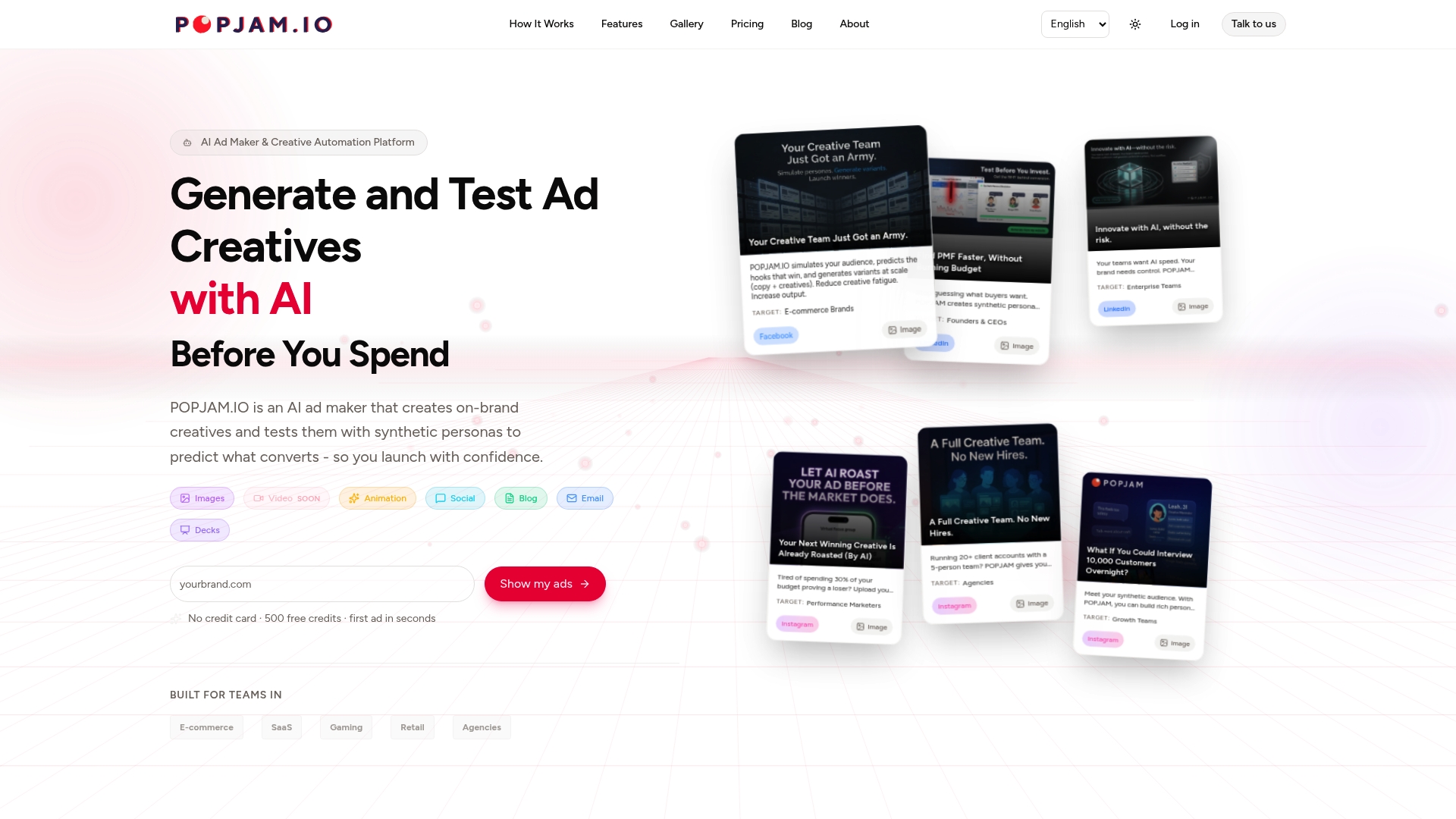
Plans start with a Free tier, then Starter at €29 per month, Essential at €99 per month and Business at €399 per month. Enterprise is available for larger teams. If you need more generations, credit packs run from 1,000 credits for €10 to 10,000 credits for €100, one-off. Compare them all on the pricing page, or see the AI ad maker itself. Comparing options first? Our roundup of the best AI ad creative tools lines them up side by side.
FAQ
What is audience simulation in marketing?
It’s the practice of modeling a target segment as AI-driven personas and having them react to creative such as ads, emails or landing pages. The output is ratings, written feedback and a ranking of variants. It’s used to screen ideas before spending on live media.
Is audience simulation accurate?
It’s good at broad patterns and weaker on nuance. Academic work from NIM found synthetic respondents rated things more positively than real people and varied less. Use it to rank and refine ideas, then verify the finalists with real audiences.
Can simulation replace A/B testing or focus groups?
No. Both Bain and Quirks commentary frame synthetic research as augmenting human input. Simulation shrinks the pile of candidates fast. A live test or real-customer research then confirms what actually moves behavior.
What do I need to start?
A clear brand brief, a defined audience, and a handful of creative variants. Real customer language, such as reviews and survey comments, makes the personas more believable. The more distinct your variants, the more you learn from each run.
Is it the same as virtual reality audience practice?
No. Those tools simulate a crowd so a speaker can rehearse. Marketing audience simulation models buyers’ reactions to creative, and it has nothing to do with stage fright.
Sources
- Do Synthetic Personas Predict Real Audience Response?
- How U.S. Bank cut development time of its campaign with AI avatars (Digiday)
- Leaving Insight to Digital Twins? (NIM)
- By the Numbers: How to keep synthetic data grounded in reality (Quirks)
- How Synthetic Customers Bring Companies Closer to the Real Ones (Bain)
- Review of 133 online platform studies on ad test randomization
- Creative Pretest Lab (GitHub)