

4 Week Persona Testing Sprint for Marketing Teams
Yes, buyer personas need testing before they drive a single dollar of ad spend, and the methods that actually work are layered, not singular: quick surveys and interviews to ground the profile in reality, targeted message A/B tests to see what people actually click, landing-page gut checks to catch confusion early, full funnel walk-throughs to expose weak links, and AI or synthetic persona simulations as a fast first filter before you touch real budget.
TL;DR:
- Testing buyer personas with quick surveys, interviews, and AI simulations prevents costly misalignment before launching paid campaigns.
- Different questions require specific methods: discovery interviews for understanding motivations, and A/B tests for measuring message effectiveness.
- Proper workflow includes hypothesis formulation, sample size estimation, audience segmentation, qualitative follow-ups, and data tagging for reliable insights.
- Pre-launch filters like AI simulations and gut checks help identify messaging flaws early, saving time and ad spend on ineffective creative.
- Most validated personas in practice are not thoroughly tested; ongoing iterative validation ensures relevance amid market changes.
Table of Contents
- What Is Buyer Persona Testing?
- Which Testing Method Fits Your Persona Question?
- How Do You Build a Persona Testing Workflow?
- What Specific Tests Should You Run Before Launch?
- How Do You Measure and Interpret Persona Test Results?
- Can AI Simulate Buyer Personas Before You Spend Ad Money?
- What Tools and Templates Help You Run Persona Tests?
- What Does a 4-Week Persona Testing Sprint Look Like?
- Your Pre-Launch Persona Testing Checklist
- How We Think About Persona Testing at POPJAM
- Test Your Creative Against Synthetic Personas Before You Spend
- Sources
- FAQ
What Is Buyer Persona Testing?
Buyer persona testing is the practice of running structured experiments and interviews to check whether the assumptions baked into a persona actually predict behavior. A buyer persona is a research-based, semi-fictional profile that blends demographics, firmographics, psychographics, and behavioral data. Testing is what separates that profile from a guess dressed up in a name and a stock photo.
Most teams build personas once, hang them on a slide, and never touch them again. That’s the failure point. A persona is a hypothesis about who buys, why they buy, and what convinces them. Hypotheses get tested. Buyer persona validation just means putting that hypothesis in front of real behavior, real clicks, and real conversations, then adjusting when the data disagrees with the assumption.
The rest of this piece breaks down exactly how to do that: which test fits which question, a repeatable workflow, specific test designs you can run this week, how to read the results without fooling yourself, and where AI-driven persona simulation fits into a responsible testing stack.
Which Testing Method Fits Your Persona Question?
Different questions call for different tools. A persona built from a hunch needs a different validation path than one built from twenty support tickets and a CRM export. Here’s how to match the method to the question you’re actually asking.
- Discovery interviews (3 to 5 per persona minimum). Use these when you don’t yet know what matters to a segment. HubSpot recommends starting with 3 to 5 interviews per persona before you even attempt a messaging test, because you need raw language and motivation before you can write a headline worth testing.
- Lightweight surveys. Use these to check breadth once interviews have given you direction. A ten-question survey sent to your existing customer list can confirm whether the pain point three interviewees mentioned is common or coincidental.
- Message A/B tests. Use these once you have two or more candidate framings and want to know which one converts. This is where A/B testing separates stated preference from revealed preference, which matters because people rarely tell you the real reason they clicked.
- Landing-page gut checks. Use these for fast, five-minute clarity tests before a page ever gets real traffic. You’re checking comprehension, not conversion yet.
- Funnel walk-throughs. Use these when conversion drops somewhere between click and purchase and you suspect the persona’s journey assumptions are wrong.
- AI and synthetic persona simulations. Use these as the earliest filter, before any of the above, to catch obviously broken messaging before it costs you media spend.
The trade-off across all six methods is consistent: speed trades against confidence, and confidence trades against cost. A synthetic simulation takes minutes and costs almost nothing, but it can’t prove purchase intent. A properly powered A/B test takes weeks and real budget, but it tells you what actually happened. Most teams get this backwards, they run the expensive test first and skip the cheap filter that would have saved them from wasting it.
How Do You Build a Persona Testing Workflow?
A persona test without a hypothesis is just an opinion with a chart attached. The workflow below moves from assumption to decision in five deliberate steps, and skipping any one of them is usually why a “validated” persona turns out to be wrong six months later.
- Write the hypothesis as a testable claim tied to a specific persona attribute. Not “Segment A cares about price” but “Segment A, defined by company size under 50 employees and self-service buying behavior, will respond better to a cost-savings headline than a time-savings headline.” The more specific the attribute, the easier it is to prove wrong, which is the point.
- Pick the metric before you pick the audience. Click-through rate, sign-up rate, reply rate, or qualified-lead rate. The metric determines your sample size, so choose it first, not as an afterthought once the test is already live.
- Estimate sample size before launch, not after. A rough heuristic: if you’re testing a message difference and expect a lift of 10 to 20 percent, you generally need several hundred conversions per variant before a result means anything. Smaller samples produce noise that looks like a signal, which is how teams end up “validating” a persona attribute that was really just random variance.
- Segment your audience deliberately, not by convenience. If you’re testing whether the “budget-conscious operations manager” persona responds differently than the “growth-focused founder” persona, your audience split has to isolate that variable. Mixing segments in one test cell muddies every result that follows.
- Collect qualitative follow-up alongside the quantitative data. Numbers tell you what happened. A five-minute follow-up interview or an open-text survey field tells you why. Pair every quantitative test with at least a handful of qualitative touchpoints, sourced from real audience research methods like short post-purchase surveys or sales call recordings.
Pro Tip: Recruit interview subjects from closed-won and closed-lost deals, not just happy customers. A HubSpot-recommended tactic is asking sales reps to flag recent wins and losses, then offering a small incentive for a 15-minute call. Losses often reveal the objection your persona doesn’t account for yet.
Selecting the right audience matters as much as the test design itself. If your persona work has already produced two or three candidate target personas, don’t test all of them simultaneously with a shared budget. Split sequentially or use clearly separated audience pools, otherwise you can’t attribute results to a specific segment with any confidence.
Data collection should happen through whatever analytics stack you already run, but the discipline that matters is consistency: tag every experiment with the persona attribute it’s testing, the hypothesis, and the date, so that six months from now you’re not reverse-engineering what “Test 14” was supposed to prove.
What Specific Tests Should You Run Before Launch?
General advice about “testing your persona” is nearly useless without a concrete design. Here are four specific tests, each targeting a different failure mode, with variations you can run depending on how much traffic or time you have.
The landing-page gut check. Show your headline and sub-headline to five to ten people outside your team, ideally people who match the persona but haven’t seen the copy before. Ask one question: “What does this page tell you the product does?” If three or more give a different answer than what you intended, the copy is failing before it ever reaches a paid audience. A five-second variation of this: flash the page for five seconds, then ask what they remember. If they remember the wrong thing, your visual hierarchy is fighting your message.
The objection stress test. Every persona carries unspoken doubts, and if your messaging doesn’t address them, no amount of clever copy will close the gap. Gather your sales team or support staff and list the five most common objections raised on calls. Then explicitly test whether your landing page or ad copy addresses each one, either through direct FAQ sections or through headline framing that preempts the doubt. A stronger version: run two ad variants, one that ignores the top objection and one that names it directly (“Worried about setup time? It takes 12 minutes.”). The direct version usually outperforms avoidance, because unresolved doubt is often the real reason for a bounce, not lack of interest.
- Run the stress test on your three biggest deal-losing objections first, not a comprehensive list.
- Keep the copy addressing the objection to one sentence. Longer justifications read as defensive.
- Retest quarterly. Objections shift as competitors change their own positioning.
Positioning experiments. These compare entirely different value-proposition framings against the same audience. One version leads with speed, another with cost, a third with trust or reliability. According to Convert’s persona-driven A/B testing framework, the key design discipline is isolating the message: keep the landing page structure, layout, and images identical, and only swap the headline, sub-headline, and primary call-to-action. That way any performance difference is attributable to the framing itself, not an unrelated design change riding along with it.
Funnel walk-throughs and segmentation microtests. Walk a fresh set of eyes through your entire funnel, ad to landing page to sign-up to first-use, and note every point of friction or confusion. This is qualitative by nature, but it reliably surfaces gaps quantitative data alone won’t show, like a persona who clicks the ad but abandons at a form field asking for information they consider irrelevant. Pair this with a segmentation microtest: split your existing list into your top two personas and run the same offer to both, watching for divergence in click-through or conversion. A gap here tells you the personas are behaviorally distinct enough to warrant separate campaigns. No gap tells you they might actually be one persona wearing two names.
Pro Tip: If you’re testing positioning across multiple ad platforms, mock up creative variants for each persona and each framing before committing media budget. A tool built for pre-launch creative testing can surface obvious clarity or tone problems before you spend a cent on impressions.
How Do You Measure and Interpret Persona Test Results?
The metrics that matter split into two tiers, and confusing them is one of the most common ways teams mislead themselves.
Primary KPIs are the outcome the test was designed to move: conversion rate, sign-up rate, reply rate, or cost per qualified lead. Secondary signals are supporting context: time on page, scroll depth, bounce rate, or qualitative sentiment from follow-up interviews. Secondary signals help you understand why a primary KPI moved, but they shouldn’t be the basis for a go/no-go decision on their own.
- Treat any lift under 5 percent with suspicion unless your sample size is large enough to rule out noise.
- Weight qualitative follow-up heavily when quantitative results are ambiguous or contradictory across channels.
- Log every test result against the specific persona attribute it targeted, not just the campaign name, so patterns across quarters are visible.
- Retire a persona attribute (not necessarily the whole persona) when two or more independent tests contradict it.
Sample-size heuristics matter more than most teams admit. Practical A/B testing guidance emphasizes testing one variable at a time and confirming sufficient sample size before drawing conclusions, precisely because small samples produce results that look meaningful and aren’t. A rough rule: if your expected lift is small, under 10 percent, you need a correspondingly large sample, often in the thousands of visits, to detect it reliably. If the expected lift is large, 30 percent or more, a few hundred conversions per variant can be enough to see a clear signal.
When results are noisy, the instinct to declare a winner early is the biggest threat to good persona work. A test that looks like it’s trending toward significance on day three often reverts by day ten. Wait for your pre-calculated sample size, not for the moment the chart looks favorable.
Here’s the decision rule that keeps teams honest: iterate on a persona attribute when a test contradicts one specific assumption but the overall persona still converts reasonably well elsewhere. Retire the persona entirely when multiple independent tests, across different channels and message types, consistently underperform against a control segment. Rework Resources notes that personas should function as living documents, reviewed at least annually or whenever a market shift makes the underlying assumptions stale, and tied explicitly to pipeline or conversion metrics so the connection between persona fit and revenue is never abstract.
Can AI Simulate Buyer Personas Before You Spend Ad Money?
AI-generated and synthetic buyer personas can absolutely speed up your earliest checks, but they answer a narrower question than most people assume. A synthetic persona simulation tells you how a modeled psychographic profile reacts to a specific piece of creative or copy. It does not tell you what a real human will actually purchase.
That distinction is the whole game. Simulated audience feedback works well as an early filter for catching obviously broken messaging, a headline that’s confusing, a value proposition that doesn’t land, a tone mismatch, before you’ve spent a single dollar on real impressions. What it can’t do is replace revealed human behavior once real budget and real stakes are involved.
- What synthetic simulations do well: fast psychographic feedback across dozens of creative variants in the time it would take to recruit one human tester.
- What they do well, continued: pre-filtering obviously weak concepts so your limited testing budget goes toward the strongest two or three candidates, not all ten.
- What they cannot do: prove purchase intent. A simulated reaction is a model’s best guess at how a persona archetype would respond, not a transaction.
- What they cannot do, continued: replace the qualitative texture of an actual customer explaining, in their own words, why they hesitated.
Simulated audience reactions are most valuable as an early filter that catches obvious messaging failures before media spend, but any high-stakes decision still needs rapid human validation to confirm the signal holds with real people.
The workflow that respects both the speed of AI and the rigor of real validation looks like this: run your creative concepts through a synthetic persona simulation first, cut the weak performers, then take the survivors into a small-sample A/B test with real traffic, and close the loop with a handful of interviews to understand the “why” behind whatever the numbers show. Platforms like POPJAM’s AI ad generation tools are built specifically for that first filtering stage, generating creative variants and running them against synthetic personas before a single impression is bought, which is exactly where AI adds the most value and takes on the least risk.
What Tools and Templates Help You Run Persona Tests?
You don’t need a research department to run a solid persona test. You need a short survey, a tight interview script, and a simple experiment-plan template that forces discipline before you launch anything.
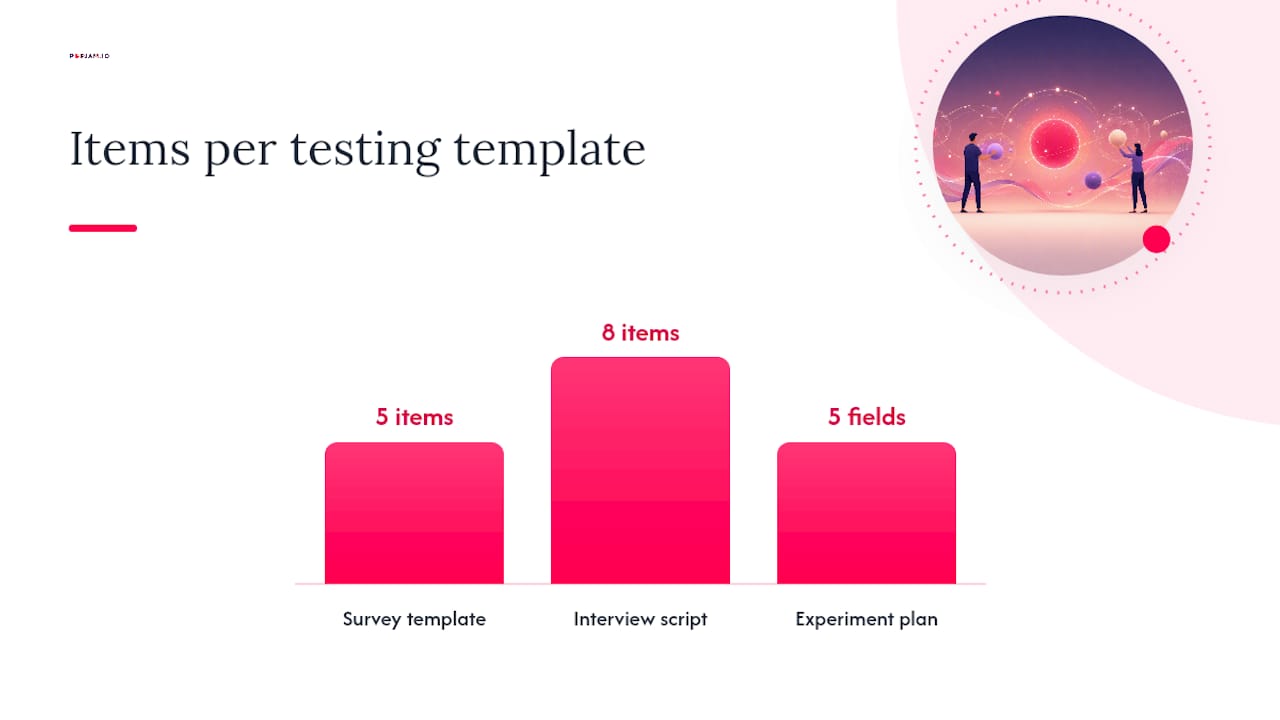
A short survey template for validating a persona assumption might include: how the respondent currently solves the problem your product addresses, what almost stopped them from buying, which feature mattered most in the decision, how they’d describe the product to a colleague, and a simple firmographic or demographic check to confirm they match the target segment.
Interview questions worth asking in every persona validation session:
- Walk me through the moment you realized you needed a solution like this.
- What did you try before finding us, and why didn’t it work?
- Who else was involved in the decision, and what did they care about?
- What almost made you not buy?
- What would you have Googled if you were starting this search over?
- How do you describe what we do to a coworker who’s never heard of us?
- What’s the one thing that would make you stop using this?
- On a scale of one to ten, how disappointed would you be if this disappeared tomorrow?
An experiment-plan template needs five fields, no more: the hypothesis stated as a testable claim, the primary metric, the target audience or segment, the planned duration, and the estimated sample size needed to reach significance. Writing these down before launch, even in a shared spreadsheet, prevents the common failure of changing the success metric halfway through because the original one isn’t cooperating.
For analytics, tag every test event with the persona attribute being validated, not just a generic campaign label. A UTM parameter or custom event property that reads “test_objection_setup_time” tells you far more six months later than “campaign_v2” ever will. If you want a starting framework for writing personas that are structured to survive this kind of scrutiny from the outset, POPJAM’s guide to writing testable buyer personas walks through the attributes worth defining before you ever open a testing tool. For methodological depth on interview and survey design specifically, this partner guide on building accurate personas is worth the extra read.
What Does a 4-Week Persona Testing Sprint Look Like?
Here’s a compressed, real-world version of how a marketing team might move from an unvalidated persona to a go/no-go decision in one calendar month.
- Week 1: Hypothesis and setup. Write the specific persona hypothesis, define the primary metric, estimate sample size, and run your top three creative concepts through an AI persona simulation to cut obviously weak options. Deliverable: a finalized experiment plan and two to three surviving creative variants.
- Week 1, continued: recruit interview subjects. In parallel, ask sales to flag three to five recent closed-won and closed-lost customers matching the target persona for follow-up interviews later in the sprint.
- Week 2: Launch the small-sample A/B test. Split traffic evenly across your surviving variants. Keep landing-page structure identical across variants, only the message-specific elements change. QA every variant for broken links, tracking, and mobile rendering before traffic starts.
- Week 2, continued: run first interviews. Conduct two to three of the scheduled customer interviews while the quantitative test is still gathering data. Early qualitative signal often previews what the numbers will confirm later.
- Week 3: Monitor without peeking too early. Check daily for tracking errors only, not for a winner. Resist declaring significance before you hit your pre-calculated sample size. Escalate immediately if a variant shows a technical problem, like a broken form, rather than waiting for the full duration.
- Week 3, continued: complete remaining interviews. Finish the interview round and start coding responses for recurring themes, especially objections or language that didn’t appear in your original persona notes.
- Week 4: Analyze and decide. Compare quantitative results against your pre-set significance threshold and cross-reference with interview themes. If the winning variant aligns with what interviewees described in their own words, confidence is high. If it contradicts them, dig deeper before acting.
- Week 4, continued: go or no-go. Either operationalize the winning message across the persona’s campaigns, or flag the specific persona attribute that failed and schedule a revision, not a full persona rebuild, unless multiple attributes failed simultaneously.
The quick QA checklist to run before any week-2 launch: confirm tracking fires correctly on every variant, confirm sample-size math accounts for your actual traffic volume, confirm the audience split isn’t accidentally overlapping between test cells, and confirm someone owns the daily technical check so a broken variant doesn’t silently skew a week of data.
Your Pre-Launch Persona Testing Checklist
Before you launch anything tied to a persona assumption, run through this fast:
- Pre-test: hypothesis written as a falsifiable claim, metric chosen, sample size estimated, audience segments clearly separated, interview subjects recruited.
- Run-time: tracking verified on day one, no mid-test changes to the success metric, daily technical checks scheduled, no early peeking for statistical significance.
- Post-test: results checked against pre-set significance threshold, qualitative interview themes cross-referenced, findings tagged to the specific persona attribute tested.
- Operationalize: share validated changes with sales, support, and creative teams, update the persona document itself, and set a review date rather than letting the update sit static for another year.
Pro Tip: Keep a single shared log of every persona test run, win or lose. A “failed” test that disproves an assumption is just as valuable as a winning one, and teams that only log wins end up repeating the same disproven ideas eighteen months later.
How We Think About Persona Testing at POPJAM
The workflow that shows up most often in our own thinking mirrors what this article lays out, mostly because we built the platform around the gap we kept running into ourselves: too many teams were shipping ad creative based on a persona nobody had actually pressure-tested.
Here’s the sequence we lean on. Start with synthetic pre-filtering, run creative concepts against modeled psychographic profiles to catch the obviously weak ones before spending a cent on media. Then move the survivors into a small-sample A/B test with real audiences and real dollars, because no simulation replaces revealed behavior. Close the loop with a handful of real interviews, because numbers tell you what happened but rarely tell you why.
None of this replaces judgment. If anything, it sharpens it, because you’re no longer defending a persona built on a hunch from a planning meeting eight months ago. If you want to go deeper on the writing side of this, our guide on persona validation as an ongoing playbook walks through how we keep personas from going stale between test cycles, and our piece on writing personas built to survive testing is the companion read for the front half of this process.
The honest take? Most “validated” personas in the wild have never actually been tested. They’ve been agreed upon in a room. That’s a different thing entirely.
— Doruk
Test Your Creative Against Synthetic Personas Before You Spend
Most of the workflow above assumes you already have creative ready to test, but building enough variants to run a real positioning experiment is where teams usually stall. A tool can close that gap by generating on-brand ad creative and running it against synthetic personas before you commit media budget, so the filtering step in week one of your sprint takes hours instead of days.
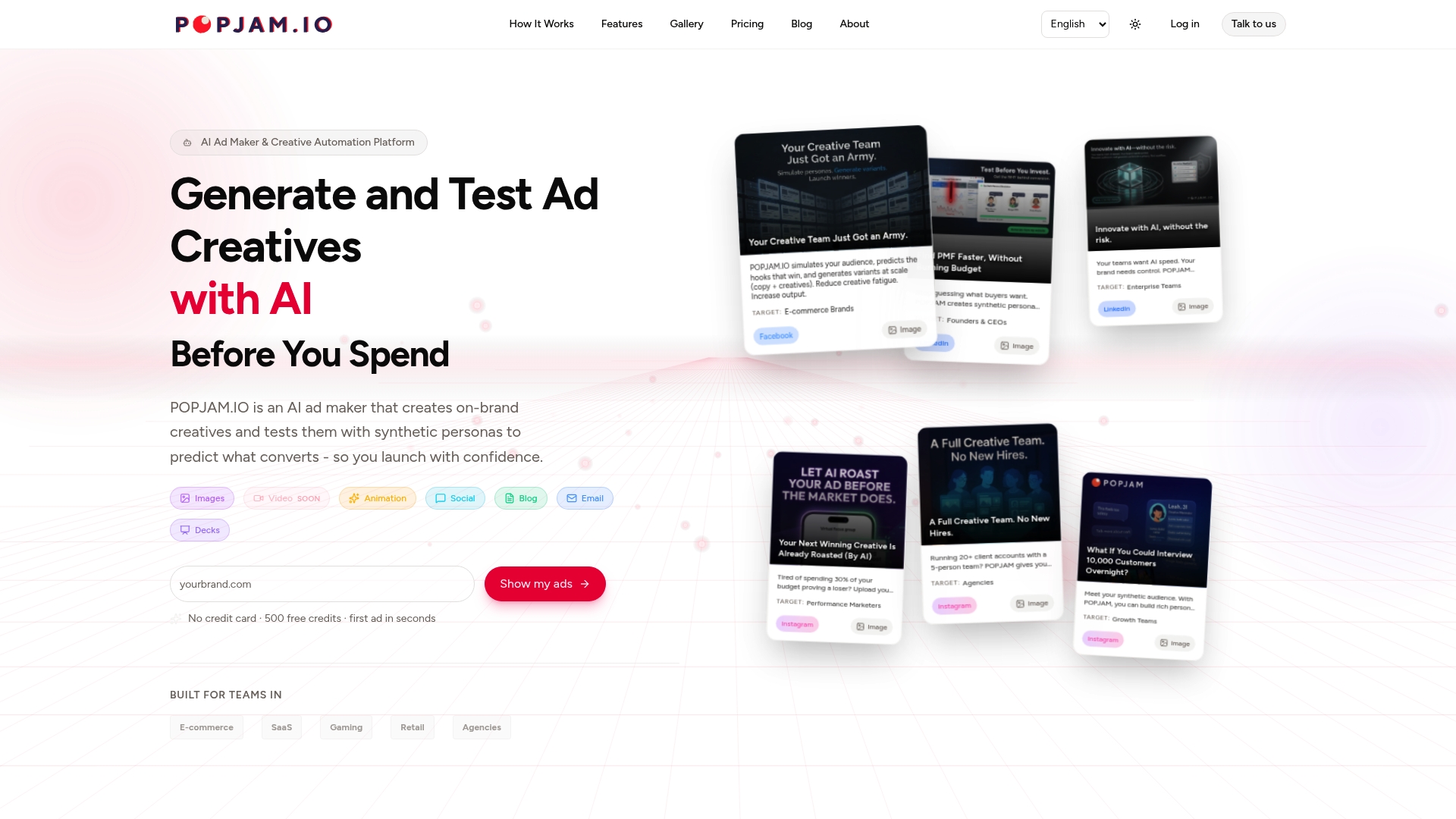
It handles images, video, animation, social posts, email, and presentations across popular ad platforms, with psychographic feedback that flags which framing, headline, or visual direction resonates with a given segment before a human A/B test ever goes live. That means your small-sample tests start with stronger candidates instead of ten untested guesses, which shortens the whole validation cycle described in this piece. If your team runs a lot of creative variants across channels, the creative automation platform is worth a look for exactly that reason.
If you’re an agency managing personas across multiple client accounts, the agency-focused version of the platform is built for running parallel persona tests without juggling a dozen separate tools. Either way, the next step is simple: run your top three creative concepts through a pre-launch persona check and see which one your synthetic audience actually responds to before you spend a dollar confirming it with real traffic.
Sources
- What Is a Buyer Persona? Types, How to Create, and Examples | Salesforce
- How to create detailed buyer personas for your business + free persona template | HubSpot
- Personas in A/B Testing: A Customer Research Blueprint for High Quality Experimentation | Convert
- How to Test Your Marketing With AI Buyer Personas (Before Spending a Dollar on Ads) | Medium
FAQ
What are the four types of buyer personas?
Most frameworks split personas into four categories: demographic-based, needs-based (built around the specific problem they’re solving), goal-based (built around what success looks like for them), and role-based, which reflects their position in a buying committee such as decision-maker, influencer, or end user.
What is a buyer persona example?
A concrete example combines a role, a pain point, and a behavioral trait, such as “Operations Manager Olivia,” who runs a 30-person logistics team, is evaluated on cost efficiency, and researches tools primarily through peer recommendations rather than paid ads.
What is the difference between an ICP and a buyer persona?
An ideal customer profile (ICP) describes the type of company most likely to buy, using firmographics like industry and company size, while a buyer persona describes the individual human inside that company, their motivations, objections, and decision-making style.
When should you conduct a buyer persona interview?
Conduct interviews early, before you finalize messaging, using recently closed-won and closed-lost customers as HubSpot recommends, and again periodically as personas age, since personas function best as living documents reviewed at least once a year.
Can AI replace human interviews in persona testing?
No. AI and synthetic persona simulations are effective as an early filter for catching weak messaging fast, but they should always be followed by real interviews and small-sample A/B tests before a decision carries real budget, a workflow platforms like POPJAM are built to support at the filtering stage.