

AI Customer Segments: A 2026 Guide for Marketers
AI customer segmentation is the practice of using machine learning models to group customers by real-time behavioral, intent, and value signals rather than static demographics. The industry standard term is customer segmentation AI, and it’s reshaping how marketing teams allocate budget and craft messaging. Companies using AI-driven personalization generate 40% more revenue than those that don’t. That gap exists because AI customer segments update continuously, catching behavioral shifts that quarterly persona reviews always miss. If you’re still building audiences from age brackets and zip codes, you’re leaving serious money on the table.
How AI customer segments differ from traditional methods
Traditional segmentation is a snapshot. You define a persona in a spreadsheet, assign customers to it, and revisit the whole exercise every few months. The problem is that customers don’t behave like spreadsheets. They browse, abandon carts, switch channels, and change their minds daily.
AI-driven market segments work differently. AI systems ingest new signals like browsing history, app activity, and purchase sequences to refresh segments in real time. A customer who spent three sessions comparing premium products gets reclassified automatically. No analyst has to notice the pattern first.

The technical engine behind this is clustering. Algorithms like K-means clustering group customers by behavioral similarity without a human pre-defining the categories. The model finds the clusters that actually exist in your data, not the ones you assumed were there. This is how AI uncovers hidden patterns that traditional analysts miss entirely.
Prompt language analysis takes this further. Five major US AI engines now classify consumers into 14 primary and 47 secondary intent-shaped segments by analyzing what people ask rather than who they are. Segments like “price-sensitive,” “safety-first,” and “provenance-driven” emerge from query behavior, not from a demographic form.
- Static segmentation relies on fixed attributes: age, gender, location, income bracket.
- AI segmentation relies on dynamic signals: click sequences, session depth, purchase timing, and query intent.
- The key difference is that AI segments evolve with the customer. Static segments go stale.
Pro Tip: Start by auditing your current segments. If they haven’t changed in six months, they’re almost certainly out of date. Real customer behavior shifts faster than any manual review cycle.
What are the main types of AI customer segments?
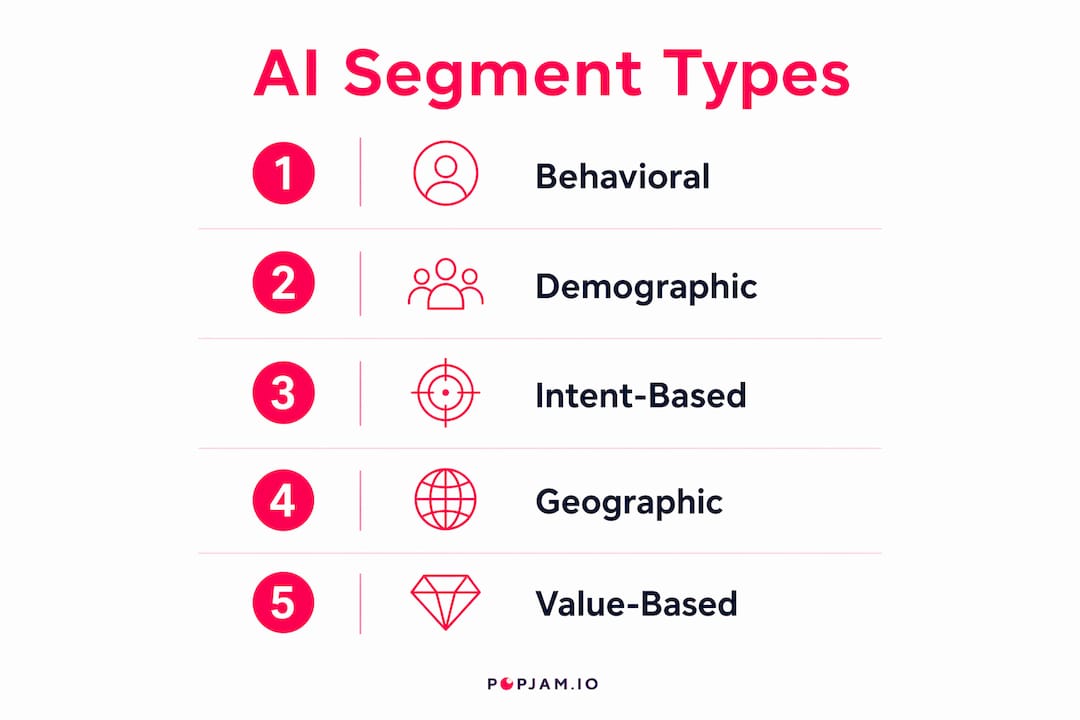
Understanding the categories of artificial intelligence customer groups helps you decide which ones to activate first. Not every segment type suits every business, but most marketing teams can benefit from at least three of these.
-
Behavioral segments. These group customers by what they actually do: purchase frequency, product categories browsed, time between orders. A “frequent buyer” segment gets loyalty offers. A “dormant customer” segment gets a reactivation campaign with a time-limited incentive.
-
Value-based segments. Predictive lifetime value (LTV) models score each customer by their projected future revenue. High-LTV customers get white-glove treatment and higher ad spend. Low-LTV customers get lower-cost nurture sequences. This prevents you from spending premium budget on customers who will never convert at scale.
-
Intent-based segments. Purchase intent prompts represent 31% of queries across major AI engines, making intent one of the richest segmentation signals available. A customer researching “best running shoes for flat feet” signals a specific need, a specific timeline, and a specific price tolerance. Intent-based segments let you match messaging to that exact decision moment.
-
Channel preference segments. AI identifies which customers convert through email, which respond to paid social, and which need SMS nudges. Sending the right message through the wrong channel is one of the most common causes of wasted ad spend.
-
Risk-based segments. Churn propensity models flag customers showing early exit signals: declining session frequency, reduced cart values, or increased support contacts. Catching these customers before they leave costs a fraction of reacquiring them later.
Pro Tip: Don’t try to activate all five segment types at once. Pick the one with the clearest revenue impact for your business, prove the ROI, then expand. AI segmentation works best when you start with manageable clusters and build from there.
What technical foundations make AI segmentation accurate?
The quality of your AI segments depends entirely on the quality of your input data. This is the part most marketing teams skip, and it’s why their segmentation results disappoint.
Effective AI segmentation requires clean, normalized data as a prerequisite. Poor schema design and inconsistent data formats produce bad clustering and unreliable propensity scores. Before you run any model, your data needs to be deduplicated, standardized, and unified across sources.
The data sources that matter most for machine learning segmentation include:
- CRM data: purchase history, support tickets, account age, and contract value.
- Web and app behavioral data: page views, session duration, click paths, and feature usage.
- Ad platform signals: which creatives drove clicks, which audiences converted, and at what cost.
- Natural language inputs: search queries, chatbot conversations, and review text processed through NLP.
Integrating these sources into a single customer profile is the hardest part of the technical setup. Once unified, clustering algorithms like K-means can find meaningful groups. Natural language processing adds a layer of intent classification on top of behavioral data.
The other critical requirement is continuous retraining. A model trained on last quarter’s data will drift as customer behavior changes. Real-time reclassification prevents audience drift and keeps your segments relevant. Set a retraining schedule, and build monitoring into your workflow so you catch model degradation early.
| Approach | Data requirement | Update frequency | Best for |
|---|---|---|---|
| Static demographic segmentation | Basic CRM fields | Quarterly or annual | Simple audience filtering |
| AI behavioral clustering | Multi-source behavioral data | Weekly or real-time | Dynamic campaign targeting |
| Predictive LTV modeling | Full purchase and engagement history | Monthly with real-time scoring | Budget allocation by customer value |
| Intent-based NLP segmentation | Query and content interaction data | Real-time | Search and content campaign targeting |
How do AI segments improve campaign performance?
The business case for data-driven customer segmentation is direct. Predictive AI segmentation improves click-through rates by up to 50% and reduces cost-per-acquisition through smarter ad targeting. That’s not a marginal gain. It’s the difference between a campaign that scales and one that bleeds budget.
The mechanism is specificity. When you know a customer is in a “high-intent, price-sensitive” segment, you don’t show them a brand awareness ad. You show them a comparison page with a discount code. The message matches the moment, and conversion rates reflect that alignment.
Predictive scoring also changes how you time campaigns. AI models can anticipate future behaviors like a customer’s next likely purchase category. A skincare brand that knows a customer just bought face wash can trigger a toner offer three weeks later, before the customer even starts searching. That kind of proactive marketing consistently outperforms reactive campaigns.
Best practices for activating AI segments across channels:
- Match creative to segment psychology. A value-based segment responds to scarcity and exclusivity. A safety-first segment responds to trust signals and reviews.
- Set segment-specific KPIs. Don’t measure a reactivation campaign against the same ROAS target as a new customer acquisition campaign. Each segment has its own economics.
- Monitor segment size over time. If a segment shrinks dramatically, the model may be drifting or the underlying behavior may have genuinely changed. Both require a response.
- Use AI ad testing before full spend. Validate that your creative actually resonates with each segment before committing your full budget.
The role of AI in marketing strategies has shifted from automation to genuine decision support. Segment-level performance data now informs creative briefs, channel mix decisions, and budget reallocation in ways that were impossible with static audiences.
Key Takeaways
AI customer segmentation outperforms static methods because it updates continuously, captures intent signals, and predicts future behavior to match the right message to the right customer at the right moment.
| Point | Details |
|---|---|
| AI segments update in real time | Static segments go stale; AI reclassifies customers as their behavior changes. |
| Intent beats demographics | Prompt-language analysis reveals what customers want, not just who they are. |
| Data quality determines accuracy | Clean, normalized, multi-source data is required before any model produces reliable results. |
| Predictive scoring improves ROAS | Anticipating next purchases lets you reach customers before they start searching. |
| Start small, then expand | Prove value with one high-impact segment before building out a full segmentation program. |
Why most teams are still doing segmentation wrong
Here’s my honest take after working with marketing teams across e-commerce, SaaS, and agencies: the biggest barrier to effective AI segmentation isn’t the technology. It’s the mindset.
Most teams treat segmentation as a project with a finish line. They build the segments, launch the campaigns, and move on. Six months later, the segments are stale, the model hasn’t been retrained, and performance has quietly declined. Nobody noticed because the benchmarks were set against the old, worse campaigns.
AI segmentation is an interactive process, not a one-time setup. The teams that get the most out of it treat their segments like living documents. They ask questions of the data regularly, use natural language prompts to explore new clusters, and adjust their activation strategy when the model surfaces something unexpected.
The democratization angle is real, too. No-code tools now let marketers run clustering and persona generation from simple prompts, without needing a data science team. That’s a genuine shift. But it also means more teams are running segmentation without understanding what makes a good segment. Bigger isn’t better. A segment of 50,000 customers with clear shared intent beats a segment of 500,000 customers with vague behavioral overlap every time.
My advice: focus on data quality first, pick one segment type that maps directly to a revenue problem you already have, and treat the first three months as a learning phase. The audience targeting insights you generate in that window will reshape how your whole team thinks about customers.
— Doruk
POPJAM turns your AI segments into tested ad creatives
Once you know who your segments are, the next question is whether your creative actually speaks to them. That’s where most campaigns fall apart. You’ve done the segmentation work, but the ad itself is generic.
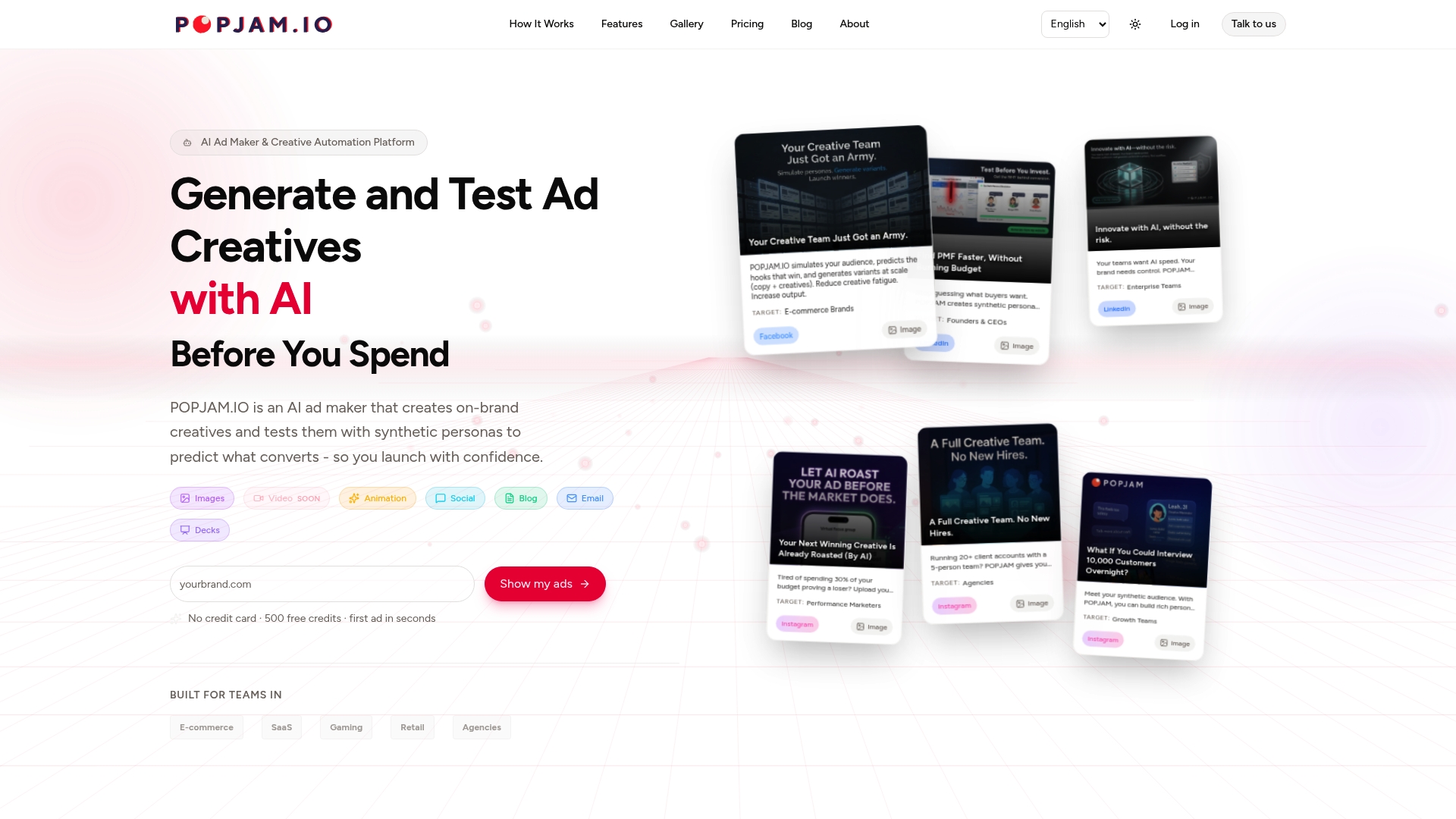
POPJAM’s AI ad generator solves that gap directly. You feed in your segment profile, and POPJAM generates on-brand ad creatives tailored to that audience’s psychographic signals. Before anything goes live, the platform tests each creative against Synthetic Personas that mirror your real segments. You get actual psychographic feedback, not gut instinct. Marketing teams using POPJAM catch underperforming creatives before they burn budget, and they ship ads that are already validated for the segments they’re targeting. That’s the end-to-end loop: AI segments tell you who to reach, and POPJAM tells you what will actually land.
FAQ
What are AI customer segments?
AI customer segments are dynamically defined groups identified by machine learning models analyzing real-time behavioral, intent, and value signals. Unlike static demographic groups, they update automatically as customer behavior changes.
How does AI segmentation improve marketing ROI?
Predictive AI segmentation improves click-through rates by up to 50% and lowers cost-per-acquisition by matching messages to customers at the exact moment of intent, reducing wasted ad spend.
What data do you need for AI customer segmentation?
Effective segmentation requires clean, normalized data from multiple sources including CRM records, web and app behavior, ad platform signals, and natural language inputs. Data quality directly determines model accuracy.
How is intent-based segmentation different from demographic segmentation?
Intent-based segmentation groups customers by what they ask and search for rather than who they are. Purchase intent prompts represent 31% of AI engine queries, making them a more reliable predictor of conversion than age or location.
Can marketers run AI segmentation without a data science team?
Yes. No-code tools now allow marketers to run clustering and generate personas using natural language prompts, making advanced segmentation accessible without engineering support.
Recommended
- How AI transforms performance marketing: insights for 2026 | POPJAM.IO Blog
- Defining behavioral audience data for smarter ad targeting | POPJAM.IO Blog
- AI Ad Generator for Retail - Test Creatives Before You Spend | POPJAM.IO
- AI Ad Generator for E-commerce - Test Creatives Before You Spend | POPJAM.IO