

AI Creative Suite: The 2026 Guide for Marketing Teams
An AI creative suite is a platform of AI-powered tools that automates and enhances advertising creative production across the full campaign workflow. These suites go well beyond a single image generator or copywriting tool. They combine generative content creation, agentic multi-step automation, and brand consistency controls into one connected system. 1 in 4 creatives now report frequent AI use, compared to 1 in 5 workers across the general economy. That gap tells you something real: creative teams are adopting these tools faster than almost any other profession, and the ones who figure out how to use them well are pulling ahead.
What does an AI creative suite actually do?
The term “AI creative suite” is a broad, descriptive phrase. The recognized industry term for the underlying technology is generative AI platform, though the suite format bundles that generation capability with editing, workflow automation, and asset management. Understanding the distinction matters because it shapes how you evaluate and buy these tools.
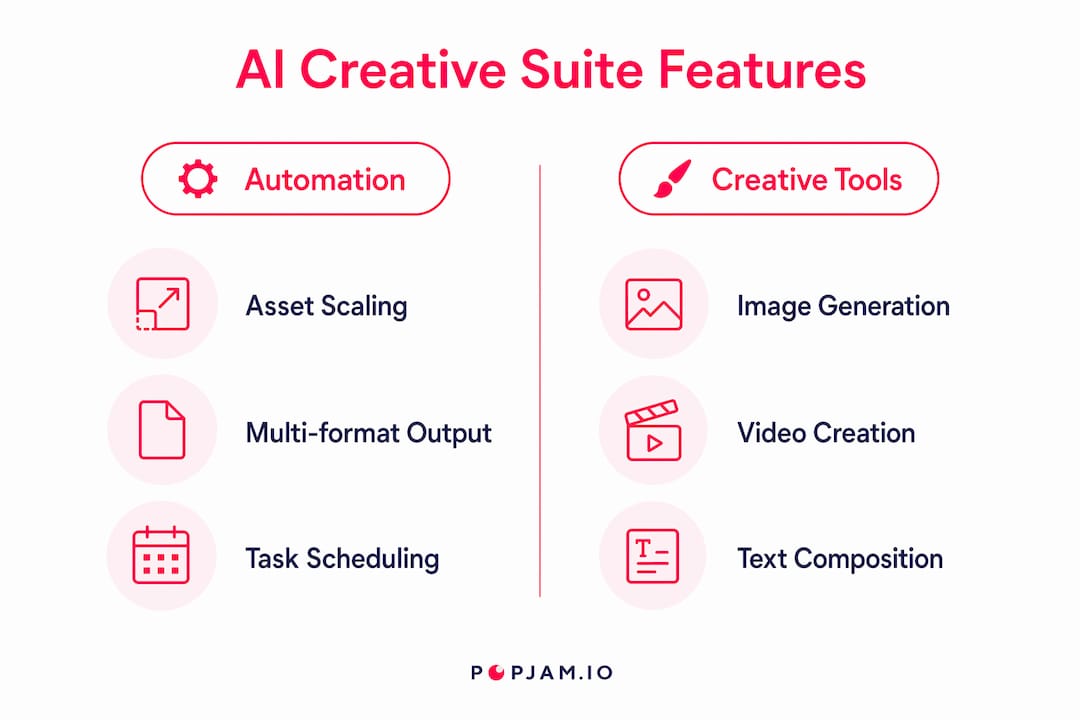
At the core, an AI creative suite handles four categories of output: images, video, audio, and text. A marketing team can generate a product visual, write ad copy, produce a voiceover, and cut a short video clip without leaving a single interface. That consolidation is the real value proposition, not any one generation feature in isolation.
Key capabilities you should expect from a mature AI creative suite:
- Generative content creation. Produce images, video clips, audio assets, and copy from text prompts or reference files.
- Agentic AI workflows. Multi-step processes run automatically, such as resizing a hero image across six ad formats while keeping every layer fully editable.
- Integration with professional apps. Connections to tools like Photoshop and Premiere give teams pixel-level control after generation, so AI output feeds into existing production pipelines rather than replacing them.
- Creative Skills libraries. Pre-built, customizable workflows let a single prompt trigger a full social media asset set, complete with platform-specific sizing and copy variants.
Pro Tip: Before committing to a suite, map your current production bottlenecks first. If your team loses the most time on asset resizing and format adaptation, prioritize agentic workflow depth over raw generation quality.
How marketing teams deploy AI creative suites for ad design
The biggest shift AI creative suites create is not speed. It is role reallocation. Generative AI moves creative roles upstream, away from manual execution and toward strategic oversight. A designer who spent 60% of their week resizing assets now spends that time on concept direction and brand judgment.
Here is a practical deployment sequence for marketing teams:
- Map your asset matrix. List every format, size, and channel variant your campaign requires before touching the AI suite. This becomes your generation brief.
- Generate concept batches. Use the suite to produce 10–20 creative directions from a single brief. Volume at this stage costs almost nothing compared to traditional production.
- Test psychographic fit. High-performing teams prototype multiple ad versions and test them against audience profiles before committing to final production. This is where pre-spend validation tools like POPJAM become critical.
- Refine with human judgment. AI output is a starting point. Brand voice, cultural nuance, and emotional resonance still require a human eye.
- Automate final production. Once a concept is approved, use agentic workflows to generate all format variants automatically.
Creative professionals use AI most for early-stage ideation and routine task automation, not operational management. That pattern is a signal: the teams getting the most value are using AI to expand their ideation surface, not just to cut production time.
Pro Tip: Build a brand guardrail document before your first AI generation run. Include approved color palettes, typography rules, and tone-of-voice examples. Feed it into every prompt as a reference. This single step prevents the brand drift that kills most AI creative programs.

Maintaining brand consistency across automated generation is the hardest operational challenge teams face. The solution is not less automation. It is better prompt architecture and a disciplined review gate before any asset goes live. Agencies embedding AI into their creative marketing workflows report that structured review gates cut revision cycles significantly.
How do credit systems work in AI creative suites?
Credit systems are the standard pricing mechanism for AI creative suites, and they catch most teams off guard at scale. Standard generative tasks consume 1 credit each, while premium features like video generation and multi-app orchestration consume credits in proportion to output complexity and size. A single video clip can cost many times more than a static image generation.
The table below shows how credit consumption typically scales across task types:
| Task type | Relative credit cost | Notes |
|---|---|---|
| Single image generation | Low (1 credit baseline) | Standard text-to-image or fill |
| Copy variant generation | Low (1 credit baseline) | Per output, not per prompt |
| Multi-format image batch | Medium | Scales with number of outputs |
| Video clip generation | High | Scales with length and resolution |
| Multi-app orchestration | High | Depends on workflow complexity |
Tracking credit consumption is not optional for teams running large campaigns. Premium features burn through allocations fast, and most platforms do not send alerts before you hit your limit. The practical fix is to assign a credit budget per campaign at the brief stage, not after production starts.
Teams planning a high-volume campaign should run a small pilot batch first. Generate 20–30 assets, log the credit cost, and extrapolate to your full asset matrix. That number becomes your production budget line. An AI growth ops audit can help teams identify where credit spend is misaligned with actual campaign output value.
How widely adopted are AI creative suites globally?
AI creative suite adoption is genuinely global. Platforms like Google Flow operate in 140+ countries, enabling teams from São Paulo to Seoul to move from brainstorming to asset production in the same session. That geographic reach reflects how quickly the category has matured from experimental to production-ready.
“AI isn’t replacing creativity. It’s moving it upstream.” The real shift is that creative professionals are spending less time executing and more time directing. The tools handle the repetitive output. Humans handle the judgment calls that machines cannot make.
The adoption data supports this framing. 25% of creative professionals report frequent AI use, a rate meaningfully higher than the 20% seen across the general workforce. The creative industry is not resisting AI. It is reorganizing around it.
The concern that AI will eliminate creative jobs has not materialized in the data. What has happened is workflow reorganization. Roles that were primarily execution-focused are shifting toward strategy, curation, and brand stewardship. Harvard Extension’s 2026 curriculum now emphasizes creative AI applied to UX, prototyping, and production-ready experience design, which signals where the profession is heading. The marketers who will win are the ones who treat AI fluency as a core skill, not a departmental experiment.
Key Takeaways
The most effective AI creative suite deployment combines agentic workflow automation with structured human review gates and disciplined credit budgeting to maximize campaign output without sacrificing brand quality.
| Point | Details |
|---|---|
| Suites consolidate four output types | Image, video, audio, and text generation in one platform reduces production fragmentation. |
| Agentic workflows save the most time | Multi-step automation like batch resizing frees teams for strategic creative direction. |
| Credit costs scale with complexity | Video and multi-app tasks consume credits far faster than standard image generation. |
| Adoption is accelerating | 25% of creative professionals use AI regularly, outpacing the general workforce rate of 20%. |
| Pre-spend testing prevents waste | Validating ad concepts against psychographic profiles before production protects campaign budgets. |
Why I think most teams are using AI creative suites wrong
Here is the uncomfortable truth I keep running into: most marketing teams adopt an AI creative suite and immediately use it to do the same work faster. They generate the same three ad concepts they would have made manually, just in less time. That is the smallest possible return on a genuinely powerful category of tools.
The teams I see getting real results are using AI to expand their creative surface area in ways that were previously impossible. They are generating 30 concept directions instead of 3. They are testing those concepts against synthetic audience profiles before a single dollar of media spend is committed. They are using the time saved on execution to have better strategic conversations about what the brand actually stands for.
The skills gap is real, though. Moving from “prompting” to genuinely integrating AI into a human-centered design workflow takes deliberate practice. Harvard’s curriculum on creative AI frames this well: the goal is not to learn the tool, it is to learn how to direct the tool toward outcomes that require human taste and judgment. That framing is exactly right.
My honest take is that the teams who will look back on 2026 as a turning point are the ones who used AI to raise their creative ambition, not just their production speed. If your AI creative program is not producing work you could not have attempted before, you are leaving the most valuable part of the technology on the table.
— Doruk
POPJAM turns AI creative generation into validated ad spend
Marketing teams that generate more creative concepts face a new problem: how do you know which ones will actually perform before you spend media budget finding out?
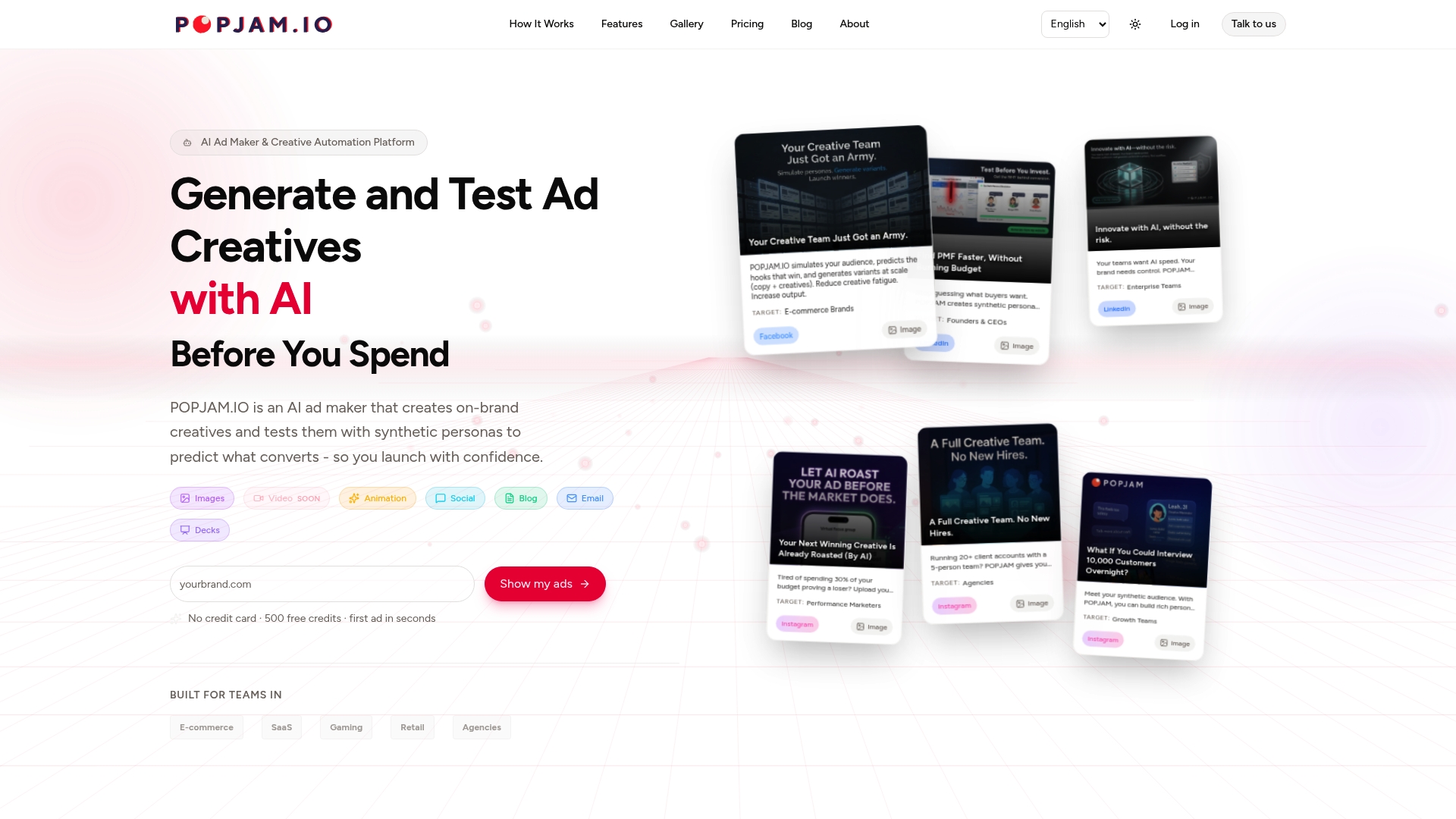
POPJAM solves that problem directly. It generates on-brand ad creatives with AI and then tests them against Synthetic Personas built from real psychographic profiles, before anything goes live. You see which concepts resonate with your target segments, which fall flat, and why. That means your AI ad generation process ends with a validated creative, not a coin flip. For e-commerce brands, SaaS companies, and agencies running multiple campaigns simultaneously, POPJAM’s pre-spend validation is the step that turns creative volume into campaign performance. Check out what creative automation looks like when testing is built into the workflow from the start.
FAQ
What is an AI creative suite?
An AI creative suite is an integrated platform that combines generative AI tools for image, video, audio, and text creation with workflow automation and editing capabilities. It is designed to help marketing and creative teams produce and iterate on campaign assets faster than traditional production methods allow.
How do agentic AI workflows work in creative suites?
Agentic AI workflows automate multi-step creative tasks, such as resizing a single asset across multiple ad formats, while keeping all files fully editable. The AI connects multiple applications and executes the sequence automatically based on a single instruction.
How much do AI creative suite credits cost?
Credit costs vary by task type. Standard image generation typically costs 1 credit per output, while video generation and multi-app orchestration consume significantly more credits based on output complexity and length. Teams should map credit budgets per campaign before production begins to avoid overruns.
Will AI creative suites replace creative professionals?
AI creative suites have not eliminated creative roles. Gallup research shows adoption has triggered workflow reorganization, shifting creative professionals toward strategic oversight and ideation rather than manual execution. The tools handle repetitive output; humans handle brand judgment and creative direction.
What is the best way to start using an AI creative suite?
Start by identifying your biggest production bottleneck, whether that is asset resizing, copy variation, or concept volume. Use the suite to address that specific constraint first, build a brand guardrail document to maintain consistency, and add agentic workflows only after your team has established a reliable review process.
Recommended
- Creative Automation: The Complete Guide for Performance Marketers (2026) | POPJAM.IO Blog
- Streamline your digital marketing creative process with AI | POPJAM.IO Blog
- Creative Automation Platform | AI Ad Generation & Testing | POPJAM.IO
- Data-backed creatives: boost campaign ROI by 47% | POPJAM.IO Blog