

TikTok Hook Testing for Creators: One Win Is Only a Maybe
Test TikTok hooks with a controlled workflow, track early watch rate and watch time, and replicate winners. Learn how POPJAM supports synthetic pretests.

The simplest reliable way to judge a TikTok hook is a controlled, A/B-style “clean test” that isolates the opening of your video while holding everything else constant. Track early watch rate and average watch time as your primary signals, and never call a winner off one post. Validate any promising result with further runs before you trust it.
TL;DR:
- Keep every element except the hook fixed, and post variants three to four days apart at comparable times or simultaneously on matched accounts.
- Use early watch rate as the primary signal and average watch time as support; completion and rewatches assess the body, while engagement proves little.
- Judge results against your account’s recent median, not one post; trending audio, external shares, and platform placement can create misleading spikes.
- Treat one win as a lead, not proof: repeat the hook across at least three runs, then template it and test small paid budgets.
- Synthetic persona feedback can shortlist ideas for teams, but it is directional only; validate finalists with live posts, while solo creators may skip pretesting.
Table of Contents
- Step-by-step clean hook test you can run today
- Which TikTok metrics to track and how to read them
- How to control timing, format, and other variables
- Ready-to-use hook formulas and concrete examples to test first
- Replication protocol and turning a winning hook into repeatable assets
- The role of AI and synthetic buyer personas in hook testing
- What creators get wrong about hook testing
- How POPJAM helps teams pre-validate hooks before spending a dollar
- FAQ
- Internal resources and partner reading
Step-by-step clean hook test you can run today
A clean test starts with a hypothesis, not a hunch. Before you film anything, write down exactly what you expect the new hook to do, like “this hook will improve early watch rate compared to our baseline.” A real hypothesis forces you to define success before you’re emotionally attached to the result.
From there, the workflow looks like this:
- Write your hypothesis. Name the metric you expect to move and by roughly how much.
- Build two variants that differ only in the hook. Same format, same thumbnail, same caption, same length, same tags.
- Pick your posting cadence. Either post at the same hour on comparable days, spacing variants apart on one account, or post simultaneously on matched accounts to cancel out time-of-day bias.
- Run each variant more than once. A single post tells you almost nothing about a hook, it tells you about that one post.
- Log everything the moment results come in in. Waiting until the end of the week means you’ll misremember context that mattered.
This is where most creators quietly sabotage their own data: they swap the hook and the thumbnail at the same time, then can’t tell which change actually moved the needle. Keep your test boring everywhere except the opening line.
Before you trust any result, run it through a three-strike check. If a hook wins once, that’s a maybe. If you recreate the same hook structure in further videos and it keeps winning, that’s a pattern worth building around. Practitioner guidance on hook testing recommends exactly this kind of replication system, treating a single win as a lead rather than a conclusion.
Keep your results in a simple spreadsheet. The fields that matter most:
- Date and time posted
- Variant label (hook A, hook B)
- Early watch rate (opening moments)
- Average watch time
- Engagement metrics (likes, comments, shares, saves)
- Notes on anything unusual (trending audio, algorithm shifts, account changes)
Pro Tip: Color-code your spreadsheet rows by hook formula type so you can spot patterns across many tests without rereading every note.
A clean test isn’t glamorous. It’s a habit of boring discipline applied to a brief moment that decides whether anyone watches the rest of your video.
Which TikTok metrics to track and how to read them
Early watch rate, the percentage of viewers still watching after the opening moments, is the single clearest signal that a hook did its job. Average watch time backs it up: a hook can earn attention in the first second and still lose people by the fifth if the payoff doesn’t match the promise.
Completion rate and rewatch rate tell you something slightly different. They confirm that people who got past the hook actually cared about what came next. A hook can spike early watch rate while the rest of the video lets viewers drift away, which means the hook worked but the body didn’t follow through. Engagement signals like likes, comments, and shares are supportive evidence, not proof on their own, since they often lag behind watch-time data and can be skewed by factors that have nothing to do with your hook.

Your account median is doing more work than you think. A hook that beats last week’s post by double digits does not mean the hook worked if last week’s post was an outlier. Compare each variant’s performance to your typical range across your recent posts, then look for repeated wins across runs rather than treating any single result as proof.
Here’s where a lot of testing goes sideways: a post that suddenly outperforms everything else might not be about your hook at all.
- Sudden viral spikes often trace back to a trending sound or a feature placement, not your opening line.
- External shares from outside the app (Reddit threads, Twitter embeds, group chats) inflate numbers in ways your next test won’t replicate.
- Platform trend placement can boost any video regardless of how it opens, so a win during a trend wave deserves extra scrutiny before you generalize from it.
A validation system, where the core elements of a winning video get recreated in additional posts, is the most dependable way to confirm a result wasn’t noise. This single habit separates creators who guess well from creators who know.
How to control timing, format, and other variables
A clean hook test only tells you about the hook if the hook is the only thing that changed. Everything else needs to stay fixed across both variants, which means building a short control checklist before you ever hit record.
Lock these in place for every test:
- Posting hour and day of week
- Caption text and hashtags
- Thumbnail frame
- Video length
- Aspect ratio
- Background audio or music choice
- Call to action placement
Timing deserves special attention because posting at different hours changes engagement patterns on its own, independent of anything in your video. The fix is straightforward: either space your variants three to four days apart on the same account so each gets a comparable time slot, or post both simultaneously on separate, matched accounts so time of day cancels out entirely. Simultaneous posting across matched accounts works best when you have the infrastructure for it; staggered same-account posting works fine for solo creators who only have one account to work with.
How many runs do you actually need before trusting a result?
A single post: not enough, too easily skewed by timing or algorithm luck. A few posts in the same direction: suggestive, worth a third run. Repeated results in the same direction: reliable enough to call a winner and start scaling.
A quick logging template keeps this honest. For each post, record the date, posting time, variant label, every control variable you held constant, and the resulting metrics. If a field changes between variants that wasn’t supposed to change, the test is compromised, not just imperfect.
Ready-to-use hook formulas and concrete examples to test first
Some hook structures consistently earn attention because they tap into curiosity or contrast. Here are formulas worth testing first, along with what each one tends to move and a sample hypothesis:
- Curiosity opener: “Nobody tells you this about…” Tends to move early watch rate; hypothesis: increases first-3-second retention versus a straightforward statement opener.
- Transformational claim: “I went from one result to another over time.” Tends to move both early watch rate and completion; hypothesis: outperforms a feature-first opener on completion rate.
- Quick demo start: Show the result in the first frame, explain after. Tends to move early watch rate; hypothesis: beats a talking-head intro on thumb-stop rate.
- Expectation flip: Set up one outcome, reveal the opposite.s to move completion and rewatch rate; hypothesis: increases rewatch rate versus a direct-answer hook.
- Numbers or countdown: “Things I wish I knew before…” Tends to move early watch rate; hypothesis: outperforms an open-ended question hook.
Adapt these to your niche rather than copying them word for word. A skincare brand’s “transformational claim” and a B2B SaaS demo’s “transformational claim” will sound nothing alike, but the underlying structure, before versus after, still applies. If your product has a visual payoff, lean on the quick demo start. If your audience responds to personal storytelling, the transformational claim usually has more room to work.
Pro Tip: When a hook formula wins consistently, don’t stop at one video. Sequence it into a short multi-part series so viewers come back expecting the next installment, which compounds the retention benefit of a hook that already works.
Replication protocol and turning a winning hook into repeatable assets
A hook that wins once is a candidate. A hook that wins repeatedly is an asset. Once your three-strike check confirms a result, the next move is to build it into something repeatable rather than treating it as a one-off success.
- Recreate the hook across new videos, holding every other variable constant, to confirm the pattern holds outside the original test window.
- Turn the validated structure into a template you can reuse across topics, swapping the specific claim or demo while keeping the opening rhythm intact.
- Branch into adjacent experiments new thumbnail frames or caption variations on top of the now-proven hook, since the hook itself is no longer the variable in question.
Once you’re confident in a hook, scaling it into paid creative is a natural next step, but start small. Validate at limited ad spend before committing a larger budget to any single creative, the same logic that applies to organic testing applies here: one strong result at low spend is a signal, not a guarantee at scale.
Watch for overfitting. A hook that performs well with your existing audience might fall flat with a colder audience or a different platform format. A quick cross-audience or cross-format check, posting the same hook structure to a slightly different segment or reformatting it for a different aspect ratio, tells you whether you’ve found something durable or something that only works because your current audience already likes you.
- Recreate before you scale.
- Template the structure, not just the words.
- Test small budgets before big ones.
- Check the hook against a different audience before declaring it universal.
The role of AI and synthetic buyer personas in hook testing
Running enough organic test cycles to get reliable data takes real time, especially when you’re trying to validate various hook formulas across different audience segments. This is where AI-driven pre-testing has started to change the pace of the work. Instead of waiting days for organic posts to generate enough views to read early watch rate, synthetic buyer personas can react to a hook concept before it ever goes live, giving a directional read on which opening is more likely to hold attention.
This doesn’t replace the clean organic test, it front-loads it. feedback to narrow several hook ideas down to the most promising before spending a single day on real posting cycles, then run the organic clean test and three-strike replication on the finalists. The combination cuts wasted production time on hooks that were never going to work while keeping the real-world validation that only live audience data can provide.
For creators working solo, this kind of pre-test might not be necessary. For marketing teams running multiple campaigns across clients or product lines, it becomes a meaningful way to protect ad budget before a creative ever reaches a real audience.
What creators get wrong about hook testing
Most hook testing fails for boring reasons. Creators change the hook and the thumbnail in the same test. They call a win after one post that happened to catch a trending sound. They compare a new video to last Tuesday’s post instead of their account’s actual median. None of these mistakes come from bad instincts, they come from skipping the discipline of a clean test.
The fix isn’t more creativity, it’s a production-line mindset: small, continuous tests, a logging habit you don’t skip when you’re busy, and a refusal to trust a result until it’s replicated.
Common mistakes worth avoiding:
- Treating a single post’s performance as proof of anything
- Changing more than one variable between test versions
- Comparing results to an arbitrary post instead of your account median
- Skipping the log because “you’ll remember it later”
Before you call any hook a winner, run through this checklist: Did you write a hypothesis before posting? Did only the hook change between variants? Did you control for posting time? Did the result repeat across at least three runs? Did you compare against your account median rather than a single lucky post?
Pro Tip: Keep a running “hook graveyard” of formulas that failed the three-strike test. Knowing what doesn’t work saves as much time as knowing what does.
— Doruk
How POPJAM helps teams pre-validate hooks before spending a dollar
Running clean organic tests is the right foundation, but for teams managing paid campaigns across multiple products or clients, waiting on organic cycles to validate every hook idea slows everything down. We built POPJAM to compress that timeline: our platform generates on-brand ad creatives and tests them against synthetic buyer personas that simulate real audience reactions before a single impression goes live, so you can narrow a stack of hook ideas down to the strongest contenders without burning ad spend to find out which ones fall flat.
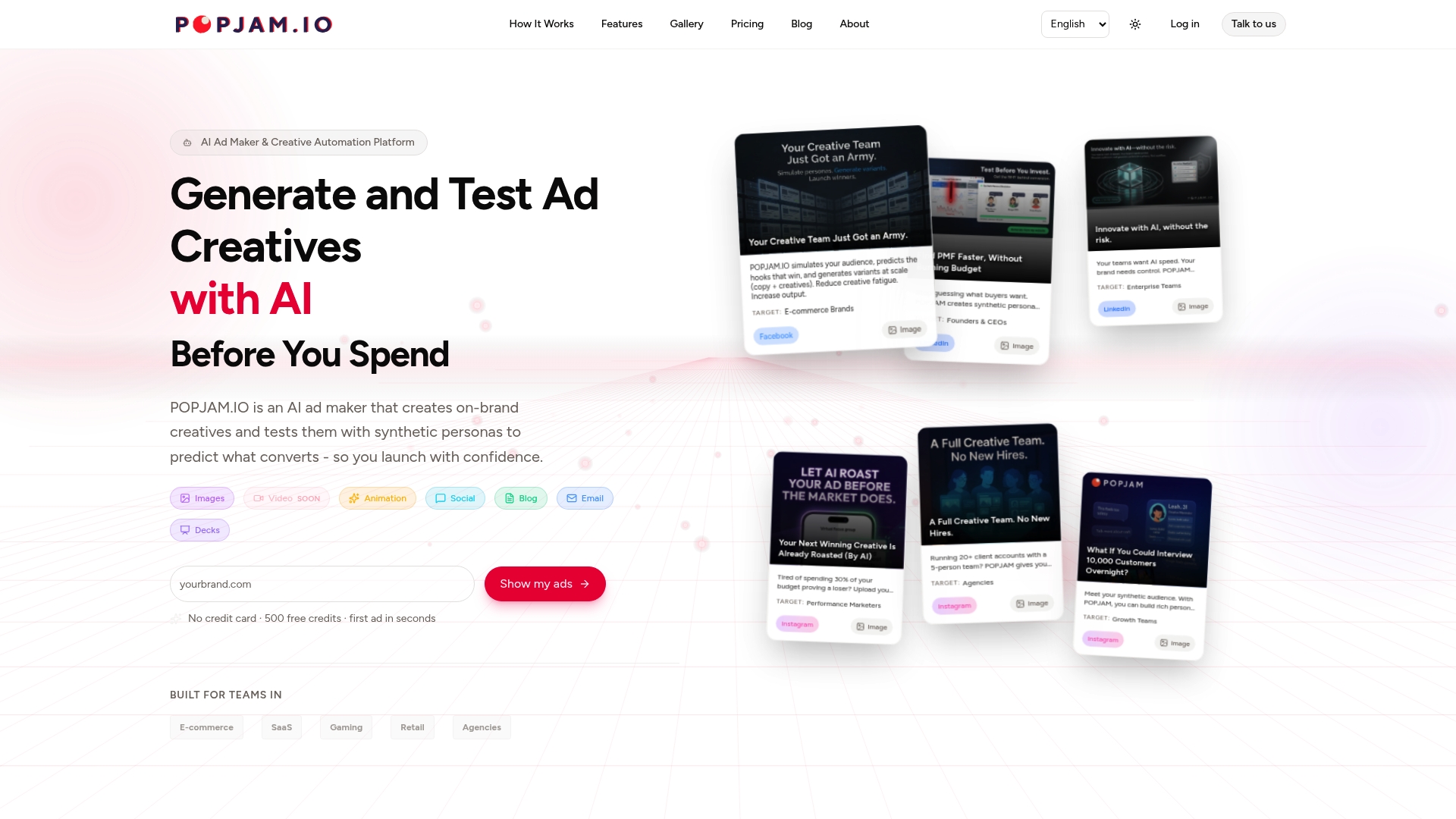
This approach fits naturally into the workflow we’ve described here: use synthetic persona feedback to shortlist hooks, then run your clean organic test and three-strike replication on the finalists with real audience data.
Performance marketers, agencies juggling multiple client accounts, e-commerce brands protecting tight ad budgets, and SaaS growth teams iterating on creative at speed all get a faster path from hook idea to validated asset. If that sounds like a fit for how your team works, take a look at our pricing plans and start a trial to see how synthetic persona testing fits into your own hook testing workflow.
FAQ
How do I filter search results on TikTok?
Open the TikTok search bar, type your query, and tap the filter icon near the top of the results to narrow by date, video length, or content type. These filters help you study how competitors or creators in your niche structure their hook openings, which is useful when researching formulas to test.
How many views do you need on TikTok to earn $100?
TikTok’s Creator Fund and other monetization programs don’t guarantee a fixed view-to-dollar ratio, since payouts depend on factors like audience location, engagement, and the specific program you’re enrolled in. There’s no single published figure that applies to every creator, so earnings vary too much to state a reliable view count here.
How do I test items or products on TikTok?
The same clean-test principles apply: create two versions of a product video that differ only in the opening few seconds, hold format and posting time constant, and compare early watch rate and completion rate across multiple runs. Validate any promising result with further tests before treating it as reliable.
How do I verify my age on TikTok?
TikTok may ask users to verify their age through methods like submitting an ID or other verification steps built into the app, depending on the account and region. The exact verification flow is managed entirely within TikTok’s own settings, so check the app’s account or privacy settings for the current option available to you.
Internal resources and partner reading
For a deeper look at testing beyond organic hooks, our guide to TikTok ad testing covers a framework for paid creative, and our piece on hook rate breaks down benchmarking for performance marketers. See also our article on hook testing validation and our AI TikTok ad generator for creating platform-native variants. For scaling a winning hook into a full campaign, this guide on crafting effective CTAs is worth a read.