

Hook Testing for Marketers: Five Gate Ladder and AI Pre Launch Validation
Predict which hooks drive real conversions. Isolate first-frame promises, apply a five gate decision ladder, and run AI pre launch checks before you spend...

Hook testing is the practice of pitting several first-frame or headline promises against each other, with everything else in the ad held constant, so you can see which idea actually earns attention and action. The one thing to do right now: build a single test that isolates the hook, measure qualified action instead of just click-through rate, and run it through a five-gate decision ladder before you scale spend. Platforms like POPJAM.IO exist to help you do this before a single dollar hits a live campaign.
TL;DR:
- Testing 5 to 8 distinct hook variants across different families provides the best chance to identify a genuine winner without diluting statistical power.
- Metrics beyond CTR, such as qualified landing sessions or trial starts, are essential to confirm a hook’s true effectiveness in driving conversions.
- Running each test for at least 5 to 7 days with sufficient spend ensures reliable results and reduces the risk of false positives caused by novelty effects.
- Using AI tools like POPJAM.IO helps generate and pre-test hooks against synthetic personas, saving budget and time before live campaign launch.
- Documenting testing outcomes and underlying principles enables repeated insights and prevents revisiting the same debates over creative variations.
Table of Contents
- What Counts as a Hook Test (and What It Doesn’t)
- How Do You Build a Hook Test Brief?
- What Metrics Actually Prove a Hook Won?
- Seven Hook Families Worth Testing
- How Do You Run and Document a Hook Test?
- Real Hook Tests That Moved the Needle
- What Tools Should You Use to Test and Analyze Hooks?
- What I’ve Learned Watching Hook Tests Go Wrong
- Test Hooks Before You Spend, Not After
- Sources
- FAQ
What Counts as a Hook Test (and What It Doesn’t)
A hook, in advertising terms, is the opening promise of an ad: the first three seconds of video, the headline on a static image, the thumbnail text that stops a thumb mid-scroll. Hook testing measures which of those opening promises pulls a qualified viewer further into your funnel. That’s a different discipline from testing an entire creative concept, and it’s worlds apart from anything involving programming frameworks. If you landed here looking for something else, this article is strictly about the marketing kind.
The core discipline is isolation. A clean hook test compares several first-frame promises against one offer, one audience, and one destination, while tracking qualified downstream action rather than clicks alone. Skip that isolation and you’re not testing hooks anymore. You’re testing noise.
How Do You Build a Hook Test Brief?
Most teams skip the brief and go straight to generating creative. That’s how you end up with six variants that differ in five ways each, and a result nobody can explain three weeks later. A one-page brief forces the discipline before the ideation starts.
Your brief needs these fields, filled in before anyone opens a design tool:
- Business question. What decision does this test inform? “Which angle earns more trial starts” is a question. “Let’s see what happens” is not.
- Audience. The exact segment, cold or warm, that will see the test.
- Offer. The specific deal or value proposition. Locked for the duration.
- Destination. The landing page or app screen. Locked.
- Hook families to test. Pick from problem, outcome, proof, objection, comparison, urgency, or identity angles.
- Proof asset. The screenshot, testimonial, or number backing the claim, if the hook needs one.
- CTA. Locked wording and button placement.
- Measurement window and MDE. How long you’ll run it and the smallest lift worth detecting.
- Success metric. The one number that decides the winner.
Once the brief is set, lock everything except the hook. The creative body, offer, audience, and destination stay fixed; only the first frame, headline, or opening line changes across variants. That’s what makes the eventual winner interpretable rather than a lucky guess.
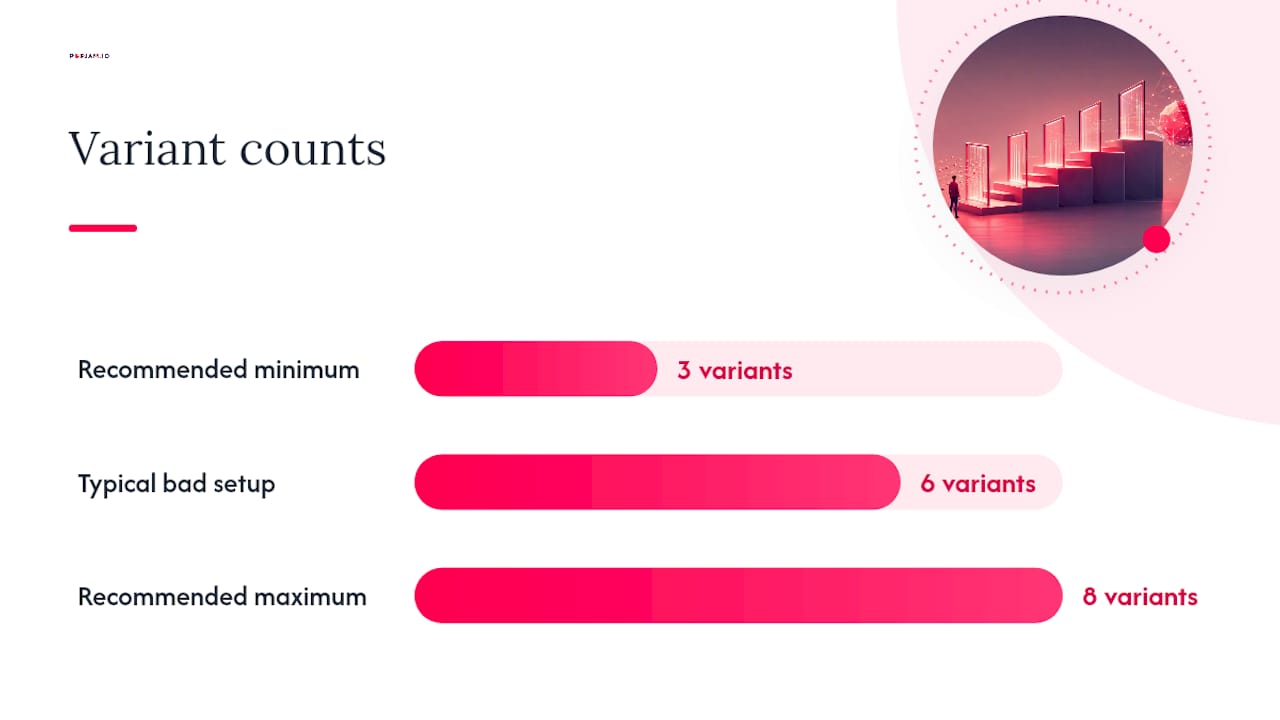
Pick 3 to 8 variants spread across distinct hook families rather than minor word swaps within the same angle. Near-duplicate wording (“Stop wasting money” vs. “Quit wasting money”) wastes a variant slot without adding real signal. Finally, set UTM parameters that map each variant directly to landing-page behavior, so you can see whether a hook that wins on click-through also wins on the metric that actually matters.
Pro Tip: Write the success metric into the brief before you see a single result. Deciding “we’ll know it when we see it” after launch is how teams talk themselves into whichever variant they already liked.
What Metrics Actually Prove a Hook Won?
CTR tells you a hook stopped the scroll. It tells you nothing about whether the person who stopped was worth acquiring. Layer your metrics instead: hook-layer signals like CTR and thumb-stop rate for early diagnosis, and a primary conversion metric that matches your actual campaign intent, whether that’s add-to-cart, trial start, demo request, or qualified landing sessions. A hook that wins on thumb-stop and loses on trial starts isn’t a winner. It’s a distraction wearing a winner’s costume.
Before launch, decide your minimum detectable effect (MDE) and target roughly 80% statistical power. These two numbers determine how much traffic and time you actually need. Lower your MDE and you need dramatically more sample; skip this step and you’re just staring at a dashboard hoping a pattern appears. AI tools make it easy to generate a dozen variants in an afternoon, but traffic doesn’t scale with variant count. Split your audience eight ways and each variant gets an eighth of the power, which is how false winners get crowned.
Run every result through a five-gate ladder before you trust it enough to spend real budget behind it:
- Gate 1: MDE. Did the observed lift clear the minimum effect you set as meaningful?
- Gate 2: Power. Did the test run long enough, with enough spend, to detect that effect reliably?
- Gate 3: Novelty hold. Does the winner still win after the initial curiosity spike fades, checked against returning-user segments?
- Gate 4: Multiplicity correction. With multiple variants compared simultaneously, does the winner survive an FDR-aware significance check rather than a raw p-value?
- Gate 5: Replication. Does the result hold on a second run before you commit full budget?
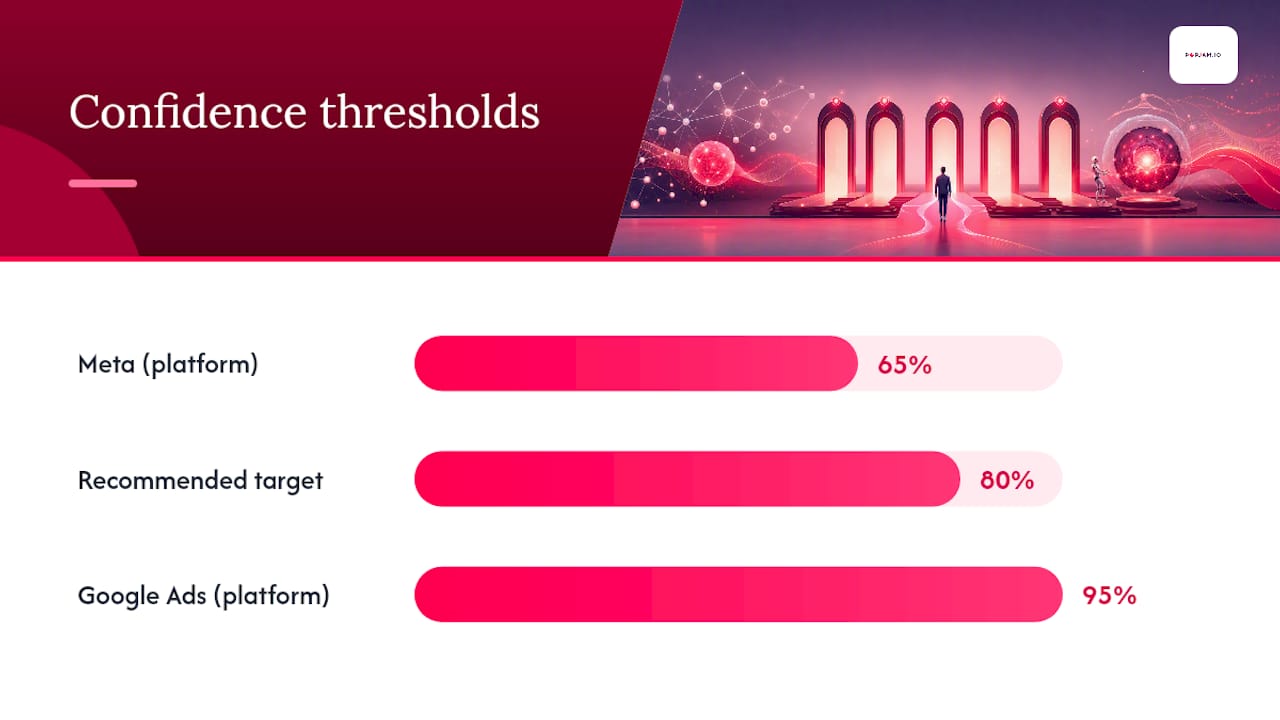
Platforms disagree on confidence thresholds. Meta often calls a winner at roughly 65% confidence internally, while Google Ads experiments hold out for closer to 95%. Set your own threshold before launch instead of borrowing whichever number the platform dashboard happens to show you.
As a floor, plan for 5 to 7 days minimum runtime, enough per-variant spend to clear your platform’s learning phase, and a sample-ratio mismatch (SRM) check comparing actual traffic split against your planned split. An SRM failure means your “winner” was decided by a broken randomization, not a better hook.
Seven Hook Families Worth Testing
Hook families are reusable angles, not one-off headlines. Once you know which family wins with a given audience, you can spin off a dozen fresh variants from that single insight instead of starting from a blank page every sprint.
- Problem. Names the pain directly. “Still manually stitching together ad reports every Monday?” works as a static headline or a video’s spoken first line.
- Outcome. Leads with the result, skipping the mechanism. “Cut creative testing time from three weeks to three days.”
- Proof. Opens with a number, screenshot, or third-party signal. “4.8 stars from 900+ marketing teams” reads well as thumbnail text.
- Objection. Preempts the hesitation. “No, this isn’t another dashboard you’ll ignore by week two.”
- Comparison. Frames against a familiar alternative. “Skip the agency retainer. Get creative feedback in hours.”
- Urgency. Uses time or scarcity honestly. “Q1 ad budgets get reviewed this week. Know your winning hook first.”
- Identity. Speaks to who the viewer is. “Built for growth teams tired of posting and praying.”
Cold audiences respond better to problem and outcome hooks since there’s no existing trust to lean on. Warm audiences tolerate comparison and proof hooks because they already know your category. On carousel and TikTok formats, sequence your hook family across the first two or three cards or seconds. A problem hook that hands off to a proof card mid-sequence often outperforms either angle alone.
How Do You Run and Document a Hook Test?
Discipline in execution matters as much as discipline in design. Follow this sequence every time, without skipping steps when you’re in a hurry:
- Brief. Fill out the one-page brief above before anyone touches a design file.
- Ideate. Generate hook concepts across at least three families.
- Generate variants. Produce 3 to 8 finished creatives, hook as the only variable.
- QA. Check that offer, destination, and CTA are identical across every variant.
- Launch with UTMs. Every variant gets a unique tag mapping to a creative ID.
- Monitor. Watch spend pacing and SRM early, not just final results. Read the full pre-launch testing workflow for a longer walkthrough of steps 6 through 9.
- Gate checks. Run the five-gate ladder before declaring a winner.
- Decide. Scale, hold, or kill based on what cleared the gates.
- Archive. Record the winning principle, not just the winning asset.
Set kill and scale rules before launch, not after you’re emotionally attached to a variant. A common band: kill a variant that’s spent 2 to 3 times your target cost-per-result with no sign of recovery by day 4. Scale a variant that clears all five gates by widening budget in 20 to 30% increments rather than doubling overnight, which lets you catch a novelty-driven false positive before it burns real budget.
When a hook wins, don’t just save the asset. Extract the underlying principle. If a comparison hook won because it named a familiar alternative, that’s the insight worth reusing. Spin up the next batch of variants around that principle rather than around the exact wording, since pairing quick qualitative checks with quantitative testing at this stage often surfaces a second angle worth testing before you commit to scale.
Pro Tip: *Record creative ID, hook family, audience segment, spend, and primary metric for every test in one shared log. Six months from now, “the video one that did well” will be useless.
Real Hook Tests That Moved the Needle
The pattern behind most documented hook wins is consistency, not cleverness. Teams that isolate the hook and hold the rest of the creative steady tend to find real, repeatable lifts. Teams that change three things at once tend to find a mystery.
A common structure that shows up across documented ad creative testing frameworks runs the hook layer first with 5 to 8 variants and a minimum spend per variant, before ever touching offer or format tests. Teams that follow that sequence report cleaner signal because they aren’t asking the data to explain three variables at once.
One recurring pattern worth borrowing: comparison hooks tend to outperform generic outcome hooks in categories where the audience already knows the established alternative. A SaaS tool competing against manual spreadsheets or an agency retainer often wins bigger with “skip the retainer” framing than with a plain feature callout, because the hook does the work of reframing the decision instead of just describing a benefit.
Another pattern shows up in the objection family. Ads that name the skepticism directly, rather than avoiding it, often earn a longer watch time on video because the viewer feels understood rather than sold to. That’s not universal. It works best when the objection named is genuinely the top reason people hesitate, which is exactly the kind of insight a synthetic persona review or a small qualitative pre-test can surface before you spend a cent testing it live.
What Tools Should You Use to Test and Analyze Hooks?
You don’t need enterprise martech to run a disciplined hook test, but you do need something better than gut feel and a shared spreadsheet nobody updates.
For generation and pre-launch validation, an AI ad maker like POPJAM.IO produces on-brand hook variants across families and tests them against synthetic buyer personas before any media spend, giving you a directional read on which angles resonate with a given psychographic profile. That’s a genuinely different step from traditional A/B testing: you’re getting simulated feedback before the test even goes live, not after you’ve already spent budget finding out.
For the live test itself, your ad platform’s native experiment tools (Meta Experiments, Google Ads experiments) handle the actual split and reporting, though you still need to apply your own MDE, power, and multiplicity checks on top, since platform dashboards rarely surface those by default. For tracking variants through to conversion, a UTM structure tied to your analytics platform (Google Analytics 4, a data warehouse, or your CRM) closes the loop between hook and qualified action.
For documentation, a shared log using the metadata fields from your workflow (creative ID, hook family, spend, primary metric) beats a folder of exported creative files every time. The tool matters less than the habit of using one consistently, connecting testing outcomes back to campaign ROI instead of treating each test as a one-off.
What I’ve Learned Watching Hook Tests Go Wrong
The biggest trap isn’t a statistics mistake. It’s overvarianting: generating twelve hooks because AI made it easy, then wondering why nothing reaches significance. Cap your variants, not your ambition. Peeking is the second trap, checking results daily and calling a winner the moment a lead opens up, before novelty has a chance to fade.
The third trap is chasing CTR as if it were the finish line. A hook that stops thumbs but doesn’t produce qualified action isn’t a win, it’s a distraction with good production values. And the quietest trap is winning a test, then never archiving the principle behind it, so the same debate happens again next quarter with a different creative team.
Used well, AI tools like POPJAM.IO help you generate diverse hook families fast and enforce the tagging discipline that makes results interpretable later, as long as you prune down to a testable number of variants instead of launching everything the model produces.
— Doruk
Test Hooks Before You Spend, Not After
Every method in this playbook, the brief, the five-gate ladder, the hook families, still leaves one gap: you’re guessing how a real audience will react until the ad is actually live. POPJAM closes that gap. It generates on-brand hook variants across families in minutes, then runs them against synthetic buyer personas built from psychographic profiles before you spend a dollar on media. You get a directional hook-rate read and qualitative feedback on which angle resonates with a given segment, the kind of signal that used to require a week of live spend and a lot of patience.
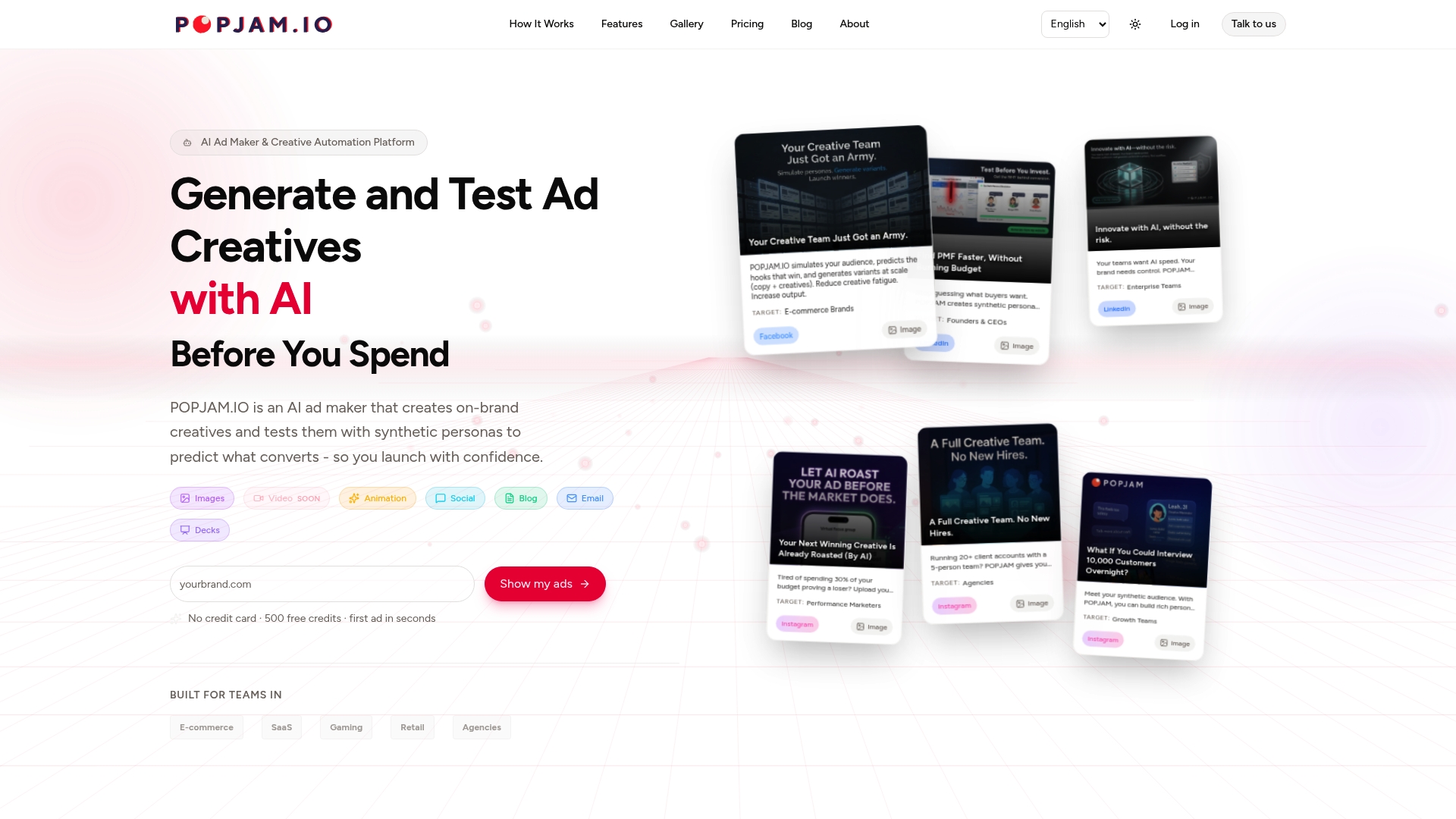
Live A/B testing still has its place once you’ve narrowed to your strongest 2 or 3 hooks. The synthetic testing step is for the earlier, riskier phase: when you have 8 rough ideas and a limited budget, and burning real spend to rule out weak ones feels wasteful. That’s exactly where POPJAM fits between ideation and the live test. If you’re ready to see how it works on your own hooks, try the free ad testing tool and run your first pre-launch test before your next campaign goes live.
Sources
- Hook Testing Framework for Paid Social Ads | AttentionClaw
- An AI Ad Creative Testing Framework That Works
- Ad Creative Testing Framework: Find Your Winner Faster (2026 Guide)
- The Creative Testing Framework That Scales What Works — Ads & Scale
- The complete guide to creative testing | Listenlabs
FAQ
What Is Hook Testing in Advertising?
Hook testing compares several first-frame or headline promises against each other while holding offer, audience, and destination constant, so you can see which opening idea drives qualified action rather than just clicks.
How Many Hook Variants Should I Test at Once?
Most frameworks recommend 5 to 8 variants spread across distinct hook families, since more variants split your traffic and reduce the statistical power of each one.
What’s the Difference Between CTR and a Real Winning Hook?
CTR only shows a hook stopped the scroll; a real winner also clears your primary conversion metric, whether that’s add-to-cart, trial starts, or qualified landing sessions, matched to your actual campaign intent.
How Long Should a Hook Test Run?
Plan for a minimum of 5 to 7 days with enough spend per variant to clear your platform’s learning phase, then confirm the result with a sample-ratio mismatch check and a novelty hold before trusting it.
Can AI Tools Help With Hook Testing Before I Spend Ad Budget?
Yes. Platforms like POPJAM.IO generate hook variants and test them against synthetic buyer personas before launch, giving you directional feedback on resonance before any media spend, which then narrows your live A/B pool to the strongest candidates.