
On this page
On this page
Meta ad fatigue is what happens when the same people see the same creative too many times and stop responding. Your click-through rate slips, your cost per result climbs, and the ad that carried your account last month starts to drag it down. The fix is rarely a bigger budget. It is fresh, genuinely different creative, plus a habit of checking that fatigue is really the problem before you swap anything out.
This guide walks through how to diagnose it, which numbers to watch, how frequency fits in, what changes on TikTok, and how to keep new creative coming when your budget is small.
TL;DR
- Fatigue shows up as falling click-through and rising cost per result for one specific creative, usually alongside rising frequency.
- Frequency alone is a weak signal. Meta itself says it is not a good indicator of creative fatigue, so read it next to CTR, reach and cost.
- Rule out learning-phase resets, tracking changes and auction swings before you blame the creative.
- Fix it with new concepts, not tiny tweaks. Meta reports an average 8% conversion rate lift when fresh creative is added to highly fatigued ad sets.
- On a small budget, test a few distinct concepts before launch so your live spend only goes behind ads with a real shot.
Table of Contents
- What Meta Ad Fatigue Actually Is
- Rule Out the Impostors First
- The Metrics That Flag Fatigue Early
- Ad Frequency: What the Numbers Really Say
- How Fast Does Creative Wear Out?
- TikTok Creative Fatigue: Same Problem, Faster Clock
- The Refresh Playbook
- Small Budget? Test Smarter, Not More
- Keep Fresh Creative Flowing With POPJAM
- FAQ
- Sources
What Meta Ad Fatigue Actually Is
Meta’s own analytics team describes creative fatigue as users repeatedly seeing the same creative, with responsiveness declining as exposures pile up. They also note that adding new creative can improve performance, which is what separates fatigue from audience saturation, where you have simply run out of fresh people to reach.
That distinction matters because the cures differ. If the creative is tired, new creative helps. If the audience is tapped out, you need new people, and Meta says targeting new audiences can resolve the problem too.
Here is how I think about it in practice:
- Creative fatigue: the same ad, seen again and again, gets ignored. Newer ads in the same ad set still perform.
- Audience saturation: everyone reachable has already seen most of what you run. Even new ads struggle.
- Something else entirely: a tracking change, a learning reset, a seasonal auction spike or a landing page problem.
The third bucket is where many teams lose money, so we start there.
Rule Out the Impostors First
Before you label a decline as fatigue, check whether something you did (or something outside the ad) caused it.
Check your change log
Progress Bar Growth suggests looking at Meta’s change history first. Edits to targeting, creative, the optimization event or bid strategy, adding a new ad, or resuming an ad set after a pause of at least seven days can send the ad set back into learning, where results are less stable and cost per result may temporarily rise. That looks a lot like fatigue, but waiting a few days can fix it.
Check tracking and attribution
The same source recommends reviewing Events Manager Diagnostics, your attribution settings and your store’s own order data when conversions fall. If clicks hold steady but reported conversions drop, a tracking or attribution change is a more likely culprit than a tired ad.
Check the auction
Izoard, a Belgian agency, compares the signals this way: rising frequency, falling CTR and rising CPM on older ads, but not on newer ones, fits creative fatigue better than a broad auction change. If CPM jumps across all your ads at once, the auction is the more likely cause. Think peak retail seasons, when everyone is bidding for the same eyeballs.
A quick sorting table helps:
| What you see | More likely cause |
|---|---|
| Older ads decline, newer ads in the same ad set hold up | Creative fatigue |
| CPM rises on every ad at the same moment | Auction conditions |
| Clicks stable, reported conversions down | Tracking or attribution |
| Decline starts right after an edit or restart | Learning phase reset |
| CTR and video retention stable, cost per purchase up | Landing page or offer, after the click |
That last row comes from Progress Bar Growth’s reasoning: if CTR and opening video retention stay stable while cost per purchase rises, the problem is more likely after the click than in the creative.
The Metrics That Flag Fatigue Early
You do not need a fancy dashboard. You need a weekly habit and a creative-level view.
Look at the creative, not the campaign
Meta’s analytics team says creative-level exposure is more informative than frequency measured at the ad, ad set or campaign level. That makes sense: one ad set can hold three creatives, and an average frequency of 3 can hide one ad that people have seen eight times.
Compare four weeks, side by side
Progress Bar Growth recommends comparing each ad’s weekly frequency, reach and cost per result over roughly four weeks. Fatigue becomes more plausible when frequency rises, incremental reach shrinks and cost per result climbs for that specific creative.
A stronger early warning: link CTR and video opening retention both fall week over week while frequency rises. If you only watch cost per result, you find out late. CTR and hook retention move first.
A simple weekly check for each ad:
- Note frequency, reach added this week, link CTR, and cost per result.
- For video, add the share of viewers who get past the opening seconds.
- Flag any ad where CTR and retention fall two weeks in a row while frequency rises.
- Confirm newer ads in the same account are not suffering the same way.
- If only the older ad is sliding, queue its replacement now.
Use Meta’s built-in flags, with limits
Ads Manager shows delivery statuses. Per Izoard’s summary, “Creative limited” means cost per result is higher than for previous ads but less than double, while “Creative fatigue” means double or more. The flags count recent impressions of the same image or video across the Page’s campaigns, and only appear for ad sets with a single ad. They exclude Advantage+ catalog ads, dynamic creative and Advantage+ app campaigns. So the absence of a flag does not mean you are safe. It may mean your setup is not eligible.
Ad Frequency: What the Numbers Really Say
Frequency is impressions divided by the number of distinct people reached. It is easy to read and easy to misread.
Meta’s data team is blunt: frequency is not a good signal of creative fatigue on its own. Their 2023 analysis found a mean of 4.2 prior exposures per user and creative, and more than 19% of impressions had gone to people who had already seen the creative more than five times in a 30-day lookback. They also found repetition is best spread across different-looking ads, not the same ad over and over.
So what is an optimal frequency? There is no single number. Some practitioner guides treat an average frequency above roughly 3 to 4 on Facebook and Instagram as something to watch. Treat that as a prompt to look closer, not a rule. A retargeting pool of 2,000 warm visitors will hit a high frequency fast and still convert. A cold prospecting ad at the same frequency with falling CTR is a different story.
The agency Space Ads makes the same point from the practitioner side: compare reach and frequency with downstream conversion and customer-quality data before concluding anything.
Practical frequency habits:
- Read frequency next to CTR and cost per result, never alone.
- Expect retargeting to run hotter than prospecting.
- Spread the repetition: several visually distinct ads in one ad set beat one ad shown to exhaustion.
- When frequency climbs and response drops together, add creative or widen the audience.
How Fast Does Creative Wear Out?
It depends on placement and platform. Accelerated Digital Media reports that Meta Feed ads typically take 2 to 4 weeks for returns to diminish, Reels around 5 to 10 days and Stories 10 to 20 days, per their paid social fatigue guide. Those are rules of thumb from one agency, not laws. Your audience size, spend and offer will move them.

The takeaway is that fast-moving placements need a faster creative pipeline. If you run Reels-heavy campaigns, plan new concepts weekly, not monthly.
TikTok Creative Fatigue: Same Problem, Faster Clock
TikTok readers ask about this often, and the short version is that the clock runs quicker. Logical Position notes that while Meta ads can sometimes stay effective for weeks or months, TikTok assets often show fatigue within a few days.
The diagnosis uses the same logic you apply on Meta: look at one creative at a time and watch for falling click-through and early-view retention while spend and reach continue. The difference is cadence.
What that means for your workflow:
- Build in volume. Plan a steady stream of new hooks and openings rather than a few polished hero videos.
- Vary the first seconds. Same message, different opening shot, different first line.
- Test before you spend. When assets wear out in days, burning budget on an unproven video hurts more.
- Keep a bench. Have the next two or three concepts ready before the current one slips.
I will be honest: public, official guidance on exact TikTok fatigue thresholds is thin, so build your own baseline from your account’s history instead of borrowing someone else’s number.
The Refresh Playbook
When you have confirmed fatigue, you have four moves.
1. Add genuinely new creative
Meta’s data says adding fresh creative to ad sets with high fatigue can lift conversion rates by an average of 8%. Note the word fresh. Changing a button color is not new creative. A new angle, a new hook, a new format or a new face is.
Creative quality also carries weight. A Meta Performance Marketing Summit analysis, as summarized by Decode Marketing, attributed 56% of campaign outcomes to creative quality. That is a good argument for putting your effort here before fiddling with bids.
2. Expand the audience
If the creative still works on people who have not seen it, widen the net. This is the right call when newer people respond as well as ever and only your saturated segment has gone flat.
3. Pause and return
Some teams retire a creative for two to four weeks and bring it back to a refreshed pool. It is a cheap experiment, though results vary, so track it like any other test.
4. Repackage the message
If the message works, keep it and change the wrapper. Turn a static image into a short video, a carousel into a single hero shot, or a long caption into a punchy overlay. Even small stylistic choices, such as the Facebook emoji ads approach to copy, can make a familiar offer feel new. And the call to action deserves a rewrite too: stronger prompts can change how people click once they have seen your message a few times.
A note on what not to do: do not edit a winning ad in place. Duplicate it, change one thing, and launch the variant alongside the original. Edits to a live ad can reset learning and muddy your read.
Small Budget? Test Smarter, Not More
With a few hundred dollars a week, you cannot afford to test ten ads live and hope. You can still run a tight system.
- Pick concepts, not variations. Three different angles teach you more than three color swaps.
- Pre-screen. Before you spend, get feedback on the ads. This is exactly where we built POPJAM to help (more on that below).
- Launch two or three ads per ad set. Enough variety to spread exposures, not so many that each starves.
- Decide your kill rule in advance. For example, pause an ad when CTR drops for two consecutive weeks while frequency rises.
- Keep a rolling bench. Always have the next concept designed before the current one fades.
If you want a structured approach, our guide to a Facebook ad testing recipe lays out how to organize tests, and our creative fatigue breakdown goes deeper on diagnosis.
Our Take: Stop Posting and Praying
Here is what we have seen again and again. Teams make a handful of ads, launch them, and pray. Then the live budget becomes the test. By the time fatigue shows up in the data, the money is already gone.
We built POPJAM around a different order of operations. Generate on-brand creative, run it past synthetic buyer personas that simulate how your audience may react, and refine before a dollar goes behind it. That does not make fatigue disappear, nothing does, but it changes how you handle it. You walk into every refresh with a bench of tested concepts instead of a scramble.
Our view is that fatigue is a supply problem. If it takes you two weeks to make one new ad, you will always lose to a clock that runs in days. If you can generate, check and export platform-ready variations quickly, refreshing becomes routine instead of a fire drill.
The goal is simple: spend your live budget on ads that have already earned it.
Doruk
Keep Fresh Creative Flowing With POPJAM
If you are tired of finding out an ad is fatigued only after it has eaten your budget, POPJAM is built for that exact gap. You can generate on-brand creatives, test them against synthetic personas before launch, and export formats made for Meta, TikTok and other channels.
Start with the free AI ad testing tool, or look at our AI Meta ad generator if Facebook and Instagram are your main channels.
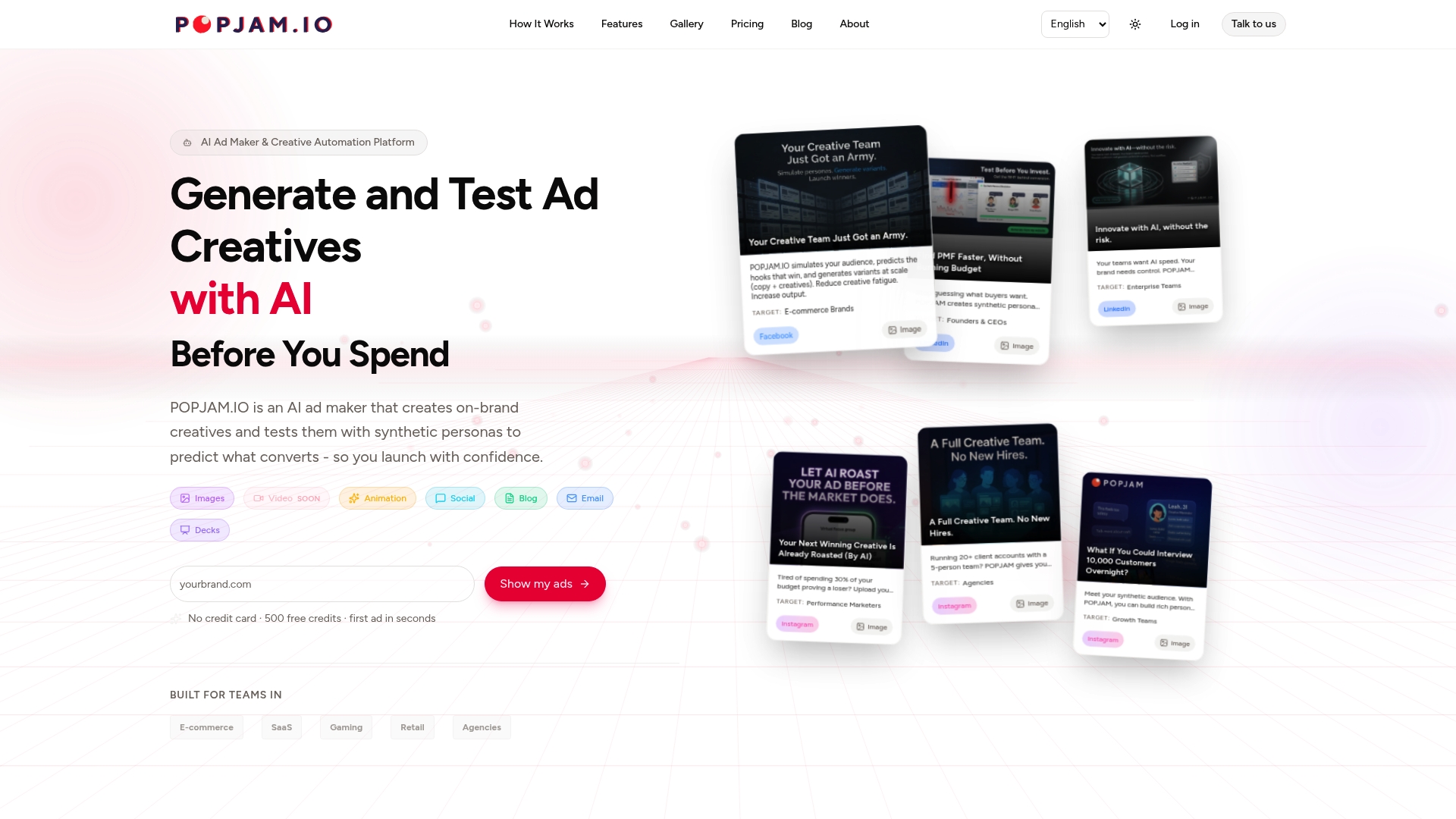
Plans start with a Free tier. Paid plans run €29 per month for Starter, €99 per month for Essential and €399 per month for Business, with Enterprise available on request. If you only need extra creative volume, credit packs run from €10 for 1,000 credits to €100 for 10,000 credits. See the full pricing page for what each tier includes.
FAQ
What is the first sign of Meta ad fatigue?
The earliest pattern is usually link CTR and opening video retention falling week over week while frequency rises for one specific ad. Cost per result tends to follow later. Check that newer ads in the same account are not declining too, which would point elsewhere.
What frequency is too high on Meta?
There is no universal cutoff. Meta says frequency alone is not a good fatigue signal, so judge it next to CTR, reach and cost per result. Some practitioners watch averages above about 3 to 4 on Facebook and Instagram, but retargeting audiences normally run higher than cold ones.
How often should I refresh Meta ad creative?
It depends on placement and spend. One agency reports Feed ads typically wear down in 2 to 4 weeks, Reels in 5 to 10 days and Stories in 10 to 20 days. Use those as starting guesses and set your own cadence from your account’s weekly trends.
Does TikTok creative fatigue happen faster than on Meta?
Usually, yes. Agency reporting suggests TikTok assets can show fatigue within a few days, while Meta ads sometimes last weeks or months. Plan for a faster stream of new hooks and test them before they go live.
Can I fight ad fatigue on a small budget?
Yes. Test distinct concepts rather than minor variations, pre-screen them before launch, run only two or three ads per ad set, and set a pause rule in advance. That keeps live spend focused on ads with a real chance.
Sources
- Creative fatigue: how advertisers can improve performance by managing repeated exposures (Meta Analytics)
- Is it creative fatigue? 5 checks before new Meta ads (Progress Bar Growth)
- Creative fatigue on Meta: how to spot and prevent it (Izoard)
- How to Identify and Prevent Creative Fatigue (Accelerated Digital Media)
- Creative Velocity: The Meta Ads Strategy (Logical Position)
- How to combine Brand Consistency and Creative Diversity (Decode Marketing)
- Master Facebook Emoji Ads: Boost Conversions
- How to Create Compelling CTAs for Higher Conversion Rates