

Prove Creative Testing ROI for Ad Teams: Incrementality and Kill/Keep Rules
Prove creative testing ROI with an incrementality-first framework for performance marketers. Use 90% to 95% confidence, kill/keep thresholds, and...

Creative testing ROI is the incremental business outcome you can trace directly back to a creative change, not just the metrics that moved while it ran. If you’re asking a channel-level question, run an incrementality or platform-lift test first. If you’re choosing between two creative directions, an A/B test will get you there faster. Both Think with Google and POPJAM build their testing logic around that same distinction.
TL;DR:
- Conduct incremental impact tests that compare results against control groups to accurately measure a creative’s true contribution to ROI.
- Choose the appropriate test type based on your question, with geo holdouts being the most reliable for channel-level budget decisions.
- Ensure hypotheses and primary KPIs are set before testing, with a recommended duration of 7 to 14 days to avoid false positives.
- Allocate testing budget in three stages: exploration, validation, and scaling, to balance insight gathering with campaign economics.
- Use synthetic pretesting tools to validate concepts early, saving costs and preventing weak creative spend on media before confirming its potential.
Table of Contents
- Which KPIs actually link creative tests to ROI?
- Which test type fits your question: A/B, multivariate, platform lift, or geo holdout?
- How do you design an experiment without fooling yourself?
- How should you split your testing budget across exploration, validation, and scale?
- How do you scale creative production without burning it out?
- What does the evidence say about testing’s effect on ROI?
- How POPJAM applies this playbook before you spend a dollar
- Prioritize incrementality, then build the system around it
- Test creatives before you spend a dollar on media
- Sources
- FAQ
Which KPIs actually link creative tests to ROI?
Not every metric that moves during a test proves your creative caused the movement. Click-through rate and hook rate tell you if people stopped scrolling. Conversion rate tells you if they acted. ROAS tells you what came back for what you spent. None of them, on their own, tell you what would have happened without the ad.
That’s where incremental impact comes in. It’s the gap between your test group’s results and a matched control group that saw nothing, or saw your old creative. Think with Google treats this gap as the only reliable way to connect a creative decision to a business outcome, because attributed conversions can look great while incremental lift stays flat.
- CTR and hook rate tell you if the creative earns attention, not whether it earns revenue.
- Conversion rate and ROAS tell you what happened, not what would have happened anyway.
- Incremental ROAS isolates the lift your creative caused versus a control group.
- Blended MER smooths out platform noise across your whole account.
A well-designed experiment aims for a 90% to 95% confidence interval to separate a real signal from random variance. Anything looser and you’re making budget calls on noise.
Which test type fits your question: A/B, multivariate, platform lift, or geo holdout?
The test you run should match the question you’re asking, not the tool that’s easiest to open. MMA’s testing framework lays out four distinct methods, and mixing them up wastes both budget and time.
- A/B testing compares two creative variants head to head and works best for tactical questions like which hook or thumbnail wins. It’s fast, cheap, and needs the smallest sample.
- Multivariate testing isolates which specific element (headline, image, CTA) drives performance, but it needs far more traffic to reach significance, so it fits high-volume accounts only.
- Platform lift studies measure incrementality within a single environment like Meta or TikTok, useful for validating a channel’s contribution but limited because they can’t isolate cross-channel halo effects.
- Geo holdouts withhold a whole region from a campaign to measure true incremental impact across channels, the gold standard when you’re deciding whether a channel deserves budget at all.
Platform lift tools are convenient but stay boxed inside one platform’s attribution logic. When the stakes are a channel-level budget decision, a geo holdout is worth the extra setup time.
How do you design an experiment without fooling yourself?

Every test needs a hypothesis written before you launch it, something specific like “creative B increases conversion rate by lowering friction in the first three seconds.” Name your primary KPI up front so you’re not shopping for a metric that looks good after the fact.
Runtime matters as much as sample size. Most tests need 7 to 14 days, or until you hit a minimum event threshold, whichever comes later. Checking results daily and calling a winner early is one of the fastest ways to burn budget on a false positive, since early data swings wildly before it settles.
- Write the hypothesis and primary KPI before launch, not after.
- Target a 90% to 95% confidence interval, matching the Think with Google standard for causal claims.
- Let the test run its full window or event threshold before reading results.
- Treat an inconclusive test as a hypothesis to refine, not a failure to bury.
Pro Tip: If your test is inconclusive after the full runtime, don’t extend it hoping for significance. Redesign the hypothesis and run a cleaner version instead.
How should you split your testing budget across exploration, validation, and scale?
Testing only works if it doesn’t wreck the campaign economics you’re trying to improve. A simple three-stage framework keeps that balance: exploration finds candidates, validation confirms the winner, and scale spends with confidence.
- Exploration (around 10% to 20% of budget): run fast, high-variance concept tests across many creative directions to surface early signal.
- Validation (matched to business-as-usual spend): once you have a favorite, test it at the spend level you’d actually use, because a probe budget won’t reveal real-world fatigue or diminishing returns.
- Scale: commit budget only after validation clears your confidence threshold, not before.
Smaller accounts that can’t afford full validation spend should lean on synthetic pretesting or staged rollouts instead, confirming direction with a smaller audience slice before committing larger sums.
How do you scale creative production without burning it out?
Testing volume only works if your production pipeline can keep up. A hybrid structure, one strategist directing a small in-house team plus recurring freelance creators and AI generation tools, tends to sustain the throughput that constant testing demands without ballooning headcount.
Fatigue doesn’t creep in quietly. It shows up in numbers you can watch weekly.
- Frequency climbing past your platform’s comfort range signals the same people are seeing the ad too often.
- Hook rate dropping below roughly 20% is a kill signal on its own.
- Hook rate above 35% with CTR above 1.4% is a scale signal worth acting on, per the thresholds operators use in 2026.
- Rising CPM alongside flat CTR usually means the algorithm is running out of fresh audience to show the ad to.
Structure your variant pipeline in tiers: Tier 1 tests bold new concepts, Tier 2 refines what worked, Tier 3 produces small iterative tweaks to extend a winner’s life. Keep enough inventory in the queue that a fatigued creative never leaves a gap.
Pro Tip: Build your next batch of Tier 1 concepts while your current winner is still performing, not after it starts to slide.

What does the evidence say about testing’s effect on ROI?
The case for structured testing isn’t theoretical. Think with Google’s DefShop case study used a randomized test and control setup on a dynamic remarketing campaign and measured real incremental lift, not just correlation.
- Purchases rose 12%, site visits rose 23%, and brand search rose 38% in the DefShop experiment, all measured against a genuine control group.
- Adaptive online testing that screens AI-generated creative candidates has produced winners that outperformed the best human-made ads by 36% to 46% in controlled field experiments, though offline predictions alone weren’t reliable without that online validation step.
A field study found that adaptive online screening of AI-generated creative slates beat human-picked winners by 36% to 46%, which is a strong argument for testing before trusting any single model’s top pick, whether that model is human or AI.
How POPJAM applies this playbook before you spend a dollar
POPJAM runs your creative through synthetic personas before it ever reaches a live audience, collecting psychographic feedback that flags weak concepts before they burn budget. It’s a preflight layer, not a replacement for live validation. Once a concept clears synthetic testing, pair it with a platform lift study or A/B test to confirm real incrementality, following the creative testing framework that maps this exact exploration-to-scale path.
Prioritize incrementality, then build the system around it
If you take one thing from this playbook, make it incrementality first. This quarter, put a decision rule in writing before your next test launches, and resist the pull to call a winner from day two data. Discipline beats instinct here.
— Doruk
Test creatives before you spend a dollar on media
Most testing frameworks assume you already have working ads to test. POPJAM lets you validate concepts against synthetic personas before production even starts, catching weak creative direction while it still costs nothing but a few credits.
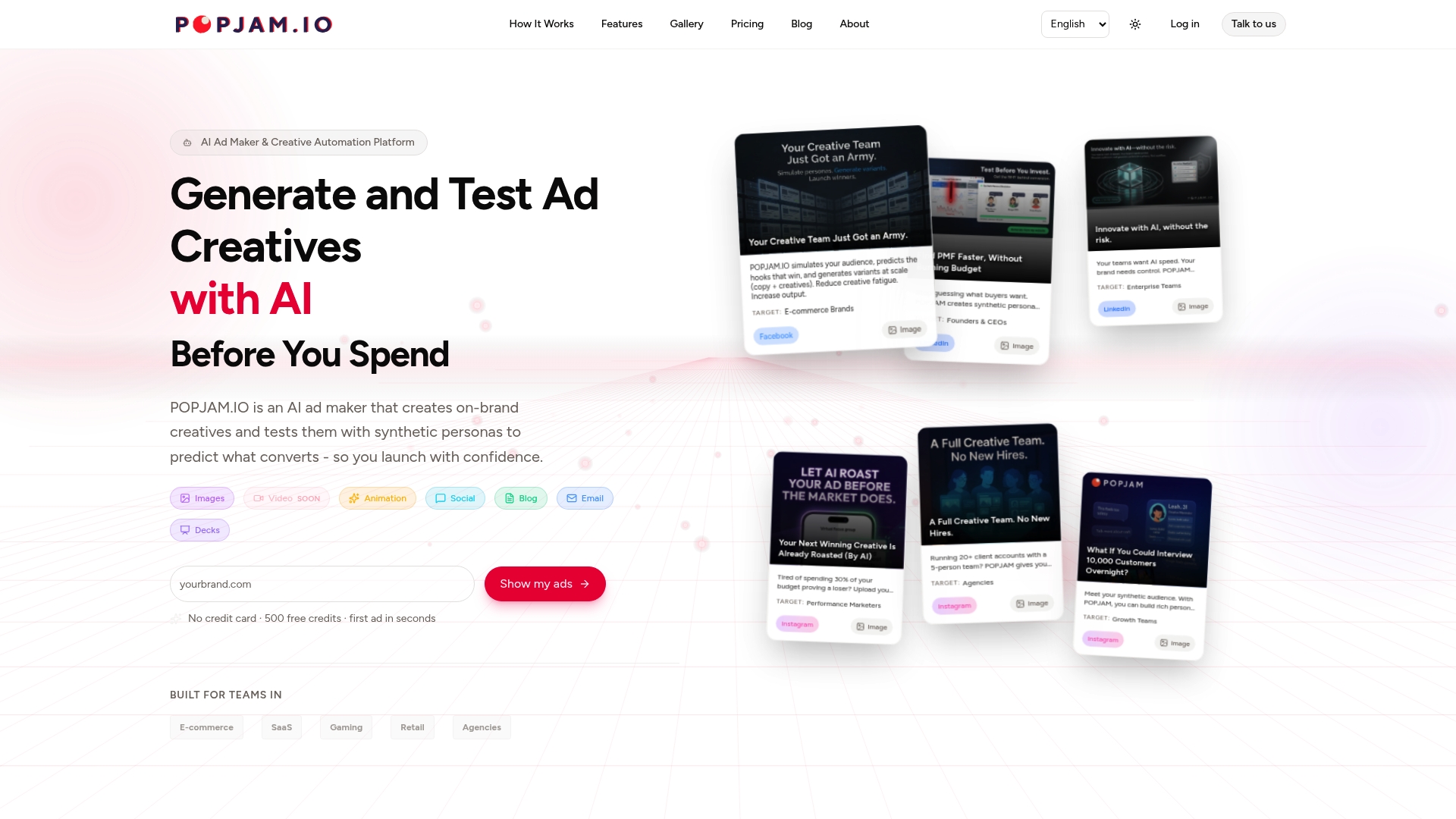
That matters most for teams without the budget to run a full geo holdout on every concept. Instead of guessing which of five directions deserves real media spend, you get psychographic feedback on all five first, then commit validation budget to the one or two that actually resonate.
- Explore plans starting with a free tier through Enterprise.
- Try the AI ad generator to build and pretest creative directly.
- Review the creative automation platform if you’re scaling variant production across a team.
Start on the Free plan or move straight to a paid tier once you know how many concepts you need tested each month.
Sources
Think with Google covers incremental measurement design. MMA explains test type selection. AppsFlyer and platform guides cover performance creative metrics, alongside a recent arXiv study on adaptive testing.
- Proving marketing impact — Think with Google
- What Is Marketing Testing and Experimentation? | Ipsos MMA
- The Complete Guide to Meta Advantage+ Creative Testing in 2026 – D2C Times
- Offline-to-Online Creative Optimization with Generative Models and Adaptive Testing — arXiv
- How earlier ad testing supercharges creative ROI — Kantar
FAQ
What is ROI in test automation?
In creative testing, ROI measures the incremental business outcome, like added revenue or conversions, caused by a specific creative or automated variant, not just the metrics that moved during the test. It’s calculated by comparing a test group’s results against a genuine control group, following the incrementality standard described by Think with Google.
Who owns Creative Testing Solutions?
There’s no single, widely documented company operating under that exact name in the creative testing space. Several platforms, including POPJAM, offer creative testing tools, so it’s worth checking the specific product you’re researching directly.
What is creative testing?
Creative testing is the practice of comparing ad variations, whether through A/B tests, multivariate tests, platform lift studies, or geo holdouts, to find which version drives measurable improvement in a defined KPI. The right method depends on the question you’re asking, as outlined by MMA’s testing framework.
How much does it cost to test ads?
Costs vary widely depending on the method: a platform A/B test can run within your existing ad budget, while a geo holdout requires matching business-as-usual spend across withheld regions for a fair read. Synthetic pretesting tools like POPJAM offer a lower-cost entry point, with plans ranging from a free tier to paid options starting at €29 per month.
Why is early ad testing valuable?
Testing creative concepts before full production lets teams catch weak ideas while changes are still cheap to make, rather than after a video shoot or design sprint is finished. Kantar’s research found that early-stage testing reduces wasted production cost and improves the final ad’s effectiveness.