

Growth Teams: Creative Learning Systems, 4 Variants, 14 Day Hold
For growth teams: an operations-first roadmap to run creative learning systems, with taxonomy, versioned prompts, persona pretests, 4 variant tests and a...

Creative learning systems are AI platforms that generate ad creatives, test them against synthetic audience personas, and learn which variants deserve real budget before you ever spend a dollar. The payoff is straightforward: faster iteration, fewer wasted impressions, and a test slate that’s already been through a quality filter. POPJAM.IO builds its whole product around this workflow, and independent research from arXiv backs the core mechanic: predictive models plus adaptive testing beat gut-feel creative decisions.
TL;DR:
- Most creative learning systems rely on a fixed tagging taxonomy, prompt governance, and test-cell architecture to produce reliable, actionable insights.
- Generating large volumes without proper structure wastes resources and hampers the ability to identify why certain creatives outperform others.
- Running a minimum 14-day hold on test cells prevents premature optimization, ensuring that winners reflect genuine audience preference rather than early platform bias.
- Synthetic persona pre-screening filters out weak creatives early, saving ad spend and increasing the likelihood of launching high-performing variants.
- Implementing a feedback loop that updates prompts and briefs based on test results boosts the system’s learning capability and leads to stronger, more effective creatives over time.
Table of Contents
- What Are Creative Learning Systems, Exactly?
- Core Building Blocks: Taxonomy, Prompt Governance, and Test Cells
- How Does the Generate-to-Learn Workflow Actually Run?
- What Should You Actually Check Before Launch?
- What Breaks a Creative Learning System (and How to Stop It)
- What Do Real Implementations Actually Look Like?
- How Do You Scale This Without Losing Control?
- Where Should Teams Actually Start?
- Where POPJAM.IO Fits Into This Workflow
- Sources
- FAQ
What Are Creative Learning Systems, Exactly?
Think of a creative learning system as an assembly line with a quality inspector built into every station. Generation produces the raw variants. Tagging and taxonomy label what’s actually in each asset (hook type, visual style, tone). Synthetic personas run a pre-test before any human sees the results. A selection step narrows the field. Adaptive online experiments run the survivors against real audiences. Then everything loops back to sharpen the next round of generation.
That synthetic-persona layer is the part most teams skip, and it’s the one doing the heaviest lifting. A pure A/B test tells you which of two ads won, eventually, after you’ve spent money finding out. A persona pre-screen tells you which ads are obviously weak before spend happens at all. Research from Toluna found ads with clear emotional storytelling scored much higher on attention metrics, and personas caught that signal reliably.
Here’s the component list in practice:
- Generation: produce many controlled variants from a shared creative brief
- Tagging: label each asset against a fixed taxonomy at the moment it’s created
- Synthetic pre-tests: run persona panels to catch comprehension and clarity problems early
- Selection: narrow dozens of candidates to a handful of worth real budget
- Adaptive testing: deploy the survivors into live experiments
- Learning: feed results back into the prompt library and creative briefs
Core Building Blocks: Taxonomy, Prompt Governance, and Test Cells
Volume without structure is just noise with a bigger budget. If you generate two hundred creatives and can’t say why the winners won, you’ve learned nothing repeatable. That’s the failure mode Ad-times points to directly: a taxonomy is the enabler, not an optional nice-to-have.
Three controls make generative volume usable:
- A tagging taxonomy with fixed dimensions. Hook type, visual format, tone, offer frame, and audience signal, tagged at creation, not after the fact. Retroactive tagging is where most teams give up and lose the data.
- Prompt governance. Keep a versioned prompt library. Track which prompt produced which asset. Run quarterly prompt audits and test prompts across more than one model, since output quality drifts between them.
- Test-cell architecture. Cap each test cell at four variants. Anything more and you can’t isolate what drove the result.
The budget split matters just as much as the cell size. Industry practice recommends 70% of spend on proven performers, 20% on structured experiments, and 10% on genuine moonshots, according to the same ad-times.com analysis. Pair that with a mandatory 14-day hold period before you let any platform’s algorithm fully optimize toward a “winner.” Cut that hold short, and you’re not testing creatives anymore. You’re testing how fast Meta’s delivery system can lock in on a lucky early result.
Pro Tip: Tag the prompt version alongside the creative asset, not just the creative attributes. When a variant wins, you want to know which exact prompt iteration produced it, so the win updates your library instead of evaporating into a folder of one-off assets.

How Does the Generate-to-Learn Workflow Actually Run?
Most teams either skip pre-screening entirely or treat it as a formality. Neither works. Here’s the sequence that turns raw generative output into a repeatable learning loop:
- Generate controlled variants. Write prompts tied directly to your taxonomy dimensions, so every asset produced is instantly classifiable. Aim for volume here. This is the cheap stage.
- Pre-screen with synthetic personas. Run the full batch through a persona panel scoring comprehension, emotional clarity, and segment sensitivity. Personia’s guidance on pre-screening recommends narrowing to three to five survivors before any real traffic touches them.
- Deploy adaptive online tests on the survivors. Run your test cell live, watch a holdout group separately, and resist the urge to call a winner before the hold period ends. Early platform consolidation will hand a mediocre creative the algorithm happens to like, not the creative your audience actually prefers.
- Close the loop. Feed the results, including the losers, back into your creative briefs and prompt library. The point of a learning system is that generation four is smarter than generation one because of what generation two and three revealed.
The arXiv study on offline-to-online creative optimization found this exact sequence, using predictive models to bias generation and adaptive testing to confirm winners, produced engagement lifts up to 45.1% over the best human-authored creative in field experiments. That’s not a marginal improvement. That’s the difference between a campaign that plateaus and one that keeps compounding.
Predictive models are noisy when used alone, which is why they work better as filters than as final judges. Use them to narrow the field, then let live traffic settle the argument.
What Should You Actually Check Before Launch?
A checklist only works if it’s specific enough to catch real gaps. Before any creative batch goes near ad spend, confirm you have:
- A finalized tagging taxonomy with dimensions locked, not still in draft
- A prompt library with version history, not a folder of copy-pasted text files
- A defined persona panel matching your actual buyer segments
- Automated tagging at the point of asset creation, not a manual cleanup pass later
- Analytics integration that ties creative tags back to performance data automatically
On the measurement side, instrument these metrics from day one: attention or thumb-stop proxies, click-through rate, comprehension scores from your persona pre-tests, conversion rate, and a direct holdout comparison against your current control creative.
By the numbers: Field experiments applying a predictive-model-guided generation and adaptive testing loop produced engagement lifts of 45.1%, 46.7%, and 36.2% across three separate trials, according to the arXiv research on generative creative optimization.
Set your operational cadence now, not after launch chaos hits: cap test cells at four variants, hold every cell for 14 days minimum, and rotate creatives on a fixed schedule rather than waiting until performance visibly drops.
What Breaks a Creative Learning System (and How to Stop It)
Most failures aren’t technical. They’re discipline failures.
- Volume without tagging. A hundred untagged creatives is a hundred data points you can’t use. Tag at creation, always.
- Too many variables at once. Change the hook, the visual, and the offer simultaneously and you’ll never know which one moved the needle.
- Early algorithmic consolidation. Platforms optimize toward early signal fast. Enforce the hold period even when the temptation to “let the algorithm decide” is strong.
- Brand and cultural risk. Generative volume increases the odds something slips through tonally wrong or culturally tone-deaf.
Pro Tip: Build a five-minute human review gate for every batch before it goes live, checking brand coherence, factual accuracy, and tone. It’s fast, and it catches the mistakes that a persona panel isn’t designed to flag. This kind of review gate is exactly what ad-times.com recommends as the final checkpoint before spend.
What Do Real Implementations Actually Look Like?
The theory is only useful if it survives contact with a real budget. One of the clearer public examples comes from Admiral Media, an agency that built a dedicated AI creative production system for a fasting app client. The result, according to coverage in The Drum, was a reported 70% reduction in creative production costs, alongside meaningful uplift in click-through rate and return on ad spend for the winning variants.
What made that result repeatable, rather than a lucky quarter, wasn’t the generation volume alone. It was the testing infrastructure wrapped around it: structured tagging, a defined test-cell process, and a loop that fed winning attributes back into the next production cycle. Agencies that treat AI generation as a content firehose without that structure tend to see a short-term spike in output and a long-term mess of unattributable data.
The pattern holds across the broader research too. The arXiv field experiments weren’t run in a lab vacuum. They tested real ad placements against real audiences, and the lift held up across three separate trials rather than one cherry-picked result. That consistency is what should give a growth team confidence: this isn’t a one-off case study, it’s a workflow producing repeatable gains when the taxonomy and hold periods are respected.
How Do You Scale This Without Losing Control?
Scaling a creative learning system isn’t about generating more. It’s about generating smarter, in bigger batches, without letting quality control lag behind volume.
Start by scaling your taxonomy before you scale your output. If you add new ad formats or new markets, extend the tagging dimensions first, so new volume is classifiable from day one instead of creating a parallel pile of unlabeled assets.
Next, widen your persona panel deliberately as you expand into new segments or geographies. A panel built for one core buyer persona won’t catch comprehension issues for a segment it was never designed to represent. Toluna’s research on persona evaluation found that ads reviewed against poorly matched personas lose much of their diagnostic value, since the panel isn’t actually simulating the audience you’re targeting.
Then automate the parts that don’t need judgment: tagging at creation, routing survivors into test cells, and pulling performance data back into your prompt library. Keep the parts that do need judgment manual: the human review gate, brand safety checks, and the decision to extend or kill a test cell early.
Finally, review your prompt library on a fixed schedule, not reactively. Quarterly audits catch prompt drift before it compounds into a whole quarter of underperforming generations. Teams that scale successfully treat the system itself as a living asset that needs maintenance, not a machine you build once and leave running.

Where Should Teams Actually Start?
Most teams want to jump straight to generation volume because it’s the visible, exciting part. That’s backwards. Build your taxonomy and your measurement plan first, even if it means a slower first month. Without a tagging structure, your first hundred creatives teach you nothing you can act on later.
Treat every AI-generated output, and every persona score, as a hypothesis rather than a verdict. Synthetic personas are excellent at catching obvious weak points in clarity and emotional resonance, but they’re a filter, not a final decision-maker. Keep a human in the loop for brand safety and tone, every time, no exceptions.
If you only have bandwidth for one investment this quarter, make it the feedback loop: the mechanism that takes a winning test result and turns it into an updated prompt or brief. Without that loop, you’re just running expensive one-off experiments instead of building a system that gets smarter.
— Doruk
Where POPJAM.IO Fits Into This Workflow
There are platforms that run generation, synthetic-persona pre-testing, and pre-launch scorecards inside one platform, validating ad creatives before any spend goes live, removing the need to stitch together separate tools for generation, tagging, and testing.
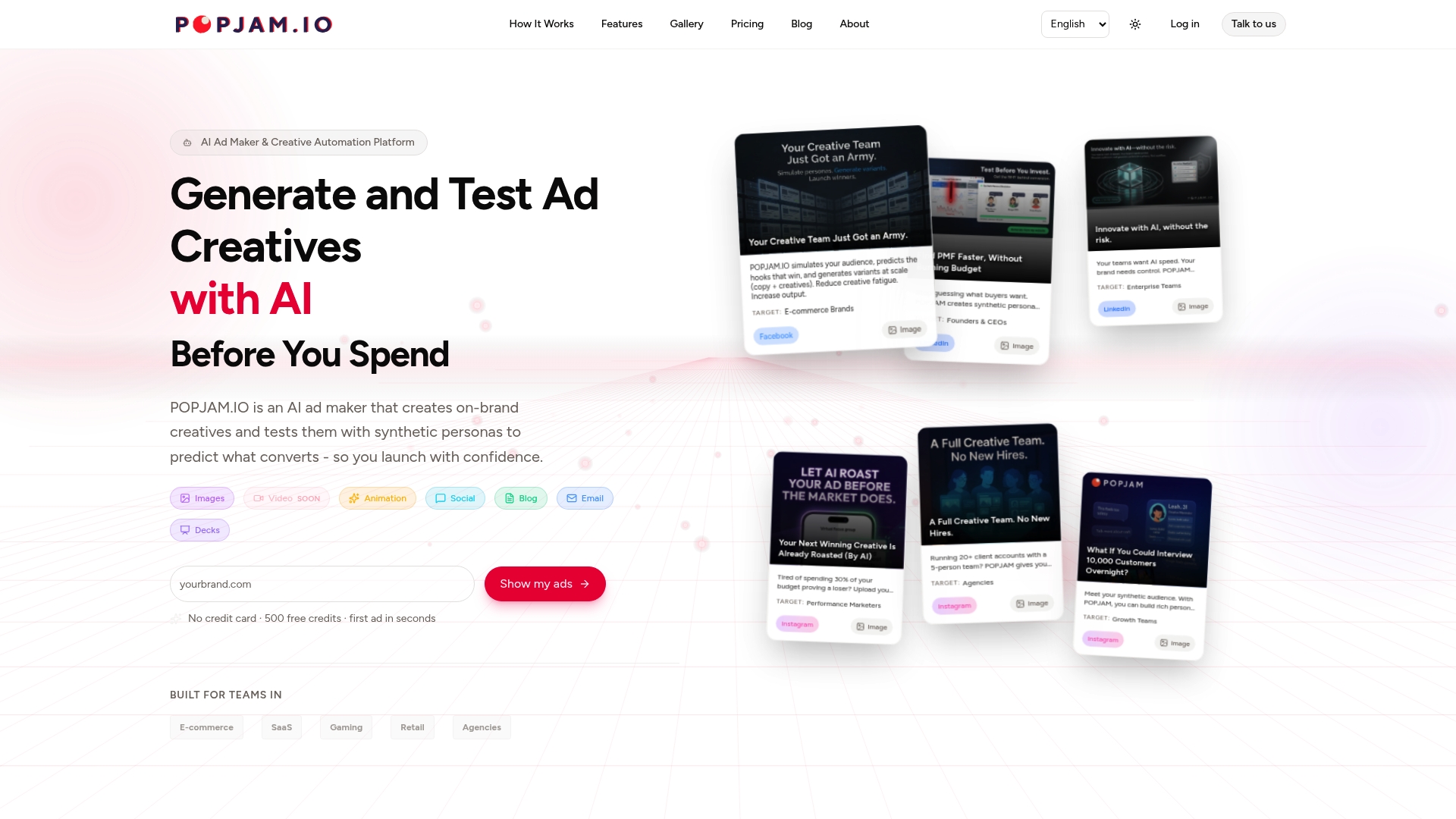
The platform’s AI ad generator produces on-brand creative variants across images, video, animation, social posts, email, and presentations, exportable natively for Meta, Google, TikTok, LinkedIn, and Reddit. From there, synthetic personas simulate how different buyer segments react before a single impression is served, providing the psychographic feedback that pure A/B testing can’t offer until real money is already spent.
On the pricing page, you’ll find the Free plan alongside Starter at 29 € per month, Essential at 99 € per month, and Business at 399 € per month, plus Enterprise pricing available on request. Credit packs start at 1,000 Credits for 10 € and scale up to 10,000 Credits for 100 € for teams that need extra generation volume without upgrading tiers. Head to the pricing page to compare plans or start with the free tier and run your first pre-launch test today.
Sources
- Offline-to-Online Creative Optimization with Generative Models and Adaptive Testing
- Toluna synthetic personas whitepaper
- Ad-times
- A/B testing with synthetic personas: pre-screening variants
FAQ
What Is a Creative Learning System?
A creative learning system is an AI workflow that generates ad creatives, tests them against synthetic audience personas, and uses the results to improve the next round of generation. POPJAM.IO builds this entire cycle into one platform, from asset generation through pre-launch validation.
How Are Synthetic Personas Different From A/B Testing?
Synthetic personas pre-screen creatives before spend happens, catching comprehension and clarity problems that would otherwise cost real ad budget to discover. Research on persona pre-screening recommends narrowing to three to five survivors with personas, then confirming the winner with a live A/B test on real traffic.
How Many Creative Variants Should One Test Cell Include?
Cap each test cell at four variants. Testing more at once makes it nearly impossible to isolate which specific attribute, the hook, the visual, or the offer, actually drove the performance difference, according to industry guidance on scalable creative testing.
How Long Should You Hold a Test Before Declaring a Winner?
Hold every test cell for a minimum of 14 days before letting any platform algorithm fully optimize toward one variant. Cutting the hold short risks early algorithmic consolidation around a creative that simply got lucky in the first few days rather than one that genuinely performs best.
What Does POPJAM.IO Cost?
POPJAM.IO offers a Free plan, plus Starter at 29 € per month, Essential at 99 € per month, and Business at 399 € per month, with Enterprise pricing available on request. Credit packs for additional generation range from 1,000 Credits at 10 € up to 10,000 Credits at 100 €, all listed on the pricing page.