

Marketers: Win Up to 50% More Purchases with Buyer Psychology Ads
Marketers: Match creative to cold, warm, and hot buyers. Pretest psychology driven ads to lift clicks and purchases before you spend a dollar.

Buyer psychology ads are creatives built to move a specific mental lever, be it loss aversion, authority, or social proof, rather than just showcasing a product. The single highest-impact move is mapping each creative to where the buyer actually stands mentally (cold, warm, or ready to buy) and validating that match before spending real money. High-performing campaigns lean on emotional content nearly twice as often as rational appeals, and matching ads to psychological traits has driven measurable lifts in clicks and purchases in field research. POPJAM.IO exists to test that match before launch, not after the invoice arrives.
TL;DR:
- Emotional content is used nearly twice as often as rational appeals in high-performing ads, making feelings a key driver of buyer response.
- Effective ads leverage loss aversion, authority cues, social proof, familiarity, and cognitive fluency, each matched to specific buyer states.
- Mapping creative strategies to audience belief states and testing psychographic relevance beforehand prevents wasteful ad spend and mismatched messaging.
- The POPJAM platform enables prelaunch testing against synthetic personas, validating psychological lever choices before deploying on ad platforms.
- Campaign success depends on iterative testing and focusing on one psychological lever at a time, guided by hypothesis and proper metrics measurement.
Table of Contents
- Core Psychological Principles That Move Buyers
- Mapping Psychology to Every Funnel Stage and Format
- Creative Techniques You Can Steal Today
- How to Test Which Psychology-Driven Creative Actually Works
- Where Persuasion Ends and Manipulation Begins
- Cognitive Biases That Shape Every Buying Decision
- How Culture and Demographics Change What Persuades
- Needs, Motivation, and Why Maslow Still Matters in Ads
- Storytelling as a Persuasion Mechanism, Not Just a Style Choice
- Why Color and Visual Design Change How Buyers Feel About an Ad
- How POPJAM.IO Turns Psychographic Theory Into a Testing Workflow
- Cognitive Biases and Creative Fatigue: The Practitioner’s Checklist
- Test Your Ad Psychology Before You Spend a Dollar on It
- Sources
- FAQ
Core Psychological Principles That Move Buyers
Every ad that works is quietly exploiting one of a handful of well-documented mental shortcuts. You don’t need a psychology degree to use them, but you do need to know which one you’re pulling.
Start with emotion versus logic. Marketers love to explain features. Buyers respond to feelings. Research from USC Applied Psychology found that high-performing ad campaigns favor emotional content over rational content by a wide margin, 31 percent to 16 percent among top-tier work. That’s not a marginal edge. It’s a structural preference in how the best ads get built.
Statistic Callout: High-performing campaigns use emotional content nearly twice as often as rational content (31% vs. 16%), according to USC’s applied psychology research.
Loss aversion is the second lever, and it’s often stronger than its opposite. People will work harder to avoid losing $50 than to gain $50, a pattern behavioral economists have documented for decades. In ad copy, that shows up as “don’t miss out” framing, expiring offers, and “still available” badges, all designed to make inaction feel like the risky choice.
Authority and social proof do similar work from different angles. Authority cues (credentials, media logos, expert quotes) short-circuit the buyer’s instinct to doubt you. Social proof (reviews, user counts, “joined by 50,000 others”) reduces the friction of being the first person to try something. Neither replaces the product. Both reduce hesitation around it.
Two more mechanics round out the toolkit:
- Halo effect and familiarity: linking a new offer to something the buyer already trusts (a known category, a familiar face, a recognizable format) makes the unfamiliar feel safer.
- Cognitive fluency: ads that are easy to process, visually clean, repeated enough to feel familiar, simply worded, get liked more, independent of the actual argument being made.
A systematic review of neuromarketing research backs this up at the brain-processing level, identifying emotion, attention, memory, and reward processing as core mechanisms behind how people actually respond to advertising, not just what they say they respond to in a survey.
Mapping Psychology to Every Funnel Stage and Format
The mistake most teams make isn’t picking the wrong psychological lever. It’s using the right lever at the wrong moment. A scarcity countdown means nothing to someone who has never heard of your brand. A soft brand story does little for someone who already has your product in their cart.
Think in three belief states instead of vague funnel labels:
- Cold audience (unaware): they don’t know you have a solution to their problem. The job is interruption, not persuasion.
- Warm audience (considering): they know the category and are comparing options. The job is credibility and connection.
- Hot audience (ready): they’ve shown intent (cart abandonment, repeat visits, past purchase). The job is removing the last excuse to wait.
For cold audiences, pattern interruption and high-valence emotion win. Think jarring visuals, unexpected framing, a hook that breaks the scroll pattern in the first two seconds of a video. This is not the place for a feature list.
Mid-funnel creative should lean on storytelling, authenticity, and social proof rather than hard selling. This matches what researchers found in a recent Frontiers study on social media advertising: credibility, perceived authenticity, and trust are strong predictors of ad effectiveness, and trust itself mediates whether authentic-feeling ads convert.
Bottom-funnel creative is where scarcity, urgency, and direct validation earn their keep. Real stock counts, honest deadlines, and price anchoring work because the buyer already wants the thing. Your job is just to remove friction.
Format changes the execution, not the principle:
- Short video: the hook has to land in the first two seconds, before the platform’s algorithm decides whether to keep showing it.
- Static image ads: visual hierarchy does the persuading, since there’s no time-based reveal.
- Carousels: built for sequential proof, one card per objection or benefit.
- Search ads: less about emotional hooks, more about matching the exact belief the buyer already typed into the search bar.
Creative Techniques You Can Steal Today
Principles are useless without templates you can actually build from. Here’s a working toolbox, organized by what each technique tries to do to the buyer’s head.
Hooks. An emotion-led hook opens with a feeling state (“Tired of redoing this every Monday?”). A curiosity hook withholds the payoff (“The one setting most people never touch”). A contrast hook sets up a before/after in the first line. Pick based on funnel stage: curiosity performs well cold, contrast performs well warm, and emotion works at every stage if it’s specific rather than generic.
Framing. Gain framing says “Save $40 this month.” Loss framing says “Stop losing $40 every month.” Loss framing tends to hit harder for urgency-based offers (subscriptions, limited stock), while gain framing works better for aspirational purchases (upgrades, premium tiers).
Social proof placement. Micro-influencer clips work best early in a video, before the pitch. Review counts work best near a price point or CTA button, right where doubt peaks. “Join 50,000 users” style copy works best in headline position for cold audiences who need instant credibility.
Authority and design cues. Logo placement in the first frame builds trust fast for unfamiliar brands. Face placement (a real human looking at the camera) increases attention and perceived trustworthiness. High contrast between subject and background pulls the eye exactly where you want it before the buyer has consciously decided to look.
Pro Tip: Generic creative doesn’t just underperform, it accelerates fatigue. If your hook could run for any brand in your category with the logo swapped out, the audience’s brain has already learned to skip it. Specificity is what keeps a psychological lever working past the third impression.
How to Test Which Psychology-Driven Creative Actually Works
Knowing the theory doesn’t tell you which lever your specific audience will respond to. That’s what testing is for, and most teams skip the rigor that makes a test trustworthy.
- Start with a hypothesis, not a hunch. Name the psychological lever explicitly (“scarcity framing will lift click-through rate for cart abandoned”) before you build the creative, so you know what a win actually looks like.
- Randomize and segment properly. Split traffic by audience temperature, not just by ad variant, or you’ll credit a loss-aversion hook for a win that really came from a warmer audience.
- Track the right primary metric. Click-through rate tells you about the hook. Conversion rate tells you about the offer and landing experience. Don’t judge a psychological lever on the wrong metric.
- Pretest before spending. Synthetic-persona pretesting and psychographic pretests let you gut-check a creative’s emotional and cognitive resonance before it touches a live budget, closer to how psychological targeting research found lifts of up to 40% in clicks and up to 50% in purchases when messaging matched audience traits.
- Give it statistical power before calling a winner. Small sample sizes produce false winners constantly. A test that “wins” after 200 impressions is noise, not signal.
Statistic Callout: Matching ads to audience psychological traits produced up to 40% more clicks and up to 50% more purchases in large-scale field experiments, per Matz et al.'s research at Columbia Business School.
A structured creative testing framework removes most of the guesswork from steps two through five, which is where most in-house testing programs quietly fall apart.
Where Persuasion Ends and Manipulation Begins
Persuasion respects the buyer’s ability to decide. Manipulation exploits a psychological vulnerability the buyer doesn’t know is being targeted. The line matters more than it sounds, because it’s also a business risk, not just a moral one.
Inferring psychographic traits (personality, insecurities, emotional triggers) from behavioral data raises real privacy questions. The FTC’s own analysis of behavioral advertising notes that targeted ads can shift beliefs about price and quality in ways that don’t always serve the buyer’s actual interest, even when they lift click-through rates.
Practical safeguards: infer only what you need for the creative decision at hand, give people a real opt-out, and never target based on sensitive traits like health conditions or financial distress. Ethical creative isn’t a compliance tax. Trust is what keeps a customer relationship alive past the first purchase.
Cognitive Biases That Shape Every Buying Decision
Loss aversion gets most of the attention, but it shares the stage with biases that quietly steer buyer behavior in every ad campaign.
Anchoring is the most exploitable. The first number a buyer sees becomes the reference point for every number after it. Show a $199 “original price” next to a $129 sale price, and the second number reads as a bargain, regardless of whether $199 was ever a real price point. This is why crossed-out prices remain a permanent fixture of ecommerce creative.
Confirmation bias works differently. Buyers already hold beliefs about what they need, and ads that confirm those beliefs get less scrutiny than ads that challenge them. A skincare ad that says “your dry skin needs more hydration” to someone who already believes that gets nodded along. An ad that contradicts a buyer’s existing belief has to work much harder to be believed at all.
The availability heuristic also matters for ad recall. People judge how common or important something is by how easily examples come to mind, which is part of why repetition and recency work: an ad seen three times in a week feels more relevant than one seen once. None of these biases require devious intent to use. They just require creative that’s honest about the reference points and beliefs it’s leaning on.
How Culture and Demographics Change What Persuades
A hook that lands with 22-year-olds on TikTok can fall flat with 45-year-olds on Facebook, and it’s rarely about the platform. It’s about what each group has been culturally trained to trust.
Collectivist-leaning audiences (common in many East Asian and Latin American markets) tend to respond more strongly to social proof framed around group belonging: “join thousands of families” outperforms “join thousands of individuals.” Individualist-leaning audiences, common in much of the US and Western Europe, often respond better to personal-benefit framing: “get your edge” over “join the community.”
Age cohorts diverge on authority signals too. Older buyers frequently weight institutional authority (credentials, established brand history, press mentions) more heavily. Younger buyers, particularly Gen Z, often weight peer authority higher, meaning a relatable creator with a modest following can outperform a celebrity endorsement for the same product.
Income and education level shift how buyers process risk-based messaging like scarcity and urgency. Buyers with more financial slack tend to respond to scarcity as a status signal (“limited edition”), while price-sensitive buyers respond to scarcity as a practical warning (“stock running low”). The mechanism is the same. The emotional read is different. Testing creative against segmented audiences, not just a blended average, is the only reliable way to catch these divergences before they cost you budget.

Needs, Motivation, and Why Maslow Still Matters in Ads
Abraham Maslow’s hierarchy of needs is decades old, but it still explains why certain ads convert and others feel tone-deaf, because it maps directly onto why someone is buying anything at all.
An ad selling budget groceries succeeds by speaking to safety and physiological needs: reliability, affordability, and getting through the week. An ad for a premium software subscription is usually selling further up the hierarchy, toward esteem or self-actualization: status, mastery, becoming a better version of a professional identity.
The mismatch happens when creative pitches the wrong tier. A luxury watch ad that leads with “reliable timekeeping” is answering a need the buyer solved decades ago; they’re actually buying status and self-expression. A budget insurance ad that leads with aspiration and self-actualization language misses a buyer who just wants to feel financially safe this month.
Mapping your offer to its real position on the hierarchy, before you write a single line of copy, prevents this entire category of creative mismatch. It also explains why the same product can need completely different ad angles for different customer segments: a single insurance policy might be sold on safety to one buyer and on peace-of-mind status to another, and both ads can be true simultaneously.
Storytelling as a Persuasion Mechanism, Not Just a Style Choice
A story isn’t decoration on top of an ad’s argument. It’s a different processing pathway entirely, one that routes around the skepticism a direct claim usually triggers.
When a buyer processes a narrative, they’re not evaluating a claim for accuracy in the same way they’d evaluate a stated fact. They’re following a character through a problem, which lowers critical resistance and increases emotional transportation, the sense of being pulled into the scene rather than watching it from a distance. This lines up with the information-processing model researchers use to describe advertising cognition: exposure, attention, comprehension, encoding, retrieval, and ultimately decision and action, a sequence a well-built story moves a buyer through more smoothly than a direct pitch does.
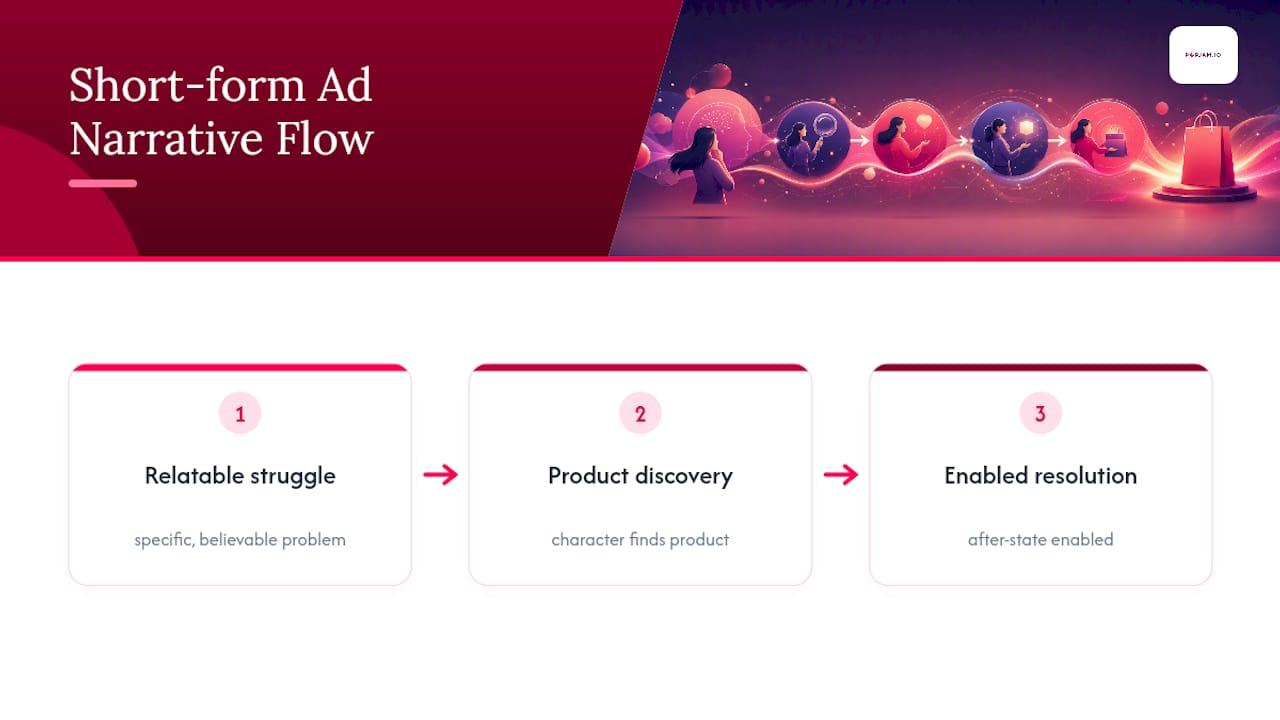
The most reliable narrative structure in short-form ads is simple: a relatable struggle, a discovery moment, and a resolution that the product enables. The struggle has to be specific enough to feel real, not a generic “life is hard” setup. The discovery moment is where the product enters, ideally as a solution the character finds rather than one being sold to them. The resolution needs to show the after-state, not just claim it.
Testimonial-style ads borrow this structure naturally, which is part of why they consistently outperform direct-pitch alternatives for mid-funnel audiences. The buyer isn’t being told what to believe. They’re watching someone else arrive at the belief on their own.
Why Color and Visual Design Change How Buyers Feel About an Ad
Color isn’t just a brand guideline decision. It’s one of the fastest signals a buyer’s brain processes, often before a single word of copy gets read.
Warm colors (red, orange) tend to raise urgency and energy, which is why they dominate clearance sales and limited-time offers. Cool colors (blue, green) tend to signal calm, trust, and stability, which explains their dominance in finance, healthcare, and enterprise software branding. Neither association is universal across every culture, but the pattern holds broadly enough in Western markets to be a reliable creative default.
Contrast does heavier lifting than color choice alone. A CTA button that matches the background palette gets ignored regardless of how appealing the color is in isolation; a CTA button in a contrasting color gets found in under a second. This is a design mechanic, not a psychological trick, but it interacts directly with cognitive fluency: buyers trust and click things their eyes can locate without effort.

Whitespace and clutter matter just as much. A cluttered ad forces the brain to work harder to parse the offer, which increases the chance the buyer disengages before understanding what’s being sold. Clean layouts with one clear focal point consistently test better, not because they look nicer, but because they cost the buyer less mental effort to process.
How POPJAM.IO Turns Psychographic Theory Into a Testing Workflow
Everything above is only useful if you can actually validate it before spending real ad budget, and that’s the exact gap POPJAM.IO was built to close.
The platform generates on-brand ad creatives with AI, then runs them against synthetic buyer personas that simulate how different audience segments react before a single dollar goes to Meta, Google, TikTok, LinkedIn, or Reddit. Instead of guessing whether your loss-aversion hook or your authority cue will land, you get psychographic feedback on the creative itself.
That workflow maps directly onto the testing principles above:
- Hypothesis-driven creative gets validated against a simulated audience before the “real” test even starts.
- Psychographic pretests catch a weak hook or a mismatched belief-state before it burns impressions.
- Feedback comes back as both qualitative reads and quantitative signals, closer to what a proper creative analytics pretest should provide.
- Teams can iterate on framing, color, and hook structure in the same session, rather than waiting a week for live data.
This isn’t a replacement for live testing. It’s a filter that keeps weak psychological bets from ever reaching a live budget in the first place.
Cognitive Biases and Creative Fatigue: The Practitioner’s Checklist
Treating creative strategy as a research discipline, not a gut-feel exercise, is the single biggest shift a performance team can make. Most creative underperforms not because the idea was bad, but because nobody mapped it to a belief state before building it, and nobody checked whether the psychological lever actually matched the audience being served.
Here’s the checklist worth running before every campaign brief:
- Map the audience’s current belief state (cold, warm, hot).
- Pick exactly one psychological lever to lead with, not three competing ones.
- Write a hypothesis that names the expected metric lift.
- Pretest the creative on a small scale, or against a synthetic persona, before committing spend.
- Measure the metric that actually corresponds to the lever being tested.
- Iterate based on what the data shows, not on which version you personally like more.
— Doruk
Test Your Ad Psychology Before You Spend a Dollar on It
POPJAM is the practical alternative to launching ads on instinct and hoping the psychology lands. Instead of guessing whether a loss-aversion hook or an authority cue will resonate, you generate the creative and run it against synthetic buyer personas that react the way real segments do, before any ad spend goes out the door.
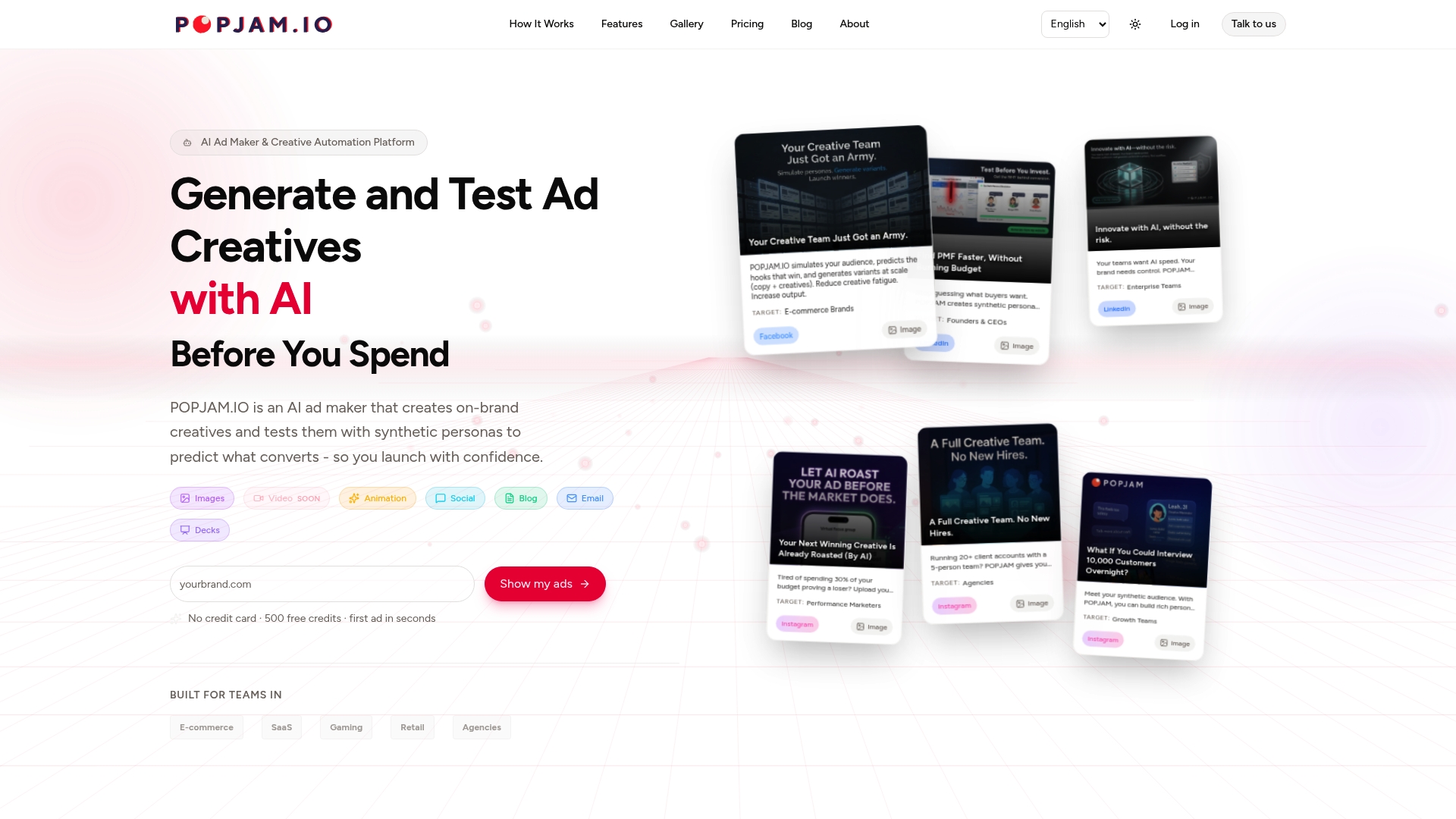
The platform covers the full creative lifecycle: AI-generated, on-brand ad creatives, psychographic pretesting, and platform-native exports for Meta, Google, TikTok, LinkedIn, and Reddit. That means the mapping work described throughout this guide (belief state, lever selection, hook testing) happens inside one workflow rather than across five disconnected tools.
Plans include a free tier and multiple paid options with separate credit packs for additional generation capacity; full pricing details are available on the POPJAM pricing page. Full details live on the POPJAM pricing page. If you’d rather see the workflow first, try the AI ad generator and run your next creative through a psychographic pretest before it ever reaches a live campaign.
Sources
- Thinking vs. feeling: the psychology of advertising (USC Applied Psychology)
- Psychological targeting as an effective approach to digital mass persuasion (Matz et al., Columbia Business School)
- Neuromarketing systematic review (PMC, 2022)
- Impact of social media advertising on consumer behavior: credibility, perceived authenticity, and sustainability (Frontiers, 2025)
FAQ
What is buyer psychology?
Buyer psychology is the study of the mental and emotional processes behind purchase decisions, including biases like loss aversion and anchoring, motivations tied to needs, and social influences like authority and proof.
What is the psychology behind ads?
Effective ads work by triggering specific mental shortcuts, emotion over pure logic, loss aversion, social proof, and cognitive fluency, matched to what the buyer already believes at that moment. Platforms like POPJAM.IO let teams test which of these levers actually resonates before spending on a live campaign.
What is the rule of 7 in advertising?
The rule of repeated exposures is a long-standing marketing idea that a buyer needs multiple touches to a message before they act on it, though modern attribution research suggests the real number varies heavily by channel, offer, and audience familiarity.
Does Gen Z hate ads?
Gen Z doesn’t reject ads outright, but they’re highly sensitive to inauthenticity and generic creative, favoring peer-style credibility and relatable creators over polished, traditional brand messaging.