

Fix Brand Consistency in Ads Before They Air, for Marketers
Build one source of truth for assets, automate prelaunch compliance, and use AI persona testing to scale brand consistent ads without slowing creative...
Fix drift before it airs, not after. Build one source of truth for your logo, name, color codes, and typography, run every ad through pre-launch validation against that standard, and automate compliance checks so platform-generated variations never slip past you. System1/IPA research shows consistent creative compounds in effectiveness over time, and tools like POPJAM now let teams test creative against synthetic audiences before a single dollar hits Performance Max or any other platform.
TL;DR:
- Small and growing brands should prioritize strict brand consistency to build long-term recognition, while large brands can incorporate more creative variation without harming their identity.
- A digital asset management system should be used as the single source of truth, with clear permissions, tagging, and immediate retirement of outdated assets to prevent drifts.
- Adapting brand assets for platforms like Performance Max requires format-specific adjustments and campaign-level controls, but core elements must remain unchanged across all placements.
- Automating compliance with visual and copy checks will help scale campaigns efficiently, but pre-launch synthetic-persona testing remains crucial for catching tone and recognition issues early.
- Continuous monitoring of both compliance and effectiveness metrics is essential to verify that ads stay on brand and positively impact long-term brand recall and attribution.
Table of Contents
- Why Brand Consistency Ads Actually Drive Better Returns
- Lock Down the Core Brand Assets and Governance
- Adapting Brand Consistency to Platform Constraints Like Performance Max
- Separate Non-Negotiables From Testables, Then Automate the Check
- Measuring Whether Your Ads Are Actually Staying On-Brand
- Scaling the Workflow Without Creating Approval Bottlenecks
- Keeping Brand Consistency Ads Aligned Across Every Platform
- When Your Brand Identity Changes, Your Ad Governance Has to Change With It
- Getting Teams and Agencies to Actually Follow the Brand Guide
- Where Pre-Launch AI Testing Fits Into Brand Governance
- Add Pre-Launch Testing to Your Brand Governance Stack
- Sources
- FAQ
Why Brand Consistency Ads Actually Drive Better Returns
Consistent creative doesn’t just look tidier. It performs better over a longer time horizon. System1’s research with the IPA found that when brands keep their creative foundations stable, the effects compound. Each new ad builds on recognition earned by the last one instead of starting from zero, and that “creative wear-in” period turns into a genuine performance asset rather than a liability marketers rush to fix.
There’s a wrinkle worth knowing before you lock everything down. A peer-reviewed study analyzing 247 television ads across 33 brands found that strict consistency helps smaller, challenger brands more than it helps large, established ones. Big brands with strong existing memory structures sometimes benefit from breaking pattern to stay fresh.
What this means for your team:
- Small or growing brands should protect consistency aggressively. It’s how memory gets built.
- Large brands can afford more creative variation, as long as core identity markers stay intact.
- Either way, the goal is stable strategic ideas with room to innovate in execution, not identical ads on repeat.
Lock Down the Core Brand Assets and Governance
Not every element of your ad deserves protection. Some things are truly non-negotiable: your business name, exact logo files and clear space specs, approved color hex codes, typography rules, required legal disclaimers, and your core brand promise. Everything else, from headline phrasing to imagery style, is fair game for testing.
The fix for chronic drift is a digital asset management system (DAM) that functions as your single source of truth. A well-built DAM setup uses consistent tagging and taxonomy so nobody hunts through old email threads for “the real logo,” permissioned access so freelancers only see what they’re cleared to use, and CDN-linked files so updating one master asset updates every live placement automatically.
Here’s how to operationalize it:
- Audit every brand asset currently in circulation across teams and agencies.
- Build a taxonomy (by campaign, platform, asset type, approval status).
- Upload only approved, current versions to the DAM.
- Set permission tiers for internal teams, freelancers, and partner agencies.
- Retire outdated files immediately rather than archiving them where they can resurface.
- Link all templates to the DAM via CDN so updates propagate without manual re-uploads.
Pro Tip: Retire old logo files the same day you approve a new one. A stray outdated version sitting in a shared drive is how three-year-old branding ends up in a live campaign six months from now.
Adapting Brand Consistency to Platform Constraints Like Performance Max
Google’s Performance Max shows why “consistent” can’t mean “identical” across every placement. Performance Max requires a business name and logo at the campaign level, while fonts and colors remain optional inputs, and support for each control varies by placement and format. That gap between what’s required and what’s optional is exactly where brands lose consistency without noticing.
The practical fix is a channel adaptation matrix. Map your message hierarchy first, then adapt format by format:
- Rewrite headlines to fit the 30-character short and 90-character long headline limits without losing the core claim.
- Prepare crops for every aspect ratio the placement supports, not just the one you designed first.
- Check rendered placements directly. Automated asset assembly can combine approved pieces into off-brand results even when each individual asset passed review.
- Confirm the business name and logo Google displays match what you submitted, since brand inputs can be inferred from your final URL rather than pulled from your actual settings.
Pre-fill your brand controls at the campaign level rather than letting the platform guess. It takes minutes and it closes the biggest gap between your brand guide and what actually reaches a customer’s feed.
Separate Non-Negotiables From Testables, Then Automate the Check
Every brand has a short list of elements that never move: the logo, the brand promise, required legal language. Everything else, including hook, opening frame, image crop, and call-to-action phrasing, should be treated as a variable worth testing. Drawing that line clearly before production starts is what makes scale possible without chaos.
Once that line exists, automated compliance becomes practical rather than theoretical. A typical stack pairs computer vision for visual checks (logo placement, color adherence, clear space) with NLP-based tone scoring for copy, then routes each asset through a composite compliance threshold. One operational framework for AI-generated ad creative recommends a tiered system: assets that clear the bar run automatically, borderline ones get batched for human review, and clear violations pause and escalate.
- Non-negotiables: logo integrity, brand promise, legal copy, trademarked claims.
- Testables: hook, crop, CTA phrasing, opening frame, imagery style.
- Automated layer: computer vision for visuals, NLP for tone and copy, composite scoring for the go/no-go decision.
- Escalation layer: human review for anything that lands in the gray zone.
This is also where pre-launch testing earns its place in the workflow. Synthetic-persona testing, the approach POPJAM builds its platform around, lets teams see how a creative variation reads to a modeled buyer segment before real budget touches it. That catches tone problems and recognition gaps that a compliance scanner alone would miss, since a logo can be pixel-perfect and the message can still land wrong.
Pro Tip: Expect a rocky start with automated compliance. Give new models a 30 to 60 day calibration window and tune thresholds until manual review sits under 10% of total volume. Rushing this step is how teams end up disabling the whole system out of frustration.
Measuring Whether Your Ads Are Actually Staying On-Brand
Compliance checks and effectiveness metrics answer two different questions, and treating them as one is a common mistake. Compliance tells you whether the ad matches the guide. Effectiveness tells you whether matching the guide actually helped.
The IPA’s guidance on creative consistency recommends tracking both categories side by side rather than defaulting to click-through rate as a stand-in for brand health.
| Metric type | What to track | Why it matters |
|---|---|---|
| Compliance | Logo usage, color adherence, typography, imagery style | Confirms the asset matches the brand guide |
| Compliance | Tone, CTA phrasing, landing-page continuity | Catches drift that visual checks alone miss |
| Effectiveness | Branded search volume | Signals whether the ad built brand memory |
| Effectiveness | Aided and unaided recall | Measures whether the creative stuck |
| Effectiveness | Brand attribution, conversion lift | Ties consistency back to business outcomes |
Run compliance checks continuously, since they’re cheap and automatable. Reserve effectiveness reviews for a monthly or quarterly cadence, and connect every fix back to a measurable result. If a corrected asset didn’t move recall or attribution, that’s useful information too. Reviewing brand lift alongside conversion metrics rather than in isolation keeps teams from over-indexing on the numbers that are easiest to pull.
Scaling the Workflow Without Creating Approval Bottlenecks
Governance breaks down fastest at the handoff points, not inside your own team. Agencies and freelance partners need brand assets without needing full system access, and that’s exactly what permissioned DAM portals solve. Set up collections scoped to a specific campaign or partner, send secure share links for upload and review, and skip the email attachment chain entirely.
CDN-linked assets solve the other half of the problem: update the master file once, and every distributed placement inherits the change automatically, no re-uploading required.
- Assign a named owner for every asset category, not a team, a person.
- Set corrective deadlines when a compliance flag comes in, and track whether they’re met.
- Watch for pattern alerts. A single misconfigured feature in an automated creative platform can quietly generate dozens of off-brand variations before anyone notices.
- Route agency-submitted work through the same compliance check as internal work. No exceptions for “the agency knows the brand.”
Keeping Brand Consistency Ads Aligned Across Every Platform
Meta, TikTok, LinkedIn, Google, and Reddit each render creative differently, and treating platform-specific formatting as an excuse for inconsistent branding is the most common failure point in cross-channel campaigns. A logo that looks correct in a Meta feed placement can appear cropped, recolored, or oddly scaled in a TikTok in-feed unit if nobody checked the render.
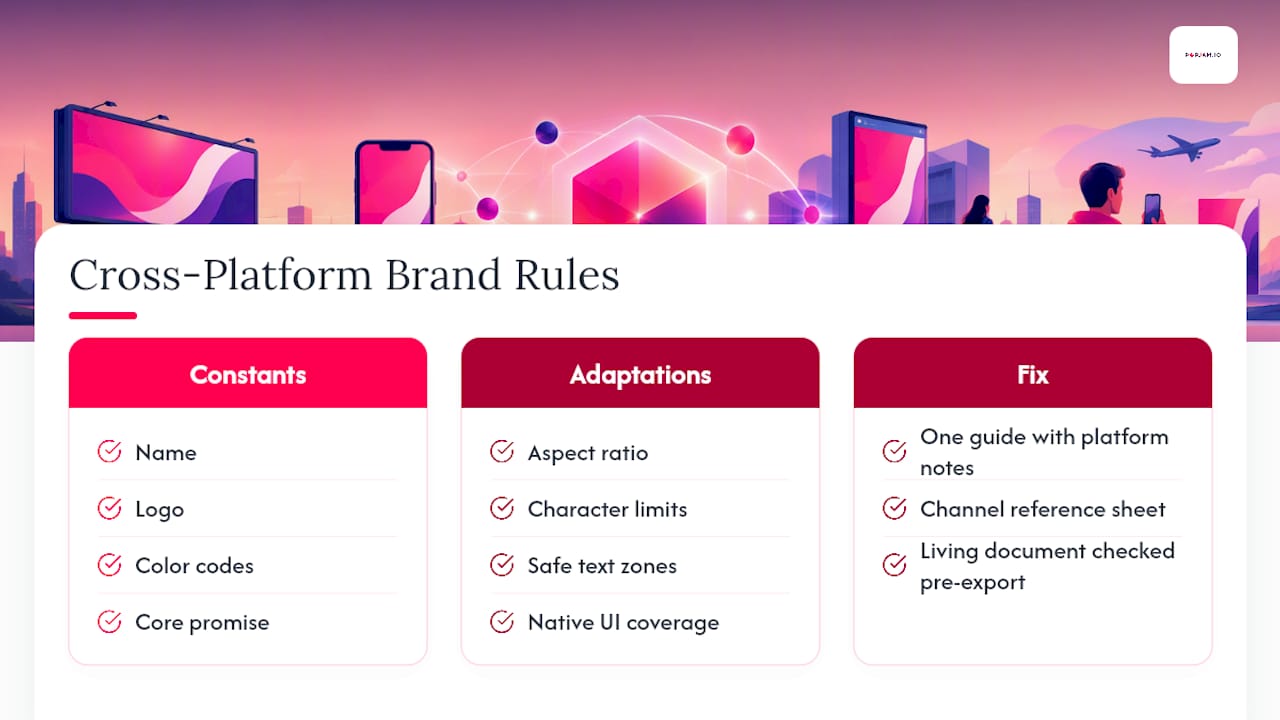
The fix isn’t a separate brand guide per platform. It’s one guide with platform-specific adaptation notes attached. Your non-negotiables (name, logo, color codes, core promise) travel unchanged across every channel. What changes is execution: aspect ratio, character limits, safe zones for text overlay, and how much of the frame a platform’s native UI elements will cover.
Build a simple channel reference sheet once, listing exact specs for each platform you actually run ads on, and treat it as a living document your creative team checks before every export. This matters more as teams add channels. A brand that looks sharp on Google and Meta but sloppy on TikTok isn’t failing at TikTok specifically. It’s failing at applying the same governance standard everywhere.
Cross-platform consistency also protects against a subtler problem: a customer who sees your brand on LinkedIn and then on Reddit should recognize it as the same company without having to think about it. That recognition is what compounds into the long-term creative effects research keeps pointing to. Break that thread on even one platform and you’re asking your audience to rebuild recognition from scratch every time they switch channels, which is the opposite of what consistent branding is supposed to buy you.
When Your Brand Identity Changes, Your Ad Governance Has to Change With It
Brand identity isn’t static, and pretending otherwise is how outdated logos and abandoned color palettes keep showing up in live campaigns months after a rebrand. When leadership approves a new visual identity, a new tagline, or a repositioned core promise, that update has to cascade through every asset in your DAM, not just the homepage and the new hero banner.
The practical failure point is timing. Marketing teams often update the primary brand assets first and assume distributed teams, agencies, and automated ad platforms will catch up. They usually don’t, not without a deliberate push. Old logo files linger in shared folders. Agency partners keep working from the last brief they received. Templates built on the previous color palette stay live in ad platforms because nobody scheduled a swap.
Treat every brand update as a mini rollout with its own checklist:
- Retire every outdated asset in the DAM the same day the new identity is approved, not weeks later.
- Push updated files through CDN links so distributed placements inherit the change automatically.
- Re-brief every agency and freelance partner with the updated non-negotiables list, not just the new logo file.
- Re-run automated compliance thresholds against the new standard, since a model calibrated on the old brand will pass assets it shouldn’t.
- Spot-check a sample of live campaigns across platforms within the first week to catch anything the update missed.
A brand refresh that takes months to fully propagate through your ad ecosystem isn’t really a refresh. It’s a source of ongoing inconsistency that looks, to customers, exactly like carelessness.
Getting Teams and Agencies to Actually Follow the Brand Guide
A brand guide nobody reads protects nothing. The gap between having documentation and having consistent ads almost always comes down to how that documentation gets communicated, not whether it exists.
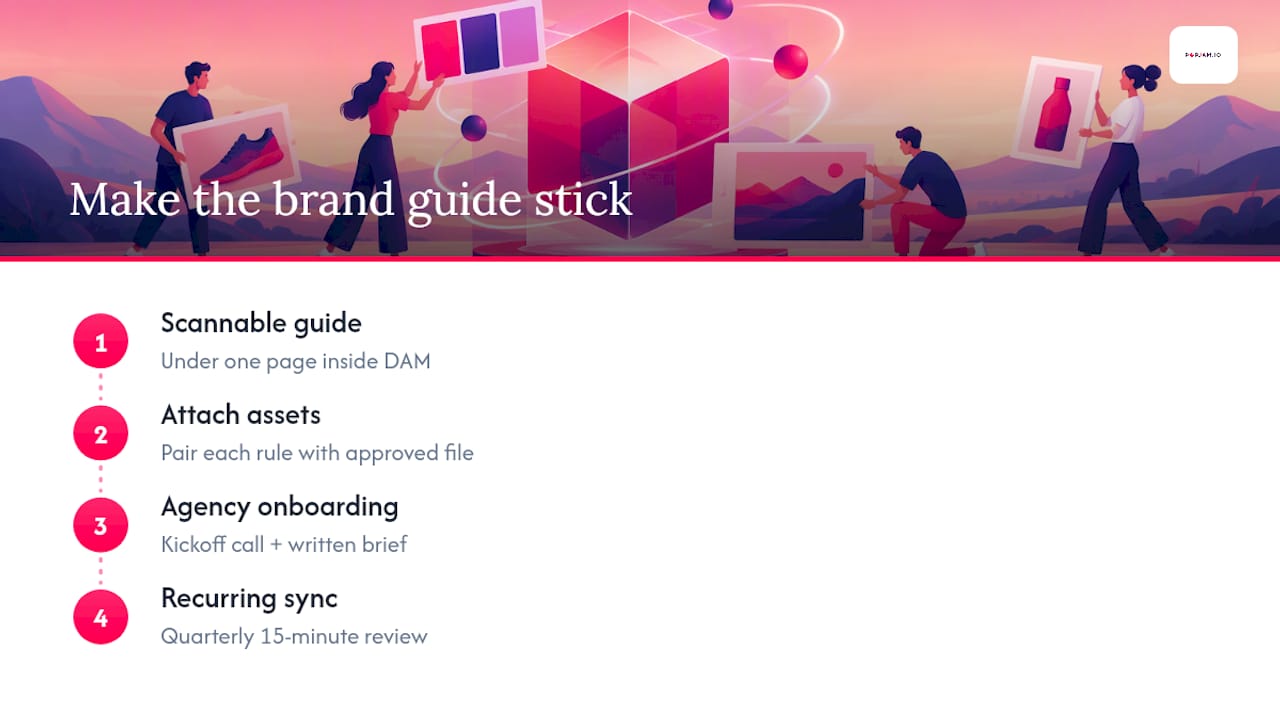
Static PDFs buried in a shared drive fail for a predictable reason: nobody opens a 40-page document before building a single ad. What works better is turning the non-negotiables into a short, scannable reference, ideally under one page, that lives inside the DAM itself next to the assets it governs. Pair every rule with the actual approved file, not just a description of what it should look like.
Agencies need a slightly different approach than internal teams. External partners don’t have the tribal knowledge that builds up inside a company over years, so their onboarding needs to spell out things internal staff take for granted, like why a specific shade of the brand color exists or what the core promise actually means in practice. A kickoff call covering the non-negotiables list, followed by a written brief they can reference later, beats a document dump every time.
Build a recurring touchpoint, not a one-time training. A quarterly 15-minute sync where the brand team reviews recent flagged assets with creative teams and agencies does more to prevent drift than an annual training session ever will. It keeps the standard current, catches misunderstandings early, and makes compliance feel like a shared responsibility rather than a rule imposed from above.
Where Pre-Launch AI Testing Fits Into Brand Governance
Manual review scales poorly once creative volume climbs past a handful of ads a week. That’s the practical gap synthetic-persona testing fills. An AI ad maker generates on-brand creatives and tests them against synthetic buyer personas before anything goes live, giving teams psychographic feedback instead of a guess about whether a variation will land.
That kind of simulated feedback doesn’t replace human judgment on brand fit, but it catches tone and recognition problems earlier, which is exactly where wasted ad spend and creative fatigue usually start. Treat it as another layer in the governance chain, not a substitute for the brand guide or the DAM sitting underneath it.
— Doruk
Add Pre-Launch Testing to Your Brand Governance Stack
Most brand guides tell your team what “on-brand” looks like. Almost none tell you whether a specific ad variation will actually land with your audience before you’ve spent the media budget to find out. POPJAM closes that gap by generating on-brand creative and running it against synthetic buyer personas first, so you catch tone and recognition problems while they’re still free to fix.
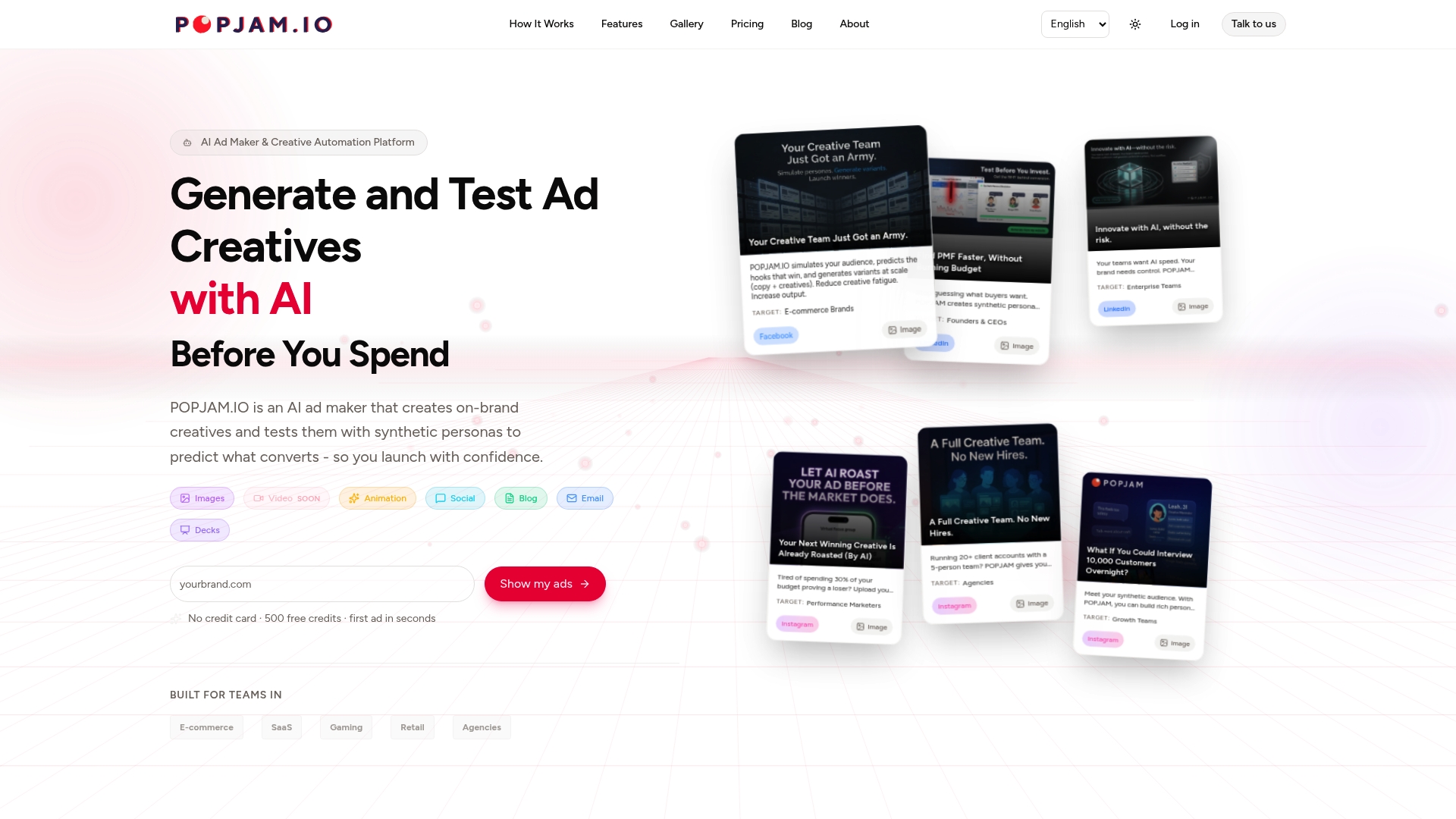
The platform maps directly onto the workflow this guide just walked through: brand-safe generation, pre-launch validation, and full creative lifecycle automation with platform-native exports for Meta, Google, TikTok, LinkedIn, and Reddit. If you’re building the kind of channel adaptation matrix described above for Google’s ad formats, POPJAM’s generator is built to produce and test those variations before they ever touch a live budget.
Plans start with a free tier, scale through Starter at 29€ per month and Essential at 99€ per month, and go up to Business at 399€ per month for teams running heavier volume. Credit packs, from 1,000 credits at 10€ up to 10,000 credits at 100€, cover extra generation without forcing a plan change. Check the pricing page and pick the tier that matches your current campaign volume.
Sources
- Set brand guidelines for Performance Max campaigns - Google Ads Help
- Why some brands should be consistent and common in advertising - ESCP
- Brand consistency in AI ad creative: a COO framework - Intercept / Moburst
FAQ
What Is Brand Consistency in Ads?
Brand consistency in ads means every campaign keeps the same core identity elements, logo, name, color codes, typography, and brand promise, intact across every platform and format. System1’s research shows this consistency compounds into stronger long-term creative performance rather than a one-time effect.
Does Brand Consistency Always Improve Ad Performance?
Not universally. A peer-reviewed study of 247 television ads found consistency benefits smaller, challenger brands more than large, established ones, which sometimes gain from creative variation instead.
How Does Performance Max Handle Brand Guidelines?
Performance Max requires a business name and logo at the campaign level, while fonts and colors remain optional inputs. Not every placement supports every control, so Google recommends verifying rendered placements directly rather than assuming the settings applied everywhere.
How Can I Catch Brand Drift Before an Ad Goes Live?
Pre-launch validation is the most direct fix. Platforms like POPJAM generate on-brand creative and test it against synthetic buyer personas before any media spend, catching tone and recognition issues that a compliance checklist alone might miss.
What Does POPJAM Cost?
POPJAM offers a free plan, a Starter plan at 29€ per month, an Essential plan at 99€ per month, and a Business plan at 399€ per month, with Enterprise pricing available on request. Credit packs for additional generation range from 1,000 credits at 10€ to 10,000 credits at 100€, all listed on the pricing page.