

One Page AI Creative Briefs With Prompts and Persona Pretests
Make one page AI creative briefs with ready prompts, rejection rules, and persona simulated pretests so marketing teams ship tested ads fast.

An AI creative brief is a one-page, editable brief produced or bootstrapped by generative models that captures the objective, single message, audience, proof points, deliverables, and success metrics so creative teams can act faster. It works for in-house marketing teams, agencies, and solo creative leads who need a strategic starting point without spending days in meetings. Done right, it turns a blank page into a working document in minutes.
TL;DR:
- Feeding accurate background, past performance data, and clear constraints significantly improves the quality of AI-generated briefs.
- Matching the AI tool to your team’s workflow and collaboration needs is crucial for effective brief development and sign-off.
- Reinforcing that AI is a drafting partner and not a strategist helps maintain focus on human insight and clear messaging.
- Incorporating pre-launch testing tools, like POPJAM, reduces wasted ad spend by validating creative concepts against simulated audience reactions.
- Keep the brief focused on one core message with a solid proof point, and always validate outputs against strategy and objectives before production.
Table of Contents
- What counts as an AI creative brief, and why one page is the limit
- The core elements every brief must answer
- Turning a blank page into a brief: inputs, iteration, and review gates
- A prompt framework you can reuse for every brief
- Choosing an AI tool that matches how your team actually works
- From brief to tested creative: how POPJAM closes the loop
- Don’t let the model do your strategic thinking for you
- Try brief-to-creative with pre-launch testing built in
- Where to find the templates and research behind this guide
- Sources
- FAQ
What counts as an AI creative brief, and why one page is the limit
AI doesn’t replace the thinking behind a brief. It speeds up the drafting so you can spend your time on the parts that actually need a human brain: the insight, the trade-offs, the judgment calls. The AMA creative brief template recommends keeping the document succinct and focused on strategic fields rather than creative execution, and that guidance holds whether a person or a model writes the first draft.
A workable skeleton looks like this:
- Project summary: what’s happening and why now
- Objective: the business or marketing outcome you’re chasing
- Audience: who you’re talking to and what they currently believe
- Single message: the one thing the audience should take away
- Proof points: the evidence backing that message
- Deliverables and timeline: formats, channels, and dates
Paste that skeleton into any AI tool as a starting structure and you’ve already skipped the hardest part: staring at a blank document, as explained in the AI Content Briefs: The Practitioner’s Template Guide.
The core elements every brief must answer
A brief that reads well but skips strategy will produce creative that looks fine and does nothing. Before you let AI touch a draft, make sure these fields are answered in plain language, not vague adjectives.
- Objective and success criteria: name the business goal and how you’ll measure it.
- Audience and desired shift: who you’re targeting and what behavior or perception should change.
- Single proposition: one message, backed by one strong proof point, not three competing ideas.
- Tone and brand direction: mandatories, assets to reuse, and anything off-limits.
- Deliverables and logistics: channels, formats, timeline, budget, and who signs off at each stage.
The AMA’s fillable template structures these exact fields, from background and goals to channels and budget, so teams align before anyone opens a design tool.
Pro Tip: Limit the single proposition to one sentence. If you need “and” to describe it, you have two messages, not one.
Turning a blank page into a brief: inputs, iteration, and review gates
Feeding an AI tool the right inputs matters more than which tool you pick. Before you write a single prompt, gather:
- Campaign background and business context
- Past creative that worked, or didn’t, and why
- Performance data from prior campaigns
- Brand guidelines and tone examples
- Hard constraints: legal, budget, platform specs
From there, pick a generator style that matches the job. A quick draft generator is fine for early exploration. A conversational builder works better when you need to think out loud. A performance-grounded system, one that can reference past campaign data, is worth the setup time when you’re briefing a paid media push.
The iteration pattern that works: draft, apply rejection rules, human edit, approval gate. Rejection rules tell the model what an unacceptable output looks like, whether that’s a claim you can’t support, the wrong tone, or a format nobody can parse, according to ClickUp’s guidance on AI brief generators.

Before a brief goes to production, it’s worth a quick validation pass. Persona-conditioned simulations are a practicable preflight check, not a replacement for a live test.
Persona-conditioned AI simulations reached 67% overall alignment with historical A/B test outcomes, according to SimAB research on persona-conditioned testing, with stronger accuracy on high-confidence predictions. That’s a useful filter for killing weak concepts before they reach a designer.
A prompt framework you can reuse for every brief
The most reliable structure for briefing prompts separates four things: Goal, Context, Source, and Expectations. Goal states what the brief needs to accomplish. Context gives background on the product, campaign, or audience. Source points to reference materials, past performance, or brand guides. Expectations spells out the output format and what to reject.
Four prompts cover most briefing needs:
- Quick one-page brief: “Using [background], write a one-page creative brief with objective, audience, single message, proof point, deliverables, and timeline. Reject any output over one page or with more than one key message.”
- Expanded two-page brief: same structure, plus a section for mandatories, approvals, and channel-specific notes.
- Performance-grounded brief: “Using [past creative performance data], prioritize hooks and visual directions that match our top-performing patterns from the last quarter.”
- Stakeholder interview prompt: “Ask me five questions to surface approvals, mandatories, and references before drafting the brief.”
Pro Tip: Always specify the output format, a labeled table or a two field-per-line structure, so the brief is easy to scan and easy to hand off.
A short returned example might read: Objective: grow trial signups 20% this quarter. Audience: freelance designers frustrated with slow client feedback loops. Single message: get client approval in one round, not five.
Choosing an AI tool that matches how your team actually works
Not every AI briefing tool solves the same problem, so match the tool to your input type and handoff needs. Teams with performance history need a system with ad data access, not just a text box. Teams that just need a fast first draft can get by with a lightweight generator, according to guidance on tool selection for communications practitioners.
Before committing, check for:
- Collaboration and sign-off features so stakeholders can comment in place
- Brand control templates that lock tone, colors, and mandatories
- Export formats that match what your creative team actually opens
- Asset linking to reference past creative or approved brand libraries
- Privacy and data handling, plus fully editable outputs, not locked text
During a trial, ask vendors how the tool handles rejected drafts, whether outputs are editable after export, and what happens to your data once the trial ends. A short pilot on one real campaign tells you more than any feature list. For a broader look at how these tools stack up, POPJAM’s comparison of AI ad creative tools is worth a read before you commit to one.
From brief to tested creative: how POPJAM closes the loop
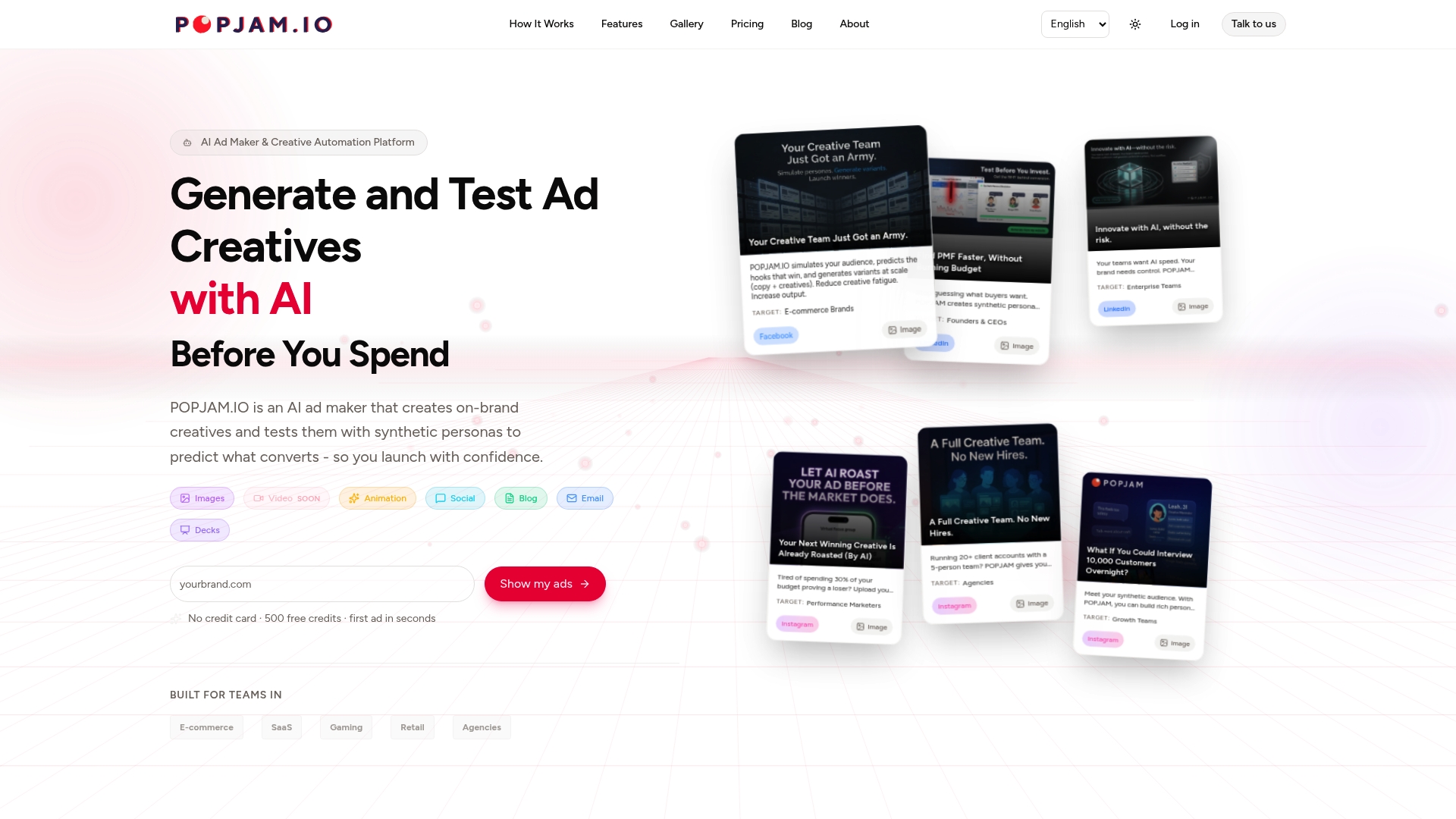
Writing the brief is half the job. POPJAM.IO takes the next step by turning that brief into ad creative and testing it against synthetic buyer personas before any money is spent. The platform generates on-brand images, video, and social creative, then simulates audience reactions to flag what’s likely to resonate and what isn’t.
Mapped to the workflow above, POPJAM fits at the input and validation stages:
- Feeds brand guidelines and past creative directly into generation
- Runs persona-simulated pretests instead of guessing which concept wins
- Produces creative scorecards so teams see feedback before launch
- Exports in platform-native formats for Meta, Google, TikTok, LinkedIn, and Reddit
For teams tired of shipping creative on instinct, this means fewer wasted iterations and validated concepts going into paid spend instead of untested guesses. You can see the workflow in more detail on POPJAM’s creative automation page.
Don’t let the model do your strategic thinking for you
AI is a drafting partner, not a strategist. It can organize a brief beautifully and still miss the point if you don’t feed it a sharp human insight first. Creative strategists have long argued that AI can’t reliably discover the strategy from a product description alone, and that still holds.
Enforce a single message and one proof point every time, even when the model wants to hedge with three. And don’t skip the briefing conversation. A document, however well structured, rarely transfers the full context a live discussion does.
— Doruk
Try brief-to-creative with pre-launch testing built in
If you’ve built a solid brief using the steps above, POPJAM turns it into tested creative without the guesswork of a blind launch. The Free plan lets you try the workflow, Starter runs 29 € per month, Essential sits at 99 € per month, and Business comes in at 399 € per month, each scaling with how much creative your team ships, according to POPJAM’s pricing page.
Credit packs are available too, from 1,000 Credits at 10 € up to 10,000 Credits at 100 €, for teams that need extra generation without changing plans. Whether you’re briefing your first campaign or your fiftieth, you can start free and see how a validated brief turns into creative worth shipping. Check out POPJAM’s pricing to find the plan that fits your team.
Where to find the templates and research behind this guide
For downloadable templates, start with the AMA creative brief template and the IPA’s agency briefing guidance. For the validation research behind persona-simulated testing, see the SimAB paper. POPJAM’s blog also has copy-paste brief templates ready to adapt.
Sources
- AMA Creative Brief Template - American Marketing Association
- SimAB: Simulating A/B Tests with Persona-Conditioned AI Agents for Rapid Design Evaluation
- ClickUp — guidance on AI creative brief generators and rejection rules
FAQ
What is an example of a creative brief?
A creative brief typically states the objective, audience, single message, proof point, deliverables, and timeline on one page. For instance: objective is growing trial signups, audience is freelance designers, and the single message centers on faster client approvals. POPJAM’s copy-paste templates show several working formats.
What are some creative things I can do with AI?
Beyond writing briefs, AI can generate ad images, video, and social creative, then test how different audience segments might react before launch. Tools like POPJAM combine generation with synthetic persona testing so you can validate concepts before spending on paid media.
What is an AI brief?
An AI brief, or AI creative brief, is a strategic document drafted with help from generative models that still contains the same core fields as a traditional brief: objective, audience, message, and deliverables. The AI speeds up the drafting, but the strategic thinking, the insight and hierarchy behind the message, still has to come from a person.
Is there an AI tool that can help me write creative writing?
Yes, several AI tools can help draft creative writing and briefs, ranging from lightweight text generators to platforms that generate and test full ad creative. POPJAM, for example, goes further than drafting by generating ad creative and testing it against synthetic buyer personas before launch.