

Marketers: Use Selection Rate Ratios to Find AI Bias in Advertising
A playbook for marketers to detect and fix AI bias in advertising using paired ad audits, selection rate ratios, and creative pretests.

AI bias in advertising means your algorithm can quietly show different ads to different people based on race, gender, or age, even when your targeting looks completely neutral. It shows up as skewed delivery: some groups see your campaign far more than others, and that gap can mean wasted spend, missed customers, and real legal exposure. The fix starts now: audit how your current campaigns are actually delivering before you launch another dollar of spend.
TL;DR:
- Auditing delivery with paired-ad tests and demographic segmentation is essential to identify bias caused by targeting, creative scoring, or optimization choices.
- Bias tends to accumulate across campaign stages, especially if lookalike audiences are built from biased data, and remains hidden without segmented measurement.
- Regulatory bodies expect proactive testing and documentation of fairness claims, with a four-fifths ratio below 0.8 signaling the need for audit and correction.
- Implementing prelaunch creative testing with synthetic personas helps catch skewed ads early, reducing biased impressions before they go live.
- Assign dedicated owners to monitor, report, and review fairness metrics regularly, integrating bias management into ongoing campaign operations.
Table of Contents
- 1. What is AI bias in advertising and how does it form?
- 2. Where bias shows up across the campaign lifecycle
- 3. Legal and regulatory risk: what HUD and the FTC expect from advertisers
- 4. How to detect and audit bias in ad delivery
- 5. Practical mitigations marketers can implement today
- 6. Trade-offs, success metrics, and a short operational checklist
- 7. Applied example: a pre-launch creative testing workflow
- 8. The impact of AI bias on different demographic groups
- 9. Long-term reputational risks of biased advertising campaigns
- 10. Emerging technologies and research directions to reduce AI bias
- 11. Who should own bias management inside a marketing team
- Run your pre-launch checks with POPJAM
- FAQ
- Sources
1. What is AI bias in advertising and how does it form?
AI bias in advertising happens when the systems that decide who sees your ad, built on machine learning models, end up favoring or excluding certain groups regardless of your stated targeting. It is not usually intentional. It is baked into the mechanics.
Training data carries human history with it. If past ad performance data shows a certain demographic clicked more on housing or job ads, the model learns to keep showing those ads to that group, reinforcing the exact pattern that caused the skew in the first place. Metric choices make this worse: when a platform optimizes purely for clicks or conversions, it will chase whichever audience converts fastest, even if that means quietly sidelining others.
Creative classification adds another layer. Platforms score your images, copy, and video for “relevance” before an auction even happens, and that scoring can push certain creatives toward certain demographics before you ever see a performance report.
- Training data reflects historical human behavior and bakes those patterns into future delivery.
- Optimization for clicks or conversions can chase the fastest-converting segment at the expense of broader reach.
- Creative classification systems score ads for relevance before auctions run, shaping who sees what from the start.
- External audits have repeatedly found skew in delivery that advertisers never requested or noticed.
2. Where bias shows up across the campaign lifecycle
Bias does not appear at a single point. It accumulates across four stages of a typical campaign, and each stage leaves its own fingerprint.
- Audience creation: Lookalike audiences built from a biased seed list will reproduce that bias at scale, and so-called “neutral” interest targeting can still proxy for protected characteristics.
- Creative delivery: Images, headlines, and cultural cues in your ad get auto-scored for relevance, and that scoring can steer your campaign toward or away from specific groups before you spend a cent on media.
- Optimization objectives: When you tell the platform to optimize for clicks or conversions, the algorithm will gravitate toward whichever segment responds fastest, often concentrating delivery in a narrower slice of your intended audience than you planned.
- Measurement gaps: Most dashboards report aggregate reach and conversions, not delivery broken out by demographic proxy, so skewed outcomes often go completely undetected until an external audit or a complaint surfaces them.
Each of these stages compounds the next. A biased seed audience feeds a biased optimization loop, and without segmented measurement, nobody on the marketing team ever sees the gap. That is exactly why paired-ad audits conducted outside the platform’s own reporting have found delivery skew that internal dashboards never flagged, a pattern documented in reporting on Facebook’s ad delivery system.
3. Legal and regulatory risk: what HUD and the FTC expect from advertisers
Regulators are no longer treating algorithmic delivery as a technical curiosity. For housing, credit, and related real estate ads, HUD guidance warns that automated delivery systems can concentrate impressions or steer ads away from protected classes, and it recommends advertisers proactively test and adopt less discriminatory alternatives rather than wait for a complaint. That expectation of proactive testing is spreading to other high-stakes verticals like employment and credit, even where it is not yet codified the same way.
The FTC has sharpened its focus too. Recent FTC enforcement activity signals closer scrutiny of deceptive AI claims in advertising, including representations about fairness or objectivity that a company cannot back up. If you claim your targeting is neutral or your AI avoids bias, you need documentation to support it.
A selection rate for any group substantially below that of the highest-performing group is a recognized screening indicator of potential adverse impact, under what is known as the four-fifths rule. It is a heuristic, not a courtroom verdict: small sample sizes can produce misleading ratios, so treat it as a trigger for deeper review, not a final answer.
- HUD expects proactive testing and less discriminatory alternatives for housing-adjacent ads.
- FTC scrutiny extends to unsubstantiated AI fairness claims.
- A four-fifths ratio below 0.8 should trigger a stop-and-audit, not a shrug.
- Red flags: unexplained reach gaps, demographic clustering in conversion data, or vendor refusal to share delivery breakdowns.
4. How to detect and audit bias in ad delivery
You do not need a research lab to run a credible bias audit. The method researchers use, and that you can adapt, is the paired-ad test: run two identical campaigns with identical targeting but different creative, then compare delivery. Because targeting is held constant, any difference in who sees which version isolates the platform’s own delivery mechanics rather than your audience strategy, a technique detailed in academic paired-ad research.
The metrics that matter are straightforward to compute from exported campaign data:
- Impressions by demographic proxy segment (age, gender, inferred location clusters).
- Impression variance across segments relative to your intended audience split.
- Selection-rate ratios between the highest and lowest performing segments.
- Conversion rates broken out the same way, not just in aggregate.
Sample size matters more than most marketers assume. A segment with fewer than a few hundred impressions will produce a selection-rate ratio that swings wildly from noise alone, so set a minimum impression threshold per cell before you trust any ratio, and report a confidence range rather than a single number.
| Audit component | What it measures | Recommended cadence |
|---|---|---|
| Paired-ad test | Delivery skew isolated from targeting | Each major creative launch |
| Impression variance | Spread of reach across segments | Weekly during active campaigns |
| Selection-rate ratio | Four-fifths screening against the top segment | Monthly, or at campaign midpoint |
| Conversion parity check | Outcome gaps beyond impression counts | Post-campaign review |
An audit report worth sharing with stakeholders should include the paired-ad setup, the raw segment-level numbers, the computed ratios with confidence ranges, and a short list of remediation steps, not just a pass or fail stamp.
5. Practical mitigations marketers can implement today
Detecting bias is only half the job. Here is what to actually do about it, in order of how fast you can act.
- Pretest creatives before launch using synthetic personas or simulated audience reactions to catch skewed appeal across demographic segments before any media dollars move, an approach our AI advertising campaign guide walks through in more depth.
- Design audiences deliberately, seeding lookalike models with diverse source lists and splitting budgets across stratified segments instead of letting the algorithm consolidate spend on whichever group converts fastest.
- Use platform-level controls where available, including manual placement and delivery options that resist full automation when even delivery matters more than raw efficiency.
- Write audit rights into vendor contracts, requiring ad-tech and agency partners to document delivery methodology and share segment-level reporting on request.
Pro Tip: Run your pretest on the exact creative variants you plan to ship, not a simplified mockup, since relevance scoring and persona reactions both respond to the finished asset.
None of this requires slowing campaigns to a crawl. It requires building a checkpoint into the workflow you already run, the same way you already check brand compliance or legal copy before anything goes live.
6. Trade-offs, success metrics, and a short operational checklist
Fairness is rarely free. Enforcing even delivery across segments can mean some reach loss, a higher cost per recipient in underserved segments, and frequency effects where the algorithm has to work harder to reach its least-efficient audience. Academic research on fairness in ad delivery shows that enforcing statistical parity carries measurable utility costs, and those costs are most sustainable when platforms share the burden rather than advertisers absorbing it alone through negotiated remedies or platform-level fixes.
- Expect some reach loss when you intervene for fairness, and budget for it rather than treating it as a failure.
- Push for platform-level remedies in vendor negotiations instead of only adjusting your own spend.
- Track fairness metrics the same way you track CPA or ROAS: as a recurring line on your dashboard, not a one-time project.
| Checklist item | Why it matters |
|---|---|
| Pretest creative with segmented audience simulation | Catches skew before spend |
| Set minimum impression thresholds per audit cell | Avoids false positives from small samples |
| Run paired-ad tests on major launches | Isolates platform delivery effects |
| Compute selection-rate ratios monthly | Flags adverse impact early |
| Require vendor delivery documentation | Creates accountability in contracts |
| Escalate four-fifths violations to legal/compliance | Matches regulatory expectations |
| Review fairness metrics at campaign retrospective | Keeps bias management ongoing, not one-off |
7. Applied example: a pre-launch creative testing workflow
Here is how this plays out in practice using our own platform as the example. In POPJAM, a marketer generates several creative variants for a single campaign, then simulates audience reactions using synthetic personas built on psychographic profiles rather than demographic guesswork. Each variant can get segmented reaction data back, and creatives showing high variance in simulated response across segments can be flagged before launch instead of after.
- Generate creative variants for the campaign concept.
- Simulate reactions across synthetic personas spanning different psychographic profiles.
- Segment the resulting reaction metrics and flag variants with wide swings.
- Iterate on flagged creative and re-test before any media spend.
This workflow can help catch creative-driven skew early. It does not replace a post-launch delivery audit using real impression data, since simulated reactions and live platform delivery are different signals, a distinction our guide to what AI creative analysis can and can’t tell you covers directly. The useful audit artifacts from this step may include segmented reaction exports and flagged-creative lists, which can feed into the paired-ad audit described earlier.
8. The impact of AI bias on different demographic groups
Biased delivery does not spread its costs evenly. When an algorithm learns that one demographic converts faster on a job or credit ad, it can quietly reduce how often other groups see that same opportunity, narrowing their access to housing, employment, or financial products advertised online. Older users and users in certain racial or ethnic groups have shown up disproportionately underserved in delivery audits of housing and employment-adjacent ads, a pattern Northeastern’s reporting documented alongside gender-based skew tied to creative content and platform optimization.
The effect compounds for groups already underrepresented in a platform’s historical conversion data. If a model was trained on a dataset where one segment converted less often, often for reasons unrelated to actual interest, the algorithm can learn to deprioritize that segment going forward, creating a feedback loop that gets harder to detect the longer it runs.
For marketers, this means your “best performing” segment in a dashboard might reflect algorithmic steering as much as genuine audience fit. A campaign that looks efficient in aggregate can still be systematically excluding viable customers, which is both a fairness problem and a missed-reach problem. Segmented reporting, broken out by demographic proxy rather than only by aggregate conversion rate, is the only way to see this gap before it shows up as a complaint, a regulatory inquiry, or a competitor reaching the audience you missed.

9. Long-term reputational risks of biased advertising campaigns
A single skewed campaign rarely makes headlines. A pattern of them does, and once a brand gets tied publicly to discriminatory ad delivery, that association tends to outlast the campaign that caused it.
The reputational cost compounds in a few predictable ways. Journalists and researchers who study algorithmic delivery, the same kind of reporting that surfaced skew in Facebook’s ad systems, actively look for repeat offenders, and a brand that shows up more than once in that coverage faces a harder credibility problem than one that was never flagged at all. Customers in excluded segments notice too, even without a formal audit, when they realize a brand’s offers never seem to reach them or their community.
There is also an internal cost. Marketing teams that build a reputation for ignoring delivery skew find it harder to attract partners, agencies, and platform reps willing to extend favorable terms or early access to new ad formats, since nobody wants their name attached to a brand under regulatory watch.
The fix is not complicated, just consistent: treat delivery fairness as a standing item in campaign retrospectives, the same way you already review creative performance and budget pacing, so a pattern never has the chance to form in the first place.
10. Emerging technologies and research directions to reduce AI bias
Academic and industry research on fairness in ad delivery has moved past simply measuring bias toward building systems that correct for it during optimization, not just after the fact. Work presented at ACM’s FAccT conference explores fairness-constrained optimization, where a delivery algorithm is explicitly penalized for selection-rate gaps between segments while it is still learning, rather than leaving fairness as a manual audit layered on top of a finished campaign.

Synthetic audience simulation is another direction gaining traction, letting marketing teams test how a creative is likely to land across different psychographic and demographic segments before any real impressions are spent, reducing the number of biased creatives that ever reach a live auction in the first place.
There is also growing interest in standardized disclosure, where platforms would report segment-level delivery breakdowns by default rather than requiring advertisers to run their own paired-ad experiments to find the gap. None of this is fully mature yet. The direction, though, is consistent: move fairness checks earlier in the pipeline, make them continuous rather than one-time, and give marketers the segmented data they need without forcing every advertiser to build their own audit infrastructure from scratch.
11. Who should own bias management inside a marketing team
Assign a campaign owner to flag skew, a data steward to maintain segmented reporting, and a legal or compliance reviewer for anything housing, credit, or employment-adjacent. Review fairness metrics on the same cadence as pacing and budget. Treat it as an ops KPI, not a one-time project.
— Doruk
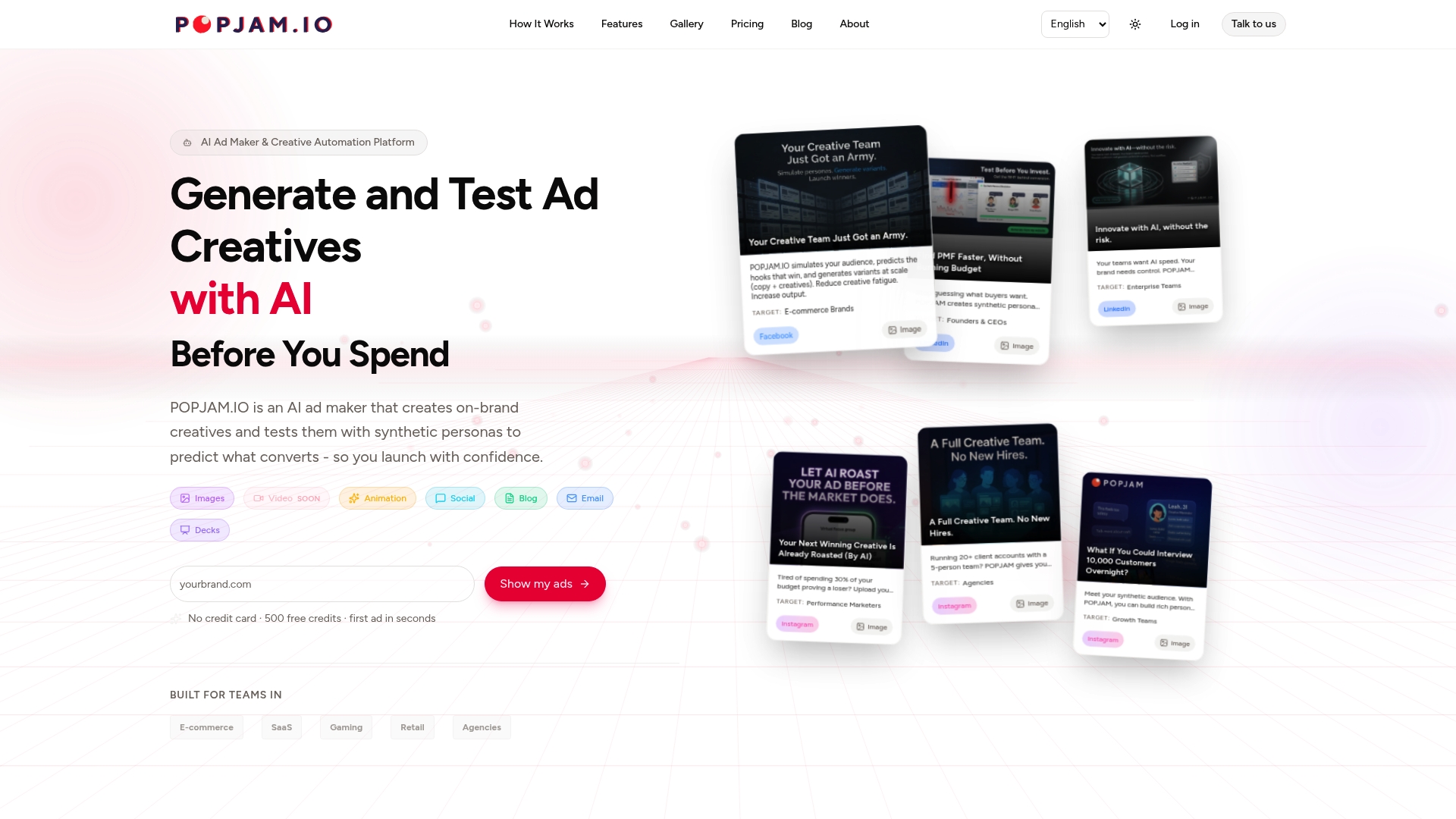
Run your pre-launch checks with POPJAM
Everything in this article points to one habit: test before you spend, then keep watching after launch. POPJAM builds that pretest step directly into creative generation, simulating audience reactions across synthetic personas so skewed creative gets caught before it reaches a live auction. Some platforms offer plans starting with a free tier for teams that want to try the workflow first.
FAQ
What are some famous examples of AI bias in advertising?
The most cited example comes from paired-ad research showing Facebook’s delivery algorithm skewed housing and employment ad impressions by gender and race even when advertisers used identical, neutral targeting, as documented by Northeastern researchers. That case became a reference point for HUD’s later guidance on algorithmic delivery in housing advertising.
What is the four-fifths rule in AI and advertising?
The four-fifths rule is a screening heuristic stating that if a protected group’s selection rate falls below 80% of the highest-performing group’s rate, it flags potential adverse impact worth investigating, per EEOC guidance. It is a starting signal for deeper review, not a definitive legal finding on its own.
How does AI promote bias in advertising delivery?
AI systems learn from historical performance data and optimization objectives like clicks or conversions, which can cause them to concentrate ad delivery on whichever segment responds fastest while reducing impressions to others. Creative relevance scoring adds another layer, shaping who sees an ad before the auction even runs.
Can AI-driven advertising count as false advertising?
Yes, when claims about an AI system’s fairness, accuracy, or targeting neutrality cannot be substantiated, which is an area the FTC has signaled closer scrutiny over. Advertisers making unverified claims about how their AI targets or avoids bias face the same truthful-advertising standards as any other marketing claim.
How can marketers test ad creative for bias before launch?
Marketers can simulate audience reactions across different persona segments before spending any media budget, flagging creative variants that show wide swings in simulated response by segment. Pairing this pretest step with a post-launch paired-ad audit, as described earlier in this guide, covers both the creative stage and the delivery stage.
Sources
- Guidance on Application of the Fair Housing Act to the Advertising of Housing, Credit, and Other Real Estate-Related Transactions through Digital Platforms
- Facebook algorithm discrimination (Northeastern reporting)
- FTC press materials on AI and advertising enforcement
- Questions and answers to clarify and provide common interpretation of the Uniform Guidelines
- Fairness in online ad delivery (ACM FAccT proceedings)