

672,814 Versions to Study: 10 AI Ad Examples for Marketers
Ten marketer-focused case studies from 2025–26 pairing AI creative techniques with real metrics, tools, and a four-step pilot you can run before you buy...

Shell, Lysol, The Salvation Army, Coca-Cola, Goodwipes, and Rouge Care all ran AI-driven ad campaigns in the past year, and each one proves a different point: personalization at scale, faster production, measurable sales lift, or a wildly efficient media buy. If you’re building the case for AI creative on your team, these are the receipts. Short case notes follow, with the tool, the outcome, and the lesson for each.
TL;DR:
- Personalized AI campaigns like Shell’s F1 films achieve higher reach and engagement, but require extensive volume to be effective at scale.
- Generative image and video tools rapidly produce assets but still need human review to fix artifacts and ensure brand consistency.
- AI-driven media buying systems extend automation into campaign optimization, requiring vigilant oversight and responsible AI policies.
- Validating AI creative with quick consumer or simulated testing helps prevent negative sentiment and improves campaign impact before launching at full scale.
- Starting with small, KPI-focused pilots and involving human final approval maximizes learning while minimizing risk.
Table of Contents
- 1. Ten AI ad campaigns worth copying right now
- 2. What tools and techniques actually powered these campaigns
- 3. Which metrics actually prove an AI campaign worked
- 4. What can go wrong when brands ship AI ads too fast
- 5. A four-step playbook to pilot AI creative on your team
- 6. How POPJAM.IO applies these same tactics for you
- 7. What I’d prioritize if I were running this pilot
- 8. Test your next ad before you spend a cent on media
- Sources
- FAQ
1. Ten AI ad campaigns worth copying right now
Ten brands ran the experiments so you don’t have to guess what works. Here’s what happened when they let AI into the creative process, and what each one teaches you about doing it yourself.
- Shell V-Power, “Feel Closer”: Shell used AI-powered personalization to generate 672,814 unique F1-themed films, each tailored to a viewer’s local context. The campaign pulled in 106.8 million social views and 50 times higher reach than Shell’s non-campaign posts, alongside a 2% sales volume increase. Lesson: personalization at F1 scale beats one polished hero video when the audience is broad and varied.
- Lysol’s generative AI pilot: Lysol used generative AI to compress ideation from weeks to hours and cut cost per creative asset by 80%, then ran two weeks of consumer testing before locking final assets. Lesson: speed only pays off if you still test before launch.
- The Salvation Army, “The Thrift That Got Away”: A custom Gemini pipeline turned plain inventory photos into stylized retail images, driving an $11 cost per store visit and a click-through rate 2.6 times higher than Google Display Network benchmarks. Lesson: AI image generation can make thin retail assets look like a real campaign without a studio budget.
- Goodwipes’ AI spoof ad: Goodwipes built a glossy parody of OpenAI’s Astra ad in just four days using AI tools, though the team had to manually fix repeated visual artifacts the model kept producing. Lesson: budget time for human cleanup, because AI still gets weird in the details.
- Coca-Cola’s AI holiday ad: The spot generated over a million engagements but landed only about 37% positive sentiment on social. Lesson: reach and approval are two different scoreboards, and AI creative can win one while losing the other.
- Heinz’s DALL-E ketchup campaign: Heinz used DALL-E to generate ketchup-bottle imagery from absurd prompts, leaning entirely on the fact that every AI output still looked unmistakably like a Heinz bottle. Lesson: a strong enough brand identity survives even loose, playful AI generation.
- Nike’s Midjourney-based visuals: Nike explored Midjourney-generated imagery for stylized campaign visuals, treating the tool as a mood-board and concepting engine rather than a finished-asset machine. Lesson: generative image tools are often strongest earlier in the process, not at the final export stage.
- Popeyes’ “Wrap Battle”: Popeyes used AI UGC video for ecommerce, made from your products to produce a surreal, high-energy ad around its wrap launch, betting on novelty and shareability over polish. Lesson: AI-generated weirdness can be the creative angle itself, not just a production shortcut.
- Under Armour and Anthony Joshua: Under Armour built an AI-assisted spot featuring Anthony Joshua, blending generative video techniques with a recognizable athlete presence. Lesson: pairing AI production with a known face helps ground an experimental format in something familiar.
- Monks for Hatch, and Tombras for PODS: Monks used Gemini to role-play audience personas and generate creative directions for Hatch, reporting an 80% improved CTR and 31% improved cost-per-purchase. Tombras took a similar approach for PODS with its “World’s Smartest Billboard,” seeing a 60% increase in web sessions and 33% more quote requests in New York testing. Lesson: persona role-play with a large model sharpens targeting language before you ever open a design tool.
Rouge Care’s agentic media buy and Google’s earlier Lysol work round out the picture in the next sections, since their real value shows up in the metrics and the workflow, not just the headline.
2. What tools and techniques actually powered these campaigns
Strip away the brand names and you’ll find four recurring tools behind almost every example above: personalization engines, generative image or video models, voice and digital-twin technology, and agentic buying systems.
Shell’s 672,814 films came from a personalization engine that assembled unique clips from location, weather, and viewer data at F1 scale. The Salvation Army and Heinz leaned on image generation (Gemini and DALL-E, respectively) to turn plain inputs into finished visuals fast. Popeyes and Goodwipes used generative video to produce short, high-concept spots in days instead of weeks. Under Armour’s spot points to where voice and digital-twin technology is heading: consented likeness and voice replication used to scale a real athlete’s presence across more creative than a single shoot could ever produce.
Rouge Care’s case shows a different layer entirely: agentic AI that handles media buying and optimization, not just creative production. That’s a workflow shift as much as a creative one, and it requires the same human oversight the other examples do, just applied to spend decisions instead of scripts.
- Personalization engines generate volume, not just variety, which is what let Shell hit hundreds of thousands of unique versions.
- Generative image and video tools compress the ideation phase from weeks to hours, but still need human review before launch.
- Agentic buying systems extend AI past creative and into the media plan itself.
Pro Tip: When prompting for audience-aligned creative, ask the model to role-play a specific persona first, then generate copy or visuals in that persona’s voice, rather than asking for generic ad copy and hoping it lands.
3. Which metrics actually prove an AI campaign worked
The brands that won didn’t just launch and hope. Those are the KPIs worth borrowing: unique asset count, reach multiplier, CTR lift, cost per visit or purchase, and sales lift over a defined window.
Short validation cycles matter as much as the metric itself. Lysol’s team ran two weeks of consumer testing before locking final creative, which is what turned a fast pilot into a defensible campaign rather than a guess.
Shell’s 672,814 personalized films drove 106.8 million views and 50 times the reach of non-campaign posts, showing what volume-based personalization can do when the audience is genuinely diverse.

4. What can go wrong when brands ship AI ads too fast
Coca-Cola’s holiday ad is the cautionary tale here: over a million engagements paired with only about 37% positive sentiment shows that visibility and approval don’t move together. Goodwipes ran into a smaller but telling problem: AI models kept producing repeated visual artifacts that a human had to catch and fix before the spot could ship.
The mitigations that worked across these pilots were consistent: a written responsible-AI policy, consented likeness or digital-twin agreements, clear disclosure when a spot is AI-generated, and a staged round of consumer testing before wide release.
- Run a responsible-AI checklist before every AI-generated spot goes live, not after complaints arrive.
- Get explicit consent for any likeness, voice, or digital twin used in the ad.
- Test sentiment on a small audience segment before the full launch, the way Lysol tested for two weeks.
5. A four-step playbook to pilot AI creative on your team
You don’t need Shell’s budget to borrow Shell’s method. Start narrow, measure honestly, and keep a human on the final call.
- Pick one focused use case and one KPI, whether that’s CTR, store visits, or a sales lift target.
- Build prompts and synthetic personas, then generate a batch of variants sized for real segmentation, not just three options.
- Run a short validation test, an A/B split or a brief sales-lift read, and collect psychographic feedback on what resonated.
- Scale the winners with human finalization and a responsible-AI sign-off before the full launch.
A simple version looks like this: prompt for a persona-specific hook, generate ten variants, test against two audience segments, then iterate on whichever direction moved the KPI. Our generative AI for marketing playbook walks through a longer version of this cycle.
Pro Tip: Treat your first AI pilot as a two-week experiment with a single KPI, not a full campaign relaunch. Small, measurable wins build the internal case for bigger budgets.
6. How POPJAM.IO applies these same tactics for you
POPJAM.IO builds on the same idea behind Shell’s personalization and Lysol’s rapid testing cycle: generate on-brand creative, then validate it against synthetic buyer personas before any money goes to media. The platform simulates audience reactions with psychographic feedback, so you see what resonates before launch instead of after the spend is gone.
- Generates on-brand ad creative across image, video, and social formats.
- Tests variants against synthetic personas for qualitative and quantitative feedback.
- Exports platform-native formats for major social and advertising platforms.
A quick starter experiment: generate twelve hero image variations and test them against two synthetic personas to see which direction earns stronger simulated engagement before you commit to a shoot.
7. What I’d prioritize if I were running this pilot
Start small, pick one KPI, and keep a human making the final call on anything that goes public. Speed is the easy win with AI creative. Brand stewardship is the part that takes actual discipline, and it’s the part Coca-Cola’s mixed sentiment reminds us not to skip.
— Doruk
8. Test your next ad before you spend a cent on media
POPJAM.IO generates on-brand ad creative and tests it against synthetic buyer personas before you ever launch, so you find out what resonates while it’s still free to fix. It’s built for performance marketers, growth teams, agencies, and e-commerce brands who are tired of learning what works only after the ad spend is gone.
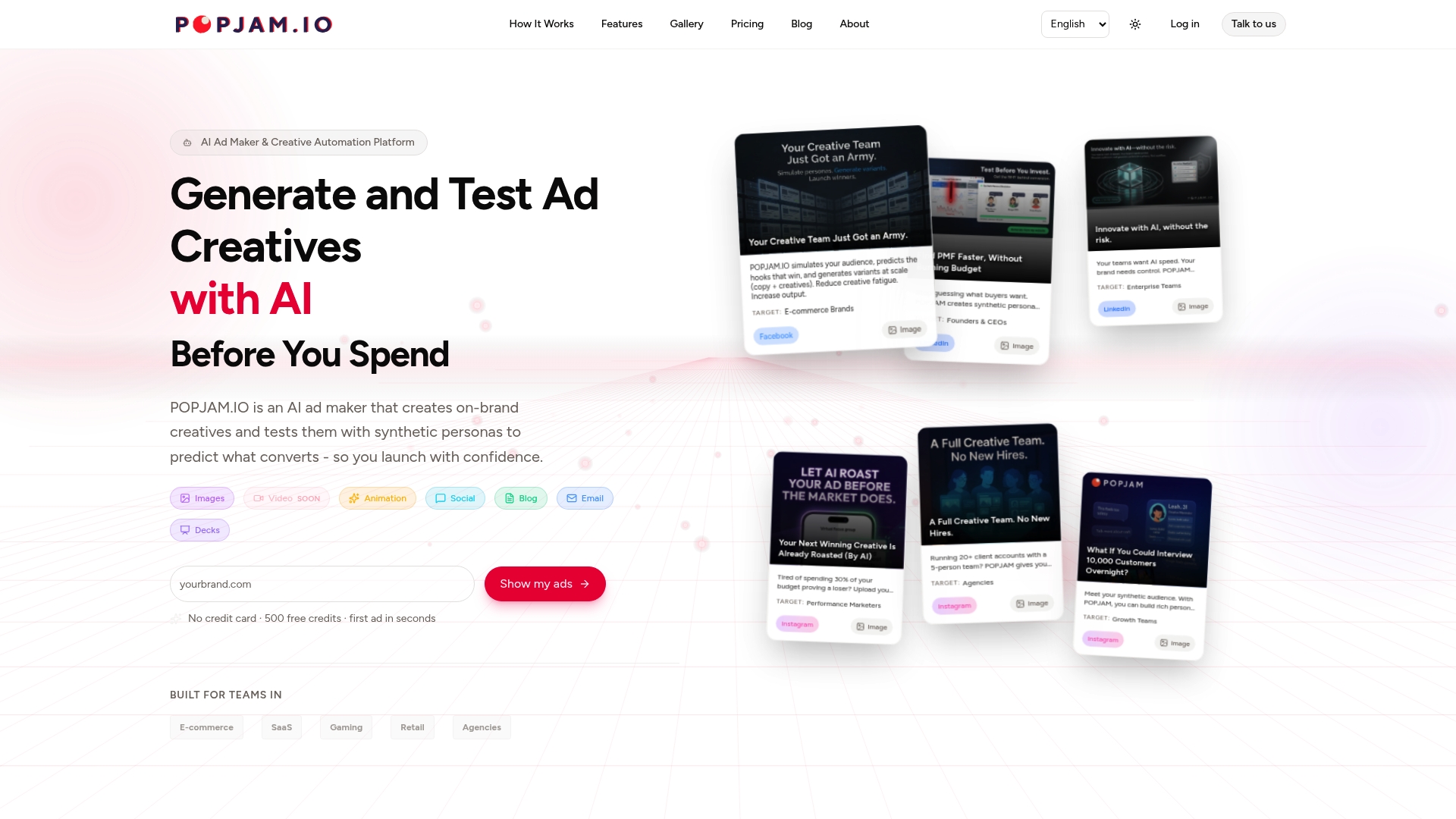
- Generate creative variants and simulate audience reactions
- See pricing across Free, Starter, Essential, Business, and Enterprise plans on the pricing page.
- Try the AI ad generator to build your first test batch today.
Sources
- Why Shell used personalized AI to create 672,814 unique F1 experiences | The Drum
- Lysol’s creative development with gen AI - Think with Google
- Goodwipes Uses AI to Spoof OpenAI’s Astra Ad, With a Butt-Wiping Twist | Adweek
- Coca-Cola’s AI Christmas ad ‘most talked about’ on social | Campaign Live
FAQ
What is the 30% rule for AI in advertising?
A common practical version teams use is capping AI-only creative at a modest share of total spend until testing confirms it performs, then scaling from there.
What are some examples of AI used in advertising?
Brands like Shell, The Salvation Army, and Lysol have used AI for personalization at scale, image generation from product photos, and faster creative ideation. Rouge Care took it further by using agentic AI to plan and buy television ad space, not just to generate creative.
Why did Coca-Cola use an AI ad for its holiday campaign?
Coca-Cola used AI to produce its holiday spot quickly and at a distinctive visual style that stood out in a crowded season. The bet paid off in reach, with over a million social engagements, but sentiment came in mixed at about 37% positive.
How is an AI-generated ad different from a traditional one?
An AI-generated ad is typically produced faster and at far lower cost per asset, as Lysol showed with an 80% reduction in cost per creative asset. Traditional production still tends to win on fine control and polish, which is why most successful pilots pair AI speed with a human finishing pass before launch.
How can I test an AI ad idea before spending on media?
Generate a batch of creative variants, then validate them against a small test audience or simulated personas before committing budget. Platforms like POPJAM.IO build this step in directly, letting you test AI-generated creative against synthetic personas and see simulated audience reactions before you spend on media.