

Pitch 1.5x Sales: A Creative Testing Plan for Performance Marketers
Performance marketers: a testing blueprint that uses prelaunch scoring, platform experiments, and finance ready metrics to prove campaign ROI.

Start by writing one clear hypothesis, picking a single primary metric, running a short controlled experiment, and scaling only the winners through a staged playbook. That’s the whole game. Highly creative ideas convert roughly twice as effectively as average ones, and tying creative tests to your marketing mix model is how you get finance to care. POPJAM’s synthetic-persona approach fits right at the start of that process, before you spend a dollar.
TL;DR:
- Creative ideas that are sustained across channels and given media weight outperform one-off bursts, making longer runs more effective.
- Pre-testing with predictive scoring can identify weak concepts early, preventing wasted media spend and driving up to 1.5 times sales and ROI improvements.
- Tests should isolate one variable at a time, reach platform-specific data thresholds like 50 conversions per arm, and be documented with clear naming and decision rules.
- Primary metrics like conversion rate or ROAS should guide budget shifts, supported by secondary metrics for explanation, with caution against premature victory declarations.
- Building a repeatable testing program requires clear decision rights, structured workflows, and tools like POPJAM to score concepts before live launch, reducing costly failures.
Table of Contents
- Why creative testing matters and what the evidence says
- A practical creative testing blueprint you can run this quarter
- Test design, platform mechanics, and the statistics that keep you honest
- Reading the results: metrics, thresholds, and turning lift into budget decisions
- Making creative testing a real program, not a one-off sprint
- POPJAM in practice: scoring concepts before they ever go live
- What I’d tell any team starting this today
- Try POPJAM for pre-launch creative scoring
- Sources
- FAQ
Why creative testing matters and what the evidence says
Here’s the thing most teams get backwards: they treat creative as a feeling, not a variable you can measure. That’s expensive.
WARC’s analysis of award-winning campaigns found that highly creative ideas deliver about 44% effectiveness conversion compared to 21% for average awarded creative, roughly double. That gap is not noise. It’s the difference between a campaign that pays for itself and one that just burns budget while looking nice in a deck.
21%).** That single WARC finding should be the opening slide in every creative budget conversation you have this year.
The same research points to something marketers underrate: creative commitment. Ideas sustained across channels, with real media weight behind them for a real duration, consistently outperform one-off bursts. That means your testing plan can’t just ask “which ad wins this week.” It has to ask “which concept deserves a longer run and a bigger footprint.”
On the pre-testing side, Google and Kantar’s work on closing the creative measurement gap shows that predictive scoring, run before launch, can process concepts quickly and flag likely winners during development rather than after the media spend is gone. That’s the whole point of pre-testing: catch the weak concept before it eats your budget, not after.
And the financial case is concrete. In a Kantar case study involving KFC, integrating creative quality scores into media allocation produced a 1.5x sales uplift and a 1.4x improvement in ROI. That’s not a hypothetical. That’s what happens when creative quality becomes a measured input to budget decisions instead of an afterthought.

A practical creative testing blueprint you can run this quarter
Here’s the framework, stage by stage. None of this is complicated. It just requires discipline most teams skip because it feels slow when it’s actually the fast path.
- Set the objective and primary metric first. Decide whether you’re optimizing for conversion rate, ROAS, or a brand metric, and write down the threshold that counts as a win before you see any data.
- Write one testable hypothesis per creative variant. “A video hook showing the product in use will outperform a static lifestyle shot on click-through rate” is testable. “Let’s make it punchier” is not.
- Apply the one-variable rule. Change the hook, the CTA, or the format, but not all three at once, or you won’t know which change drove the result.
- Stage your budget in three phases. Run a small pilot to kill obvious losers, a validation round on the survivors with a larger spend, then scale the confirmed winner across channels.
- Document everything with consistent naming. A test ID, the hypothesis, the variable changed, and the outcome, stored somewhere the whole team can search later.
The pilot phase exists to filter cheaply. You’re not trying to reach statistical certainty yet, you’re trying to avoid wasting validation budget on a concept that was never going to work. Once a concept survives the pilot, the validation phase is where you commit real spend and real patience, because this is the number you’ll report to finance.
Naming and tagging matter more than people expect. If your test IDs don’t follow a pattern (something like campaign_hypothesis_variant_date), you’ll spend next quarter re-running tests you already ran, just because nobody could find the results.
Pro Tip: Write the decision rule (what counts as a win, and what sample size you need before you trust it) before you launch the test, not after you see which version is ahead.
A quick two-stage approach, outlined in this practical testing framework, echoes the same logic: filter fast and cheap first, then commit budget only to what survives. It’s a useful sanity check against overbuilding your own process.
Test design, platform mechanics, and the statistics that keep you honest
Not every test type fits every question, and picking the wrong one wastes both budget and time.
- A/B testing compares two creative variants head to head and works best when you have one clear variable to isolate, like a headline or a thumbnail.
- Multivariate testing evaluates several elements at once and needs more traffic, so it suits high-volume accounts rather than lean budgets.
- Creative sequencing tests the order in which a viewer sees multiple assets, useful for awareness-to-conversion funnels.
- Platform-native experiments, like those in Google Ads or Meta Ads Manager, automate the traffic split and reporting for you.
Google Ads’ experiment guidance for Demand Gen campaigns recommends testing one variable at a time with a balanced traffic split, often 50/50 between control and treatment, and it flags minimum data thresholds before you trust the output. Specifically, the platform notes that conversion-based bidding experiments often need around 50 conversions per arm before the results are reliable enough to act on.
Google Ads experiment guidance recommends roughly 50 conversions per arm before trusting a conversion-based test result. That’s the floor, not a suggestion you can round down when you’re impatient.
Meta’s Ads Manager offers a similar structured path: pick the ads to test, set a budget, define a duration, and let the platform run the split for you, as described in its creative test setup guidance. The mechanics differ slightly between platforms, but the discipline underneath is identical: isolate one variable, give the test enough volume, and resist the urge to call a winner early.
Before you launch anything, run through a short hygiene checklist: confirm every asset is tagged with a unique test ID, confirm the control and treatment differ by exactly one variable, confirm your budget split matches your platform’s recommendation, and confirm you’ve set a stop date in advance so nobody eyeballs the dashboard and calls it early.

Reading the results: metrics, thresholds, and turning lift into budget decisions
A test is only useful if you know which numbers to trust and which to treat as color commentary.
- Primary metrics like conversion rate and ROAS should drive the go or no-go decision, because they tie directly to revenue.
- Secondary metrics like click-through rate and engagement help explain why a creative worked, but shouldn’t override the primary metric on their own.
- Minimum sample thresholds protect you from calling a winner on a lucky weekend; if you haven’t hit the platform’s recommended conversion count, treat the result as directional only.
- Non-significant results are still information: they often mean the variable you tested doesn’t matter as much as you thought, which saves you from testing it again.
- Lift translates into reallocation, not celebration: if a variant beats control by a measurable margin on your primary metric, the next move is shifting budget toward it, not just writing it up.
This is where the finance conversation gets easier. Google and Kantar’s measurement research points out that predictive creative scores can be fed into marketing mix models to forecast ROI, which means a creative win stops being a marketing anecdote and becomes a line item finance can underwrite. If a tested variant lifts ROAS in validation, the natural next step is proposing a specific percentage shift in next quarter’s media plan, backed by the test data rather than a hunch.
One caution worth repeating from Ipsos’s creative evaluation guidance: pre-testing scores should inform decisions, not replace judgment entirely. A raw concept that scores below average isn’t automatically dead. Sometimes it needs one more iteration, not a death sentence.
Making creative testing a real program, not a one-off sprint
A single successful test proves a concept. A program proves you can repeat the win on demand, and that’s the part most teams never build.
- Assign clear decision rights, so everyone knows who approves a test, who reads the results, and who greenlights the scale-up.
- Build a handoff ritual between analytics and creative teams, so test learnings reach the people making the next batch of concepts instead of dying in a spreadsheet.
- Templatize your production pipeline so a new variant doesn’t require starting from a blank page every time.
- Keep a living backlog of hypotheses, ranked by expected impact, so the team always knows what to test next instead of waiting for inspiration.
Tools matter here too. If you’re scaling creative volume without a system behind it, production becomes the bottleneck long before testing does, and that’s covered in more depth in this overview of AI creative tools.
Pro Tip: Review your test backlog every two weeks, even when nothing new has launched. Stale backlogs are the quiet reason testing programs die.
POPJAM in practice: scoring concepts before they ever go live
Pre-launch synthetic testing belongs in the pilot stage, before any media budget touches a concept. POPJAM generates on-brand creative and runs it against synthetic buyer personas, returning qualitative and quantitative feedback on what’s likely to resonate. The practical first move: upload two or three concept variants, score them against your target persona, and iterate on the weakest elements before you ever touch a live platform experiment. It’s a faster, cheaper filter than running a pilot on real spend, and a free pre-launch testing tool is a reasonable place to try the idea on your own creative.
What I’d tell any team starting this today
The most common mistake is skipping the hypothesis and testing on vibes. Write it down first. Pick one metric, give the test real volume, and keep checking that your creative wins are actually moving revenue, not just click-through rate.
— Doruk
Try POPJAM for pre-launch creative scoring
If you’ve read this far, you already know the expensive part of creative testing is finding out a concept fails after the media budget is spent. POPJAM flips that: it generates on-brand ad creative and tests it against synthetic buyer personas before launch, so you get psychographic feedback on what resonates without burning a single impression.
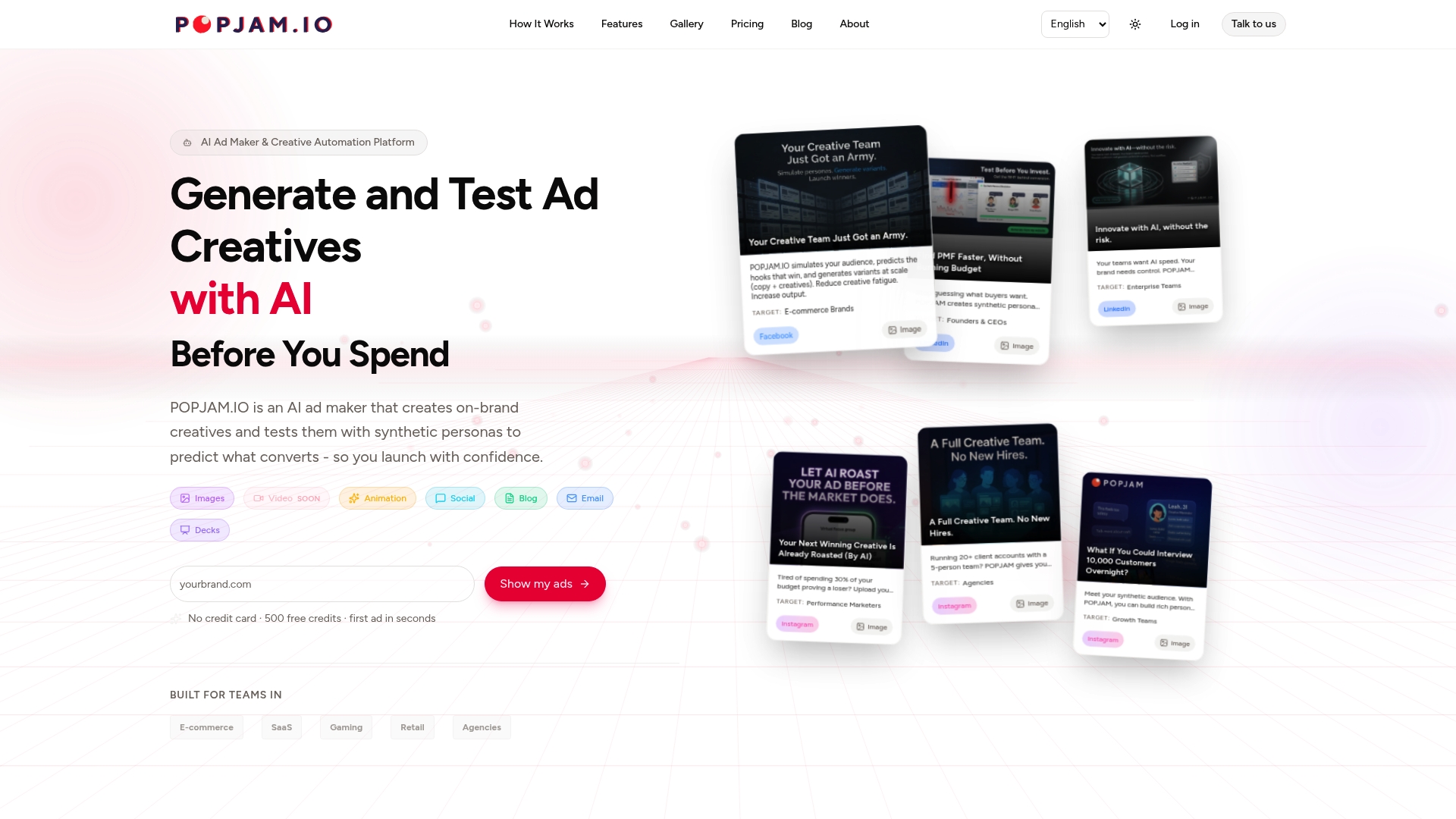
- The Free plan lets you try the core workflow without commitment, and paid tiers (Starter at 29 € per month, Essential at 99 € per month, and Business at 399 € per month) add capacity as your testing volume grows, per the pricing page.
- Credit packs cover extra generation without forcing a plan upgrade; current details are available on the pricing page.
- The platform supports exports native to major social and advertising platforms to help move validated concepts into your existing workflow.
If pre-launch testing is the gap in your current process, start with the AI ad generator and see what a scored concept looks like before you commit spend to it.
Sources
- Highly Awarded Creative Ideas are Significantly More Effective, WARC Research Reveals | LBBOnline
- New report shows how AI can close the creative measurement gap
- How KFC integrated creative quality into their marketing effectiveness assessments
- Create A/B experiments for Demand Gen campaigns - Google Ads Help
FAQ
What is creative testing?
Creative testing is the structured practice of comparing ad variants against each other, usually by changing one variable at a time, to find out which version performs better against a defined metric like conversion rate or click-through rate. It relies on controlled experiments rather than guesswork, often using platform tools like Google Ads experiments or Meta’s creative test flow.
What is a creative plan?
A creative plan is a written framework that defines the objective, hypothesis, primary metric, budget stages, and decision rules for testing and scaling ad creative before and during a campaign. It typically moves through a pilot phase, a validation phase, and a scale phase, with documentation at each step so results are repeatable.
What is creative testing in Meta Ads and how is it used?
In Meta Ads Manager, creative testing lets advertisers select multiple ad variants, set a shared budget and duration, and let the platform split traffic between them automatically, as described in Meta’s own setup guidance. Marketers use it to compare formats, hooks, or visuals under controlled conditions before committing larger budgets to a winner.
Can you give me an example of test marketing?
A simple example is running two versions of a video ad, one that opens with a product demo and one that opens with a customer testimonial, under identical budgets and audiences, then comparing click-through rate and conversion rate after reaching the platform’s recommended minimum conversions. The version that clears the predefined threshold on the primary metric becomes the one you scale, while the other gets archived as a documented learning.