

Pretest Ads Before You Spend with Brand Voice Prompts for Marketers
Layer brand voice prompts with examples and versioning, then pretest ad variations to ensure consistent, on brand copy before you spend.

Brand voice prompts are structured instructions that tell an AI model exactly how your brand sounds, so every ad, email, and support reply reads like it came from the same person. Use the layered template below (voice core, context, examples, rules) plus the ready-to-run prompts further down to produce consistent copy across channels, then validate the output before it ever reaches a customer. This page gives you both the templates and the checks to keep them honest.
TL;DR:
- A layered prompt structure including a voice core, context, examples, and rules is essential to maintain on-brand tone and consistency across channels.
- Without strict control layers and regular testing, AI-generated copy can drift off-brand, especially when prompts lack contrast and specific examples.
- Validating generated copy against synthetic audience personas before publishing helps prevent costly mistakes and ensures alignment with brand voice.
- Versioning prompts and incorporating human editorial oversight are vital to sustain tone consistency over multiple content pieces and campaigns.
- Relying solely on general adjectives like “friendly” is ineffective; contrastive examples and concrete rules improve AI adherence to brand personality.
Table of Contents
- Why Structured Brand Voice Prompts Work (And Where They Fail)
- The Layered Prompt Template You Can Reuse
- Ready-to-Use Brand Voice Prompts by Channel
- How to Test and Validate AI-Generated Brand Copy
- Prompt Tuning Checklist and Common Mistakes
- Where Brand Voice Prompts Fit an Ad Testing Workflow
- What Marketers Get Wrong About “Brand Voice” and AI
- Generate On-Brand Ads, Then Prove They Work Before You Spend
- Sources
- FAQ
Why Structured Brand Voice Prompts Work (And Where They Fail)
A prompt is really an instruction set. It encodes personality, vocabulary, and constraints the same way a style guide does, except a model reads it fresh every time instead of internalizing it once. That is the appeal and the catch. Large language models scale production beautifully, generating fifty ad variations in the time a copywriter drafts three, but they drift without guardrails, according to academic research on brand voice management, which proposes a five-level control system: voice core, an adaptive layer for context, instruction management, editorial oversight, and ethics and transparency.
The practical takeaway is that a single-sentence prompt like “write in our brand voice” almost never works. You need layers.
- A voice core defines who you are in a handful of traits.
- A context layer tells the model who it’s talking to and why.
- Examples show, rather than describe, what on-brand sounds like.
- Rules set the hard boundaries the model can’t cross.
Skip any one of those and you get copy that’s technically correct but tonally off, which is worse than obviously wrong copy because it slips past a quick skim.
The Layered Prompt Template You Can Reuse
Here’s the structure that solves most consistency problems, built to work whether you’re prompting ChatGPT, Claude, or a creative tool with a prompt field.
- Voice core. List 3 to 5 traits plus a one-sentence definition each. Not “friendly,” but “friendly: we talk like a smart coworker, not a brochure.”
- Context. State the audience, the goal, the channel, and the call to action in one or two lines. A prompt without a target reader defaults to generic marketing filler.
- Examples. Give two on-brand lines and two off-brand lines. Contrast teaches faster than description, and practitioner guidance on brand voice guidelines treats do/don’t pairs as the backbone of any usable voice chart.
- Rules. Vocabulary to use or avoid, contraction policy, emoji policy, sentence length caps, and formatting limits.
For few-shot use, paste 3 to 5 real examples of your best-performing copy directly into the prompt before asking for new output. For instruction-only use (when you have no strong samples yet), lean harder on the voice core and rules layers, and expect to revise the first two or three outputs before the model locks in.
Pro Tip: Open every prompt with a role instruction, such as “Act as a senior copywriter for a B2B SaaS brand.” Practitioner testing from Copyhackers found role-play framing consistently improves alignment over generic requests.
Ready-to-Use Brand Voice Prompts by Channel
Copy these, swap in your own voice core and product details, and run them as-is. Each one assumes you’ve already pasted your voice core and two do/don’t examples above it in the same conversation.
- Short ad copy: “Write 5 variations of a 15-word ad headline for [product] targeting [audience]. Tone: [trait 1, trait 2]. Optimize for click-through, not brand awareness. Avoid exclamation points and superlatives like ‘best’ or ‘ultimate.’”
- Social post: “Write a 3-line Instagram caption announcing [feature/offer]. Match the voice core above. Max 280 characters. No emoji unless the brand rule allows it. End with a question, not a hard CTA.”
- Social reply: “Respond to this customer comment: [paste comment]. Keep it under 2 sentences, acknowledge the specific concern by name, and stay in the brand voice defined above. Never use corporate deflection phrases.”
- Email subject line: “Generate 8 subject lines for an email announcing [offer] to [persona]. Under 45 characters. Curiosity-driven, not clickbait. Match brand voice traits [x, y].”
- Email body: “Write a 150-word email body for [persona] promoting [offer]. Open with the benefit, not the company name. One CTA only: [CTA text]. Match the do/don’t examples above.”
- Support reply: “Write a support response to a customer who [describes issue]. Lead with empathy in one sentence, then the fix. If the issue requires escalation, say so plainly and give a timeframe. Stay warm but never overpromise.”
- Long-form/landing page: “Write a 200-word section for a landing page about [feature]. Preserve the brand voice traits above. Include the phrase [SEO anchor] naturally once. Subheading should ask a question a buyer would actually search.”
Paste two or three of your top-performing past examples into any of these prompts before running them. According to Copyhackers’ testing, few-shot examples consistently produce tighter, more usable first drafts than instruction-only prompts.
How to Test and Validate AI-Generated Brand Copy
Generating on-voice copy is half the job. Proving it stayed on-voice, at scale, across a content calendar, is the harder half, and it’s the one most teams skip.
- Run do/don’t comparison tests. Feed the model both an on-brand and off-brand sample of the same message and ask it to flag which is which and why. If it can’t tell the difference, your voice core needs sharper language.
- Version your prompts. Treat every prompt like code. Save the version that worked, log what changed, and note why you changed it. This is exactly the instruction management layer that research on LLM brand voice control identifies as the difference between scalable consistency and slow drift.
- Build a human-in-the-loop gate. No AI-generated copy ships without one editorial pass, especially on customer-facing channels like support and email.
- Watch for sentiment drift. Track whether tone shifts over a content run, not just whether a single piece looks fine in isolation.
- Canary-test before full rollout. Run new prompt versions on a small audience segment first, and compare engagement against your existing baseline before scaling the prompt across every channel.
Consistent, well-governed messaging tends to build recognition over repeated exposure. The 3-7-27 rule, used as a practitioner heuristic suggests it takes roughly three touches for basic awareness, seven for category association, and around 27 for emotional recall, which is precisely why voice drift across dozens of AI-generated touchpoints does real damage instead of staying a minor inconsistency.
Prompt Tuning Checklist and Common Mistakes
Before you trust a prompt for repeat use, run it against this list:
- Audience is named specifically, not “our customers.”
- Vocabulary rules include actual banned and preferred words, not vague adjectives.
- At least two on-brand and two off-brand examples are included.
- A length limit is stated for the channel.
- A rule exists for what the model should never do (overclaim, use slang, add emoji).
The most common failure is vague adjectives with no example attached, “sound bold,” with nothing showing what bold means in your brand’s actual words. A close second is mixing channel rules, using an email-length prompt to generate a social caption. A third is skipping negative examples entirely, since a model shown only what to do will still guess wrong on edge cases.
Pro Tip: When output drifts, don’t rewrite the whole prompt. Add one new off-brand example based on the exact output that went wrong. Targeted correction fixes drift faster than a full rewrite.
Where Brand Voice Prompts Fit an Ad Testing Workflow
Prompts are the input stage of a bigger loop: generate, test, refine. Once a layered prompt produces a batch of on-voice ad variations, the smarter move is validating them against real audience reaction before spend, not after. POPJAM uses synthetic persona testing to simulate how different audience segments react to a creative, which complements editorial review rather than replacing it. Treat prompts and testing as a pairing, not a single-source guarantee. Neither one alone catches everything.

What Marketers Get Wrong About “Brand Voice” and AI
Most brand voice advice treats tone as a personality quiz, pick three adjectives, done. That’s the gap. Adjectives without contrast are decoration, not instruction, and a model handed “playful” with no example will default to whatever “playful” means in its training data, which is rarely what you meant.

The research actually supports a narrower, less glamorous conclusion: governance beats inspiration. A brand voice guide that lives in a slide deck and never gets versioned or tested is functionally the same as no guide at all, because nobody, human or model, revisits it consistently. The teams getting real mileage out of AI copy are the ones treating prompts like living documents, updated when output drifts, tied to specific do/don’t pairs, and checked against real audience reaction before wide release.
If you take one thing from this, prioritize the examples layer over the adjectives layer. Two sharp contrast pairs will fix more drift than a paragraph of trait descriptions ever will. And validate before you scale. A voice that reads fine to your internal team can still land flat, or badly, with the audience actually seeing it.
— Doruk
Generate On-Brand Ads, Then Prove They Work Before You Spend
Writing the perfect prompt only gets you half the answer. You still don’t know if that on-brand ad will actually convert, and traditional testing means burning real ad spend to find out. POPJAM closes that gap: generate ad creatives that follow your voice core and rules, then run them against synthetic buyer personas that simulate real audience reactions before a single dollar goes to Meta, Google, TikTok, LinkedIn, or Reddit.
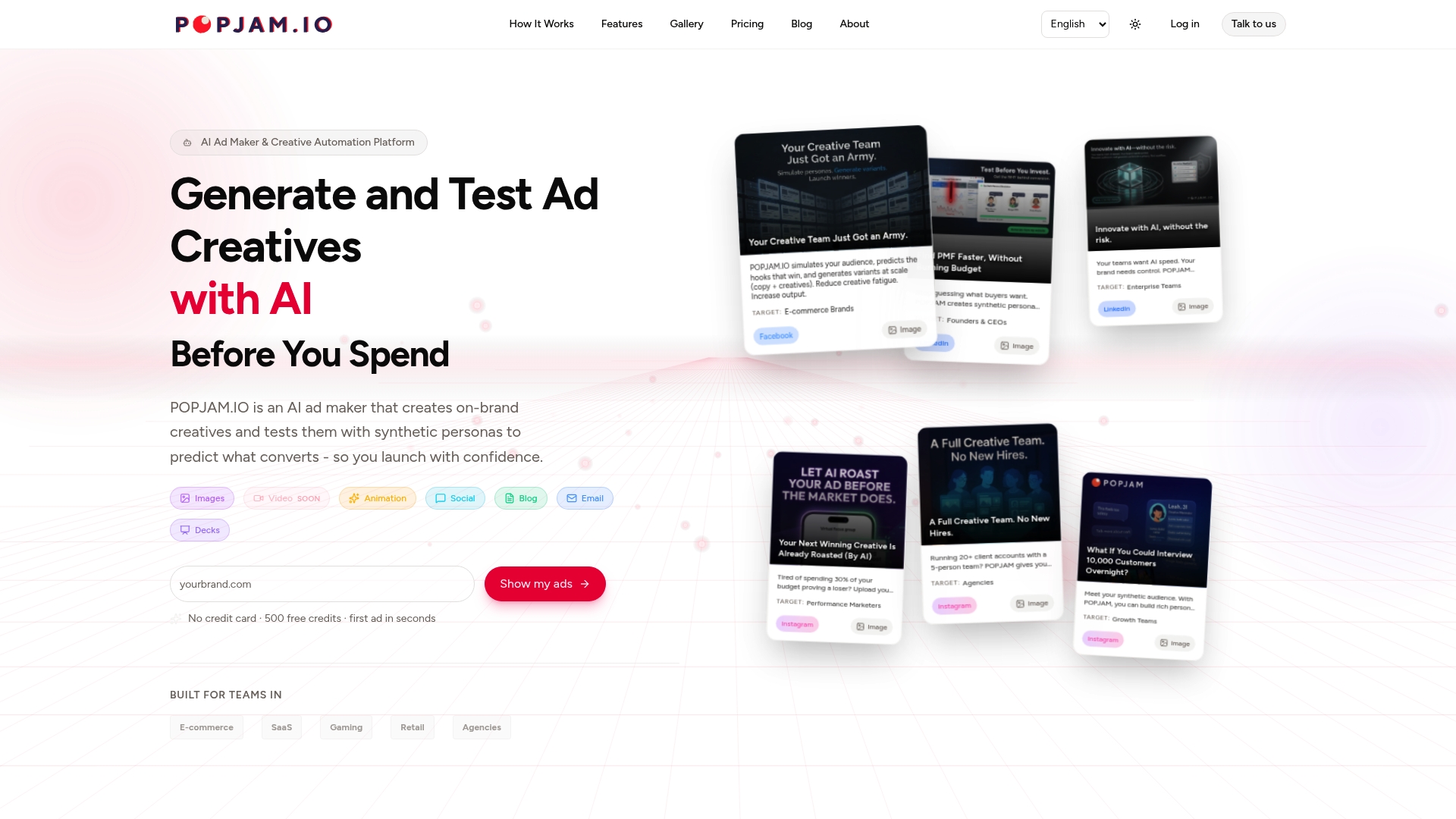
The workflow mirrors everything covered above. You feed your layered voice prompt into creative generation, POPJAM produces on-brand variations across image, video, and social formats, and the platform’s AI ad generation and testing tools score how different audience segments respond, giving you qualitative and quantitative feedback instead of a guess. Compare that against the full feature set to see how generation and testing connect in one pass.
Plans start with a Free tier and scale through multiple paid tiers, with credit packs available for teams that need extra generation volume. Check current pricing and plans on the client’s website. Check current pricing and plans and run your first prompt-to-test cycle before your next campaign goes live.
Sources
- Brand Voice Management in the Era of Large Language Models
- Brand Voice Strategy: How to Build Brand Guidelines | Sprinklr
- Brand Voice with AI | ChatGPT 4 prompts by Copyhackers
FAQ
What Are Some Good Prompts for Branding?
The strongest branding prompts combine a voice core (3 to 5 traits with definitions), audience and channel context, two on-brand and two off-brand examples, and explicit vocabulary rules. A prompt that just says “write in our brand voice” without those layers tends to produce generic output regardless of the model.
What Are Examples of Brand Voice?
Brand voice shows up as consistent word choice, sentence rhythm, and personality across every channel, a brand that’s “playful” might use contractions, short sentences, and pop culture references, while a “trusted advisor” voice avoids slang and leans on data. The clearest way to define yours is contrast: write one on-brand sentence and one off-brand sentence for the same message, then note exactly what changed.
What Is the 3-7-27 Rule of Branding?
The 3-7-27 rule, used as a practitioner heuristic is a practitioner heuristic suggesting it takes about three exposures to build basic awareness of a brand, seven to form a category association, and around 27 exposures to create emotional recall. It’s used informally to plan content cadence and channel mix, not as a strict scientific law.
What Are Voice Prompts?
Voice prompts, in a branding context, are written instructions given to an AI model that specify tone, vocabulary, and constraints so generated copy matches a brand’s established personality. They typically layer a voice core, context about the audience and channel, sample examples, and hard rules, rather than relying on a single vague adjective like “friendly.”
How Do I Keep AI-Generated Copy On-Brand at Scale?
Version every prompt like a piece of code, run do/don’t comparison tests before publishing, and keep a human editorial gate on customer-facing channels. Pairing prompt generation with pre-launch testing, such as synthetic persona feedback, adds a validation layer that catches drift editorial review alone can miss.