

Stop Bad Ads Before Spend: 6 Step Ad Sentiment Analysis for Marketers
A marketer's six step workflow for ad sentiment analysis: multimodal measures, KPI validation, and POPJAM persona tests to cut creative waste.

Ad sentiment analysis measures the emotions people express about an ad, then turns those signals into decisions that cut creative waste and lift brand outcomes. Ad-evoked feelings have a substantial and direct influence on brand evaluations, separate from whether people simply like the ad. We built POPJAM to put that kind of insight to work before a single dollar hits the ad platform.
TL;DR:
- Automated sentiment analysis tools vary in accuracy, with multimodal pipelines providing the best results for video and image ads.
- Validating sentiment models against human annotations is essential to avoid misleading insights caused by bias or low confidence.
- Running sentiment analysis early in campaigns helps identify emotional misfires, allowing cost-effective adjustments before significant media spend.
- Combining sentiment scores with specific emotional and aspect-based insights enables precise creative improvements and audience segmentation.
- Using synthetic personas for pre-launch testing can catch weak creative concepts and improve targeting without risking real audience backlash.
Table of Contents
- What ad sentiment analysis actually measures
- How sentiment analysis works under the hood
- Step-by-step: how to run an ad sentiment analysis
- Tool categories and where each one fits
- Where sentiment analysis pays off fastest
- Reading the numbers and connecting them to KPIs
- Limitations, bias, and how to keep signal quality high
- How POPJAM puts sentiment-informed testing into practice
- When to prioritize sentiment analysis and how to scale it
- POPJAM: test ads before you spend on them
- FAQ
- Sources
What ad sentiment analysis actually measures
Sentiment and emotion aren’t quite the same thing, and mixing them up leads to messy reporting. Sentiment is the simple positive, negative, or neutral read on a piece of text or a reaction. Emotion goes deeper: joy, anger, surprise, disgust, the specific feeling behind the reaction. Researchers often add two more dimensions on top of that: valence (how positive or negative) and arousal (how intense or calm).
Then there’s the question of scope. Ad-level sentiment tells you how people felt about one specific creative, maybe even one specific moment in a video. Brand-level sentiment aggregates across dozens or hundreds of ads to tell you how people feel about the brand overall. Aspect-based sentiment analysis splits the difference, tagging feelings to specific elements, the voiceover, the product shot, the call to action, so you know exactly what to fix.
Because ads combine images, sound, and copy, AI for agencies delivers productivity gains that help overcome the limitations of text-only sentiment tools. A multimodal approach that fuses audio, visual, and text signals significantly improves affect prediction compared with text alone, especially for video creatives.
- Sentiment is the broad positive, negative, or neutral tone.
- Emotion names the specific feeling: joy, fear, anger, surprise.
- Valence and arousal add intensity and direction to the emotional read.
- Aspect-based scoring ties feelings to specific creative elements rather than the whole ad.
How sentiment analysis works under the hood
Most sentiment systems fall into one of a few buckets, and knowing which one a tool uses tells you a lot about what you’ll get.
Lexicon-based methods score words against a dictionary of pre-tagged terms. They’re fast and cheap to run, but they stumble on sarcasm, slang, and anything context-dependent. Supervised machine learning models fix some of that by learning from labeled examples instead of fixed word lists, trading setup time (you need annotated training data) for sharper precision.

Large language models trained or fine-tuned specifically on consumer language go further still. A fine-tuned LLM approach called Linguistic eXtractor detects a wide range of consumption-related emotions and evaluations more accurately than lexicon methods, which matters because those richer emotion signals predict product ratings and purchase behavior beyond what a simple star rating shows.
For video and image ads, none of that works alone. Multimodal pipelines combine visual analysis, audio tone, and on-screen text to catch what a transcript misses, like a cheerful voiceover over a tense visual cue.
- Lexicon-based scoring: fast, cheap, weak on sarcasm and context.
- Supervised ML classifiers: need labeled data, deliver sharper precision.
- Fine-tuned LLMs: capture nuanced emotion and evaluation signals from consumer text.
- Multimodal pipelines: fuse visual, audio, and text data for video and image ads.
Whatever stack you use, validate it against human annotations and holdout sets before trusting the output.
Pro Tip: Run a small human-annotated calibration set through any new sentiment model before trusting it on a full campaign. A 200 to 300 sample batch is usually enough to catch obvious blind spots.
Step-by-step: how to run an ad sentiment analysis
Running this well is less about the model you pick and more about the discipline around it.
- Set your objective and KPIs first. Decide whether you’re watching brand lift, click-through rate, conversions, or a sentiment threshold, before you collect a single comment.
- Collect data from every relevant touchpoint. Pull ad creative files, social comments, paid placement reactions, survey voice-of-customer data, and view-through behavior.
- Sample and annotate with calibration sets. Platforms behave differently, so build a reference set per channel and keep annotation guidelines consistent across reviewers.
- Model and aggregate at three levels. Score at the sentence level, roll up to the ad level, then roll up again to the audience level, keeping confidence scores and metadata attached at each step.
- Validate against real outcomes. Use A/B tests, holdout groups, or pre and post lift studies to confirm that sentiment shifts actually track with the KPIs you set in step one.
- Act on what you find. Iterate the creative, adjust placement, segment messaging by audience, and keep monitoring rather than treating this as a one-time check.
The step most teams skip is validation. A sentiment score that doesn’t move alongside an actual business metric is a vanity number, not an insight.
Tool categories and where each one fits
No single tool covers the whole workflow, so it helps to think in categories rather than brand names.
- Social listening suites track public conversation and flag crisis-level sentiment spikes in near real time.
- Voice-of-customer and survey-integrated platforms connect sentiment to structured, validated consumer feedback rather than open social chatter alone.
- Creative-testing and simulation platforms let you test synthetic audience reactions before a creative ever goes live, which is where pre-launch validation happens.
- Multimodal analysis toolkits and custom ML pipelines handle video ads where tone, pacing, and visual cues carry as much meaning as the words.
- BI and export tooling links sentiment outputs back to campaign dashboards so the numbers sit next to CTR, CPA, and brand lift instead of living in a separate report.
Most mature marketing teams end up running at least two of these categories side by side: one for listening after launch, one for testing before it.
Where sentiment analysis pays off fastest
Some applications deliver value within a single campaign cycle, others compound over quarters.
- Pre-launch creative validation catches a weak concept before any media spend goes out the door.
- Real-time monitoring flags a negative sentiment spike early enough to pause a campaign before it does real brand damage.
- Placement and context tuning avoids running an upbeat ad next to somber content, since a receptive channel environment boosts campaign impact while a poor contextual fit can undercut it.
- Audience message tailoring uses emotion data to match tone to segment, rather than running one creative for everyone.
- Long-term brand health tracking spots creative fatigue before it shows up as a slump in conversion rate.
The common thread is timing: the earlier you catch an emotional misfire, the cheaper it is to fix.
Reading the numbers and connecting them to KPIs
Sentiment outputs usually arrive as a handful of standard metrics: an overall sentiment score, a distribution across emotion categories, valence and arousal readings, and a confidence interval around each. None of those numbers mean much in isolation.
Start by deciding how you’ll aggregate. A simple mean can get skewed by a handful of extreme reactions, so many teams prefer a median, or a weighted average that gives more weight to high-impression or high-engagement comments. Set a baseline from your last few campaigns before judging a new one. A move within normal noise isn’t a signal, it’s just variance.
- Sentiment score and emotion distribution show overall tone and the specific feelings behind it.
- Valence and arousal add intensity, useful for spotting ads that provoke strong reactions either way.
- Confidence intervals tell you whether a shift is real or just sampling noise.
- Weighted aggregation prevents a few loud outliers from distorting the read.
Digital advertising’s brand-attitude effect tends to show up most clearly in perceived value, based on an analysis of ten million brand-attitude observations and $264 billion in ad spend across 575 advertisers. That’s a useful reminder that different ad types move different brand metrics, so match your sentiment KPIs to the attitude dimension you actually care about. Once a shift looks real, move from observation to a controlled test before betting the next budget cycle on it.
Limitations, bias, and how to keep signal quality high
Sentiment data has real blind spots, and pretending otherwise leads to bad calls.
Platform skew is a big one: comments on one channel don’t represent your whole audience, let alone the general public. Sarcasm and figurative language still trip up a lot of models, and demographic gaps in training data can make a tool read certain groups’ language less accurately than others. On the technical side, watch for low-confidence predictions that get treated as certainties, and for multimodal signals that disagree with each other, like a transcript reading as positive while the visual tone reads as flat.
- Platform and demographic skew can make a sample feel representative when it isn’t.
- Sarcasm and figurative language remain weak points for most automated systems.
- Low-confidence predictions deserve a flag, not a silent pass-through into your dashboard.
- Conflicting multimodal signals are worth a human look rather than an automatic average.
Keep a human reviewer in the loop for edge cases, retrain models periodically as language shifts, and be transparent with stakeholders about where synthetic or simulated feedback stands in for real consumer data, including how any persona-based testing handles privacy.
Pro Tip: Flag every prediction below your confidence threshold for manual review instead of folding it into the aggregate score. It’s a small step that quietly protects your whole dataset.
How POPJAM puts sentiment-informed testing into practice
We built POPJAM to sit right at the step most teams struggle with: validating a creative before it ever reaches a live audience. Our platform runs ad concepts against synthetic personas built from psychographic profiles, collecting both qualitative and quantitative feedback before spend goes out.
- Synthetic persona testing simulates how different audience segments might react to a creative, pre-launch.
- Creative iteration lets teams refine messaging and visuals based on that simulated feedback before launch.
- Platform-native exports cover Meta, Google, TikTok, LinkedIn, and Reddit formats.
- Full creative lifecycle support spans images, video, animation, social posts, email, and presentations.
In the six-step workflow above, this is where we plug in primarily at steps three through six: calibration, modeling, validation, and the creative iteration that follows.
When to prioritize sentiment analysis and how to scale it
Start small. A single campaign pilot tells you more than a company-wide rollout before you know your own baseline. Show procurement a before-and-after on one concrete metric, not a slide deck of theory.
The biggest mistake we see is treating sentiment scores as automatic truth. Keep a human checking the edge cases. Automation should speed up your judgment, not replace it.
— Doruk
POPJAM: test ads before you spend on them
Here’s the part that actually changes campaign economics: you don’t need to guess how an audience will react before you launch. We built POPJAM so you can generate on-brand ad creatives and run them against synthetic buyer personas first, catching a weak concept while it still costs nothing to fix.
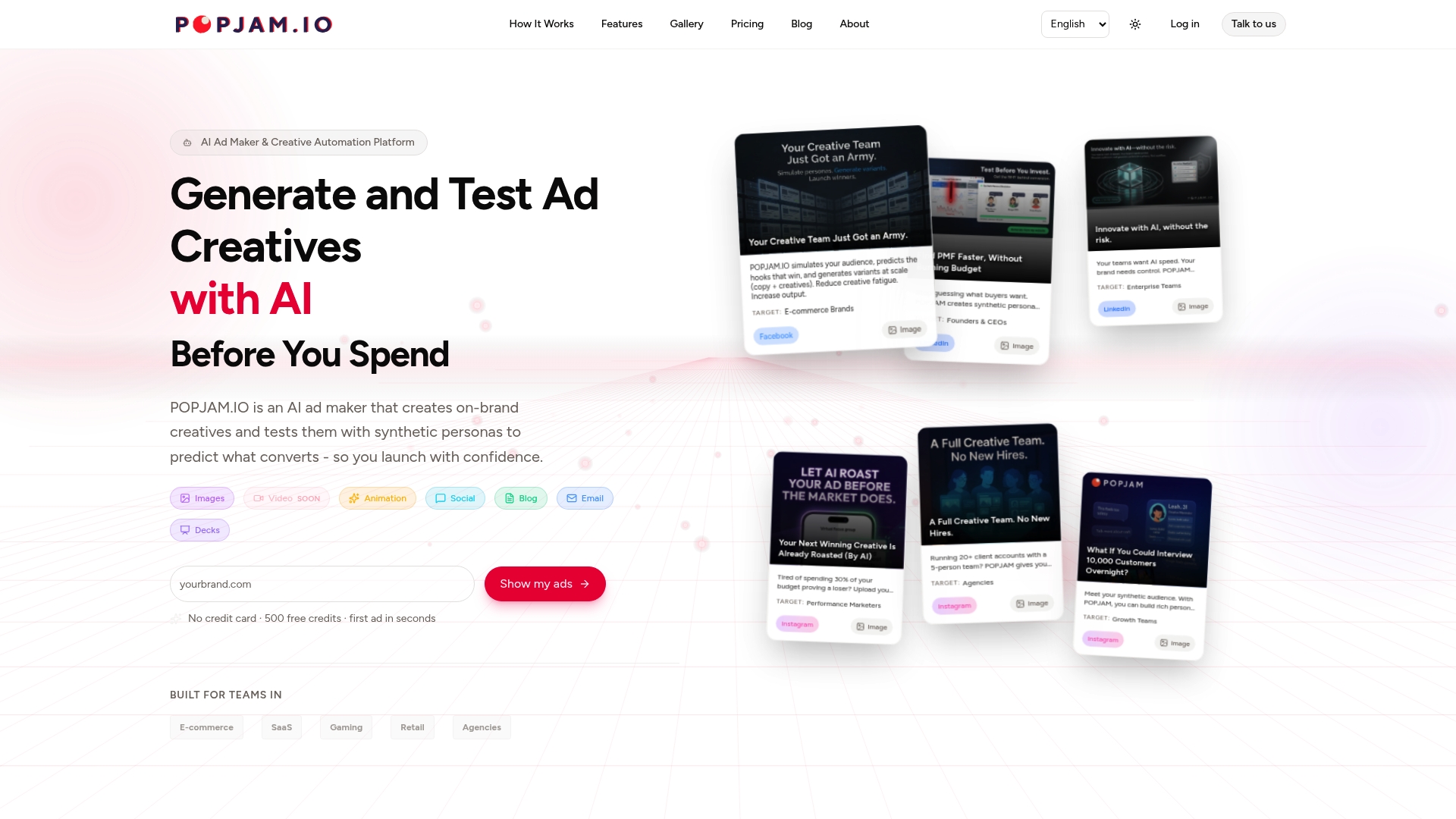
If you’re running performance campaigns across Meta, Google, TikTok, LinkedIn, or Reddit, this is the step that sits between your creative draft and your media budget. Our Starter plan runs 29 € per month, with Essential at 99 € per month and Business at 399 € per month for larger teams, and credit packs available from 10 € for 1,000 credits if you need extra generation capacity between cycles. Start with our AI ad generator and run your next creative through persona testing before it goes live.
FAQ
How can social media be used to analyze sentiment?
Social listening tools scan public posts, comments, and reactions to classify them as positive, negative, or neutral, then group results by topic, hashtag, or time period. This gives advertisers an early read on how a campaign is landing, though platform-specific audience skew means the results reflect the people who comment publicly, not necessarily your whole target audience.
Can you provide an example of an ad analysis?
A typical analysis pulls comments and engagement data from a running ad, scores them for sentiment and specific emotions like joy or frustration, then breaks results down by audience segment and creative element. Teams compare that output against a pre-set baseline to decide whether the ad needs a creative change, a new audience, or a different placement.
What does sentiment mean in the context of marketing?
In marketing, sentiment refers to the overall positive, negative, or neutral tone behind how people talk about a brand, product, or ad. It’s often paired with emotion detection, which identifies specific feelings like excitement or skepticism, giving a fuller picture than a single tone score on its own.
What are the different types of sentiment analysis methods and tasks?
The main methods are lexicon-based scoring, which matches words against a pre-built dictionary, supervised machine learning, which learns from labeled examples, and fine-tuned language models, which capture more nuanced emotion and context. Common tasks include document-level sentiment, aspect-based sentiment tied to specific features, and multimodal analysis that combines text, audio, and visual signals for video ads.
Sources
- The Influence of Ad-Evoked Feelings on Brand Evaluations: Empirical Generalizations from Consumer Responses to More Than 1,000 TV Commercials
- Affect recognition in ads with application to computational advertising
- Media Reactions 2025: Where do people prefer advertising?