

Generative AI for Marketing: Your 2026 Playbook

Generative AI for marketing is defined as the use of AI systems that automatically produce, personalize, and test marketing content at scale. This is not a future trend. 76% of CMOs already see it as fundamental to staying competitive, and those who delay adoption are falling behind fast. The technology covers everything from automated ad copy and image generation to hyper-personalized email sequences and synthetic audience testing. If you’re a marketing professional or business owner trying to figure out where AI actually fits in your workflow, this guide cuts straight to what works, what doesn’t, and what’s coming next.
How does generative AI enhance marketing creative processes?
Generative AI removes the biggest bottleneck in marketing: content production speed. Automated content pipelines can produce publication-ready long-form content in 30–60 minutes. That’s a task that used to eat up a full day of a writer’s time.
The real power shows up in personalization. Instead of writing one email for your whole list, AI generates hundreds of message variants, each tailored to a specific psychographic profile or behavioral segment. 64% of marketing leaders plan to deploy AI for content personalization within 12–24 months. That number tells you where the industry is heading.
Here’s what AI-driven creative production actually looks like in practice:
- Ad copy generation: AI writes multiple headline and body copy variants based on your product brief, tone guidelines, and audience segment data.
- Visual creative production: AI generates on-brand image and video ad concepts using your brand colors, fonts, and style references.
- Email personalization: AI builds dynamic email content blocks that change based on the recipient’s past behavior or purchase history.
- Social content calendars: AI drafts weeks of posts across platforms, maintaining a consistent brand voice throughout.
- Landing page variants: AI creates A/B test versions of landing pages with different value propositions for different audience segments.
The catch? Generic AI output sounds generic. The brands winning with AI-generated content train their models on proprietary brand assets, past campaign data, and customer language. That’s what separates publish-ready content from content that needs a full rewrite.
Pro Tip: Feed your AI tools your top-performing past campaigns, brand voice guidelines, and customer reviews. The model learns your language, not just generic marketing language.
What are the best practices for integrating generative AI with existing workflows?
Getting AI into your marketing stack is not plug-and-play. The biggest failure point is data quality. Data integration failures directly hamper AI’s ability to generate personalized insights. If your customer data is siloed, incomplete, or inconsistent, your AI outputs will reflect that mess.
Here’s a practical integration sequence that actually works:
- Audit your customer data first. Map every data source: CRM records, email engagement history, ad performance logs, and social media analytics. Identify gaps and inconsistencies before connecting anything to an AI system.
- Build a unified customer view. Merge your data sources into a single customer profile layer. AI needs a complete picture of each segment to generate context-aware content.
- Connect AI to your proprietary data. Connecting AI to CRM data and social performance history enables context-aware, strategic outputs that reflect your brand’s actual audience, not a generic one.
- Implement quality gates at every stage. Quality gates and validation loops after each content phase reduce hallucinations and off-brand outputs. Think of them as automated editors that catch errors before content reaches a human reviewer.
- Start with one workflow, not all of them. Pick your highest-volume, most repetitive content task. Automate that first. Measure results. Then expand.
The emerging model here is agentic AI. Agentic AI shifts marketing from isolated AI tasks to full orchestration of complex workflows across strategy, targeting, content production, and analytics. Instead of using AI as a single tool, agentic systems coordinate multiple AI agents working together. One agent researches the audience, another writes the copy, another generates the visual, and another tests the combination before it goes live.
Pro Tip: Don’t skip the validation layer. Build a human review checkpoint into every AI workflow, especially for brand-sensitive content like ad copy and product descriptions.
How do marketing teams measure the impact and ROI of generative AI tools?
Measurement is where most teams drop the ball. They adopt AI tools, produce more content, and then struggle to connect that output to actual business results. The fix is tracking three specific metric categories from day one.

AI-generated ad creatives have delivered up to 47% CTR lift in real campaigns. That’s not a theoretical number. It reflects what happens when AI tests dozens of creative variants and surfaces the ones that actually resonate with a specific audience before you spend budget on them.
The metrics that matter most:
- Content production speed: How long does it take to go from brief to publish-ready asset? Track this before and after AI adoption.
- Creative variant volume: How many ad or email variants can your team produce per sprint? AI should multiply this number significantly.
- Campaign engagement lift: Measure CTR, open rates, and conversion rates on AI-generated content versus manually produced content.
- Cost per creative asset: Divide total creative production cost by the number of assets produced. AI should drive this number down over time.
- Ad spend efficiency: Track how much budget you waste on underperforming creatives. Pre-launch ad testing tools cut this waste by identifying weak creatives before they go live.
The smartest approach combines AI content generation with pre-spend testing. You generate multiple creative variants with AI, test them against synthetic buyer personas, and only spend budget on the combinations that score highest. That’s how you scale creative marketing without burning through your budget on guesses.
What future trends will shape generative AI in marketing?
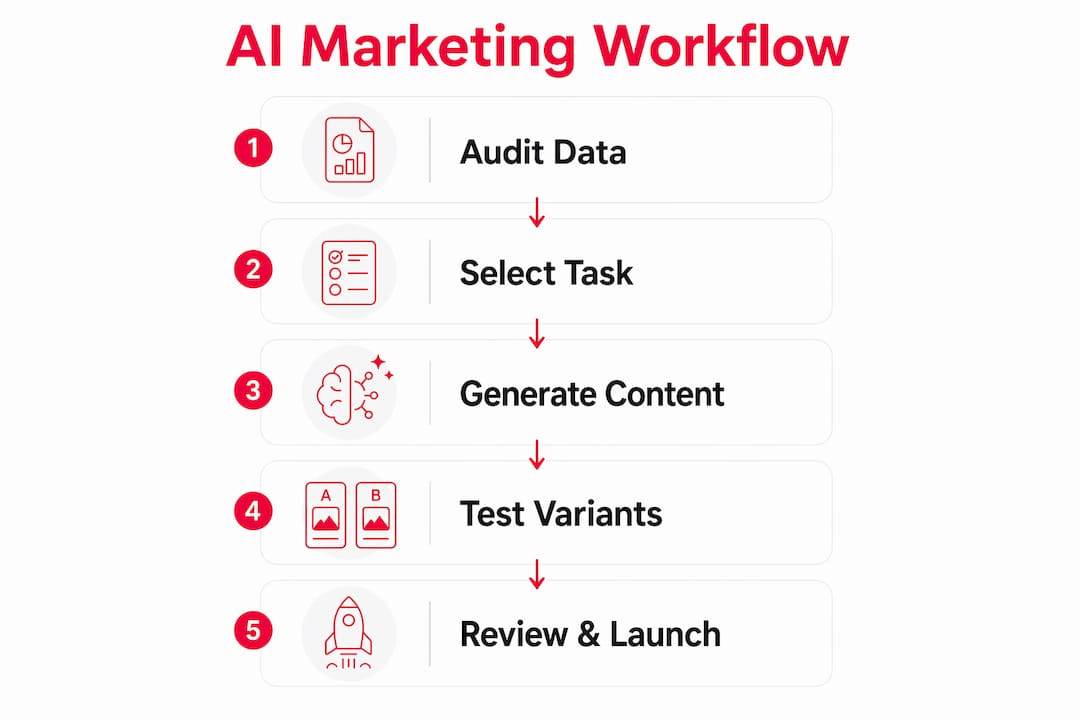
The next phase of AI in digital marketing is not about better individual tools. It’s about unified systems. Marketing teams are moving from “we use AI for copywriting” to “our entire campaign workflow runs through an AI console.”
Several shifts are already underway:
- Agentic marketing suites: Single platforms that coordinate research, content creation, testing, publishing, and analytics through interconnected AI agents. This replaces the current patchwork of separate tools.
- Real-time personalization at scale: AI systems that update messaging dynamically based on live behavioral signals, not just historical segments.
- Synthetic audience testing: Before any ad goes live, AI simulates how different psychographic profiles will respond. POPJAM already does this with its Synthetic Personas feature, giving marketing teams pre-launch feedback that used to require expensive focus groups.
- Data governance frameworks: Regulations around AI-generated content and consumer data are tightening. Marketing teams need clear policies on what data feeds their AI models and how outputs are reviewed before publication.
- Continual model training: Static AI models go stale fast. The brands that win will treat AI training as an ongoing process, feeding new campaign data, customer feedback, and brand asset updates into their models regularly.
The human oversight question is real. Many marketing teams underestimate how much human review AI-generated content still needs, especially for brand safety and factual accuracy. Speed without oversight creates off-brand content at scale. That’s worse than slow content.
The future of performance marketing belongs to teams that treat AI as a creative partner, not a replacement. The teams that build strong human-AI feedback loops now will have a compounding advantage over the next three years.
Key Takeaways
Generative AI for marketing delivers its highest ROI when teams combine clean customer data, brand-trained AI models, and pre-spend creative testing in a single connected workflow.
| Point | Details |
|---|---|
| Data quality comes first | Unify CRM, ad, and behavioral data before connecting any AI system to avoid poor outputs. |
| Brand training is non-negotiable | AI trained on your brand voice and past campaigns produces publish-ready content with far less editing. |
| Test creatives before spending | Pre-launch AI testing against synthetic personas identifies winning variants before budget is committed. |
| Measure speed and engagement | Track content production time and campaign CTR lift to prove AI ROI to stakeholders. |
| Human oversight prevents brand risk | Build review checkpoints into every AI workflow to catch off-brand or inaccurate outputs. |
What I’ve learned from watching teams get AI wrong
Here’s the uncomfortable truth I keep seeing: most marketing teams adopt AI tools and immediately try to automate everything at once. They connect a content generator to their CRM, push out 500 email variants, and then wonder why engagement dropped.
The teams that actually win with AI start with one workflow and obsess over the data feeding it. I’ve watched brands with mediocre AI tools outperform brands with premium tools, simply because their customer data was cleaner and their brand guidelines were more specific. The tool is almost secondary.
The other mistake I see constantly is treating AI output as final output. It’s not. AI is a first draft engine, not a publishing button. The brands getting 47% CTR lifts are the ones running AI-generated variants through real testing before they spend a dollar. They’re not posting and praying. They’re running a system.
My honest recommendation: pick your single highest-volume creative task, feed your AI the best data you have, set up a validation checkpoint, and measure for 30 days before expanding. The compounding effect of doing this right in one area is more valuable than doing it poorly across ten areas.
Blend AI speed with human judgment. That combination is where the real results live.
— Doruk
POPJAM turns AI-generated creatives into tested, spend-ready ads
If you’re building out your AI marketing workflow, the creative testing step is where most teams still have a gap. Generating ad variants with AI is now table stakes. Knowing which variants will actually perform before you spend budget is the real advantage.
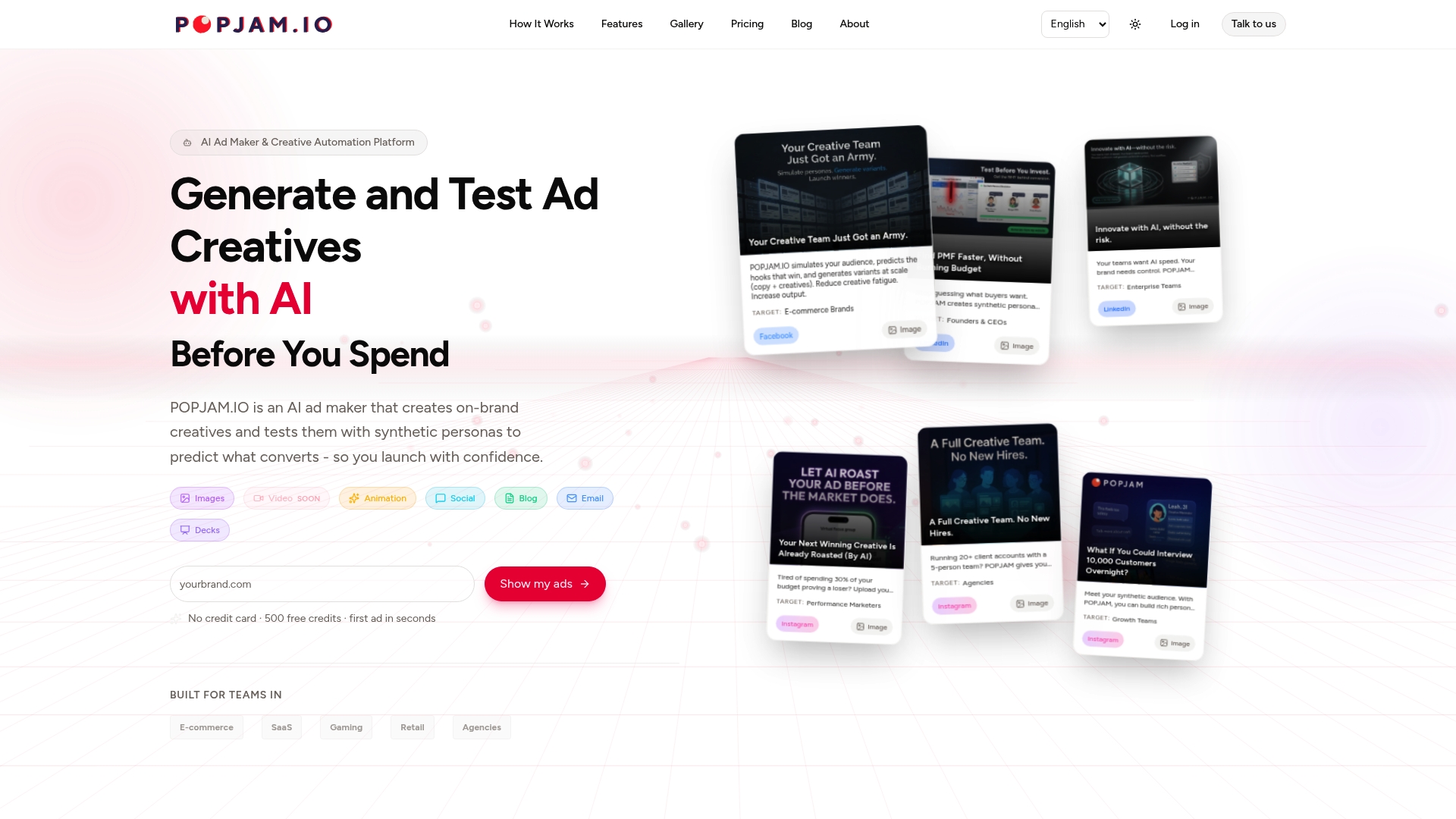
POPJAM’s AI ad maker generates on-brand ad creatives and then tests them against Synthetic Personas built from real psychographic profiles. You see how different audience segments respond to each creative before a single dollar goes to media spend. For e-commerce brands, SaaS companies, and agencies running high-volume campaigns, that pre-spend validation cuts wasted ad spend and reduces creative fatigue. The creative automation platform connects generation, testing, and publishing in one place.
FAQ
What is generative AI for marketing?
Generative AI for marketing is the use of AI systems that automatically create, personalize, and test marketing content including ad copy, images, emails, and landing pages. It replaces manual content production with automated pipelines that generate brand-aligned assets at scale.
How do I start using AI in my marketing workflow?
Start by auditing your customer data and picking one high-volume, repetitive content task to automate first. Clean data and a clear brand brief are the two inputs that determine whether AI output is usable or not.
What metrics prove generative AI ROI?
Track content production speed, creative variant volume, campaign CTR lift, and cost per asset before and after AI adoption. AI-generated ad creatives have delivered up to 47% CTR lift in real campaigns, making engagement lift the most direct ROI signal.
How does agentic AI differ from standard AI marketing tools?
Standard AI tools handle one task at a time, like writing copy or generating an image. Agentic AI coordinates multiple AI agents across an entire workflow, from audience research through content creation, testing, and analytics, without requiring manual handoffs between steps.
What is the biggest risk of using generative AI in marketing?
The biggest risk is publishing off-brand or inaccurate content at scale. Quality gates, validation loops, and human review checkpoints at each production stage are the standard controls that prevent AI speed from creating brand safety problems.