

Creative Fatigue: Diagnose and Fix It Fast
TL;DR:
- Creative fatigue occurs when repeated ad exposure reduces user response, necessitating genuinely new creatives.
- Diagnose and swap underperforming ad creatives based on ad-level frequency and CTR metrics, not campaign-wide data.
If your CTR is sliding week over week while your frequency climbs, you’re almost certainly looking at creative fatigue. The fix isn’t pausing your campaign. It’s swapping in genuinely different creative to that specific ad set, right now.
Here’s what to do in the next 24 hours:
- Pull ad-level frequency and CTR for the last 14 days. If frequency is above 2.5 and CTR has dropped 10–20% week over week, flag those creatives immediately.
- Isolate the fatigued ads. Don’t touch the whole campaign. Identify which specific creatives are underperforming and queue replacements with a different hook or format.
- Do not duplicate the ad set without changing the creative. Duplication restarts the learning phase but exposes the same tired creative to the same audience. That’s wasted budget, not a fix.
Table of Contents
- What is creative fatigue, and how does it differ from ad fatigue?
- Which KPIs move first when creative fatigue sets in?
- How do you run a diagnostic to confirm creative fatigue?
- What are the fastest ways to fix creative fatigue right now?
- How do you build a creative pipeline that prevents fatigue from recurring?
- How does pretesting with POPJAM help you avoid creative fatigue?
- How do you set up a monitoring system that catches fatigue early?
- What’s your 30/60/90-day plan when you suspect creative fatigue?
- Key Takeaways
- The real tension nobody talks about
- Stop burning budget on creative that’s already worn out
- Useful sources
- FAQ
What is creative fatigue, and how does it differ from ad fatigue?
Creative fatigue is the decline in user responsiveness that happens when the same creative is seen repeatedly. Meta’s Analytics team modeled this decay and found that click likelihood follows a curve approximately like (N+1)^-0.43, meaning each additional exposure delivers diminishing returns in a predictable, measurable way. It’s a creative-level problem, rooted in repeated-exposure decay.
Ad fatigue is the broader category. It describes declining effectiveness from overexposure to advertising generally, and it can stem from creative repetition, audience saturation, or both. The distinction matters because the correct response is different depending on the root cause.
Here’s how the three conditions compare:
- Creative fatigue: The creative itself has worn out. Users have seen it enough times that they’ve stopped responding. Fix: introduce genuinely different creative concepts, not minor text edits.
- Ad fatigue: A broader engagement decline that may involve creative, audience, or placement factors. Fix: diagnose which layer is failing before acting.
- Audience saturation: You’ve exhausted the reachable pool within your targeting parameters. Engagement drops even with fresh creative. Fix: expand targeting, add lookalikes, or restructure audience segments.
One more thing worth knowing: platforms don’t just passively reflect fatigue. Ad auction algorithms actively penalize stale creative by raising CPMs. That means creative fatigue increases your costs and degrades traffic quality at the same time. Treating it as a creative-only problem undersells how quickly it compounds.
Pro Tip: Don’t rely on a single number like frequency to call fatigue. Platform averages mask ad-level reality. An ad set with a campaign-average frequency of 1.8 can contain individual creatives with frequency above 4.0.
Which KPIs move first when creative fatigue sets in?
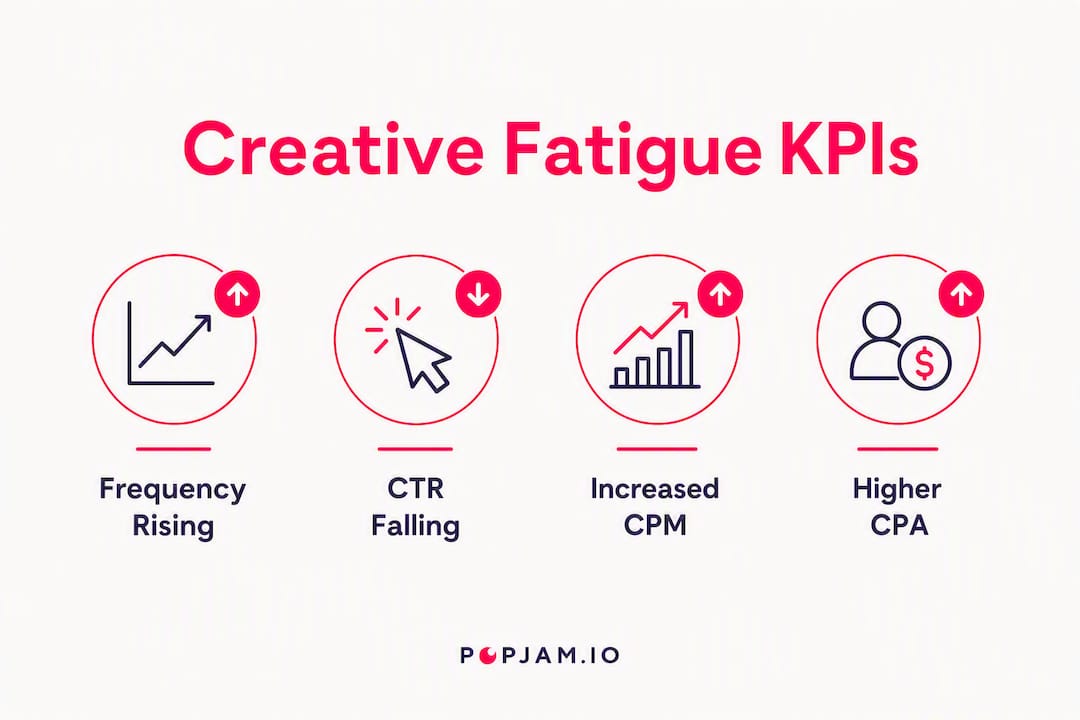
The signal sequence is consistent and worth memorizing. Frequency rises at the ad-creative level first, then CTR and engagement fall, then CPM climbs as the auction deprioritizes your creative, then CPC rises, CPA deteriorates, and finally ROAS collapses. By the time ROAS is visibly bad, you’ve already burned significant budget.

The earliest actionable signal is the paired combination of rising ad-level frequency plus falling CTR. Treat that pair as your trigger, not a lagging indicator like CPA.
| Metric pattern | Likely cause | Recommended action |
|---|---|---|
| Frequency rising + CTR falling | Creative fatigue at ad level | Swap creative, keep audience |
| CPM rising + CTR flat | Auction pressure or seasonality | Check competitor activity, review bid strategy |
| CTR flat + CVR falling | Landing page or offer mismatch | Run landing page split test |
| CPA rising + frequency stable | Audience saturation or funnel issue | Expand targeting or audit post-click experience |
| Platform “Creative limited” flag | Delivery system detecting fatigue | Add distinct creative variants per Meta guidance |
Agency guides recommend watching ad-level frequency with a warning threshold around 2.5–3.0 and a danger threshold above 3.0, combined with CTR week-over-week declines of 10–20% over two weeks as a reliable early signal. These are starting points, not universal rules. A small retargeting audience of 50,000 people will fatigue faster than a broad prospecting pool of 5 million.
Pro Tip: Diagnose change rates, not absolute thresholds. A CTR of 0.8% that was 1.4% three weeks ago is a fire alarm. A CTR of 0.8% that’s been stable for six weeks is just your baseline.
Meta’s Ads Manager also surfaces “Creative limited” and “Creative fatigue” delivery statuses when it estimates repeated exposures have reduced effectiveness. These flags are useful confirmation signals, but don’t wait for them. By the time the platform flags it, you’ve already lost efficiency.
How do you run a diagnostic to confirm creative fatigue?
Suspecting fatigue isn’t the same as proving it. Here’s a reproducible triage workflow:
- Check ad-level frequency, not campaign-level. Pull a 14-day window for each active creative. Flag any ad with frequency above 2.5 and a declining CTR trend.
- Review placement concentration. If one placement (like Facebook Feed) is absorbing most impressions, the effective frequency for that placement is higher than the blended number suggests.
- Look for delivery flags. Check Ads Manager for “Creative limited” or “Creative fatigue” statuses on flagged ads.
- Run a creative-swap experiment. Take the fatigued ad set, add a genuinely new creative (different hook, different visual concept), and let both run against the same audience for 7–14 days. If the new creative outperforms, you’ve confirmed fatigue.
- Run a holdout audience test. Duplicate the ad set with a fresh audience segment that hasn’t seen the creative. If performance recovers with the same creative on a new audience, the problem is audience saturation, not creative fatigue.
- Run a landing page split test. If CTR is holding but CVR is falling, the creative isn’t the problem. Test the post-click experience before refreshing creative.
A few methodology notes worth keeping in mind:
- Use 7–30 day lookback windows at the ad level, not the campaign level.
- For creative-swap tests, keep the audience, budget, and placement identical. Change only the creative.
- Recovery on a new audience with the same creative proves saturation. Recovery with new creative on the same audience proves fatigue.
Meta’s internal experiments confirmed this experimentally: adding new creative to fatigued ad sets produced dose-dependent improvements in conversion rates. The more distinct the new creative, the larger the lift. That’s the experimental validation behind the creative-swap approach.
One common mistake: duplicating an ad set without changing the creative. This restarts the learning phase and costs you efficiency, but it doesn’t solve the underlying decay. The same creative reaches the same fatigued users. You’ve bought yourself a few days at best, at a real algorithmic cost.
What are the fastest ways to fix creative fatigue right now?
Speed matters here. The faster you get differentiated creative in front of your audience, the less budget you waste. Here’s how to prioritize:
Fast wins (can ship in 24–48 hours):
- Swap the first 3 seconds of a video. The hook is where attention is won or lost, and changing it can reset algorithm perception without rebuilding the entire creative.
- Test a new headline and primary text on a static ad. Same visual, different angle.
- Swap format: turn a static into a short video or a carousel. Format changes register as genuinely new to both users and the delivery algorithm.
- Sequence new hooks into your retargeting pool. Users who’ve seen your awareness creative three times don’t need to see it a fourth time.
Medium-term fixes (1–2 weeks):
- Concept-level refresh. Don’t just change the headline; change the angle, the proof point, or the emotional trigger. A new testimonial format, a different use-case scenario, or a problem-first versus solution-first structure.
- Personalized variations by segment. A retargeting audience that visited your pricing page needs different creative than a cold prospecting audience. Segment-specific creative extends the life of each concept.
- Build a rotational pool of 3–5 distinct concepts and let the platform optimize within that pool using dynamic creative where it genuinely adds differentiation.
When to expand the audience instead of refreshing creative:
- Holdout test shows the same creative performs well on a fresh audience.
- Frequency is high but CTR hasn’t declined significantly.
- You’ve already refreshed creative twice and performance hasn’t recovered.
| Approach | Speed to impact | Production cost | Durability |
|---|---|---|---|
| Hook swap (video) | 24–48 hours | Low | Short (days to weeks) |
| Headline/text variation | 24 hours | Very low | Short |
| Format swap | 2–3 days | Low to medium | Medium |
| Concept-level refresh | 1–2 weeks | Medium to high | Longer (weeks to months) |
| Audience expansion | 1–3 days | Low | Medium (depends on pool size) |
Platform guidance from Amazon Ads and other major ad platforms consistently points to the same principle: regular refresh cycles, segmentation, and creative automation are the most durable prevention strategies. The tactical fast wins above buy time; the concept-level work is what sustains performance.

For creative inspiration across formats, social media ad examples that reduce similarity across variations are worth studying before you brief your next round of concepts.
How do you build a creative pipeline that prevents fatigue from recurring?
Fixing fatigue once is reactive. Building a pipeline that prevents it from compounding is where teams actually get ahead.
Pipeline roles and responsibilities:
- Concept: A strategist or senior creative defines 3–5 distinct angles per campaign, grounded in audience psychographics and competitive differentiation.
- Rapid prototyping: A designer or AI tool produces low-fidelity mockups for each concept within 24–48 hours.
- Pretest: Concepts are validated against synthetic personas or a small live test before full production spend.
- Production-ready: Only validated concepts move to full production. This is where budget concentrates.
Creative bank structure:
Tag every creative by hook type (problem-first, social proof, curiosity, direct offer), visual format, and audience segment. When a creative fatigues, you can pull a replacement from the bank that’s genuinely different on at least two dimensions, not just a color swap.
Naming conventions matter more than most teams realize. A file named “Ad_v3_final_FINAL.mp4” tells you nothing. A file named “Prospecting_ProblemHook_Video15s_Q1_2026” tells you everything you need to know when you’re pulling a replacement at 9 PM.
Scaling notes:
- Apply a 70/30 budget split: 70% on proven performers, 30% on new concepts in test. This keeps ROAS stable while building your replacement pipeline.
- Batch creative production in sprints rather than one-off requests. A two-week sprint that produces 8–10 distinct concepts is more efficient than 8 individual requests spread over a month.
- Handoffs between creative and performance teams need a shared brief that includes current frequency data, audience size, and the specific angle the new creative needs to cover. Without that context, creative teams produce variations that are visually different but conceptually identical.
Pro Tip: Balance refresh velocity against algorithm learning. Swapping creative too frequently restarts learning phases and destabilizes delivery. Give a new creative at least 7 days and enough impressions to exit the learning phase before you evaluate it or replace it.
A creative automation complete guide can help teams operationalize this pipeline, especially when scaling across multiple campaigns and platforms simultaneously.
How does pretesting with POPJAM help you avoid creative fatigue?
The most expensive way to discover a creative concept is fatigued is to let it run until the numbers collapse. The smarter approach is to validate concepts before they go live, so you’re rotating in replacements that are genuinely differentiated, not just visually tweaked.
POPJAM’s creative automation platform is built specifically for this. Here’s what’s relevant to fatigue prevention:
- Synthetic Persona testing: POPJAM simulates how distinct audience segments respond to a creative before you spend a dollar on live traffic. You can test whether a new concept actually reads as different to your audience, or whether it’s just a surface variation of what’s already fatigued.
- Rapid A/B pretesting: Generate and compare multiple creative variants at scale, with qualitative and quantitative feedback, before committing to production spend.
- Creative variant generation: POPJAM produces on-brand variants across formats (images, video, animation, social posts) so your creative bank stays stocked with genuinely distinct options.
Two practical use cases:
Recovering a fatigued prospecting ad. Your top-of-funnel video has been running for six weeks. Frequency is at 3.2, CTR has dropped 18% over the past two weeks. Instead of guessing which new concept will land, you run three distinct hook variations through POPJAM’s synthetic personas. The one that scores highest on engagement prediction goes into live test first. You’ve cut your validation time from two weeks of live spend to 48 hours of pretest.
Preventing fatigue in a high-frequency retargeting pool. Retargeting audiences are small and see your ads often. POPJAM helps you generate a rotational pool of 5–7 distinct concepts, pretested against the psychographic profile of your retargeting segment, so you’re never relying on a single creative to carry a high-frequency audience.
Pretesting ad creatives before live spend is one of the highest-leverage moves a performance team can make. It shortens the time to a working replacement and lowers the budget wasted on concepts that don’t differentiate.
How do you set up a monitoring system that catches fatigue early?
A good fatigue monitoring setup catches the problem at the frequency-plus-CTR signal stage, not after CPA has already deteriorated. Here’s what to build into your dashboard and alert rules.
Dashboard metrics for a fatigue watch panel:
- Ad-level frequency (7-day and 14-day rolling)
- CTR week-over-week change (%)
- CPM trend (7-day rolling)
- CPA trend (14-day rolling)
- Platform delivery status flags (“Creative limited,” “Creative fatigue”)
- Impression share by creative within each ad set
Alert rules to configure:
- Ad-level frequency crosses 2.5 AND CTR has declined more than 10% week over week: flag for review.
- CPM increases more than 15% in a 7-day window with flat or declining CTR: investigate auction pressure or creative decay.
- Platform surfaces a “Creative fatigue” or “Creative limited” status on any active ad: immediate creative review.
- Any single creative absorbs more than 60% of ad set impressions for 7+ days: rotation imbalance, check creative pool diversity.
Lookback windows:
Use 7-day windows for early warning signals (frequency and CTR). Use 14–30 day windows for cost signals (CPM, CPA) since those take longer to move meaningfully. Don’t use 30-day windows for CTR trend analysis; the signal gets buried in the average.
These thresholds are starting points. A retargeting campaign with a 30,000-person audience will hit danger thresholds faster than a broad prospecting campaign. Calibrate your alerts to your audience size and daily budget. An ad feedback analysis approach that connects creative-level signals to campaign-level outcomes makes this calibration much easier to sustain over time.
What’s your 30/60/90-day plan when you suspect creative fatigue?
Here’s a phased playbook you can run starting this week.
Days 1–30: Triage and stabilize
- Pull ad-level frequency and CTR for all active creatives. Flag anything with frequency above 2.5 and a declining CTR trend.
- Pause or reduce budget on confirmed fatigued creatives. Don’t pause the whole campaign.
- Run a creative-swap experiment: introduce at least one genuinely new concept (different hook, different format) to each fatigued ad set.
- Run a holdout audience test on your highest-frequency ad sets to separate creative fatigue from audience saturation.
- Stabilize spend on the best-performing replacement creatives once the swap experiment shows a winner.
Days 31–60: Scale winners and clean house
- Scale budget toward the winning replacement creatives from your swap experiments.
- Retire creatives that are conceptually identical to fatigued ones. Similarity across your active creative pool accelerates fatigue across the board.
- Expand audience targeting where holdout tests confirmed saturation rather than creative decay.
- Run longer holdout tests (21–30 days) to measure sustained recovery, not just initial lift.
- Brief your next round of concepts using the hook and angle tags from your creative bank.
Days 61–90: Embed and systematize
- Move successful new concepts into your creative bank with proper tagging by hook type, format, and audience segment.
- Update your production cadence: schedule the next creative sprint before your current winners hit the 2.5 frequency threshold.
- Measure long-run ROAS impact from the creative refresh. Compare the 30-day ROAS before the swap to the 30-day ROAS after stabilization.
- Document what worked: which hook types, which formats, which angles drove recovery. That’s your brief template for the next refresh cycle.
Key Takeaways
Creative fatigue is a creative-level problem with a predictable signal sequence: rising ad-level frequency and falling CTR appear first, and acting on that pair before CPA deteriorates is what separates efficient teams from reactive ones.
| Point | Details |
|---|---|
| Diagnose at the ad level | Pull frequency and CTR per creative, not campaign averages, to catch fatigue before CPA rises. |
| Act on the paired signal | Rising frequency above 2.5 plus a 10–20% CTR decline over two weeks is your trigger to swap creative. |
| Validate with experiments | A creative-swap test against the same audience confirms fatigue; a holdout test separates it from audience saturation. |
| Build a replacement pipeline | Maintain 3–5 distinct concept candidates so a replacement is ready when a winner decays. |
| POPJAM for pretest validation | POPJAM’s synthetic persona testing and creative variant generation help you validate replacements before live spend, cutting wasted budget. |
The real tension nobody talks about
Here’s the thing that most creative fatigue guides skip: the advice to “refresh creative constantly” is in direct conflict with how ad platform algorithms actually work. Every time you swap a creative and restart the learning phase, you’re paying an efficiency tax. The algorithm needs time and data to optimize delivery. Churn creative too fast and you’re perpetually in learning mode, which means higher CPMs and less stable results.
The conventional wisdom says “refresh early and often.” The more accurate advice is “refresh deliberately and with evidence.” Don’t swap creative because a calendar says it’s been four weeks. Swap it because your frequency-plus-CTR signal tells you it’s time, and because you have a validated replacement ready to go.
The other thing teams consistently get wrong: they treat concept-level similarity as acceptable because the visuals look different. A new color scheme on the same problem-solution structure is not a new concept. Your audience has already processed that argument. What resets engagement is a genuinely different angle: a different emotional trigger, a different proof point, a different format that changes how the message lands.
The teams that handle this best aren’t the ones with the biggest creative budgets. They’re the ones with the tightest feedback loops between performance data and creative briefs, and a pipeline that’s always one sprint ahead of their current winners.
Stop burning budget on creative that’s already worn out
Most teams discover creative fatigue after the damage is done. ROAS is down, CPA is up, and the instinct is to restructure the whole campaign. But the problem is almost always upstream: a creative that’s been seen too many times by the same audience, with no validated replacement ready to go.
POPJAM changes that equation. Instead of guessing which new concept will land, you generate and pretest multiple distinct variants against synthetic buyer personas before a single dollar of live spend. You get qualitative and quantitative feedback on what resonates, which angles feel genuinely different to your audience, and which concepts are worth moving to full production.
For performance teams running high-frequency campaigns on Meta, Google, TikTok, or LinkedIn, POPJAM’s AI ad generator gives you the creative velocity to stay ahead of fatigue without the guesswork. Agencies managing multiple clients can use the agency-focused workflow to pretest and scale differentiated creative across accounts. Start a free trial and see how much faster you can validate a replacement concept before your next winner wears out.
Useful sources
- Creative fatigue: How advertisers can improve performance by managing repeated exposures — Analytics at Meta’s primary research post defining creative fatigue, modeling the decay curve, and documenting experimental validation of creative-swap interventions.
- About creative fatigue recommendations in Meta Ads Manager — Meta’s official help documentation explaining “Creative limited” and “Creative fatigue” delivery statuses and what actions they recommend.
- Facebook Ad Fatigue Signals: The Order They Appear — Practitioner guide documenting the predictable signal sequence from frequency through ROAS, useful for building early-warning monitoring.
- 7 Signs of Facebook Ads Creative Fatigue — Agency guide with concrete frequency and CTR thresholds used as operational starting points.
- Ad fatigue: what it is, why it kills ROI and how to prevent it — Amazon Ads platform documentation on platform-agnostic prevention strategies including refresh cycles, segmentation, and automation.
- Facebook Ad Fatigue: What It Is, How to Spot It, and How to Fix It — Practitioner writeup explaining why ad set duplication without creative change is a tactical mistake.
- Creative Automation Platform — POPJAM’s product capability page covering synthetic persona testing, prelaunch validation, and creative variant generation at scale.
- Why pre-test ad creatives: maximize results and cut costs — POPJAM blog post on the value of pretesting and simulated persona feedback for reducing wasted spend.
FAQ
What is creative fatigue in advertising?
Creative fatigue is the decline in user responsiveness that occurs when the same ad creative is seen repeatedly. Meta’s Analytics team modeled this as a predictable decay curve, where each additional exposure delivers diminishing returns in clicks and conversions.
Is creative fatigue the same as ad fatigue?
No. Creative fatigue is a creative-level problem caused by repeated exposure to the same specific ad. Ad fatigue is the broader category that can also include audience saturation and placement overexposure. The distinction matters because the correct fix is different for each.
Why does my Facebook ad say “Creative fatigue”?
Meta Ads Manager surfaces this status when it estimates that repeated exposures have reduced the effectiveness of your creative. The recommended action is to add genuinely different creative variants, not minor edits to the existing ad.
How do you fix creative fatigue without pausing your campaign?
Swap the creative at the ad level rather than pausing the whole campaign. Introduce a new concept with a different hook, format, or angle to the fatigued ad set, keep the audience and budget stable, and let the new creative run for 7–14 days to confirm recovery.
How does pretesting help prevent creative fatigue?
Pretesting with tools like POPJAM lets you validate whether a new concept is genuinely differentiated before live spend. By testing against synthetic personas, you identify which replacement concepts will actually reset engagement rather than repeating the same angle in a new visual wrapper.
Recommended
- Ad Creative: A Practical Guide for Marketers | POPJAM.IO Blog
- Creative Automation: The Complete Guide for Performance Marketers (2026) | POPJAM.IO Blog
- Pre-Launch Creative Scorecard: 5 Checks Before You Spend | POPJAM | POPJAM.IO Blog
- The Bandwidth Paradox: Why Scaling Your Agency Usually Breaks It (And How to Fix It) | POPJAM.IO Blog