

The Bandwidth Paradox: Why Scaling Your Agency Usually Breaks It (And How to Fix It)
If you run a digital agency, you likely know the "Bandwidth Paradox" intimately: The more you grow, the less profitable you become. But a new model is emerging—one that uses AI not just as a tool, but as a workforce. This is the Agentic Agency.

The 14% Margin Trap
If you run a digital agency, you likely know the "Bandwidth Paradox" intimately: The more you grow, the less profitable you become.
It defies basic economic logic. In software, scale brings leverage. In agencies, scale typically brings complexity. You land three new accounts, but to service them, you need to hire two more creatives and a project manager. Your revenue goes up, but your overhead rises in lockstep.
The data confirms this stagnation. In 2024, the average digital agency net profit margin hovered around 14%, down from historical highs of 16-20%. Meanwhile, client retention rates have plummeted to near 25% as brands take capabilities in-house or switch providers in search of better performance.
The culprit isn't your pricing or your sales team. It's the new operational reality of performance marketing. The deliverable has changed. Clients no longer just need "strategy" and "a few good ads." They need volume and freshness.
This shift has broken the traditional agency model. But a new model is emerging—one that uses AI not just as a tool, but as a workforce. This is the Agentic Agency.
The "Volume + Freshness" Mandate
In the golden era of Facebook ads (2016–2019), you could run a single "hero" creative for months. Today, the lifespan of a winning ad on TikTok or Meta is measured in days, not weeks.
This is the Creative Fatigue cycle. When an audience sees the same ad too frequently, engagement drops and costs spike.
- The Cost: Research shows that CPA (Cost Per Acquisition) can double in as little as two weeks due to creative fatigue alone.
- The Demand: To combat this, high-performance accounts now require 20–30 new creative variants per week to maintain stability.
For an agency managing 20 clients, that means producing 400–600 unique assets every single week.
A human creative team cannot sustain this volume without burnout or quality degradation. If you try to solve this with headcount, you destroy your margins. If you try to solve it with "templates," you destroy your performance.
This is where the "Agentic" shift becomes the only viable path to scaling agency creative production without breaking the bank.
"Tools" vs. "Agents": The Shift That Matters
Most agencies are still using AI as a tool.
- Tool: You open ChatGPT, type a prompt, wait for a response, and copy-paste it. You open Midjourney, roll the dice, and Photoshop the result.
- Bottleneck: You are still the operator. The AI waits for you.
Agents are different. An AI agent is autonomous. It has a goal, a role, and a workflow. It doesn't wait for a prompt; it executes a job.
- Agent: You assign a "Campaign Persona" to a target audience. The agent researches the audience, drafts 50 hooks, simulates audience reaction, and presents the top 5 winners for your review.
Tools make you 10% faster. Agents give you operational leverage—breaking the linear link between revenue and headcount.
Blueprint: The Agentic Creative Workflow
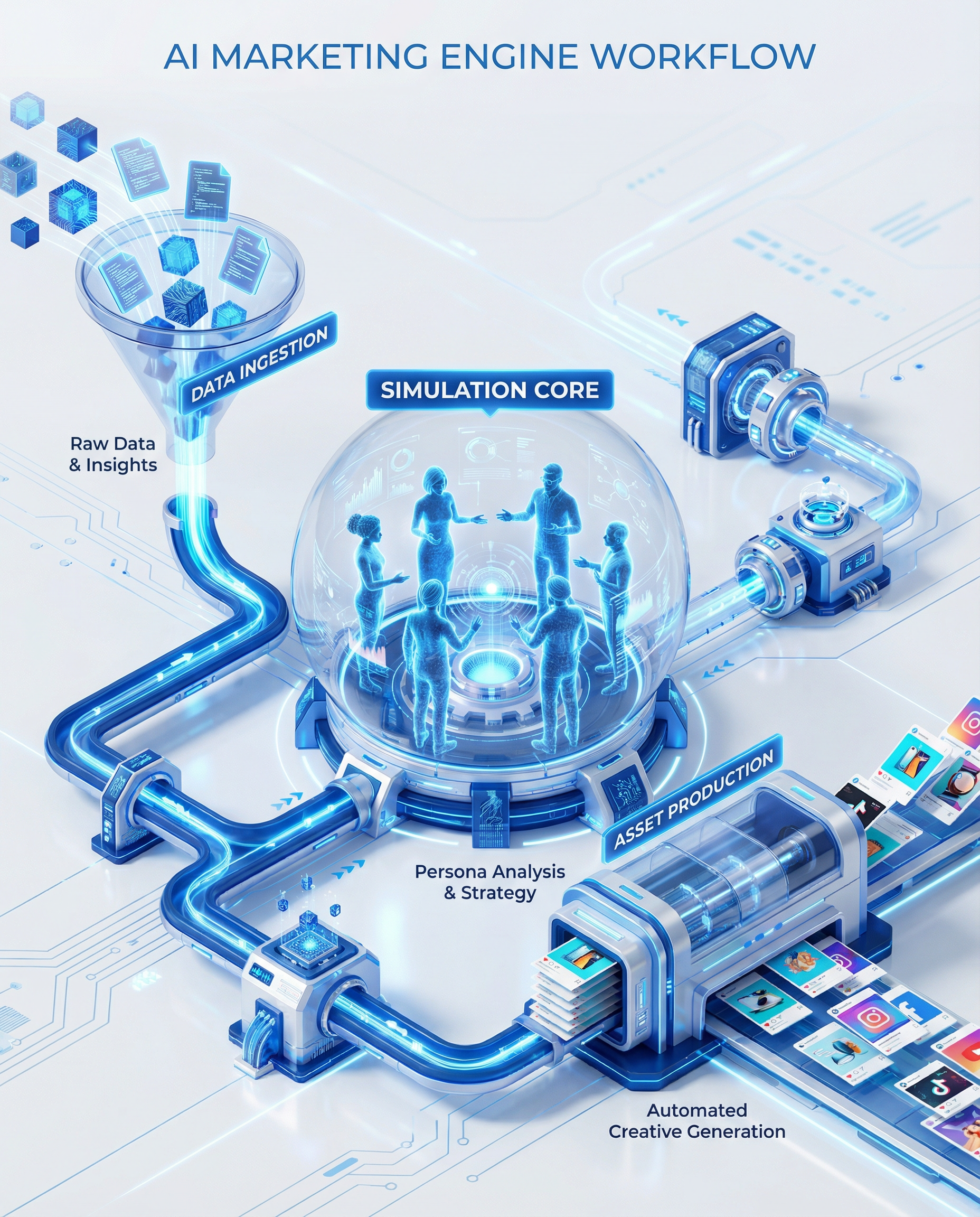
To reclaim your margins, you need to move from a linear human workflow to a circular agentic loop. Here is the framework for a modern, high-leverage creative operation.
Phase 1: Context Engineering (The New "Brief")
Instead of a human strategist spending 10 hours researching Reddit threads and competitor ads, you use research agents to ingest data.
- Input: Brand URL, competitor domains, target audience profile.
- Output: A structured "Psychographic Profile" of the buyer.
- Time Saved: ~8 hours per campaign.
Phase 2: Synthetic Simulation (The "Virtual Lab")
This is the most critical missing step in traditional workflows. Usually, you have to spend client budget to test if an ad is "good." In an agentic workflow, you test before you spend.
Platforms like POPJAM specialize in this "Pre-Launch Simulation." You can create synthetic personas (e.g., "Sarah, the skepticism-prone CFO") and run your ad concepts against them.
- The agentic personas "roast" your hooks, flagging weak angles or confusing copy.
- You get qualitative feedback ("This feels too salesy") and quantitative predictions ("Engagement Score: 62/100") instantly.
- Result: You only send "pre-validated" creative to the client, drastically reducing revision rounds and "learning phase" waste.
Phase 3: Infinite Generation (Variant Production)
Once a winning angle is identified via simulation, generation agents take over.
- Instead of asking a copywriter to "tweak the headline 10 times," the agent generates 50 variations of the winning hook tailored to different psychographic triggers (Fear of Missing Out, Status, Utility).
- Visual agents generate the accompanying media assets in bulk.
The New Unit Economics: Reclaiming Your Margins
The financial impact of this shift is structural.
| Metric | Traditional Agency | Agentic Agency | | :--- | :--- | :--- | | Output Constraint | Human Hours | Server Compute | | Cost to Scale | Linear (Hire more staff) | Flat (Software Subscription) | | Client Retention | ~25% (Performance dips) | High (Consistent freshness) | | Gross Margin | ~40-50% | 70-80% |
By offloading the "churn" work (research, basic drafting, resizing, variant testing) to agents, your senior human talent can focus on Strategy and Relationships—the only two things clients are truly willing to pay a premium for.
Integrating Agents without Losing Your "Soul"
A common fear is that using AI means producing "generic slop." This only happens if you remove the human from the steering wheel.
The Agentic Agency doesn't replace the Creative Director; it gives them an army.
- Human: Sets the strategy and "Context."
- Agent: Executes the volume (Simulates, Generates).
- Human: Curates the final output.
You are no longer charging for the hours it took to write the ads. You are charging for the outcome of the ads. That is how you break the 14% margin trap.
FAQ: Scaling Agency Operations
How does this affect my pricing model?
Shift away from "hours billed." If you generate 100 high-performing assets in an hour using an agentic workflow, billing hourly cheats you. Move to performance retainers or asset-volume pricing (e.g., "Access to 50 tested creatives/month").
Will clients know I'm using AI?
Transparecy is key, but frame it as a benefit. You aren't "using AI to be cheap"; you are "using Audience Simulation technology to de-risk their ad spend." Clients care about results, not effort.
What is the biggest barrier to adoption?
Data governance. Ensure you are using enterprise-grade tools that respect data privacy (like POPJAM’s GDPR-compliant infrastructure) rather than pasting client data into public LLMs.
References
- Promethean Research (2024). Digital Agency Benchmarks & Profitability Report.
- Simulmedia (2025). The Economics of Creative Fatigue: Impact on CPA and Conversion.
- Clutch.co (2024). Video Production Cost Analysis & Timelines.
- Search Engine Journal (2025). The State of AI in Digital Marketing Agencies.