

Static Ads: A Marketer's Guide to Better Campaigns
Static ads are fixed-image digital advertisements that show identical content to every viewer, with no personalization or dynamic content swapping. In digital marketing, the formal industry term is static display advertising, though “static ads” is the widely used shorthand across programmatic platforms and creative teams. These formats remain a core tool for brand awareness, direct response, and cost-controlled campaigns. Understanding how to design, size, and test them correctly is what separates wasted ad spend from real results.
What are static ads and how do they work in digital marketing?
Static ads are fixed-content image ads shown identically to all viewers, with no behavioral targeting or real-time content changes. They are the simplest form of digital display advertising: one image, one message, one call to action. That simplicity is a feature, not a flaw. When your message is clear and your audience is well defined, a static banner delivers it faster and more reliably than any animated unit.
Static banner advertising runs across programmatic display networks, social platforms, and direct publisher placements. The IAB (Interactive Advertising Bureau) sets the standard size specifications that most platforms accept. Marketers use static formats for product launches, seasonal promotions, retargeting reminders, and brand recall campaigns where the goal is recognition rather than interaction.

The key advantage is control. You know exactly what every viewer sees. That predictability makes static formats the cleanest environment for A/B testing, because you isolate one variable at a time without worrying about which dynamic version a user received.
What are the standard static ad sizes and format requirements?
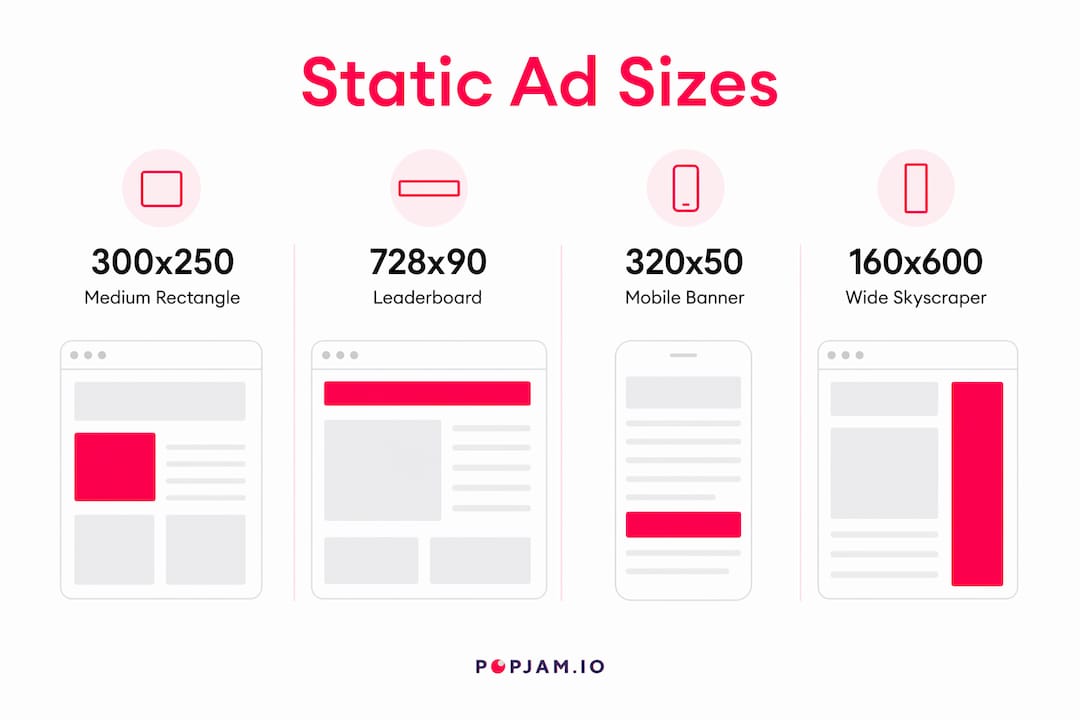
Standard static ad sizes include 300x250, 300x600, 728x90, 320x50, 160x600, and 970x250 pixels. Each size serves a different placement context, from mobile banners to desktop leaderboards. Choosing the right size for your placement is not optional. Platforms reject ads that fall outside accepted dimensions, and mismatched sizes waste impressions.
File size limits for static display ads typically range from 150 KB to 300 KB depending on the platform. Staying within those limits keeps load times fast and viewability scores high. Accepted file formats are PNG, JPG, and in some cases GIF (for non-animated use). PNG is the preferred choice for ads with text or logos because it preserves sharpness without compression artifacts.
| Size (pixels) | Common name | Primary use | Max file size |
|---|---|---|---|
| 300x250 | Medium rectangle | Desktop and mobile sidebar | 150–300 KB |
| 728x90 | Leaderboard | Desktop top of page | 150–300 KB |
| 320x50 | Mobile banner | Mobile in-app and browser | 150 KB |
| 300x600 | Half page | High-impact desktop sidebar | 150–300 KB |
| 160x600 | Wide skyscraper | Desktop sidebar | 150–300 KB |
| 970x250 | Billboard | Desktop above the fold | 150–300 KB |
Pro Tip: Always produce your static ad in the 300x250 size first. It is the most widely accepted size across programmatic platforms and gives you the highest reach with a single creative.
Check the top ad formats for e-commerce if you want a deeper breakdown of which sizes drive the best ROI by channel in 2026.
How do static ads compare to dynamic and video ads?
Dynamic ads automatically tailor content based on user behavior, making them ideal for retargeting and large product catalogs. Static ads carry fixed content and are less personalized, but they cost less to produce and are far easier to deploy at scale. The choice between them is not about which format is better. It is about which format fits your campaign goal and budget.
Video ads generate the highest engagement in awareness campaigns but require significant production resources and longer load times. Static banner advertising wins on speed, compatibility, and cost per creative. Static banners load faster and scale better across multiple sizes than animated units, which matters when you are running campaigns across dozens of placements simultaneously.
One underappreciated fact: Google’s benchmarks show static formats outperforming HTML5 ads on click-through rate in some sectors. Creative strength matters more than format type. A well-crafted static ad beats a mediocre animated one every time.
| Feature | Static ads | Dynamic ads | Video ads |
|---|---|---|---|
| Personalization | None | High | Low to medium |
| Production cost | Low | Medium to high | High |
| Load speed | Fast | Medium | Slow |
| A/B testing ease | High | Complex | Complex |
| Best use case | Brand awareness, direct response | Retargeting, large catalogs | Awareness, storytelling |
| Ad fatigue risk | Medium | Lower | Lower |
Static formats carry a real risk of ad fatigue when frequency is not managed. Seeing the same image repeatedly without variation trains audiences to ignore it. That is the one area where dynamic formats have a structural advantage. The fix is not to abandon static ads. It is to rotate creatives and cap frequency deliberately.
What are best practices for designing high-performing static ads?
A well-designed static ad includes five elements: a singular hook, a visible product or offer, a brand mark, social proof, and a clear call to action. Every element must be readable and understood within one second of viewing. That is not a guideline. It is a hard constraint imposed by how fast users scroll past display placements.
Here are the design principles that separate high-performing static creatives from wasted impressions:
- One message per ad. Trying to communicate three benefits in a 300x250 banner creates visual noise. Pick the single most compelling reason to click and build the entire creative around it.
- Contrast drives attention. Your CTA button and headline must stand out from the background. Low-contrast designs get skipped even when the offer is strong.
- Brand mark placement matters. Put your logo in a consistent corner across all ad sizes. Viewers who see your brand repeatedly in the same position build recognition faster.
- Social proof converts. A star rating, a short testimonial fragment, or a “10,000+ customers” label adds credibility without cluttering the design.
- Copy length is a ceiling, not a target. Use the fewest words possible. If your headline needs more than seven words, it is probably two ideas competing for space.
Anything harder to interpret quickly suffers rapid creative fatigue among digital audiences. That means complex layouts, small fonts, and busy backgrounds actively hurt performance. Simplicity is a performance strategy, not a design preference.
Pro Tip: Test your static ad by looking at it for exactly one second, then looking away. If you can’t recall the brand name, the offer, and the CTA, the design needs simplification before it goes live.
For a full walkthrough of creative testing methods, the guide on high-impact ad creatives covers both design and testing frameworks in detail.
How do you optimize static ad campaigns for cost-effectiveness and engagement?
Campaign optimization for static formats comes down to four levers: targeting, frequency, testing, and measurement. Pull the wrong lever at the wrong time and you burn budget. Get the sequence right and static ads become one of the most cost-efficient formats in your media mix.
- Set frequency caps before launch. Effective static ad campaigns require careful frequency capping to avoid ad fatigue. A viewer who sees the same static banner more than five or six times in a week is unlikely to convert on the seventh impression. Set platform-level caps and monitor them weekly.
- Run A/B tests on one variable at a time. Change the headline, the CTA color, or the background image. Never change all three simultaneously. Static formats are the cleanest testing environment in digital advertising because the creative is fully controlled.
- Use programmatic buying for scale. Programmatic platforms enable real-time bidding to distribute static ads across multiple sites and devices, improving targeting control and reach. Static ads’ fast load times help maintain viewability scores in programmatic environments, which directly affects impression delivery.
- Segment your audience before you segment your creative. Know which audience segment you are targeting before you design the ad. A static creative built for a cold audience looks different from one built for a warm retargeting list.
- Track the right metrics. Click-through rate tells you about creative relevance. Viewability rate tells you about placement quality. Conversion rate tells you whether the landing page completes the job the ad started. Track all three, not just CTR.
- Rotate creatives on a schedule. Even a strong static ad loses effectiveness over time. Plan creative refreshes every four to six weeks for high-frequency placements.
Pro Tip: Use data-driven creative testing to identify which version of your static ad resonates before you commit full budget. Testing two versions on 10% of your audience and scaling the winner is cheaper than running the wrong creative at full spend.
For campaigns running across multiple audience segments, ad frequency management is the single highest-leverage optimization most teams underuse. Set it, monitor it, and adjust it as performance data comes in.
Key Takeaways
Static ads deliver the best results when paired with disciplined frequency management, clear single-message design, and systematic A/B testing before full budget deployment.
| Point | Details |
|---|---|
| Standard sizes matter | Use 300x250, 728x90, and 320x50 as your core sizes to maximize platform compatibility. |
| Design for one second | Every static creative must communicate brand, offer, and CTA within one second of viewing. |
| Static beats dynamic on cost | Static ads cost less to produce and scale faster across multiple sizes than dynamic units. |
| Frequency capping is non-negotiable | Cap impressions per viewer weekly to prevent ad fatigue from killing campaign performance. |
| Test before you scale | A/B test one variable at a time and scale the winning creative to avoid wasted spend. |
Why I think static ads get less credit than they deserve
Here is something I have noticed working with marketers across e-commerce, SaaS, and agency accounts: static ads are almost always the first format teams want to move away from, and almost always the format they quietly return to when budgets tighten.
The assumption is that static means simple, and simple means less effective. That is wrong. Static ads are not a fallback. They are a precision tool. When your message is sharp, your audience is defined, and your creative is tested, a static banner outperforms animated alternatives in direct-response campaigns more often than most teams expect. Static ads are often misunderstood as outdated, but they play a critical role in direct-response marketing where low distraction and fast message delivery are priorities.
What I have seen fail repeatedly is not the static format itself. It is the habit of launching a single untested creative, running it at full frequency for six weeks, and then blaming the format when performance drops. That is a process failure, not a format failure.
The teams getting real results from static banner advertising treat it like a science experiment. They test headlines, swap background colors, rotate social proof elements, and track viewability alongside CTR. They also know when to use static and when to hand off to dynamic or video. Static ads belong at the top and middle of the funnel, where you are building recognition and driving direct clicks. Dynamic formats take over when personalization at scale becomes the priority.
The examples of digital ad creatives that actually convert share one trait: clarity. The best ones are almost always simpler than you expect.
— Doruk
How POPJAM helps you build and test static ads faster
Static ad performance lives or dies on creative quality. But most teams ship creatives based on gut feel and find out what works only after spending real budget.
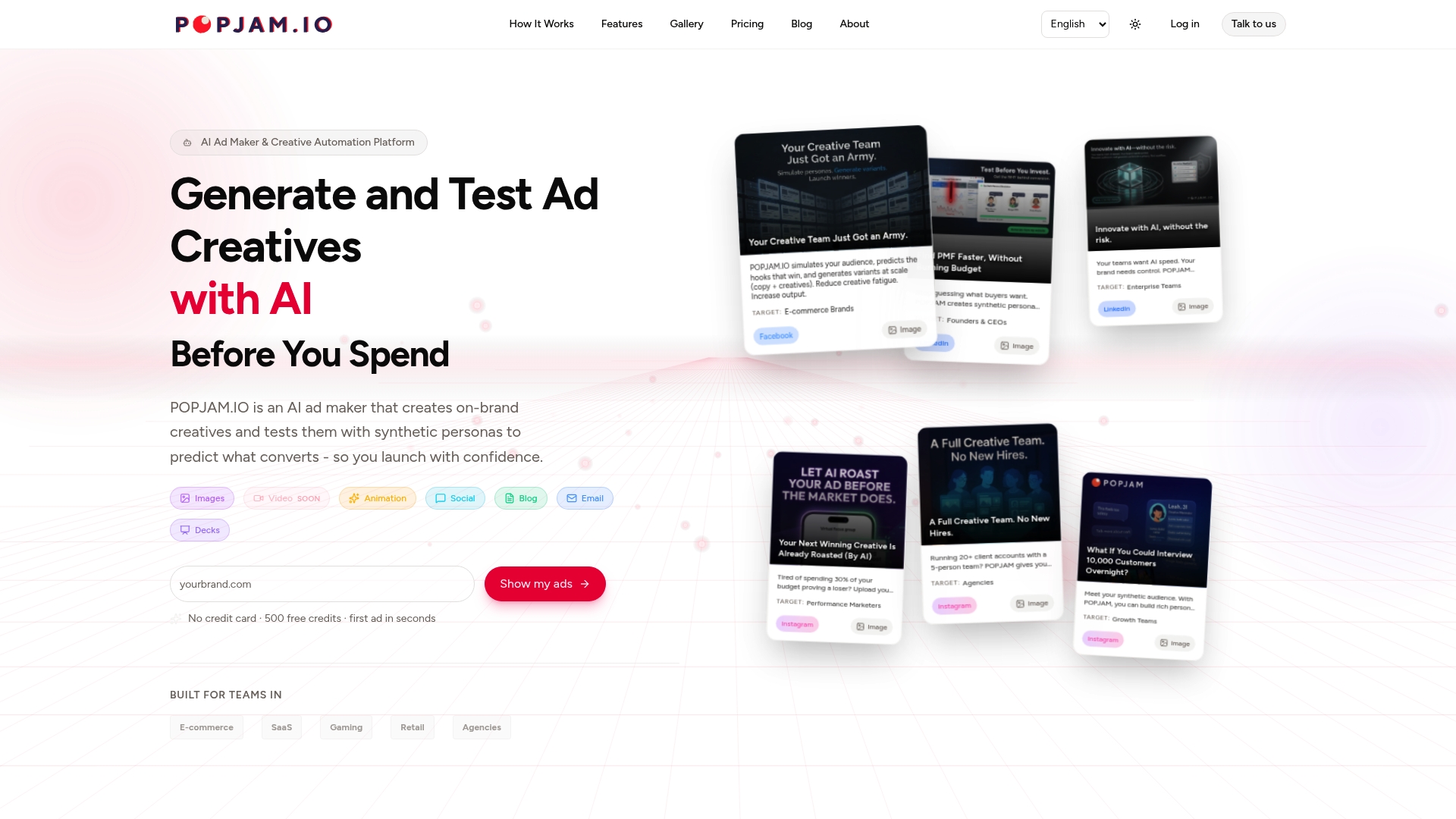
POPJAM changes that. The AI ad generator builds on-brand static creatives and tests them against Synthetic Personas before a single dollar goes to media spend. You get psychographic feedback on which version of your creative resonates with your actual audience segments, not a generic benchmark. For agencies managing multiple clients, POPJAM’s creative automation platform scales that process across accounts without adding headcount. The result is fewer wasted impressions, faster creative cycles, and campaigns that perform from day one.
FAQ
What is a static ad in digital marketing?
A static ad is a fixed-image digital advertisement that displays identical content to every viewer with no personalization or dynamic content changes. It is the most common form of display advertising and runs across programmatic networks, social platforms, and direct publisher placements.
What file formats are accepted for static display ads?
Most platforms accept PNG, JPG, and non-animated GIF files for static display ads. PNG is the preferred format for ads containing text or logos because it maintains sharpness without compression loss.
Are static ads effective compared to video or dynamic ads?
Static ads are highly effective for brand awareness and direct-response campaigns where simplicity and fast load times matter. Industry tests show near-identical click-through rates between static and animated ads in many verticals, with creative quality being the primary performance driver.
How often should you refresh static ad creatives?
Plan creative refreshes every four to six weeks for high-frequency placements to prevent ad fatigue. Rotating creatives on a set schedule maintains engagement and keeps impression quality high across the campaign lifecycle.
What is the most important element of a static ad design?
The single most important element is a clear call to action that is visible within one second of viewing. A well-designed static ad communicates brand, offer, and CTA instantly, because anything requiring longer interpretation loses the viewer before the message lands.