

Top ad formats for e-commerce: maximize ROI in 2026
Discover the top e-commerce ad formats for 2026. Compare display, shopping, social, and video ads with AI-powered insights to maximize your campaign ROI.


Choosing the wrong ad format doesn’t just waste budget. It kills momentum. With display, shopping, social, video, and Performance Max all competing for your attention, the decision feels harder than ever. Add AI-powered creative tools to the mix and the landscape shifts again, this time in your favor. This article breaks down the top e-commerce ad formats, gives you a side-by-side comparison, and walks you through a practical framework so you can match format to objective without second-guessing every campaign decision.
Table of Contents
- How to evaluate ad formats for e-commerce success
- Display ads: Versatile awareness and retargeting staple
- Shopping ads: Purchase intent and product-level precision
- Social media ads: Engaging, native, and AI-optimized creatives
- Video ads: High impact and storytelling for conversion and branding
- Comparison of top e-commerce ad formats
- Situational recommendations: Matching ad format to your goals
- Try AI-powered creative testing for every ad format
- Frequently asked questions
Key Takeaways
| Point | Details |
|---|---|
| Choose based on goals | Each ad format serves a specific role; match your format to your campaign objectives for greatest impact. |
| Leverage AI tools | AI-powered creative generation and testing dramatically improve your ability to optimize e-commerce ads. |
| Compare performance regularly | Use granular reporting and side-by-side format comparisons to refine your approach over time. |
| Blend channels strategically | Combining shopping, social, display, and video formats maximizes reach and conversion for e-commerce brands. |
How to evaluate ad formats for e-commerce success
Before you pick a format, you need a scoring system. Not every ad type performs equally across every funnel stage, and the metrics that matter for awareness campaigns look nothing like those for retargeting or conversion pushes.
Start with these core performance metrics:
- Click-through rate (CTR): Measures how compelling your creative is at driving action.
- Return on ad spend (ROAS): The clearest signal of whether a format is generating profitable revenue.
- Conversion rate: Tells you if the traffic you’re driving is actually buying.
- Cost per acquisition (CPA): Helps you compare efficiency across formats and channels.
Beyond raw numbers, creative flexibility matters. Formats that support multiple asset types, including images, video, and copy variations, give you more room to test. AI tools for creatives are now central to this process, letting you generate and rotate variants without burning out your design team.
Channel-level reporting is equally critical. AI tools and data-driven reporting help marketers optimize ad performance across channels by surfacing which placements actually convert, not just which ones get impressions.
Pro Tip: Prioritize ad formats that integrate directly with AI-driven creative testing platforms. The faster you can generate, test, and kill underperforming variants, the more budget you protect.
Display ads: Versatile awareness and retargeting staple
Display ads have been around long enough to earn skepticism, but they still serve a clear purpose when used correctly. The key is knowing when to deploy them and how to keep the creative fresh.
Best use cases for display ads:
- Prospecting: Reach cold audiences across the Google Display Network or programmatic exchanges.
- Retargeting: Re-engage site visitors who didn’t convert with product-specific visuals.
- Product launches: Build visual awareness before a new SKU goes live.
The upside is real. Display ads offer massive reach, granular targeting by interest, behavior, and demographics, and strong visual impact for brand building. The downside is banner blindness. Users have trained themselves to ignore static banners, which means stale creative is essentially invisible.

This is where AI changes the equation. Display campaigns benefit from AI-powered creative variations that enable rapid testing across dozens of size and design combinations without manual production overhead. AI-powered creative testing lets you rotate fresh variants automatically, so your audience never sees the same banner twice.
Pro Tip: Set a creative refresh cadence tied to frequency data. When average frequency hits 5 or more impressions per user, swap in new variants immediately to avoid wasting impressions on fatigued audiences.
Shopping ads: Purchase intent and product-level precision
If display ads build awareness, shopping ads close deals. These are the product listing ads that appear at the top of Google search results with an image, price, and store name. They target buyers who are already searching for what you sell.
Why shopping ads work for e-commerce:
- They pull directly from your product feed, so relevance is built in.
- Price and image are visible before the click, which pre-qualifies traffic.
- They capture high-intent searches at the exact moment of purchase consideration.
- Performance Max campaigns now layer AI across shopping placements for automated bidding and asset optimization.
“Performance Max campaigns and AI reporting are transforming shopping ad effectiveness for e-commerce, giving marketers channel-level breakdowns and search term data that were previously unavailable.”
The reporting improvements inside PMax are significant. You can now see which channels within a campaign are driving conversions, and access search term data to build negative keyword lists that sharpen targeting. AI enhancements like auto-generated headlines and image cropping also reduce the manual lift required to keep product listings competitive.
Social media ads: Engaging, native, and AI-optimized creatives
Social platforms are where creative strategy and algorithmic distribution collide. Meta, TikTok, and Instagram each offer native ad formats that blend into organic content, and their machine-learning systems are built to find the right audience for your creative automatically.
Top social ad formats for e-commerce:
- Dynamic video ads: Auto-assembled from product catalog data, personalized per viewer.
- Carousel ads: Showcase multiple products or features in a single swipeable unit.
- Story and Reels ads: Full-screen, vertical formats that drive high engagement with short-form video.
- Collection ads: Combine a hero video with a product grid for a seamless shopping experience.
The algorithms on these platforms optimize placements in real time, shifting budget toward the creative and audience combination that’s performing best. Advantage+ Creative and AI-driven generation powers social media ad performance by automatically testing asset combinations and applying enhancements like brightness adjustments and text overlays.
AI creative tools for social ads let you scale this process further, generating platform-native variants for Meta, TikTok, and Instagram without rebuilding assets from scratch for each placement.
Pro Tip: Use Meta’s Advantage+ Creative feature to upload multiple headlines, images, and videos at once. Let the algorithm identify the winning combination before you manually optimize. You’ll cut testing time by days.
Video ads: High impact and storytelling for conversion and branding
Video is the fastest-growing ad format in e-commerce, and for good reason. It’s the closest thing to an in-store experience you can deliver digitally. When a customer watches a product demo or an unboxing, they’re not just seeing a product. They’re imagining owning it.
When video ads deliver the most value:
- Product demos: Show exactly how a product works, removing purchase hesitation.
- Customer reviews and testimonials: Build social proof at scale.
- How-to content: Educate buyers and position your brand as an authority.
- Unboxing videos: Drive emotional connection and excitement around the purchase experience.
Video ads perform across YouTube, TikTok, Meta Reels, and Instagram Stories. Each platform has its own format requirements, but the storytelling principles stay consistent: hook in the first two seconds, deliver value fast, and close with a clear call to action.
AI-powered video creation and testing now enables e-commerce brands to produce scalable creative without a full production team. Automated editing tools can cut long-form footage into platform-specific clips, generate captions, and test multiple hooks simultaneously.
Comparison of top e-commerce ad formats
With each format examined, here’s a quick-reference table to align your format choice with your campaign objective.
| Ad format | Funnel stage | Reach | Creative needs | AI compatibility | Best for |
|---|---|---|---|---|---|
| Display | Awareness, retargeting | Very high | Images, banners | High | Brand visibility, remarketing |
| Shopping | Consideration, conversion | High | Product feed, images | High | Direct product sales |
| Social (Meta, TikTok) | All stages | Very high | Video, carousel, stories | Very high | Engagement, DTC sales |
| Video | Awareness, conversion | High | Short and long-form video | High | Storytelling, product demos |
Using AI tools and monitoring channel breakdowns helps you match the right format to the right funnel stage, rather than defaulting to whatever format you used last quarter. The table above is a starting point, not a rigid rule. Your actual data should always override general guidance.
Situational recommendations: Matching ad format to your goals
Frameworks are only useful when they translate into action. Here’s how to apply everything above based on your specific campaign situation.
- Building brand awareness from scratch: Lead with display and video. Display gives you broad reach at low cost per impression. Video builds emotional connection and recall. Combine both for maximum top-of-funnel coverage.
- Retargeting warm audiences: Use display and social carousel ads. Carousel formats let you show multiple products to users who already visited your site, increasing the chance one item triggers a return visit and purchase.
- Driving direct product sales: Shopping ads are your primary format. Layer in video ads on YouTube and TikTok to influence buyers who are still comparing options before they search.
- Launching a new product: Start with social video to generate buzz, then activate shopping ads once the product feed is live. Use display retargeting to re-engage viewers who watched but didn’t click.
- Scaling a proven campaign: Use AI creative tools to generate fresh variants of your best-performing assets. Run them through automated testing before pushing budget increases.
PMax reporting, search term negatives, and creative automation help you refine format choices in real time, not just at the end of a campaign cycle. Build reporting reviews into your weekly workflow so you can shift budget toward the formats that are actually delivering.
Pro Tip: Don’t run every format simultaneously with equal budget. Pick one primary format based on your objective, allocate 70% of budget there, and use the remaining 30% to test a secondary format. This keeps your data clean and your learnings actionable.
AI-powered ad format selection removes much of the guesswork from this process by simulating how different creative types will perform with your target audience before you spend a dollar.
Try AI-powered creative testing for every ad format
Knowing which format to use is only half the battle. Executing fast, testing smart, and iterating before you burn budget is where most teams fall short. That’s exactly what POPJAM is built for.
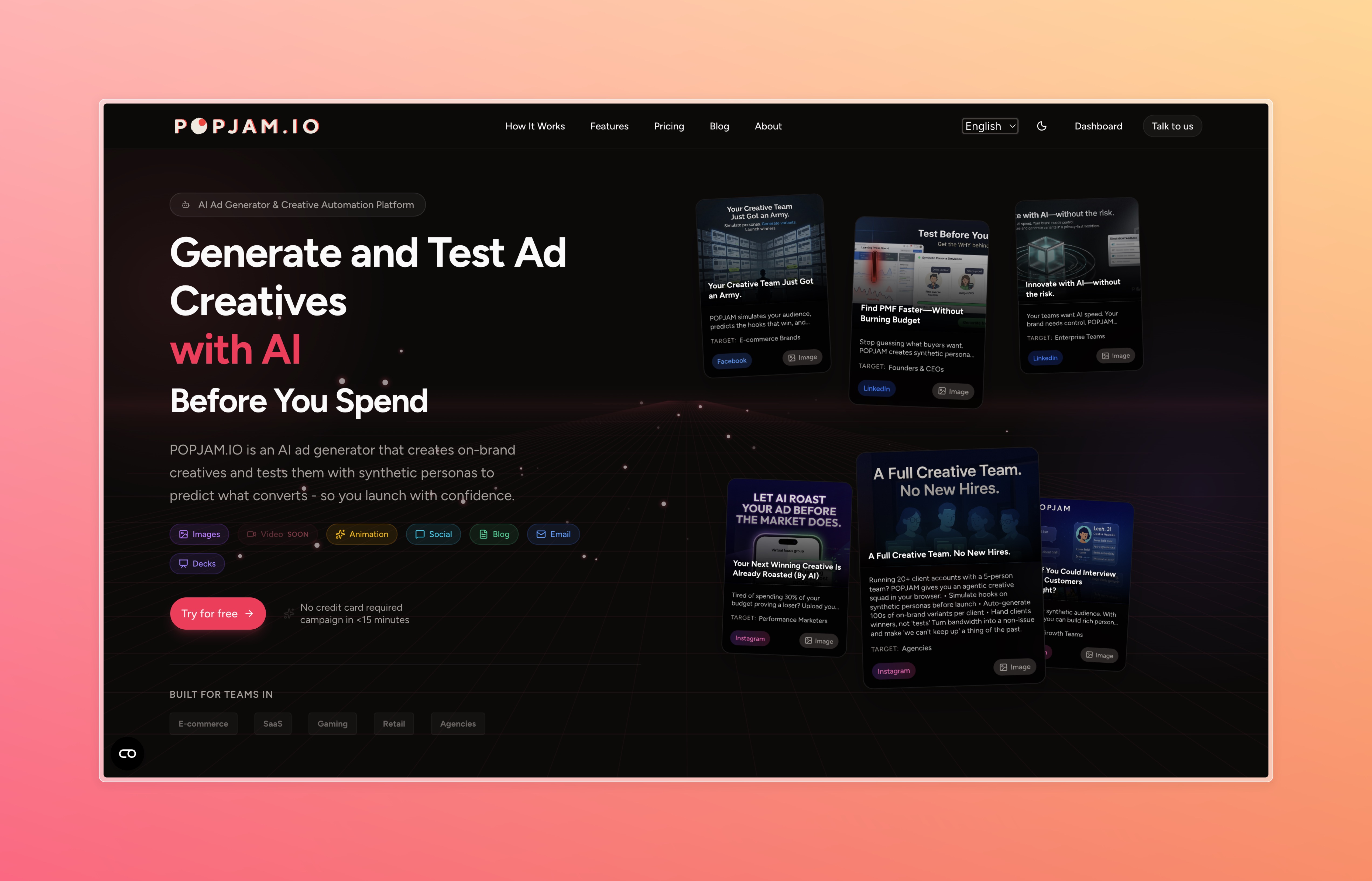
With AI Ad Generator and Creative Testing, you can generate platform-native creatives for display, shopping, social, and video formats in minutes, not days. POPJAM’s synthetic persona engine lets you simulate how your target audience will respond to each creative before launch, so you’re not guessing. Explore AI marketing tools to see how creative automation fits into your existing workflow, or check ad platform pricing to find the right plan for your team size and campaign volume.
Frequently asked questions
How do AI tools improve creative testing for e-commerce ads?
AI tools like Advantage+ Creative generate and test multiple ad variants simultaneously, helping marketers identify top performers in days rather than weeks. This speeds up optimization and reduces wasted spend on underperforming creatives.
Which ad format works best for driving e-commerce sales?
Shopping ads consistently drive the highest-intent sales because they target buyers actively searching for your products. Combining shopping with video and social formats increases both reach and conversion rates across the full funnel.
How does Performance Max (PMax) reporting help format selection?
PMax reporting provides granular channel breakdowns and search term data that show exactly which placements are converting. This lets marketers reallocate budget toward the formats and channels delivering real results.
Are video ads too expensive for small e-commerce brands?
AI creative automation has made video production significantly more affordable and scalable. Small brands can now generate, edit, and test video variants without a production team or large creative budget.