

Mkt AI: Strategies That Drive Real Campaign Results
Mkt AI is the strategic use of artificial intelligence to automate, personalize, and optimize marketing campaigns at scale. The industry term is “AI in digital marketing,” and it covers everything from content generation to autonomous ad bidding. 75% of companies already report positive ROI from AI investments, and 67% plan to increase that investment in 2025. Those numbers signal a clear shift. Marketing teams that treat AI as optional are already falling behind the teams that treat it as infrastructure. This article breaks down exactly how AI marketing strategies work, which tools matter, and how to build a workflow that actually holds up.
What are the core applications of mkt AI in digital marketing?
AI in digital marketing covers more ground than most marketing professionals realize. The applications range from writing first drafts to making real-time media buying decisions without human input at every step.
The most common use cases, ranked by adoption among marketing professionals:
- Text content creation. 55% of AI-using marketers prioritize AI for blogs, emails, and social posts. AI drafts at speed; humans refine for brand voice.
- Market research and competitive intelligence. 47% use AI for market research, synthesizing large data sets into usable summaries faster than any analyst team.
- Conversational marketing. 41% deploy AI for chatbots and messaging automation, handling lead qualification and customer support around the clock.
- Data analysis and reporting. 36% of marketers use AI specifically for analytics, surfacing patterns in campaign data that would take days to find manually.
- Ad creative generation and testing. AI generates multiple creative variations and tests them against audience segments before a single dollar is spent on media.
- Agentic marketing. The newest frontier. Agentic AI executes multi-step marketing tasks autonomously, from pulling audience data to launching a campaign sequence, without manual input at each stage.
Each of these applications compounds. A team using AI for content creation and analytics simultaneously moves faster and makes smarter decisions than a team using either alone. The combination is where the real performance gains show up.
How does mkt AI transform marketing workflows and team dynamics?
AI does not replace marketing teams. It changes what those teams spend their time on. That distinction matters enormously when you are deciding how to redesign your workflow.
Successful AI adoption requires keeping humans in charge of brand voice and strategy, while AI handles synthesis, structuring, and content variation. Think of it this way: AI turns on the lights in a dark room full of data. You still decide what to do with what you see. Marketing agents free human marketers to focus on why a campaign should exist, not how to execute every individual task.
The most common failure mode is misassignment. Most marketers fail with AI by handing strategy and brand voice tasks to the model, then spending hours fixing low-quality outputs. The fix is a clear division of labor:
- AI handles: first drafts, data synthesis, campaign brief templates, A/B variation generation, performance summaries
- Humans handle: final creative decisions, brand positioning, audience strategy, ethical review, and anything that requires genuine judgment
Two operational challenges come up repeatedly in AI marketing workflows.
Prompt drift is the first. AI output quality degrades over time when prompts are not documented and versioned. Prompt drift degrades output quality, and the fix is a shared prompt library with version control. Treat your best prompts like code. Document them, test them, and update them when performance drops.
Data hygiene is the second. Clean, normalized data is critical for avoiding AI hallucinations in marketing outputs. Feed AI messy CRM data and you get messy campaign insights. Audit your data inputs before you build any AI workflow on top of them.
Pro Tip: Build a shared prompt repository with version control from day one. Label each prompt with its use case, the model it was tested on, and the date it was last updated. This single habit prevents most of the quality drift teams complain about after three months of AI use.
The digital marketing creative process also shifts when AI enters the picture. Creative teams spend less time on production and more time on creative direction. That is a better use of skilled people.

Which tools and platforms support AI marketing integration?
Choosing the right tools depends on your marketing objectives. Here is a practical breakdown of the categories and what fits each use case.
-
General-purpose language models. Claude and ChatGPT handle content drafting, research synthesis, and campaign brief generation. Both work well for text-heavy marketing tasks. Claude tends to produce longer, more structured outputs; ChatGPT is faster for short-form iteration.
-
SEO and content optimization platforms. Surfer SEO and Semrush AI connect content creation to search performance data. They tell you not just what to write, but how to structure it for ranking. These tools are worth the investment if organic traffic is a primary channel.
-
Automation connectors. Zapier and Make connect your AI tools to your existing marketing stack. They handle the “plumbing” between platforms, triggering AI tasks based on CRM events, form submissions, or campaign milestones. No-code setup means marketing teams can build these workflows without engineering support.
-
AI-powered ad creative and testing platforms. This category is where ad spend efficiency lives. Platforms in this space generate creative variations and test them against synthetic audience profiles before launch. POPJAM sits in this category, using Synthetic Personas to simulate psychographic reactions to ad creatives before a campaign goes live. The result is fewer wasted impressions and faster creative iteration. You can see how AI ad creative drives real ROI gains when testing is built into the pre-launch process.
-
Agentic marketing platforms. Enterprise-level platforms now offer autonomous agents that execute multi-step campaign workflows. These are best suited for teams with clean data pipelines and clear campaign logic already documented.
For most marketing professionals and business owners, the right starting point is a language model for content, an automation connector for workflow, and a dedicated creative testing tool for ads. Add SEO optimization and agentic capabilities as your team’s AI fluency grows. Reviewing AI marketing trends for 2026 helps you prioritize which capabilities to build next.
What are the best practices for implementing AI marketing strategies?
A clear implementation roadmap separates teams that get lasting results from teams that run a few AI experiments and give up. Follow these steps in order.
Define objectives tied to measurable metrics. Before touching any tool, write down what success looks like. “Use AI for content” is not an objective. “Reduce content production time by 40% while maintaining a 3% email click rate” is. Specific metrics give you a baseline and a feedback loop.
Build your prompt library before you scale. A shared prompt repository with version control is the single most important operational asset for an AI marketing team. Start with five to ten prompts for your highest-volume tasks. Test each one across at least 20 outputs before locking it in.
Set up a performance testing framework. AI marketing strategies require iteration. Run A/B tests on AI-generated content against human-written baselines. Track not just clicks and conversions, but downstream metrics like customer lifetime value and churn rate. AI can inflate short-term engagement while missing long-term fit.
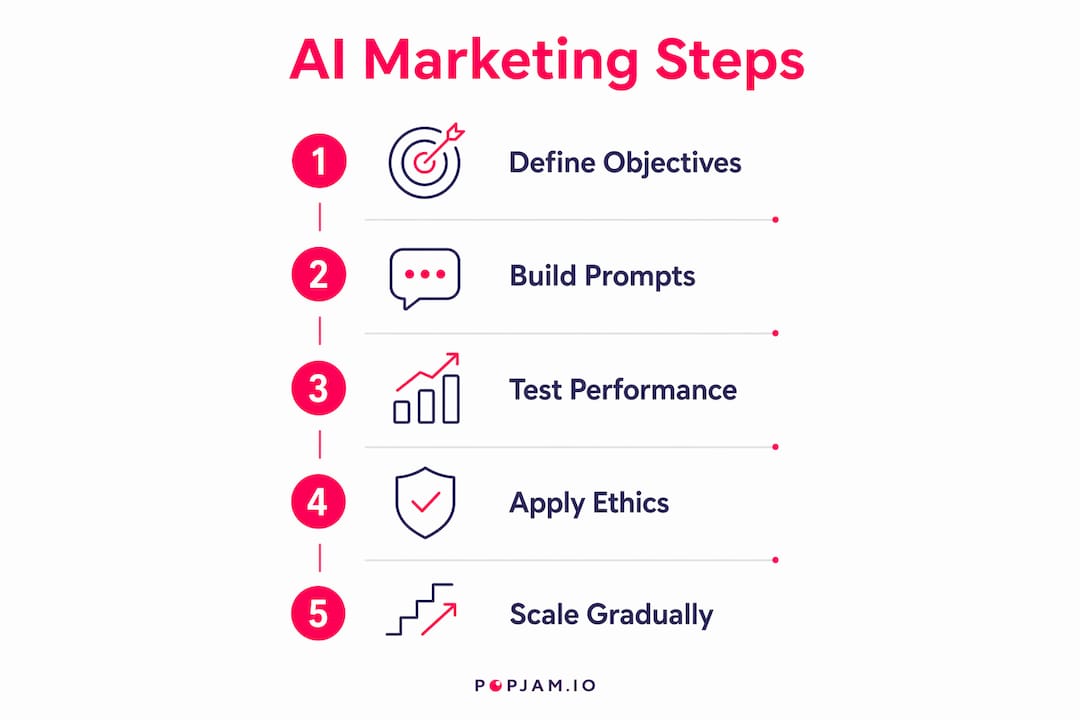
Apply ethical guardrails and brand compliance checks. Every AI output needs a review step before it reaches a customer. Build a checklist that covers factual accuracy, brand voice consistency, regulatory compliance, and representation. This is not optional. One off-brand or factually wrong AI output can cost more in brand trust than a month of content gains.
Scale gradually. Start with internal tasks where the risk is low. AI excels at drafting internal campaign briefs with zero risk to brand perception. Once your team is confident in the output quality, move AI into customer-facing content with human review. Then, and only then, consider autonomous execution for lower-stakes channels.
Pro Tip: Map your current marketing workflow on a whiteboard before adding any AI tool. Identify the three tasks that consume the most time and produce the least differentiated output. Those are your first AI candidates. Starting with high-volume, low-creativity tasks builds team confidence and delivers fast wins.
The table below shows how to match AI capabilities to marketing objectives at different stages of adoption.
| Adoption stage | Best AI use cases | Human role |
|---|---|---|
| Early (0–3 months) | Content drafts, research summaries, brief templates | Review, edit, approve all outputs |
| Mid (3–9 months) | Email sequences, ad variations, analytics reports | Strategic direction, brand review |
| Advanced (9+ months) | Agentic campaign execution, predictive audience modeling | Oversight, creative strategy, ethics review |
For SMBs specifically, AI-powered marketing strategies follow a similar staged approach, with tighter budgets making the “start internal” rule even more important.
Key Takeaways
AI marketing strategies deliver the strongest results when AI handles execution and humans retain control of strategy, brand voice, and creative judgment.
| Point | Details |
|---|---|
| Define measurable objectives first | Set specific performance metrics before choosing any AI tool or building any workflow. |
| Build a versioned prompt library | Document and test every prompt to prevent quality drift over time. |
| Assign tasks by strength | Give AI synthesis and variation tasks; keep strategy and brand decisions with humans. |
| Clean data before AI deployment | Normalized, accurate data prevents hallucinations and ensures reliable AI outputs. |
| Test creatives before spending | Use AI-powered testing against audience profiles to cut wasted ad spend before launch. |
Where I think most marketers get AI wrong
Here is my honest take after watching hundreds of marketing teams adopt AI over the past two years. The teams that struggle share one pattern: they treat AI like a junior copywriter and then get frustrated when it acts like one.
AI is not a person. It does not understand your brand, your customers, or your competitive position unless you tell it. Every time. That means the quality of your AI output is a direct reflection of the quality of your inputs. Bad briefs produce bad content. Vague prompts produce generic outputs. The teams winning with AI are the ones who invest in their prompt infrastructure the same way they invest in their creative briefs.
The second mistake I see constantly is skipping the testing step on ad creatives. Teams generate five AI variations, pick the one that looks best internally, and launch. That is “posting and praying” with extra steps. The whole point of AI in advertising is that you can simulate audience reactions before you spend. If you are not testing your creatives against psychographic profiles before launch, you are leaving the most valuable part of the technology on the table.
The future of AI in marketing is agentic. Autonomous agents executing multi-step campaigns will become standard within the next two years. But the teams that will use those agents well are the ones building clean data pipelines, documented workflows, and strong human oversight frameworks right now. The performance marketing shifts driven by AI are already visible in campaign benchmarks. The gap between AI-native teams and everyone else is widening fast.
My advice: start smaller than you think you need to, document everything, and treat your prompt library like a product.
— Doruk
POPJAM makes AI ad testing real before you spend
If you are ready to move from theory to execution, POPJAM is built for exactly this moment. POPJAM generates on-brand ad creatives with AI and tests them against Synthetic Personas before a single dollar goes to media. That means your creative decisions are backed by psychographic data, not gut feel.
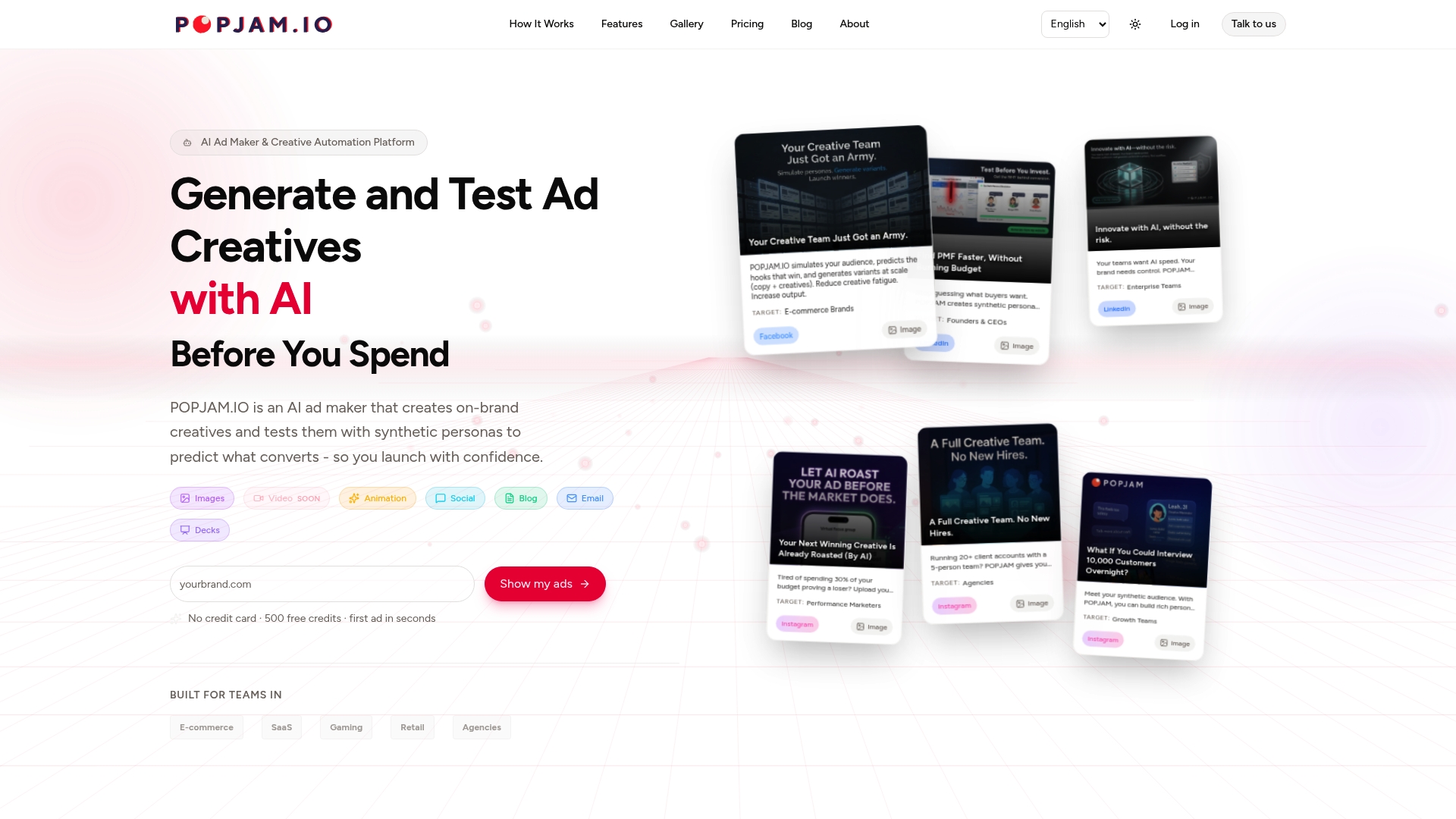
The AI ad maker gives e-commerce brands, SaaS teams, and agencies a way to produce and validate ad creatives in the same workflow. No more guessing which version will resonate. No more burning budget on creatives that flop in the first 48 hours. You can also explore the creative automation platform to see how POPJAM connects creative generation with performance testing end to end.
FAQ
What is mkt AI in simple terms?
Mkt AI is the use of artificial intelligence tools to automate, personalize, and optimize marketing campaigns. It covers content creation, data analysis, ad testing, and autonomous campaign execution.
How does AI improve ad campaign performance?
AI improves campaign performance by generating multiple creative variations and testing them against audience profiles before launch, reducing wasted spend and improving click-through rates.
What is prompt drift and why does it matter?
Prompt drift is the gradual degradation of AI output quality when prompts are not documented and updated. It matters because inconsistent prompts produce inconsistent marketing content, which hurts campaign reliability.
Which AI marketing tools should beginners start with?
Beginners should start with a general-purpose language model like ChatGPT or Claude for content drafts, paired with an automation connector like Zapier to link AI outputs to existing marketing workflows.
How do I keep AI from damaging my brand voice?
Assign brand voice decisions to humans, not AI. Use AI for structural tasks and first drafts, then apply a human review checklist that covers tone, accuracy, and brand consistency before any content reaches customers.